Feng shui principles grew from varied Chinese ways of assessing places for the living and the dead, not from one inventor’s rules for arranging a room. Richard J. Smith finds evidence of different geomantic theories and practices in the late Zhou, Qin and Han periods; he describes geomancy as coming into its own later, in the Six Dynasties era. Ideas about qi, yin-yang and symbolic relationships between space and time helped make a site interpretable. Still later, approaches associated with Form and Compass gave practitioners different, sometimes overlapping, ways to assess burial and building sites. That history can explain the language behind contemporary advice. It cannot, by itself, show that moving furniture produces a promised result.
Before a Named Tradition: Siting Places for the Living and Dead
A useful starting question is not Who invented feng shui? but What kinds of places were people trying to assess? Smith describes a concern with placing dwellings for both living people and the dead in relation to their immediate physical surroundings. A burial site raises a different decision from a proposed building site, yet both involve choosing a location rather than rearranging objects inside a room whose boundaries are already set. Keeping those decisions in view makes the historical origins easier to recognize without treating every earlier siting practice as today’s home advice.
Smith reports a variety of geomantic theories and practices in the late Zhou, Qin and Han periods. Variety matters here. Evidence of earlier practices gives the tradition antecedents; it does not establish one finished set of principles already in place, or a single date on which feng shui began. Nor does it establish that a rule proposed for a contemporary room has been followed continuously since those periods. The cautious historical claim is that people developed multiple ways to interpret the suitability of places, and that later accounts can be connected to that earlier field of practice.
In Smith’s account, geomancy came into its own during the Six Dynasties era, with Guan Lu and Guo Pu among the named figures. Smith gives their reported life dates as 210–256 and 276–324, respectively. Those dates locate people in a historical account. They are not dates for the invention of a principle, and Guo Pu’s lifetime is not proof of when a text was composed. This distinction prevents a timeline of practitioners from being mistaken for a timeline of securely dated rules.
One text is especially important to the origins story: the Zangshu, or Book of Burials. Smith calls Guo Pu its putative author. That wording records an attribution without establishing authorship. It gives readers a way to understand why Guo Pu appears in accounts of feng shui while leaving open the question of who wrote the book. His prominence and the text’s importance do not make him the first inventor of the varied practices Smith describes from earlier periods.
The resulting chronology has several distinct layers. There are varied late Zhou, Qin and Han antecedents; a Six Dynasties period in which Smith says geomancy became more fully developed; an important burial text attributed, rather than securely assigned, to Guo Pu; and, by late imperial times, two main school labels in Smith’s account. These layers are connected, but they are not interchangeable. In particular, a label documented for later methods should not be silently applied to every earlier act of choosing a grave or building site. To see what later practitioners might have interpreted at a site, it helps next to separate the concepts that contemporary accounts often bundle together.
How Cosmological Ideas Made a Site Interpretable
In historical feng shui, assessing a place could mean more than observing its visible features. It could also mean interpreting that location within a view of relationships and change. Smith describes a location as a microcosm whose proper functioning was understood to require a balance of cosmic energy, or qi. In historian Tristan Brown’s account published by MIT News, qi is described as the world’s vital essence. These are descriptions of a historical understanding: they explain what interpreters believed mattered about a site. They do not identify qi as a measured cause of an outcome in a present-day home.
Yin-yang supplies a related but different part of that understanding. Smith describes premodern feng shui as concerned with establishing, maintaining or restoring a harmonious yin-yang equilibrium amid constant change. Qi, in his account, names the cosmic energy whose balance mattered at a location; yin-yang expresses a concern with equilibrium as circumstances change. The terms therefore do not work as substitutes for one another. Together, they help explain why an interpreter might evaluate a place as a set of relationships rather than as an isolated point on a map. That is an explanation of the reasoning, not a demonstration that the interpretation could predict a household result.
The five phases, or wuxing, add another way to think about change. The Internet Encyclopedia of Philosophy describes the Chinese phases as ever-changing material forces, rather than fixed substances of the sort a reader might imagine on hearing “five elements.” It says wuxing thought became a distinct philosophical tradition during the Han dynasty. The timing of a distinct tradition is important but limited: it does not prove that every idea later associated with the five phases was first invented then. For this history, the essential point is their dynamic character. Reading them as five unchanging chemical ingredients would miss the kind of relationships the concept was used to express.
Symbols associated with the Yijing, or Changes, brought further ways of representing relationships. Smith identifies its eight three-line trigrams and sixty-four six-line hexagrams, and says they became increasingly important in the “computational arts.” He also reports that many late Zhou, Qin and Han mantic techniques came to be associated with the Yijing. Other spatial and temporal symbols from those periods became linked with the Changes and with divinatory systems including geomancy. Association is the careful word here. The Yijing did not, on that evidence, single-handedly invent feng shui, and the growing importance of its figures does not mean that qi, yin-yang, phases and every siting practice appeared together at one moment.
As an explanatory illustration, not a recorded historical case: imagine an interpreter considering a proposed site’s position and direction. The visible place gives them something to assess. They might also relate direction to a symbolic category, or consider the site through ideas of balance and change. That example shows how a physical observation and a correlative interpretation could be brought into the same question. It supplies neither a universal reading for that direction nor a prediction about what would happen if someone built there. Smith’s account of spatial and temporal symbols becoming linked with geomancy supports the historical connection; the imagined interpreter simply makes the distinction between observing and interpreting easier to see.
This distinction also helps explain why the concepts should not be flattened into one household instruction. Qi concerns how a location was understood within a broader cosmos; yin-yang concerns equilibrium amid change; wuxing names changing phases or forces; and trigrams, hexagrams and other symbols offer ways to relate spatial and temporal categories. They contribute different parts to an interpretive framework. Knowing those parts tells a reader what kind of reasoning a suggestion draws upon. It does not turn a symbolic association into an independently verified effect on health, wealth or sleep.
Form, Compass and the Methods That Could Overlap
The later history becomes more recognizable when attention shifts from broad concepts to methods of assessing a particular place. Smith says that by late imperial times there were two main schools of Chinese feng shui. One was associated with Jiangxi and the theory of forms and configurations; the other, associated with Fujian, relied heavily on a device called a luopan or luojing. “By late imperial times” is a boundary on the claim. It describes when Smith identifies these school labels, not a license to sort every earlier practitioner into one of two named camps.
The Jiangxi, or Form, emphasis directed attention to physical forms and configurations. In plain terms, that means the visible relationships of land and a site mattered to the assessment. An interpreter considering a proposed building place, for example, could attend to how that place related to the surrounding physical setting. This is an illustration of the kind of input the method emphasizes, not a claim that every Form practitioner reached the same conclusion from a given view. The surroundings would be interpreted, not merely inventoried.
The Fujian, or Compass, emphasis drew heavily on the luopan or luojing to determine a suitable site and time for construction and burial matters. Its name can be misleading if “compass” suggests only a needle reporting direction. Smith describes a magnetized needle whose red tip pointed south, surrounded by concentric rings containing symbols concerned with space, time and cosmic change. Among them were yin and yang, cardinal directions, five agents and trigrams. The instrument joined orientation to conceptual categories. A directional reading was part of a larger interpretation; the rings did not make the device a verified predictor of what would happen at a site.
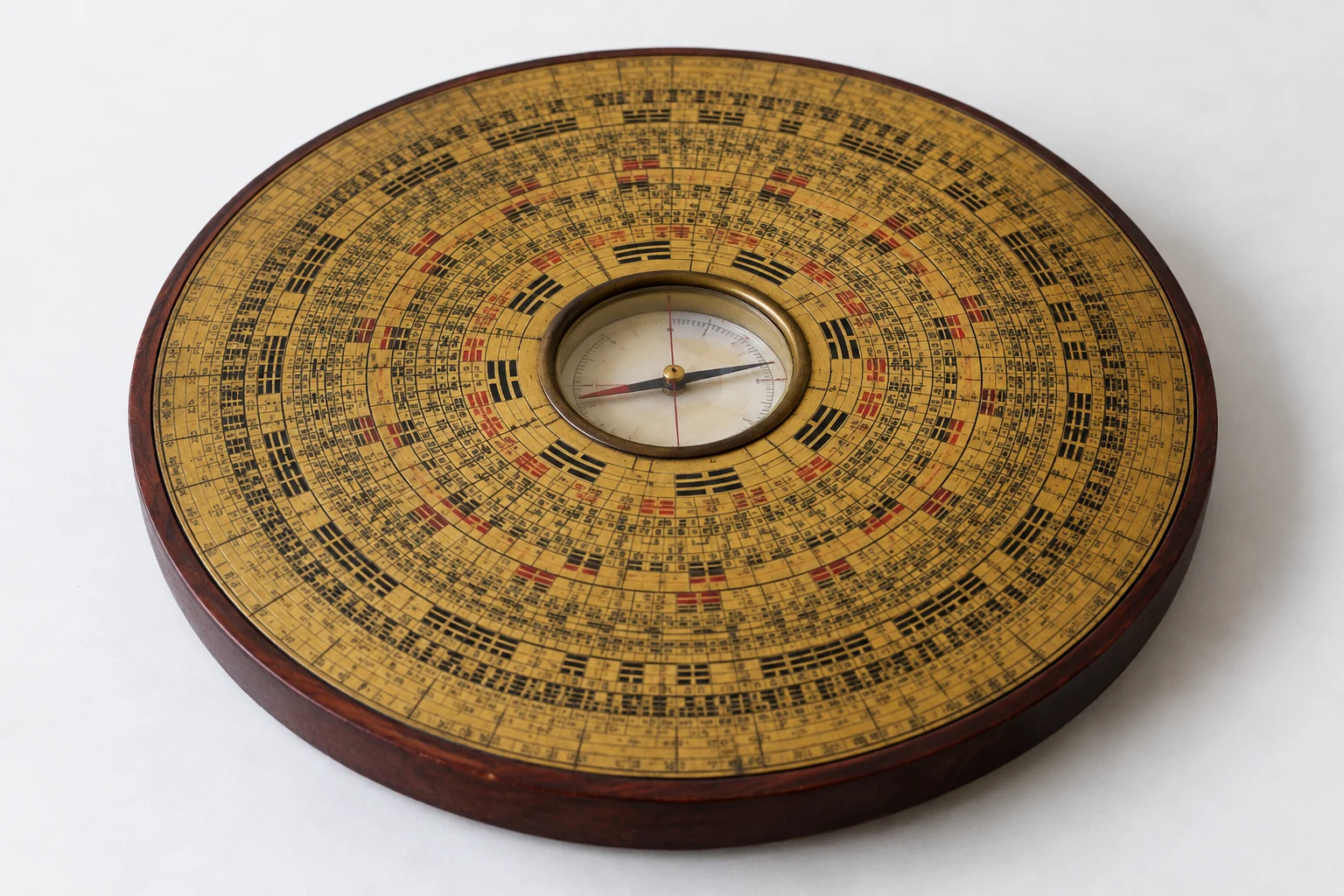
The two emphases answer related but not identical questions about the inputs to an assessment. Forms and configurations draw attention to what can be considered in the physical setting. The luopan brings a directional reading into contact with organized spatial and temporal symbols. Smith’s description of its use for both site and time decisions shows why calling the Fujian approach “direction alone” would be too narrow. Equally, describing Form as simple observation would leave out the interpretive work implied by treating a configuration as meaningful. These are ways to distinguish the methods for a reader, not fixed boundaries that every practitioner had to observe.
Indeed, Smith reports that geomancers drew freely on the vocabulary and techniques of both major schools. The history therefore does not require an old, natural Form method to be replaced by a new, technical Compass method. A practitioner’s attention to visible surroundings and use of symbolic directional categories could coexist. Nor does the presence of a specialized instrument show that the underlying concern had changed from burial and construction to arranging an existing interior: Smith explicitly connects the Fujian device to construction and burial decisions.
The Book of Burials helps explain why a text and named figures belong in this story, but it should not be made to do work the evidence cannot support. Its attribution to Guo Pu is putative, while the Jiangxi and Fujian descriptions are school labels Smith identifies by late imperial times. Text attribution, the development of conceptual frameworks and the documentation of later method families are three different kinds of historical information. Taken together, they show a tradition with recognizable concerns and techniques. They do not produce an uninterrupted chain of identical instructions from one supposed author to a modern room.
From Ancestral Graves and Public Land to Western Interiors
The scale of historical decisions is especially clear in Qing China. Smith identifies finding a proper burial place for deceased parents and other ancestors as geomancy’s most important application there. Brown’s account of Qing legal research, reported by MIT News, describes feng shui appearing in cases concerning gravesites, houses, temples, palaces, mining and industrial construction. These settings show that siting ideas could matter to family decisions and to disputes over land and building activity. Their appearance in a legal case establishes historical use and significance to participants, not that an interpretation achieved its hoped-for result.
One reported public example is specific enough to keep separate from any imagined illustration. According to the MIT account of Brown’s research, Wu Tang, governor-general of Sichuan province, banned mining in the 1870s; feng shui was a rationale used by him and other mining opponents. That is evidence of a rationale entering a consequential decision. It does not identify a particular mine, settle what everyone involved believed, or supply a measurement showing whether the feared outcome would have occurred. Brown’s account concerns historical arguments and decisions, not an experiment testing qi.
Here is an author-designed comparison of scope, not three archival cases or evidence that any choice succeeded:
- For an ancestral grave, the question is where to bury someone in relation to the landscape and family concerns.
- For a proposed building, it is where or when to build under a siting tradition.
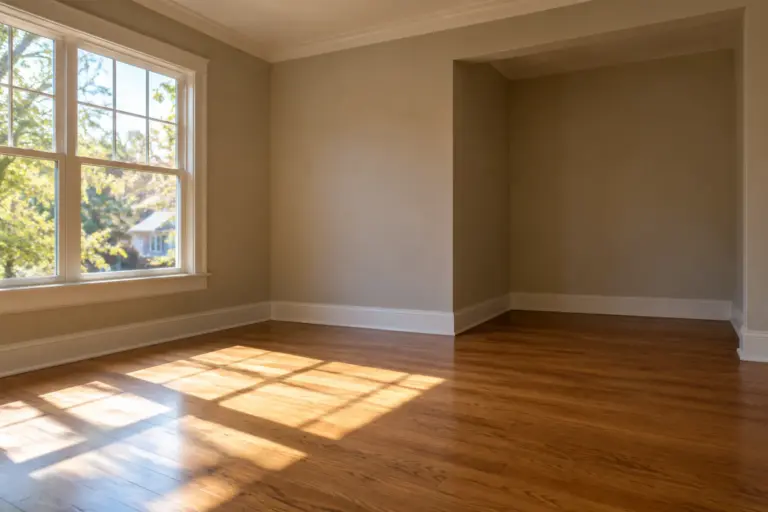
- For an existing modern room, it is where furniture can fit after walls and openings are already fixed.
The first two questions concern choosing a place, or a time connected with using that place. The third starts after major spatial decisions have already been made. Smith’s account of Qing ancestral burial and of Compass decisions concerning construction and burial supplies historical context for the first two kinds of question; the room is a deliberately generic comparison, not a reported historical example. It clarifies why a suggestion about a chair cannot be assumed to carry the same purpose, constraints or authority as choosing a burial site.
Brown characterizes a further change in Western reception: he describes feng shui being rediscovered in the West as New Age knowledge in the 1960s and 1970s, with an eventual association with harmonizing interiors such as living rooms and kitchens. He contrasts that contemporary Western interior-design association with what feng shui was in its place of origin. This is his account of a Western reframing, not a claim that Chinese land-siting practices ceased, or that every contemporary Chinese, East Asian or Western use followed a single route into the present.
What changed, for the household reader, is the immediate object of attention. A burial place, a proposed construction site, a public dispute over mining and a furnished room present different decisions. Historical concepts may travel between those settings, but their presence does not erase the differences. Brown’s Qing examples and his description of Western interiors make that change in scope visible without requiring a claim that one setting is the only authentic one.
Reading a Contemporary Suggestion in Historical Context
Suppose a room suggestion invokes a compass direction while proposing that a chair be moved. Four questions keep its claims separate. Which documented historical concept or method is it invoking? A luopan’s directional and symbolic categories have a documented place in Smith’s account of construction and burial methods. Is applying that idea to a chair in an existing room a later application? What does ordinary use of this particular room permit, given its fixed openings and the people who use it? And what remains a matter of preference?
Those questions allow a suggestion to have historical vocabulary without treating it as an ancient instruction for that exact room. The history runs through varied siting practices, developing interpretations and methods that could overlap, and changing settings of use. Historical precedent can explain a recommendation’s reasoning. Neither precedent nor a Qing dispute establishes that following it will improve health, wealth or sleep.