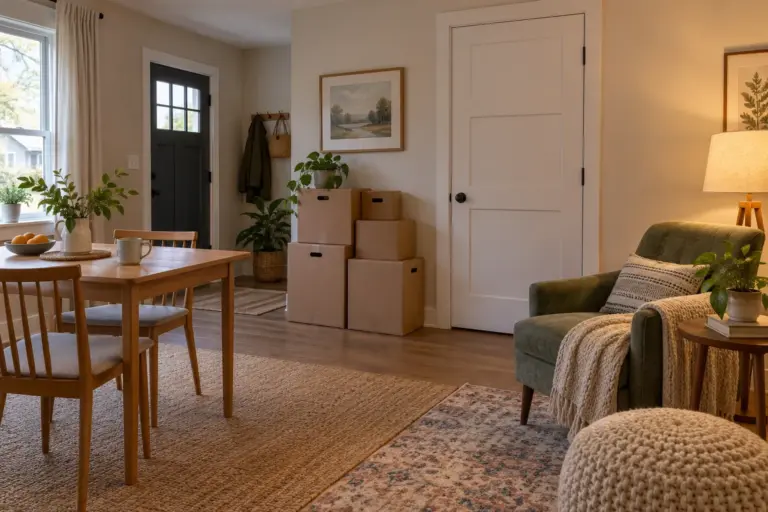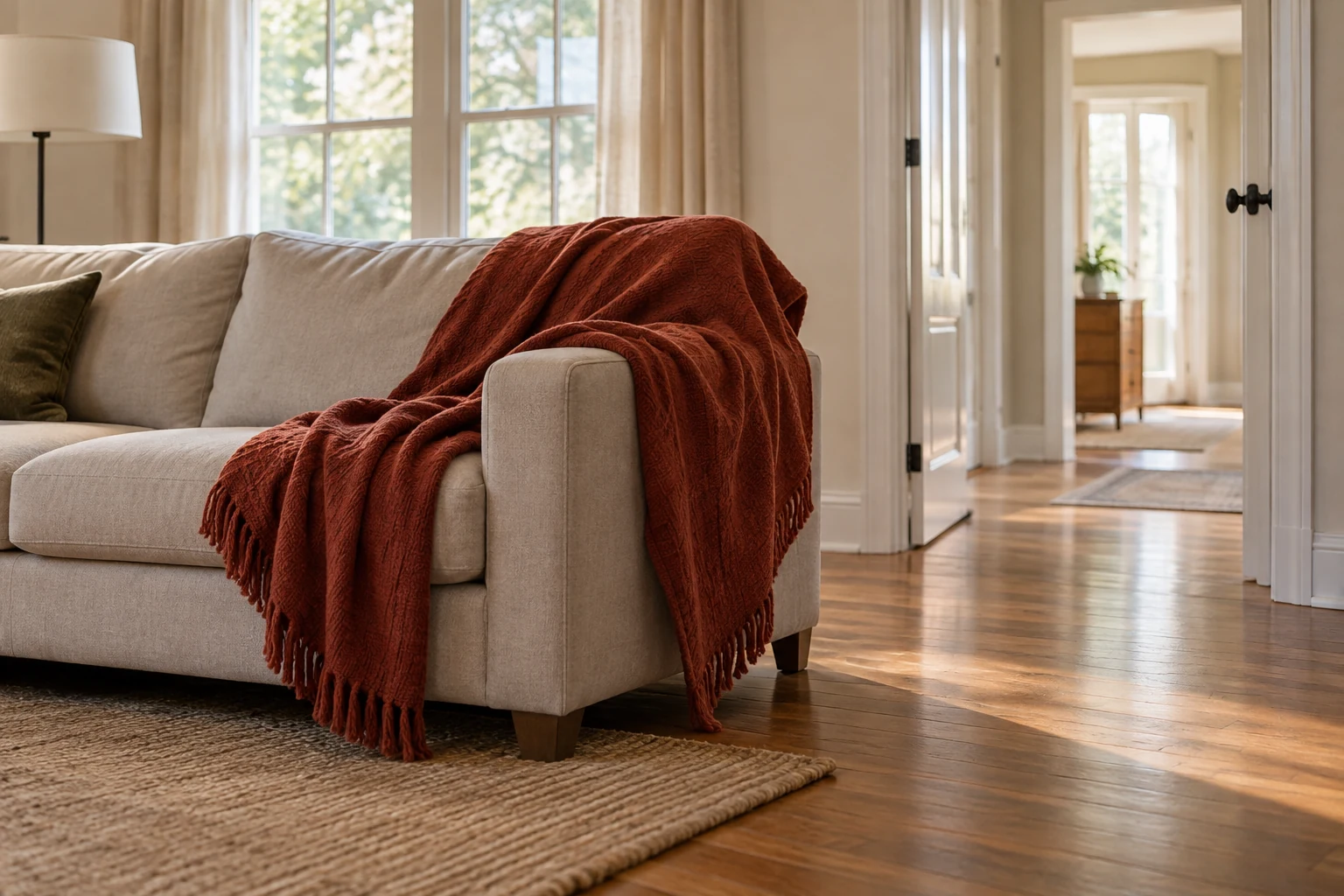
Balancing the Fire element at home means noticing the cues feng shui associates with Fire, deciding whether a room would better serve its occupants with a more active or quieter impression, and trying one reversible change. It does not require a literal flame or a fixed amount of red. Start with what the room is used for, then compare how it works before and after moving an accent. The question is not “How much Fire does this room have?” but “Does this particular cue suit what we do here?”
Recognize Fire Cues Without Looking for a Literal Flame
The Feng Shui Society names Fire as one of five elements, also called phases or transformations, alongside Water, Wood, Earth and Metal. It says elements can be represented by physical objects or metaphorically. For this exercise, that distinction matters: you can consider a visible design cue without lighting a candle or operating a fireplace.
The International Feng Shui Guild’s glossary associates Fire with red. It also describes Fire’s movement as upward, outward and expansive, and its energy as active and vibrant. The glossary separately lists a triangular shape among Fire associations. These are terms within a feng shui tradition, not a claim that a red cushion sends physical heat across a room. They give you a vocabulary for describing what stands out visually and how a room feels to its occupants.
Color takes a little more care than calling every warm-looking object Fire. In an article hosted by the Guild, practitioner Bridget Saraka says shades including pinks, oranges and purples can be classified as Fire depending on their hue and the intensity of red present. Her examples of Fire forms include triangles as well as other pointed shapes. Her treatment is conditional: a purple item is not automatically a Fire cue merely because it falls on that color list.
Prints and textiles offer a practical way to see the distinction between an association and a literal flame. A red cushion with a conspicuous triangle pattern combines the glossary’s red and triangular associations. Saraka also discusses representing Fire through home décor, textiles, color and print. In an ordinary room inventory, you could therefore note “prominent red, pointed-pattern cushion” without concluding that the cushion gives the room a measurable Fire level. A small printed accent might barely register to a resident; a large, high-contrast one might be the first thing they notice. That difference is an observation about the room, not a calculation.
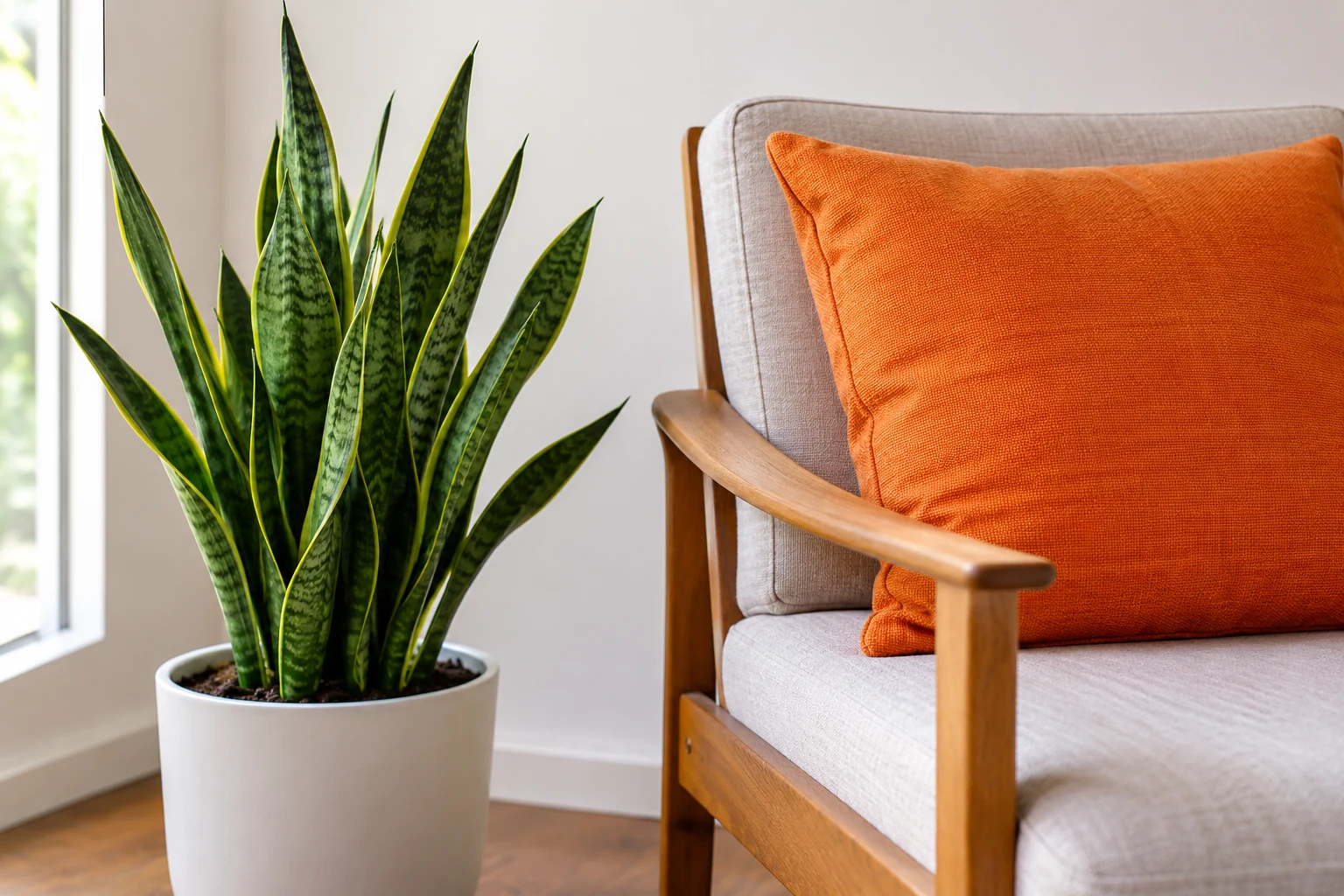
Take a first look from the places where you normally sit and move. Which colors or pointed forms draw your eye? Does a pattern seem lively or visually insistent to you, or does it fade into the rest of the furnishings? Note both the cue and its prominence. You are not counting red objects toward a quota, and a color alone cannot diagnose whether the room needs a change.
Keep symbolic and practical questions separate. A printed triangle is a possible traditional Fire association; it is not a measure of temperature or a household hazard assessment. Conversely, a working light, heater or cooking appliance has a practical job. Do not remove needed equipment to lower an imagined decorative Fire reading. The useful inventory here concerns removable visual accents and the room’s actual use.
Check What the Room Needs Before Changing It
The Feng Shui Society describes a home-focused aim in terms of giving each room characteristics suited to what people want to do there. Saraka makes a related point when discussing a child’s room: consider whether its intended use is sleep or play, and account for both rest and play if both happen there. Neither statement establishes that a particular pattern causes a person to sleep, play or behave in a certain way. Together, they offer a sound starting question for this exercise: what must this room accommodate at different times?
Consider an explicitly hypothetical family room. Its door and window stay where they are. It has a sofa, a chair and a games table, with a usual clear walking route between the furniture and the openings. Its existing lights and heating are adequate and remain in use. The family plays games there during an active period. Later, they sit on the sofa or chair to read or rest quietly. This is one room serving two purposes, not two rooms with separate design rules.
In the initial inventory, a prominent red cushion with a triangle pattern sits on the sofa. The other furniture is ordinary in this example; there is no need to assign every item an element. The cushion is worth noting because its color and pointed print match documented Fire associations and because it is visually noticeable from the seating area. That observation does not establish that the family room has “too much Fire.” It identifies one removable feature the household can assess against its uses.
Now compare the periods rather than asking for an abstract verdict on the décor. During games, do people have usable seating and access to the table? During later reading or rest, can they settle where they prefer? Is the usual route clear, and can they reach the door and window controls? In this hypothetical household, the resident finds the cushion’s large pattern busier than they would like during the quiet period. They have not reported clinical agitation or measured an energy excess. They have identified a mismatch between one visible accent and one desired use.
That distinction determines the direction of a trial. If the activity corner instead felt too subdued to the people using it for games, a modest Fire-associated accent could be worth trying there. If a prominent cue competes with a preferred quieter impression, reducing that cue is the more relevant test. Neither direction is a universal prescription for family rooms. Even when the later quiet period motivates a reduction, the room still needs to work for games, seating and movement. Likewise, an addition intended for games should not make the later quiet period less appealing to the household.
Before changing a cushion, identify what the complaint is actually about. If someone cannot read comfortably because the task lighting is inadequate, a different print does not solve that lighting problem. If the games table blocks the usual route, an accent will not clear the route. A difficult-to-use chair is a seating issue. Address those ordinary conditions on their own terms; do not keep adding or removing Fire-associated décor when the proposed change cannot address the concern.
A brief room-purpose check can keep the trial focused:
- Use: What happens here during active and quiet periods, and which period prompts the concern?
- Cue: Which removable color or pointed pattern actually stands out?
- Constraint: What seating, surfaces, routes, openings and necessary equipment must keep working?
- Test: Would one small addition or reduction plausibly change the visual impression the resident is describing?
- Comparison: When will the household use the room as usual again and decide whether it prefers the change?
For the hypothetical family room, that check points toward reducing the sofa cushion’s prominence for later reading and rest. The alternative addition below has a different entry condition: it applies if the household judges the activity corner too subdued for games. Those are separate trials, not instructions to add and remove cues until the room reaches an unseen target.
Try One Fire Cue Where Activity Feels Too Subdued
The Guild glossary says, in its productive-cycle account, that Wood enhances Fire. That is a specific traditional relationship, not a direction to add fuel, buy a plant or assign an unverified Wood cure to the activity corner. It also does not tell a resident whether this particular room needs more visual activity. The room-purpose check supplies that decision: use this branch only if the household finds the games area too subdued and wants to test a livelier impression.
Suppose, as an alternative to the family room’s quiet-use concern, its residents like the room for reading but wish the activity corner felt a little more engaging during games. They could choose one small red or pointed print or textile they already own. The Fire association comes from the Guild’s red and triangular vocabulary or from Saraka’s discussion of pointed forms and prints; the decision to try this particular item comes from the household’s stated preference. Neither source specifies a required object or an amount that will work for every room.
Place the item only where it is permitted and where it does not displace a needed function. A small existing textile might sit on available seating if the seat remains comfortable; a small print might occupy an already usable display place if it does not take over a surface needed for games. Check the location in the actual room rather than assuming that “small” means unobtrusive. The usual walking route must stay clear. The door and window controls must remain accessible. People should still be able to use the games table and sit where they normally sit.
This is a trial, so leave the rest of the room alone. Keeping other conditions steady makes the household’s preference easier to interpret: they are judging one new visual accent, not a simultaneous rearrangement of furniture, lights and storage. It also makes the decision easy to reverse. No shopping list, flame, printed bedding or prescribed arrangement is needed.
Then let both ordinary uses happen. During a games period, ask whether the residents actually like the added accent in that setting. Does it contribute to the impression they wanted, or do they prefer the corner as it was? Later, during seated reading or rest, ask a different question: can they still enjoy the quieter use with the accent in view? A preference expressed while planning the change is less useful than a comparison made after each activity.
Do not replace those observations with a prediction that red will improve mood, confer fame or change children’s behavior. Saraka’s sleep-or-play example asks readers to consider the intended uses of a space; it does not prove that one textile causes a behavioral result. In a mixed-use room, the residents may like an accent during games yet find it too prominent when they settle down later. That is useful information, not a failed attempt to reach the “correct” Fire level.
The verdict follows both uses. Keep the accent if the household likes it for games, still likes the room for later quiet use, and finds that seating, surfaces and access remain practical. Remove it and return it to appropriate existing storage if it dominates the quieter period or interferes with use. If it makes no welcome difference, returning it is reasonable too. This branch does not override the original example’s quieter-use concern; it shows what to do under a different condition.
Reduce a Prominent Cue, Then Decide Whether to Keep the Change
Return to the hypothetical family room with the prominent red triangle-patterned sofa cushion. The resident wants a less busy impression for later reading and rest, while preserving the room’s games use. One traditional interpretation can inform a replacement, but it should not be confused with the household’s reason for making the change.
In the Guild glossary’s reducing cycle, Earth reduces Fire. That statement differs from the productive cycle statement that Wood enhances Fire. The glossary also says Fire enhances Earth in the productive cycle. Direction and cycle matter: “Fire enhances Earth” and “Earth reduces Fire” are related statements from different cycle descriptions, not interchangeable commands. In particular, putting an Earth-associated object on a sofa does not physically extinguish energy or demonstrate that a measurable quantity of Fire has gone down.
The Guild associates Earth with yellow and lists flat, rectangular and square shapes. An already-owned plain yellow square cushion can therefore serve as an optional interpretive replacement for the red triangle-patterned one. Its practical appeal in this example is simpler: it removes the large pointed red pattern the resident finds busy while leaving a sofa cushion available. Its color and shape offer a traditional way to describe the swap, not a promise that the quiet period will improve. If the sofa works comfortably without a replacement, removing the original cushion alone would be an equally valid visual trial. There is no reason to purchase an Earth object.
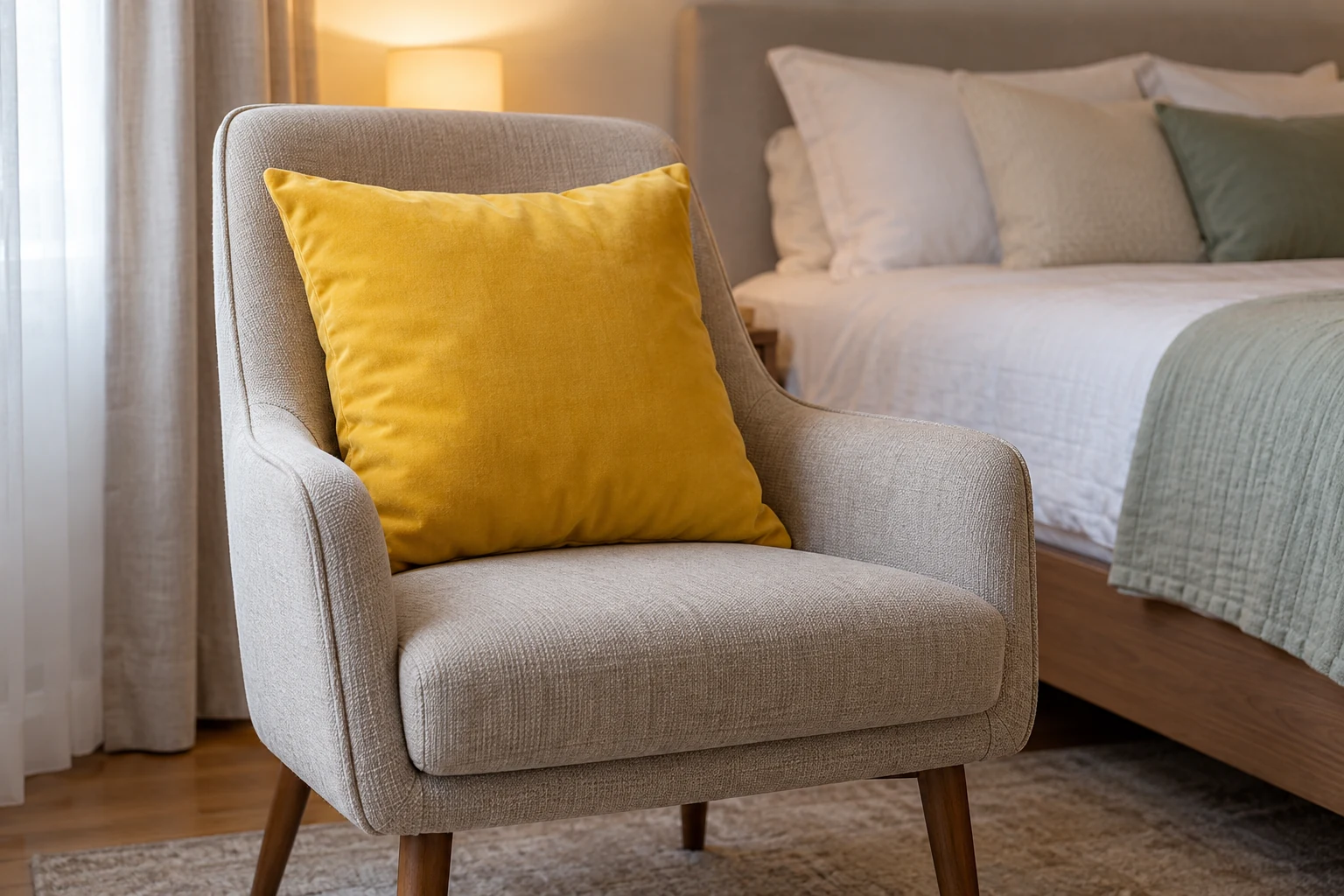
Here is the completed hypothetical reduction trial. The resident takes the already-owned plain yellow square cushion from authorized household storage and swaps only the red triangle-patterned cushion on the sofa. They put the original cushion into appropriate existing storage, out of the walking route. The door and window stay as they were; so do the sofa, chair and games table. Fixtures, adequate lights and heating remain in operation. Nothing else is moved to manufacture a stronger result.
When the family next uses the room for later seated reading and rest, the residents prefer the less prominent pattern. The sofa and chair still provide the seating they need. The usual walking route remains clear, the original door and window controls remain usable, and storing the old cushion has created no obstruction. The comparison also has to include the active period: the games table and seating still work for games. The observation supports a narrow conclusion about this household’s preference and the room’s usability after one swap. It does not show that Earth has measurably extinguished Fire.
A compact record makes the decision legible:
| Part of the trial | Completed family-room account |
|---|---|
| Initial inventory | Fixed door and window; sofa, chair and games table; clear usual route; adequate existing lights and heating; prominent red triangle-patterned cushion on the sofa. |
| Purpose and cue | Games during an active period, then seated reading or rest. The resident finds the large red pointed pattern busier than wanted for the quiet period. |
| One change | Replace that cushion with the already-owned plain yellow square cushion; store the original appropriately, away from the route. |
| Comparison | Residents prefer the less prominent pattern later. Seating, games use, route, door and window controls, and storage remain workable. |
| Decision | Keep the replacement while that preference and practical fit continue; undo the swap if either changes. |
This is a keep decision, not a permanent ruling on the room. If residents later prefer the original cushion, or if the replacement proves less useful in ordinary use, they can retrieve and restore it. If neither cushion suits the quiet period, they can assess removal without replacement, provided the seating still works. Those alternatives arise from what the household observes, not from a rule requiring a particular Earth-associated item.
The method is the same whichever direction fits the room: identify a visible cue, choose an addition or reduction based on the room’s actual purposes, change one removable accent, and compare both use and access afterward. There is no validated Fire meter or universal quota behind this exercise, and the Feng Shui Society says feng shui cannot guarantee wealth, health or happiness. A South-sector association, without the inputs for a site-specific assessment, is not a reason to alter this room; nor is decorative Fire control a reason to remove functional lighting, heating or cooking equipment.