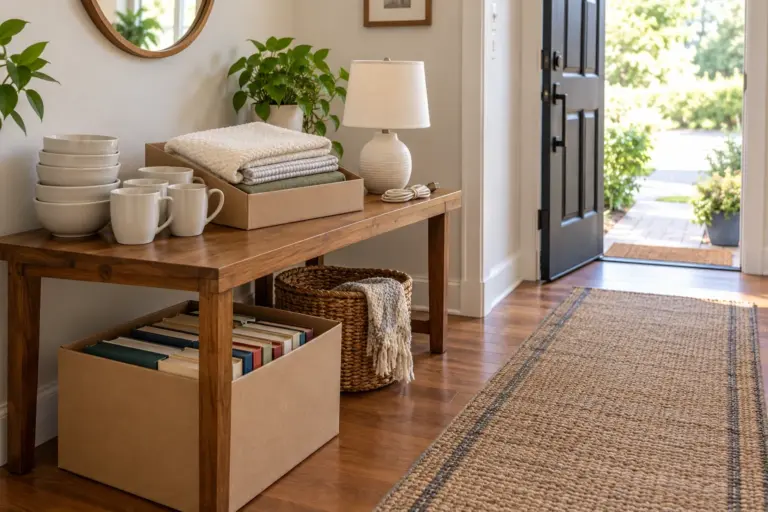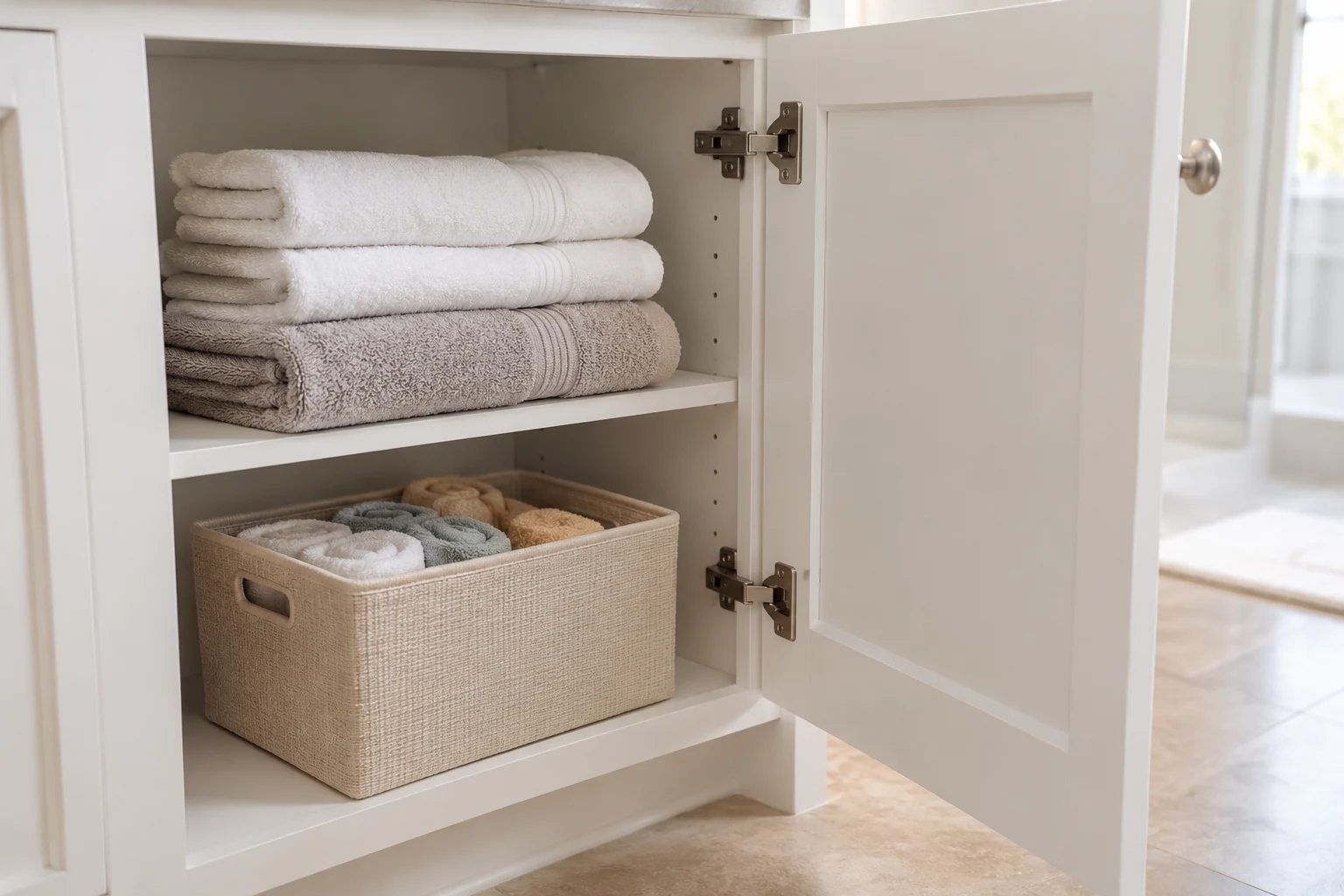
Storage avoids merely hiding clutter when you know what it holds, can find what you need, and can put it back without moving everything else. A closed door is neither the problem nor proof that the problem is solved. Start with one small area, decide what belongs there, and test the arrangement during ordinary use before buying a container.
This is also a practical way to approach a feng shui concern about neglected space. Feng shui practitioner Anjie Cho encourages looking inside a cluttered closet, rather than judging only the room outside it. Her description of stagnant and fresh qi is an interpretation within feng shui, not evidence that changing a closet will produce a particular health, financial or relationship outcome.
Inspect What the Storage Is Actually Holding
Choose one bounded area: a closet section, one drawer or a single cupboard shelf. Open it and look past the exterior. Can you name what is inside? Are the things used often reachable? Can you return them to their places without shifting other groups? The Feng Shui Society similarly draws attention to hidden areas, including cupboards, that a routine clean may miss.
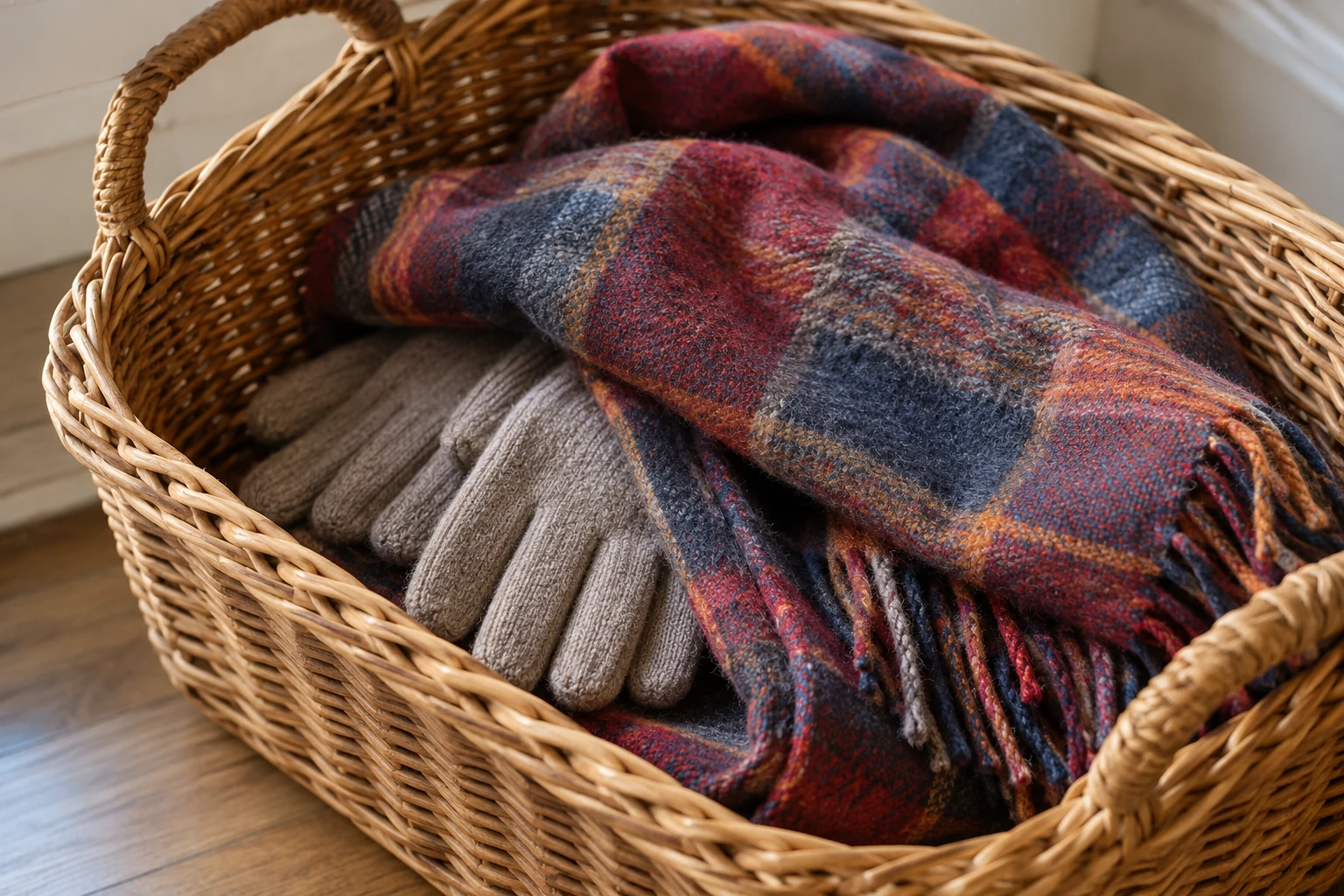
Consider an illustrative, hypothetical section of an overflowing coat closet. The resident’s daily rain jacket and bag are repeatedly buried behind their own seasonal coat. The same section holds a valued keepsake scarf, a shared household bag and items awaiting a repair decision. From the hallway, the closet door might close and everything might appear put away. Inside, though, getting ready to leave requires moving the seasonal coat and perhaps disturbing the other belongings. On returning home, there is no easy spot for the jacket and bag, so they are likely to end up in front again.
The goal is specific: make the daily jacket and bag easy to retrieve and return without unloading another group. The door still needs to open and close, the passage must remain usable, and other household users must still be able to reach what they need. The scarf does not become clutter merely because it is seldom used; the shared bag does not become the resident’s to discard because it occupies closet space. Inspection identifies an access problem, not a verdict on every object.
As you inspect your own area, note the difference between a known group stored out of sight and a mixture whose contents or destination are unclear. A box holding a deliberately kept scarf can be legitimate closed storage. A basket into which unresolved objects are repeatedly dropped may have a tidy outline while making retrieval harder. Cho’s qi language offers one practitioner’s reason to attend to such neglected space; the observable question here is whether the section works for its users. There is no need to assess the whole home or map its bagua to answer that question.
Decide What Belongs Before Choosing a Container
Keep the project as small as the goal. Organizer Nonnahs Driskill advises choosing one manageable area—for example, one drawer rather than a whole set—and illustrates a goal in terms of space for daily-use items. For the hypothetical closet, that means working on its crowded section, not emptying every coat and cupboard in the home.
Before moving anything, identify a clear temporary surface or a small area nearby where you can see the section’s contents. Keep the door’s swing and walking route clear. If the only way to spread everything out blocks the passage, handle a few objects at a time and return them to a known temporary position while deciding. The point of taking something out is to identify it and choose its home, not to create a second pile with no destination.
Ask of each object: Who uses or owns it? Is it needed for a daily task, used occasionally, deliberately valued, or awaiting a decision? Does it belong in this section, in another known place, or in a clearly named pending group? The Feng Shui Society suggests considering what people no longer love, need or use, alongside putting retained things in proper places. Use those questions as prompts, not a compulsory disposal test: an essential item may be used rarely, and a keepsake can have value without frequent use.
In the example closet, the rain jacket and daily bag belong close to an existing accessible spot because the resident takes them out and returns them often. The resident’s seasonal coat is retained but need not occupy that daily spot. The keepsake scarf is also retained deliberately; it needs a known separate home, not a justification for disposal. The repair items form a named review group so the repair decision remains visible as a decision, rather than being mistaken for a completed sort.
The shared bag needs a different kind of pause. Ask its other user where it must be available, then agree on a position both can identify. Do not quietly move it to an unfamiliar box to make the section look better. If ownership or the intended destination of any other object is unknown, mark that decision as pending and leave it accessible enough to resolve with the right person. A pending decision is honest; calling it “organized” solely because it has disappeared behind a door is not.
Editing can therefore mean assigning a place, not reducing the number of possessions. The resident has distinguished daily belongings, an occasional coat, a valued scarf, repair items and a shared bag without treating them as interchangeable clutter. Tidy Nest recommends determining what actually requires containment before choosing storage products. In this closet, that determination must include belongings that will remain, not just what the resident hopes a new box could hold.
There is a capacity decision before any container decision. If the section cannot hold the retained groups while leaving the daily spot, door, passage and other users’ access workable, stop. Look for a genuine alternative home that suits an item and its owner, or seek the outstanding owner decision. Do not compress the same inventory more tightly and call it solved; another box cannot create room for retained belongings if the usable space is already spoken for.
Give Retained Groups Homes That Their Users Can Reach
Once the contents have been identified, place them according to the activity they support and how often they are needed. Clutterbug advises keeping the tools for a repeated task together. For the closet, leaving home is the repeated task: the daily rain jacket and bag should share an accessible existing rail or spot. The resident’s seasonal coat can occupy an existing suitable compartment used less often, provided it remains safely reachable. The scarf goes in a known separate box; the repair items go in their named review place. The shared bag stays at the position agreed with its other user.
These are homes, not instructions to install a new system. A useful home is one a person can recognize while putting an item away, not merely one from which the item can eventually be excavated. If the daily bag fits at its spot only when the repair group is removed first, the groups have not yet been given independent homes. If the scarf’s box is separate but nobody can say which box it is, the separation has not improved retrieval.
How much of the contents should be visible depends on the users and the work the storage does. An open group can make a frequently used item easy to notice and pick up, but it occupies visible space. A clear container can show its contents while keeping a broad category together. A label can identify a group when visibility alone is insufficient. Closed storage can provide the exterior someone prefers while still working well inside. Clutterbug describes preferences for visible belongings and for items tucked in drawers or behind doors, and suggests clear bins and labels for visible systems. These are organizing preferences, not diagnoses or rules that everyone must follow.
A second illustrative, hypothetical example makes that choice less simple. Two adults share an everyday tea-supplies cupboard. It contains packaged tea bags or infusions, spoons and their own nonhazardous serving items. Mixed among them are reference papers from a different activity. One adult wants to see contents or receive a reminder of where they are; the other likes the cupboard’s closed exterior. Neither preference settles where the papers belong or how both adults will prepare a drink.
First, the adults agree on an existing paper location they both know, then move the unrelated reference papers there. Moving them to the floor or into an unidentified bin would only transfer the uncertainty. They retain both users’ needed beverage supplies and group the items repeatedly used to prepare a drink. The proposal is an existing clear, lidless container inside the existing cupboard, holding a recognizable beverage category. A plain label identifies that category; if both adults want one, a small cue at the agreed location helps them remember where to look.
That combination lets the cupboard door provide the preferred closed exterior while the open, clear container offers visibility on opening it and a straightforward place to return items. It is one reversible compromise, not a rule that every cupboard needs a clear bin, every container must lack a lid, or one adult’s preference should override the other’s. Clutterbug offers clear bins inside cupboards and lidless containers inside closed storage as options. Its Ladybug guidance likewise focuses on making internal drawer and closet systems quick to use.
Clutterbug gives a spice drawer used by one person as an example of arranging storage for its actual user. That logic is useful when identifying who must be able to find an item. It does not authorize either adult to reorganize this shared cupboard alone: both prepare drinks there, so both need to recognize the groups and agree on the papers’ destination.
Check Fit and Return Effort Before Buying Anything
A container has to fit both the space and the inventory that remains. Tidy Nest advises editing first, then measuring storage spaces before purchasing a product; it also suggests reusing sturdy small boxes. Treat an existing container as a candidate rather than assuming it fits because it is already in the house.
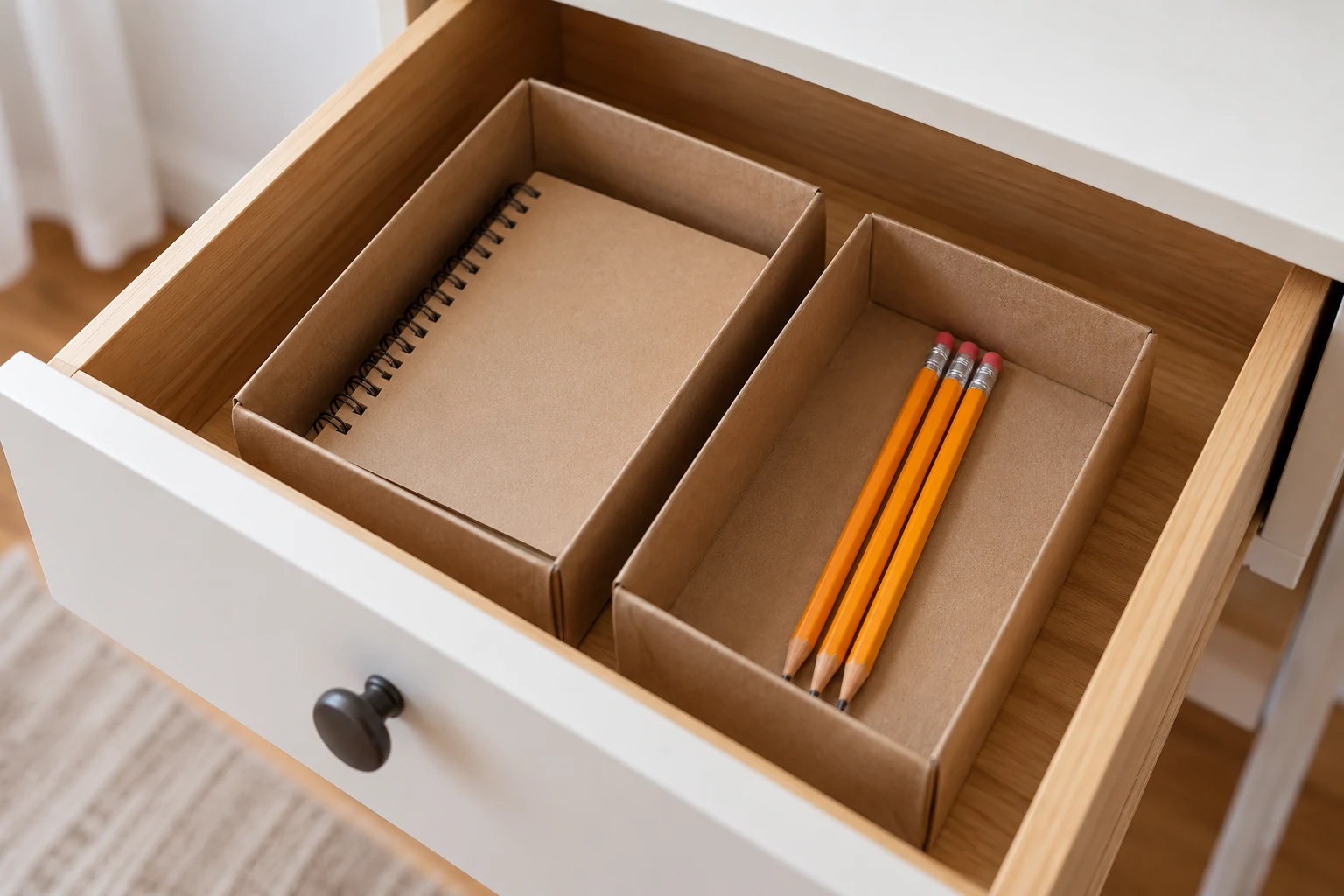
Check the usable width, depth and height of the actual shelf or compartment. Check the opening through which a box must pass, which may be less convenient than the space behind it. Then compare the retained group with the container’s usable space: can the items go in without forcing them, and can a hand remove and replace the one needed? Finally, try the movement with nearby groups in place. A box that fits while the closet is empty may fail when the daily jacket hangs beside it or the door must close.
In the hypothetical closet, test an existing box for the deliberately retained scarf against its proposed compartment and opening. Lift it in and out, reach into it, and return its contents. Check that the seasonal coat remains reachable, the daily jacket and bag can be handled without shifting the box, the rail remains usable and the door operates normally. For this illustration, the existing box fits; its contents are known or labeled, and it does not obstruct the daily group. That is a result of the example’s fit check, not an assumed dimension or a promise that an extra box fixes every closet.
Apply the same checks to the tea cupboard before buying anything. Compare the actual compartment and door clearance with the existing clear container and the retained packets and utensil group. Have each adult put a hand in, take a wanted item and return it while the other items remain in place. Use an existing clean container only if it is suitable for the intended packaged items. If that container fails the space or use test, reconsider the grouping or another suitable existing container before treating a purchase as the answer. Do not size a prospective product around the cupboard’s old mixture of papers and supplies; measure what the agreed beverage group actually contains.
Watch for effort that the closed door can conceal. A lid may add a step each time someone returns a spoon or packet; that matters if it discourages return, though another group might need or prefer a lid. Categories divided so finely that users cannot choose one quickly may need to be broader. Frequent items buried behind occasional ones require repeated rearrangement. A container bought for a previous inventory may be too small for the retained group—or so awkwardly placed that its nominal capacity is beside the point.
Open baskets, clear bins, labeled boxes and closed drawers are therefore possibilities to test, not competing ideals. The useful question is specific: Can these users recognize, reach and return these contents in this space? If not, changing placement or simplifying a category may remove more friction than adding another container.
Test Each System During Ordinary Use
A staged arrangement can look convincing before anyone uses it. Test the same actions that made the original area troublesome, with the surrounding space operating normally. Clutterbug emphasizes accessible, clearly labeled storage, while the Feng Shui Society calls for clear paths; neither condition can be established by looking only at a closed closet or cupboard door.
For the hypothetical closet, the resident takes the rain jacket and bag from their daily spot for an actual departure. On returning, they put both back without unloading the seasonal coat, scarf box or repair group. At another point, they independently find the keepsake scarf and the repair items without emptying the section. They open and close the closet door and walk the route as usual. In this fictional version, all those checks pass. The test does not prescribe how many seconds retrieval should take; it checks the stated goal and whether the rest of the closet remains usable.
The less frequently used groups matter here too. A scarf hidden in a known box is different from a scarf that is theoretically “somewhere in the closet.” Repair items kept in a named review place remain findable when the resident is ready to make the repair decision. The agreed shared-bag location also needs to work for its other user. If that person cannot locate or return the bag, the closet has not passed its shared-use test merely because the resident’s jacket is easy to reach.
For the hypothetical tea cupboard, each adult tests it separately. Each opens the door, finds their wanted packet and spoon, prepares a normal drink without rearranging the whole beverage group, returns reusable items to the agreed spot and closes the door. On the next ordinary use, a newly brought packet goes into the recognized group; both adults can still retrieve what they want. They check that the reference papers remain findable in their actual agreed paper home, and that the cupboard door, counter and walking route still work.
In this illustrative version, both adults pass the repeated-use test and the closed exterior suits the person who prefers it. The clear container remains easy for the other adult to read on opening the door. A shut door alone could demonstrate none of this: it would not show whether a packet has a recognizable home, whether a spoon can be returned or whether the papers were merely displaced.
A failed test gives a narrower next step than “buy more storage.” If a user cannot find a group, try a clearer label or a simpler category. If they can find it but cannot return it without rearranging other items, try a more accessible existing location and test again. Ask what action failed for that user rather than assigning them an organizing type. If the obstruction is simply that the retained items no longer fit, return to the capacity decision instead of hiding the overflow in another bin.
Keep the Working Arrangement—and Revisit It When Something Changes
The illustrative closet verdict is to keep the arrangement while it continues to work. Its original obstacle—the daily jacket and bag buried behind the seasonal coat—has been removed. The daily, seasonal, keepsake and repair groups have known homes; the shared bag has an agreed position. The existing scarf box fits without blocking access, and the departure, return, independent retrieval, door and route checks pass.
The illustrative cupboard verdict is also to keep the compromise while it works for both adults. The needed beverage items remain grouped, the unrelated papers have an agreed, findable home, and the existing clear container fits inside a cupboard whose exterior can stay closed. Each adult can retrieve and return supplies, including after a new packet joins the group. Those results, rather than the tidy door, support keeping it.
Neither verdict quietly resolves an unknown owner or shared destination. Any such closet decision stays paused until the relevant person can make it. Revisit the affected group when overflow appears, new items arrive, a season changes, a repair decision is made, or retrieval or return begins to fail. Adjust its place, category or retained inventory as warranted. If the belongings that must remain no longer fit, reconsider real homes and owner decisions rather than assuming another container creates capacity.
Clutterbug suggests a monthly donation practice in its Ladybug guidance, but that is an optional framework, not a required deadline or a reason to dispose of shared, sentimental or essential belongings. The practical distinction is simpler: storage is not mere concealment when its deliberately retained contents remain known, reachable and easy to return—whether they are visible or behind a door.