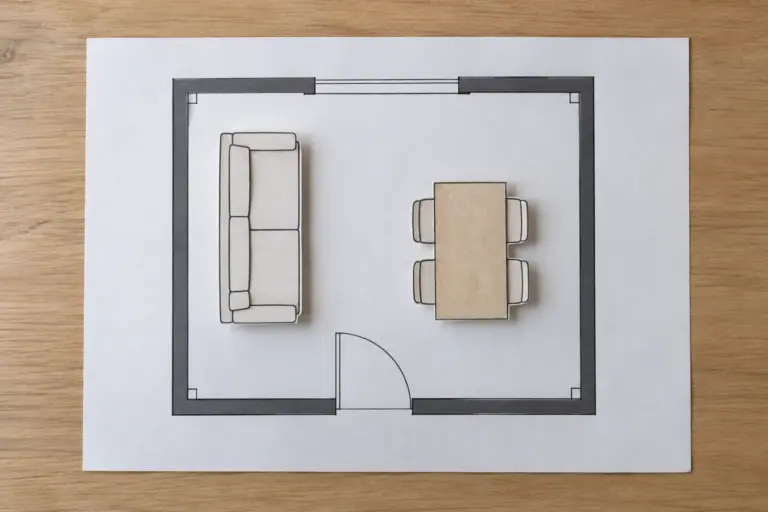
You can record a feng shui room bearing against magnetic north or true north. What matters for comparing plans is knowing which reference produced each number. “45°” on its own does not tell another reader whether it came from a compass, a map, or a converted reading. Start with the room feature or sightline you are describing, then keep the original bearing attached to the tool, setting, place and date that produced it. If two plans use different known references, a documented declination can put their bearings on a common basis. If a reference is unknown, do not guess it from the appearance of the plan or the name of an app.
What Magnetic and True North Each Mean for a Room Bearing
True north is a geographic reference; magnetic north is the direction associated with the magnetic field at the place of observation. NOAA explains that a compass follows the direction of the horizontal component of the magnetic field where it is located. It does not point geometrically toward one fixed point called the magnetic pole.
The angle between magnetic north and true north is magnetic declination. NOAA defines east declination as positive and west declination as negative, and says declination changes with both location and time. Those details matter whenever someone tries to compare a magnetic bearing with a true-north bearing: the angle needed for the comparison is not a number to assume universally.
Imagine that you stand at a marked point in a room and record a bearing of 45° toward a particular window. That number describes the observed direction only in relation to a north reference. If your instrument was set to report magnetic bearings, write 45° magnetic. If it was documented as reporting true bearings, write 45° true. Neither label changes the window or the direction you observed; it tells the next reader how the number was expressed. Two records can therefore show different numbers for the same sightline without necessarily disagreeing about the room.
The distinction does not decide which convention a feng shui practitioner should use. A physical explanation of north references tells you how to identify and compare bearings, not how a particular school interprets a room. If you are applying advice from a chosen practitioner or source, follow its documented reference. If it gives a direction but leaves the reference unspecified, ask before treating your own compass reading or map bearing as a match.
This is especially useful when comparing an older room sketch with a newer one. Before deciding that a feature has been assigned to a different direction, check whether the sketches describe the same sightline and whether both bearings have named references. A difference in numbers may call for a reference conversion; a difference in measurement points or observed features calls for clarification instead. Declination addresses the former, not the latter.
Identify the Reference and Make a Record Someone Else Can Use
Begin with the actual thing that supplied the bearing: a particular compass, phone app, instrument, map or plan. Look for its documented north reference and, where applicable, the setting in use when the observation was made. An app called Compass does not establish from its name alone which reference it displayed. Likewise, north being at the top of a printed map tells you how the page is oriented, but is not enough by itself to establish the reference for a bearing you take from it. If a map or plan specifies a grid or another directional reference, record that wording rather than silently relabeling it magnetic or true.
Next, define the observation. Where were you standing, or which point on the plan was used? Which way were you measuring—from that point toward a door, along a wall, or toward another identifiable feature? “Bedroom: 45°” is difficult to reproduce because a reader cannot tell what the bearing describes. “From the marked point near the center of the bedroom, toward the center of the doorway” gives them a sightline they can find again. For a plan rather than an in-room observation, name the line or feature on the plan from which the bearing was taken.
Keep these fields together in a room record:
| Field | What to write |
|---|---|
| Original observation | The bearing exactly as recorded, with its stated reference—or “reference unknown” |
| Source and setting | The specific device and app, instrument, map or plan; its documented reference setting or map notation |
| When and where | Observation date and location |
| Measurement point | The place in the room, or point on the plan, used as the starting point |
| Direction observed | The feature or sightline the bearing describes |
| Later calculation, if any | The assumed declination, its sign, date/location and source, plus the separately labeled converted bearing |
For example, an illustrative entry might say: “Bedroom; 12 October 2026; example location; from point A marked on the sketch toward the center of the doorway; original bearing 45° magnetic; reading from [named instrument], documented magnetic setting.” The date, location and instrument name here are placeholders for a real record, not evidence that 45° or any declination applies to a particular home. If you later convert that observation, add a second entry or line; do not replace the original 45° magnetic.
If you cannot establish the reference, the useful record is still possible: retain the number, source, setting information you can verify, point, sightline, date and location, and label the bearing reference unknown. Ask the person who made the plan, the instrument source, or the practitioner whose advice you are following what reference was intended. The tradeoff is straightforward: keeping an unknown label may delay a numerical comparison, but guessing gives a false appearance that two plans are comparable.
The same discipline applies when advice names a compass direction. First establish what direction in the room you are recording; then check the advice’s documented convention. This method helps you communicate a room observation to someone using that advice. It does not choose a feng shui school or turn a bearing into an interpretation of the room.
Convert a Documented Bearing and Compare Plans Without Losing the Original
When you know a bearing is magnetic and need to express it against true north, NOAA’s rule is:
True bearing = magnetic bearing + signed declination.
East declination is positive; west declination is negative. The word signed matters: “8° west” is entered as −8°, not added as though it were east.
Here are two arithmetic examples, not local declination values for your home:
- With an assumed declination of 8° east, a 45° magnetic bearing converts to 45° + 8° = 53° true.
- With an assumed declination of 8° west, enter −8°: a 45° magnetic bearing converts to 45° + (−8°) = 37° true.
If a calculation passes the end of the compass circle, express the result within 0–360° by adding or subtracting 360° as needed. For instance, a calculated 363° is written as 3°. This changes only how the result is displayed; it does not alter which reference or declination was used.
Do not let the converted number overwrite its history. A useful paired entry reads, for example: “Original: 45° magnetic, [instrument and setting], [observation date and location], [point and sightline]. Conversion for comparison: assumed declination +8° east, [declination source and applicable date/location]. Result: 53° true.” That format lets someone distinguish the observation from the assumption used in the calculation. NOAA notes that declination changes with location and time, so the value chosen for a conversion needs its own context.
To compare two plans, establish each plan’s original reference first. If one has a documented magnetic bearing and the other a documented true bearing, convert the magnetic one only when you have a suitable, recorded declination, then compare the two values on the same true-north basis. If both are already documented as true-north bearings, do not add declination again. If one reference remains unknown, a conversion cannot resolve that uncertainty: keep the plans provisionally separate and ask what the unknown bearing meant.
A conversion also has a narrower job than correcting a measurement. NOAA says its geomagnetic model does not include stray magnetic fields from power lines or similar sources. A declination lookup therefore cannot, by itself, tell you whether a reading taken in a room was affected by a nearby magnetic source, or establish that a phone reading was accurate. Treat a converted bearing as a documented comparison of references, not as proof of survey precision.
For a householder choosing between differently labeled room plans, the practical verdict is conditional: use the documented reference of the actual map or instrument; convert a known magnetic bearing only when a recorded declination is needed for comparison; leave an undocumented reference unknown. A comparable room record preserves what was observed, what was assumed, and what—if anything—was converted.