Feng Shui can “work” in several different senses, and the answer depends on which one you mean. It can provide a way to interpret a room and consider changes to it. A change might make a walking route easier to use or leave you liking the room more. Researchers can also measure features of environments and test how people respond to particular designs. Those are different outcomes—not evidence that an arrangement will bring wealth, improve health, or make someone happy.
The Feng Shui Society describes the practice’s aim as adjusting living and working environments so they better support occupants, but says it cannot guarantee wealth, health, or happiness . A 2023 review reported findings about environmental features while finding human effects undetermined in the studies it examined . A later randomized study measured responses to simulated hospital rooms, not life outcomes in homes . Together, they support a modest approach: be specific about the result you want, and judge a low-risk room change by what you can actually observe.
What Would Count as Feng Shui Working?
Before asking whether a layout works, name the job you expect it to do. The Feng Shui Society’s stated aim is to make adjustments to surroundings so living and working environments support people better rather than hinder them . That explains the practice’s purpose; it does not establish that any particular adjustment achieves it.
Consider a room where furniture interrupts the route between the door and a desk. “Can I walk through without detouring?” is a question about use. “Is this a comfortable place for me to work?” adds a personal response. Both questions can guide a sensible room decision, even if two residents answer the second one differently. Neither requires a prediction about what will happen to their finances or health.
A traditional interpretation is another kind of answer. It may offer a reason to consider one arrangement rather than another, but the interpretation itself is not a measurement of the result. If you move a chair and prefer the new position, you have learned something useful about your experience of that room. You have not established that the traditional explanation caused your preference, or that the chair will affect unrelated outcomes.
The distinction is also consistent with the Feng Shui Society’s own limit: it says the practice cannot guarantee wealth, health, or happiness . A clearer route needs evidence about the route. A claim about how people respond to a design needs observations of people. A claim about prosperity or medical benefit would need evidence about prosperity or medical benefit. Calling all of these “working” hides the difference between a useful household choice and a much larger promise.
What the 2023 Review Found About Environments—and People
An August 2023 systematic review provides one way to see why an environmental finding is not automatically a finding about human welfare . Its authors searched four databases: Taiwan Periodical Literature and WANFANG DATA in Chinese, and Web of Science and SCOPUS in English. They reviewed 36 articles . That is a defined body of work, not a test of every claim made about Feng Shui.
Among the results the review reported, Feng Shui environments in Asia had more comfortable wind fields than non-Feng Shui settings . The important question is what was compared. Wind conditions are properties of environments. A comparison can tell us something about those properties without telling us what happened to the people who lived or worked there.
For a homeowner, the distinction is familiar in smaller form. Suppose you can identify a draft in one part of a room. That observation might help you decide where to sit. It would not, on its own, show that a different seat improved your health or mood. The observation is relevant to a room choice; it simply answers a narrower question than a claim about an occupant’s life.
The review’s conclusion made that boundary explicit. It found validity with respect to environmental features but said Feng Shui’s influence on humans had not been determined . That is not the same as saying that people cannot respond to rooms. It means the environmental results in the work reviewed did not settle the question of human effects.
The review also described why its included experimental evidence could not carry a strong causal conclusion. Of the 36 articles, only two used experimental methods. Neither was a randomized controlled trial, and the reviewers judged both to be of poor research quality . Those are findings about the articles included in the review published in 2023, not a declaration that no randomized study could appear later.
So a useful question to carry from this review is: Was the measured result a feature of the setting, or a response by a person? If someone points to a wind-field comparison as evidence for a more comfortable physical environment, you can assess it on those terms. If they present the same comparison as proof that occupants became healthier, an essential link is missing. The outcome being claimed has changed, but the outcome measured has not.
What the 2024 Randomized Room Study Compared
A study published in PLOS ONE in June 2024 examined a different question: how people responded to representations of differently designed hospital rooms . It was an online, four-arm randomized trial. The researchers assigned 558 individuals in a 1:1:1:1 ratio to a control condition or one of three redesign conditions labeled Golden Ratio, Feng Shui, and Evidence-Based Design .
The hospital room was the setting depicted, not a reason to call the participants hospital patients. Participants encountered a 3D room simulation through a combination of video, images, and descriptions . They were therefore responding to presented interiors, rather than living in the rooms or using them during hospital care. Random assignment helps make a comparison between the assigned presentations meaningful, but the exposure still matters when deciding where the findings apply.
The Feng Shui condition was also a particular version of a redesign, not a stand-in for every Feng Shui method. The authors focused on Form School and five-elements ideas. Because the setting was virtual, they excluded other aspects they identified, including flying stars, the fortune of patients and doctors, timing of use, and the Feng Shui of the entire hospital building . The study consequently cannot answer what would happen if someone applied those excluded ideas, assessed an entire building, or rearranged a whole home.
Those limits do not make the comparison pointless. A simulated room can be used to ask how people respond to the designs shown to them. The key is to keep the comparison attached to its actual conditions: which room presentation was assigned, which presentation it was compared with, and which response was measured. That prevents a finding about one online interior from silently turning into a verdict on a tradition or a prediction for a household.
What the Anxiety Findings Do—and Do Not—Show
The trial reported two findings that are easy to blend together but should be read separately. First, compared with the baseline control condition, participants assigned to the Evidence-Based Design condition experienced less anxiety. The reported mean difference was −1.35, with a 95% confidence interval from −2.15 to −0.55 . This was a direct comparison involving the assigned room conditions and the measured anxiety response. It is not a reported direct anxiety reduction for the Feng Shui condition.
For Feng Shui, the paper reported indirect effects on anxiety through perceived room pleasantness and social support . In plain language, the authors’ model connects the assigned Feng Shui condition with those reported perceptions and then connects the perceptions with anxiety. That is a more specific statement than “the Feng Shui room directly lowered anxiety compared with control.”
Why does the wording matter? Assignment to a room condition was randomized; how pleasant a person found the room and what social support they perceived were not separately randomized . Randomizing the presentation does not automatically turn every later relationship among reported perceptions and anxiety into a demonstrated causal chain. The indirect result is worth understanding as a modeled association, without treating the model as proof of exactly how the room produced an effect.
There is also a difference between an anxiety response during online exposure and a clinical outcome. Participants viewed a simulated hospital room through videos, images, and descriptions . The reported findings do not establish that a redesign treated patients, aided recovery, or would produce the same response during an actual hospital stay. Nor does the Feng Shui condition’s modeled pathway establish that pleasantness or social support can be reliably produced by applying the same ideas in someone’s home.
A practical reading rule follows from the contrast: when you hear that a design “reduced anxiety,” ask whether the statement refers to a direct comparison of assigned conditions or to an indirect pathway estimated through measured perceptions. Then ask where the response was measured. The answers let you appreciate a finding about room response without enlarging it into a clinical claim the study did not test.
Where Room Evidence Stops Short of Life-outcome Claims
The two bodies of evidence address different links in a possible argument. The 2023 review reported environmental findings, including a comparison of wind fields, but concluded that human influence remained undetermined in the articles it reviewed . The 2024 trial went on to test responses to specific online simulated hospital-room conditions, reporting a direct anxiety comparison for Evidence-Based Design and indirect modeled pathways for its Feng Shui condition . Neither result is interchangeable with a resident’s long-term experience in a home.
It helps to put the outcomes side by side. A wind field describes an environmental feature. An online anxiety report describes a person’s response in a particular study setting. A homeowner’s judgment that a changed room is easier to use or nicer to occupy describes their experience of that room. Each can be useful on its own terms. None, merely by existing, establishes that a layout changes personal prosperity, produces a medical benefit, or guarantees happiness. The Feng Shui Society itself declines guarantees of wealth, health, and happiness .
A stronger claim would have to follow the promised outcome rather than substitute a convenient one. If the claim is financial, what financial result is meant, for whom, and compared with what? If it is a clinical-health claim, what health result was measured? Evidence about wind comfort, perceived pleasantness, or anxiety during an online simulation cannot answer those questions in place of the claimed result. This is a standard for matching evidence to a claim, not a claim that this article has surveyed all research published since the cited studies.
When you encounter a new Feng Shui claim, a short sequence of questions is more useful than either blanket acceptance or blanket dismissal:
- What is the promised outcome? A more usable room and improved health are different claims.
- For whom, and in what setting? An online response to a depicted hospital room is not a home outcome.
- Compared with what? A result needs a meaningful point of comparison.
- What was actually measured? Was it a feature of the environment, a reported perception, or the promised life outcome?
- How was the result obtained? Was it a direct comparison of assigned conditions or a reported indirect pathway?
The conditional answer is that these findings can inform questions about particular environments and responses to particular room designs. They do not establish general wealth, medical, or happiness effects. That distinction leaves room to make an ordinary, useful change without borrowing certainty from evidence about a different outcome.
A Proportionate Way to Try a Change at Home
For a household decision, begin with the room you have rather than a supposedly universal placement rule. Notice its shape, openings, fixed fixtures, furniture, walking route, and the needs of people who share it. Include constraints: what cannot be moved, what others need access to, and what you are authorized to change. Then choose one goal you can recognize in ordinary use—perhaps an unobstructed route or a more comfortable place to work.
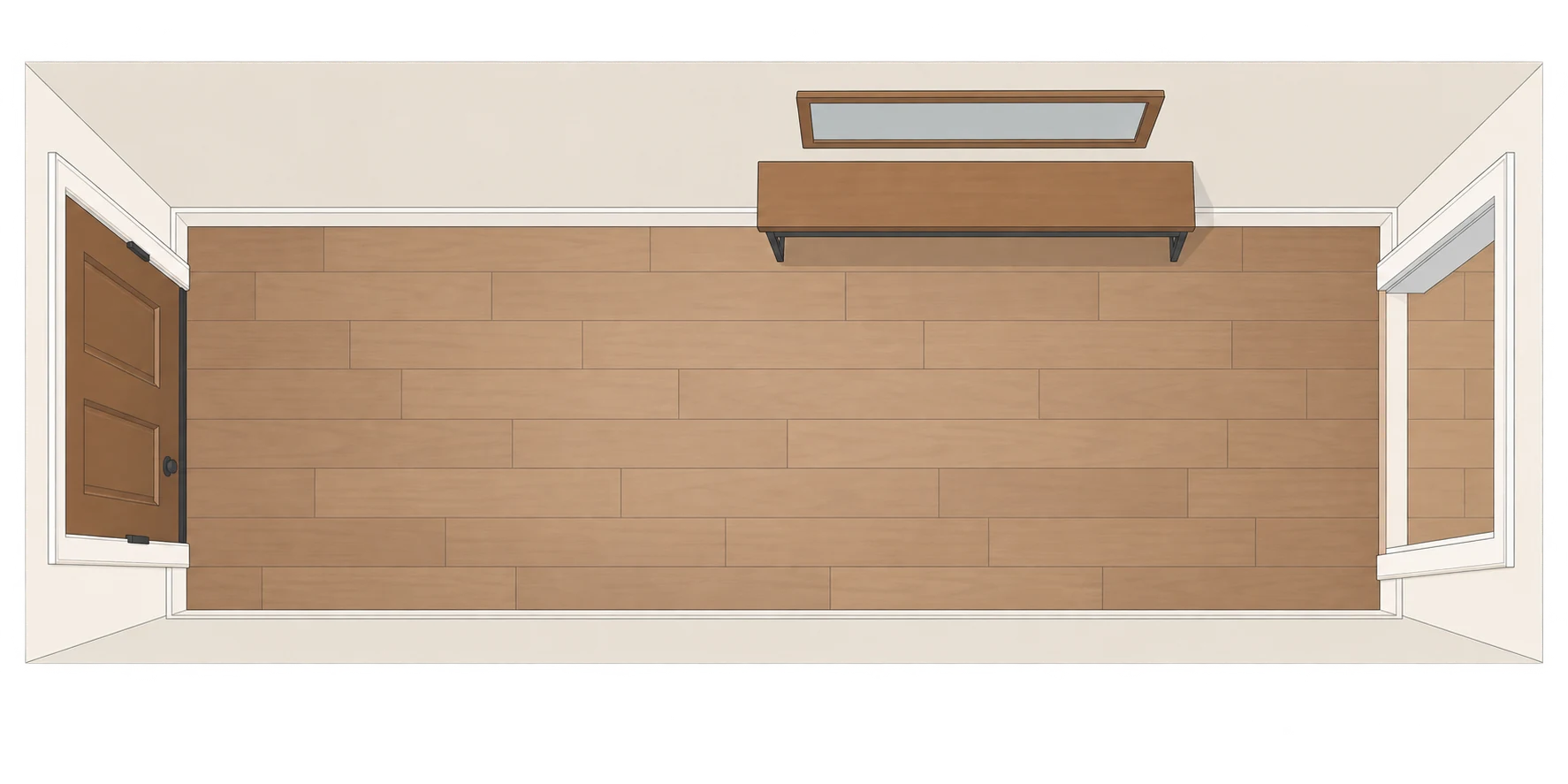
Compare only feasible arrangements. A traditional interpretation can be one reason to consider an option, while circulation, household needs, and personal preference remain separate reasons to accept or reject it. The cited review and virtual-room trial do not prescribe a placement that works for every home . There is no need to turn a modest question about a desk or chair into a complete redesign.
Choose one low-cost move you are allowed to make and can easily undo. After using the room normally, ask two questions: Does the change help the task you chose, and do the residents who use the space prefer it? If the route is easier and the arrangement works for the household, keeping it can be a reasonable decision. If it creates a new obstruction or someone who relies on the space dislikes it, undoing it can be just as reasonable.
This kind of informal home observation helps you choose between arrangements; it is not a controlled test of why you prefer one. Other things about your day and the room may differ, and preference alone cannot establish a causal Feng Shui effect, a future change in fortune, or a treatment benefit. You do not need that larger proof to decide whether a reversible move is worthwhile.
So, does Feng Shui actually work? As a way to consider room changes, it can prompt choices you can judge by use and preference. Research has examined some environmental features and particular human responses, with important limits on what those results establish . Keep a modest change if it improves your room on the terms you chose; reserve health and financial promises for evidence that actually measures those outcomes.