Arrange a home library by finding a sound place for the books, a comfortable place for the reader, and a clear route between them. Then adjust how the shelves look from the seat. Feng shui adds a useful question about that relationship: does the arrangement feel supportive, or does a large collection seem to crowd the place where you sit?
You do not need to discard well-used books or hide their spines to create a calmer room. A working library can be full. The more useful changes are often relocating one case, supporting a leaning row, or moving the reading chair out of a narrow passage.
Survey the Collection Before Choosing a Wall
Make a rough plan showing doors, windows, heating, outlets and the routes people already use. Measure the depth of each bookcase as well as its width. A case that fits along a wall may still project into the route beside a sofa or prevent a cupboard from opening.
Sort the collection temporarily by use and physical needs. Separate everyday reading, work references, oversized volumes and fragile books. Estimate their shelf space using the books themselves, rather than assuming that every shelf holds the same number. Include somewhere for returns and new arrivals if those already form a pile on the floor.
Try the route with another person browsing. Can someone reach a shelf while somebody else passes? Can you remove a large book without striking a light fitting or moving the chair? If the only available wall makes those tasks awkward, reduce the depth of storage there or distribute the collection across two areas.
Avoid making the window wall the automatic choice just because symmetrical cases would frame it beautifully. Check direct sunlight, nearby radiators and any signs of moisture first. The Library of Congress recommends protecting books from intense light, heat and unsuitable storage conditions. A different wall may be a better long-term home for the collection.
Use Feng Shui to Consider the Reader’s Position
For a library with a desk, Anjie Cho's command-position guidance favors seeing the entrance while seated without being directly aligned with it. You can also use the question of door visibility when trying a reading chair, but that is an adaptation for this layout, rather than a rule about where every bookshelf must stand.
Sit in the chair before deciding where it belongs. Notice the entrance, the nearest shelf edge and what lies immediately behind your head. A chair facing into the room with a wall nearby may feel settled to you. Another reader may prefer looking out of a window. Preserve a workable position and choose between those experiences deliberately.
Also notice the nearest shelf edge from the chair. If a projecting corner feels intrusive, move or turn the chair first. Compare the view before and after: can you see into the room, and can you reach a book without squeezing past the case? This is a practical layout test, not a claim that an ordinary book spine emits harmful energy. You may prefer the adjustment without needing to conceal a useful library.
Do not reorganize every case around a supposed universal lucky direction. This arrangement starts with room form, access and the reader's use. A compass-based consultation would need its own method and inputs; a title about bookshelves does not establish those for your house.
Place and Secure Cases Before Styling Them
Wall-based cases usually make the layout easier to understand: storage occupies the perimeter, while the remaining space holds browsing and reading. Start with the largest case on a suitable uninterrupted wall, then test smaller units around it. Keep doorways and switches usable.
Secure furniture according to its instructions and the wall construction. CPSC advises anchoring bookcases and dressers and storing heavier items on lower shelves. If you cannot obtain permission for the required fixing, choose a different suitable storage solution rather than presenting an unsecured tall case as a finished layout.
Check each shelf's stated capacity and condition before loading it. Bowing, loose supports or damaged joints need attention; styling does not solve a structural problem. Large books can make a shelf heavy before it looks visually full. Spread the collection according to the unit's instructions instead of assuming an empty top shelf compensates for an overloaded middle one.
A case used across a room must be appropriate for that purpose and secured as its design requires. It also needs to look and function sensibly from both sides. In a narrow living room, a short wall-based case may separate activities adequately without creating a new corridor around a tall divider.
Arrange Shelves so Finding a Book Remains Easy
Choose a retrieval system before choosing a color pattern. For a household collection, broad subject groups may be sufficient: fiction, cookery, work references and children's books, for example. Within a group, use author or another familiar order. Put everyday books where their users can reach them comfortably without treating furniture as a ladder.
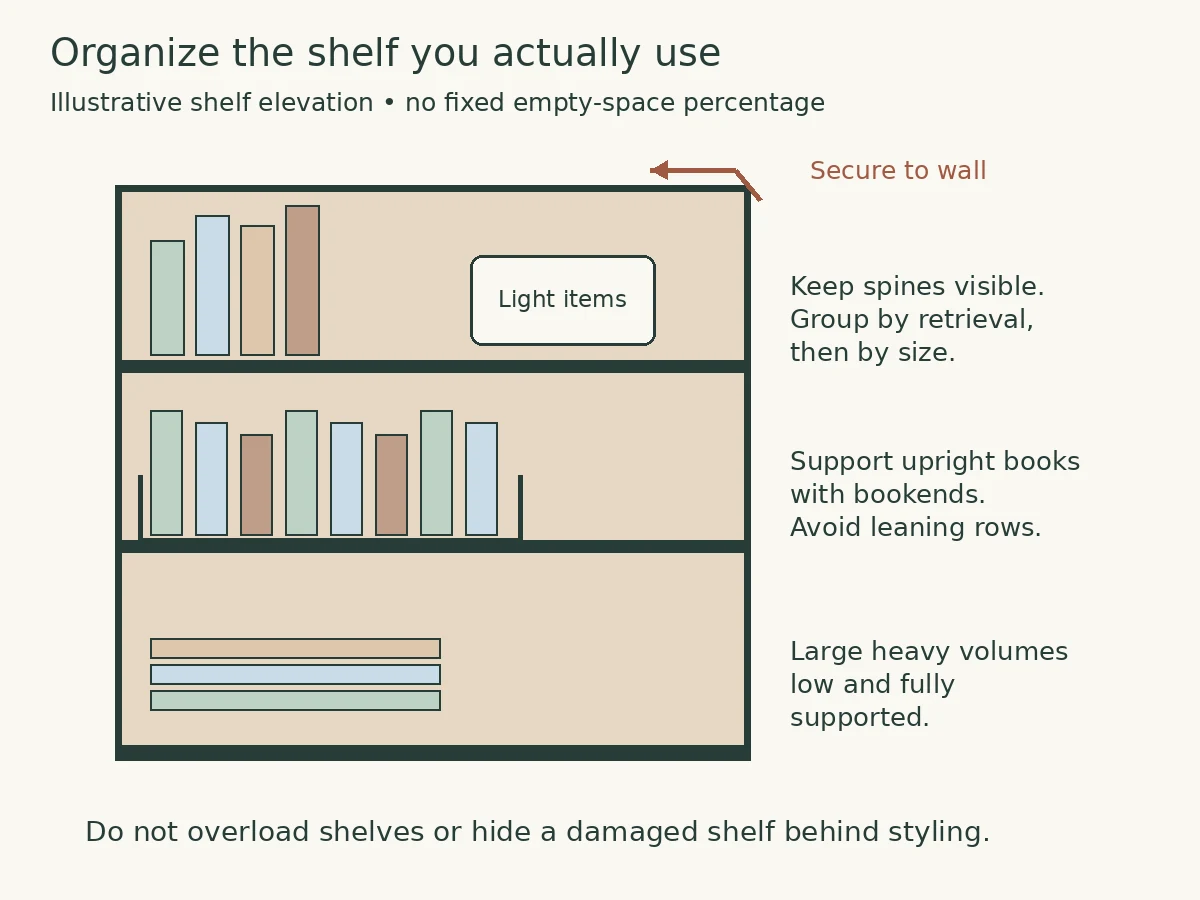
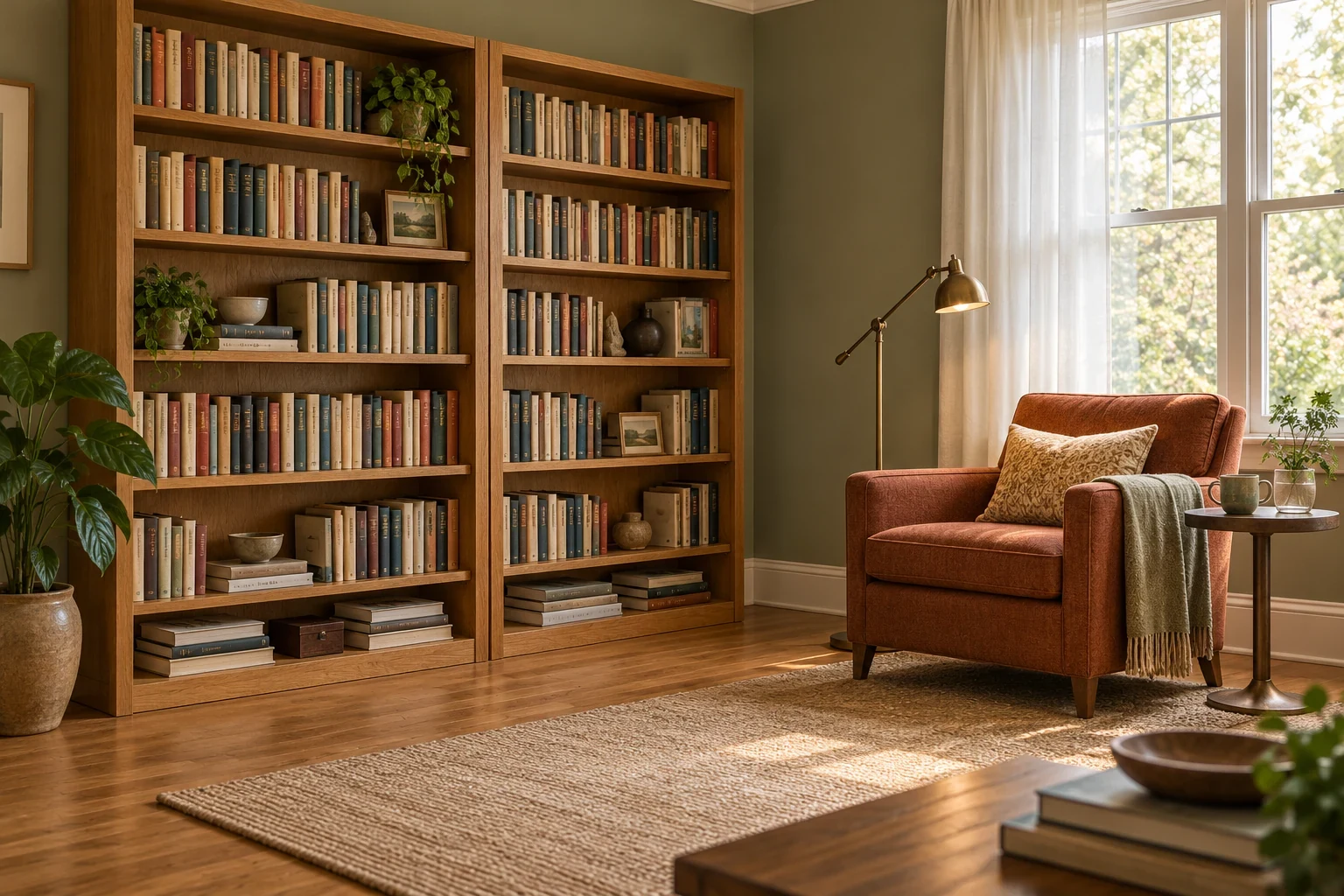
The shelf illustration shows a practical hierarchy: lighter objects above, supported upright books in the middle, and large heavy volumes below. It is an example of organization rather than a load-rating diagram. The actual shelf and fixings still determine what the case can hold.
Keep ordinary books upright with support at the end of the row. The Library of Congress advises against leaving them leaning; oversized books can be stored flat with full support. Leave enough room to take a volume out without forcing its neighbors apart.
Avoid reversing the entire collection so that page edges face out if you use titles to find books. Likewise, an arrangement by spine color is optional. It is helpful only if the people who use the library can still retrieve what they need. A simple shelf label inside a cupboard or a small written map can help with a large collection without making the room look institutional.
Leave openings where they serve a purpose: a temporary return space, room to lift a large book, or a pause beside a favorite object. There is no necessary percentage of empty shelf. If your collection fits securely and works well, a full shelf is not automatically a feng shui failure.
Give the Reading Area Its Own Working Space
The main library scene pairs wall storage with a chair beside controlled daylight. Notice that the chair does not sit in the browsing route and the small table gives a drink somewhere separate from the books. Those relationships matter more than reproducing the furniture or colors.
Try a lamp beside the chair and open a book in your usual reading position. Adjust the light until you can see the page comfortably, and keep the stand and cable out of the route. If daylight falls directly on the collection, use a shade or reconsider the shelf location rather than sacrificing book care for a bright photograph.
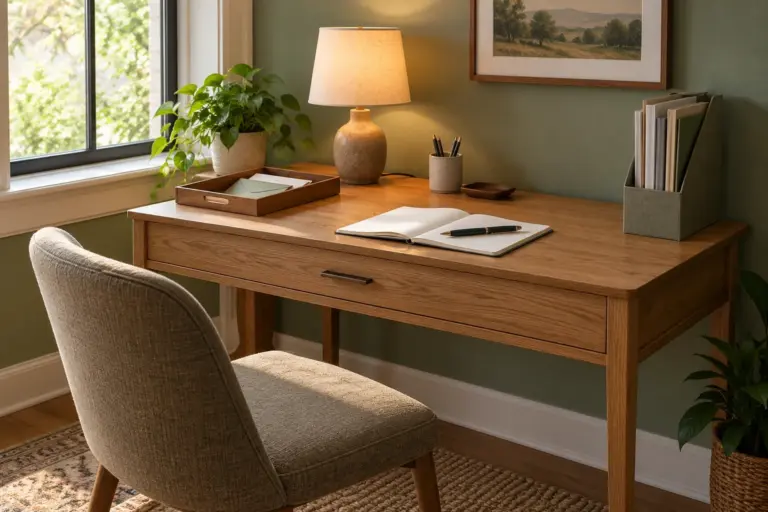
Allow a surface for the book currently being read and a place for returns. Without those, books often become unstable piles on the floor. A small tray that is emptied regularly can be more useful than a decorative object occupying the only clear tabletop.
Adapt the Arrangement to a Bedroom or a Large Library
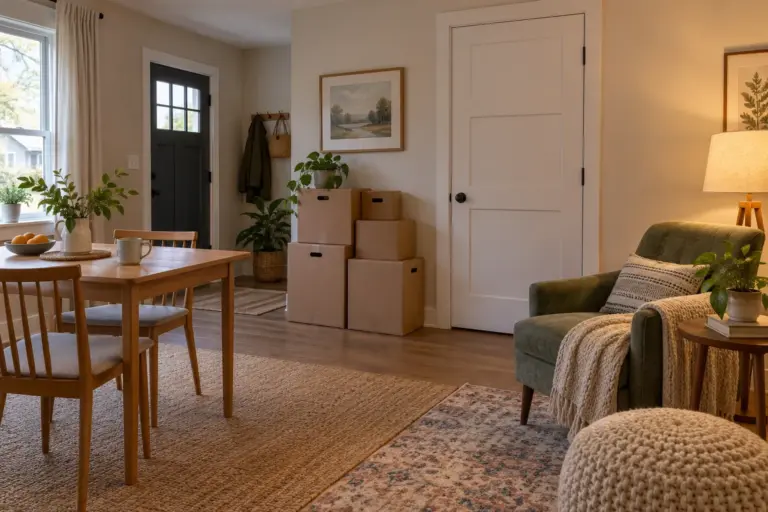
In a bedroom, begin with the bed and its access, then find room for reading storage. A low cabinet on a separate wall can hold a current selection without placing a dense shelf over the pillow area. The bedroom scene shows this smaller approach: the collection has a place, but it does not surround the head of the bed.
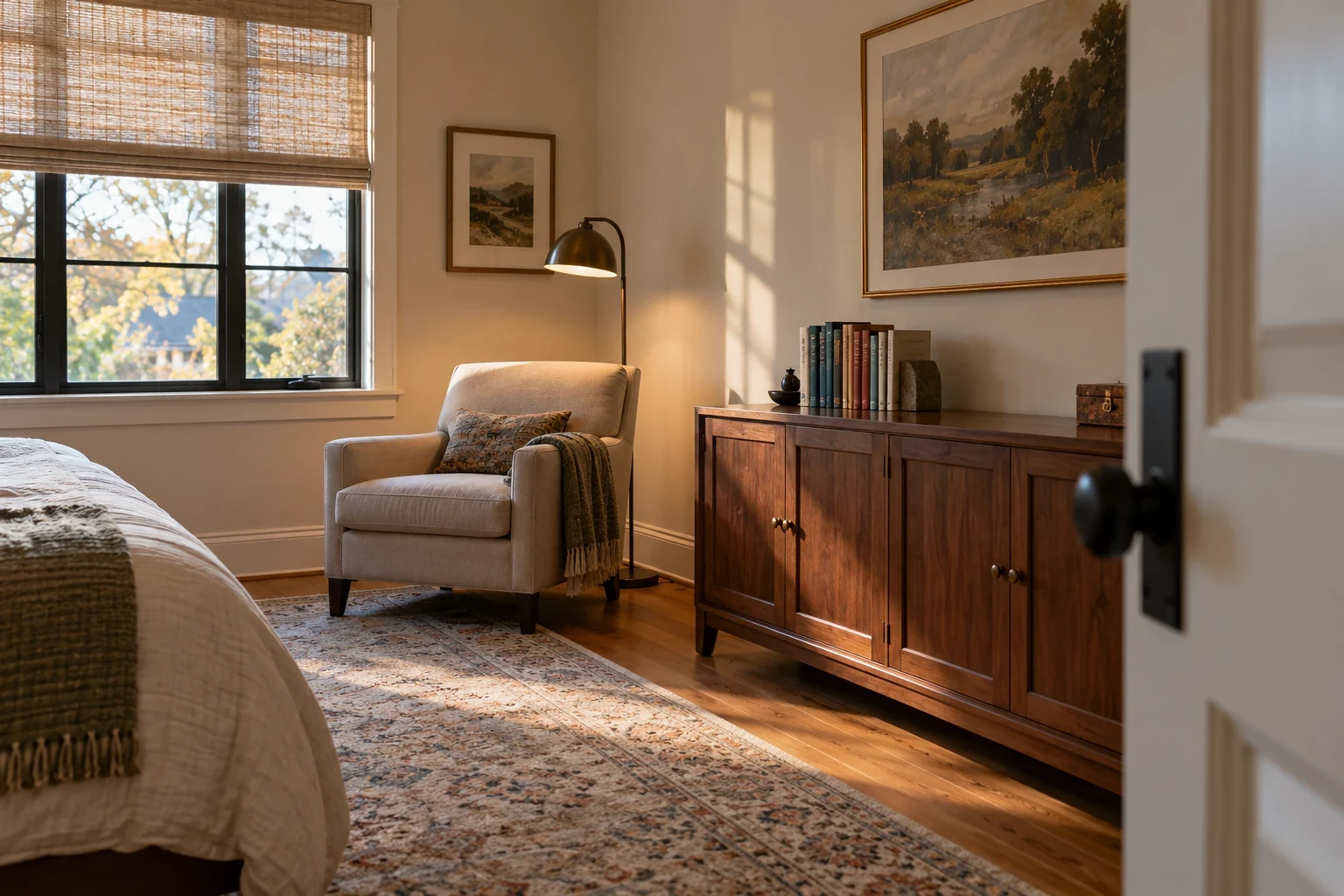
If looking at work references from bed feels like unfinished business, move those books to a closed cupboard or another part of the home. Keep books you enjoy nearby. This is a preference about what you see while resting, not a ban on reading in bedrooms.
For a dedicated library, divide the space by use rather than making every wall identical. Put frequently consulted references near a desk, general reading near the chair, and fragile books in appropriate protective storage. Preserve an open browsing route between those areas. If upper shelves require access equipment, plan where that equipment is used and stored before filling them.
Reset the Room by Using It
Finish by choosing a book, carrying it to the chair, reading a few pages and returning it. Note each interruption: a shelf too tightly packed, a lamp base in the way, a label you cannot see, or nowhere to put the book while standing up.
Make the smallest change that removes the interruption. Then view the shelves from the entrance and the reading seat. Keep the arrangement that holds the collection securely, helps you find it, and leaves the room comfortable to occupy. The books can remain visibly books; the balance comes from how storage, reading and movement fit together.