Fountains and aquariums make the idea of flow visible: water moves, light changes across a surface and, in an aquarium, living things move through the scene. In some feng shui teaching, that activity represents circulating qi, renewal and abundance. It is a symbolic interpretation, not evidence that installing a pump changes your income.
Before choosing either, look at the room that would hold it. A fountain needs stable support, a suitable electrical arrangement and a place where its sound and splashes are welcome. An aquarium adds the requirements of living animals and a continuing care routine. The most suitable expression of flow may be a modest feature, an image of water, or no added object at all.
Water Is Both a Material and an Element
A basin contains literal water. “Water” in a feng shui discussion can also name one of the five elements: a category of relationships and symbolism that extends beyond a liquid's physical presence. That is why advice may discuss water imagery or colors alongside ponds and fountains.
In Jennifer Too's account for World of Feng Shui, moving water is described as yang water, and fountains, waterfalls and fish tanks are given as examples. The movement is central to the way these features are interpreted. A still bowl and an active fountain are therefore not necessarily interchangeable within a practitioner's method, even though both contain water.
The connection with abundance is a reading of movement and replenishment. A circulating feature can stand for resources moving rather than becoming stuck. It does not create an economic mechanism. A household can enjoy the reminder while continuing to make financial decisions on their actual merits.
Distinguish this symbolism from ordinary effects you can observe. You can hear a splash, see a ripple, notice a pump vibration or discover that cleaning the basin takes more effort than expected. Whether you find those experiences pleasant is personal. None measures how much qi or prosperity the feature supposedly supplies.
What a Fountain Makes Visible
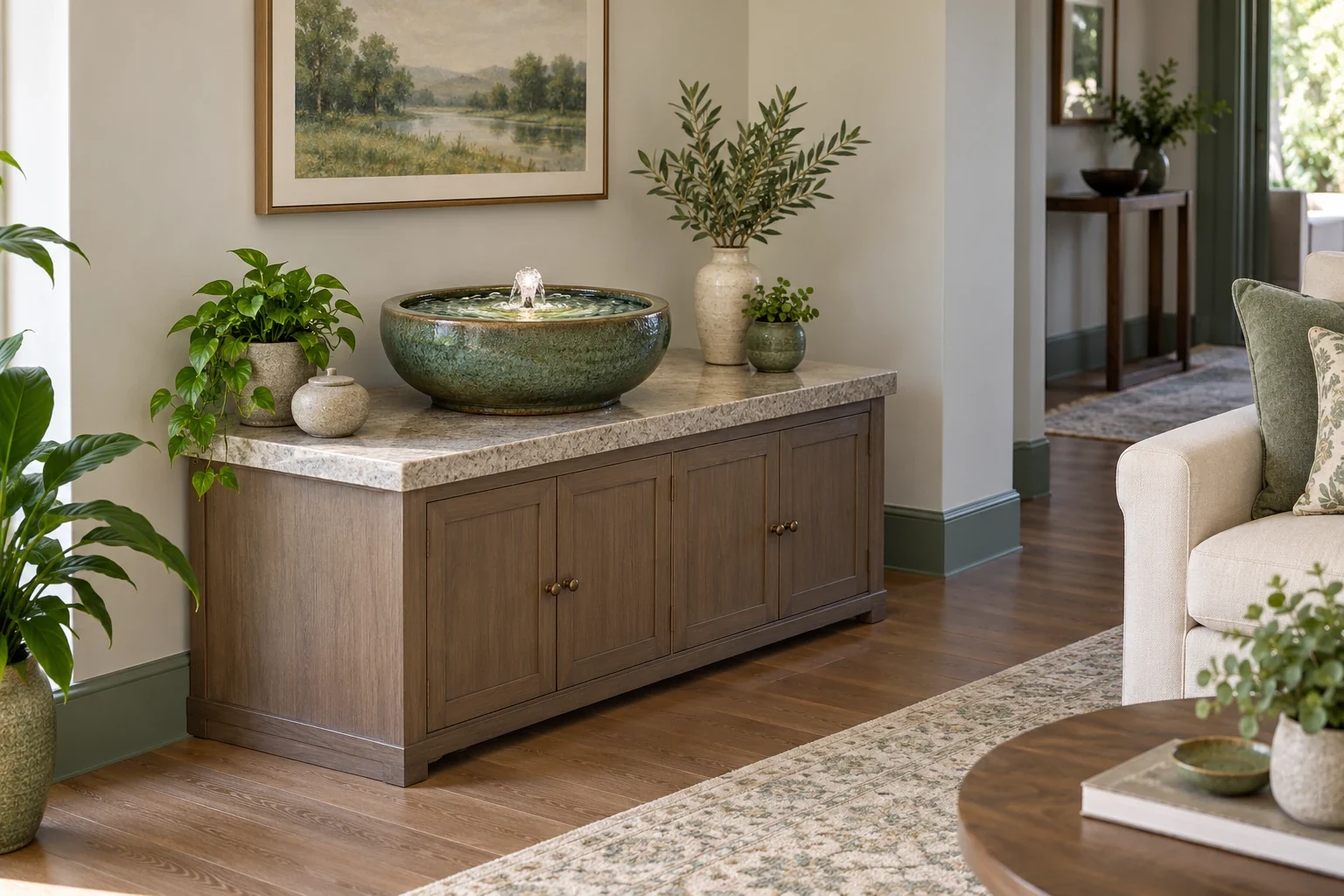
Illustrated fountain study: a low ceramic basin bubbles at its center on a broad cabinet. Its scale, support and position outside the main walking route are the details to notice.
A recirculating fountain repeatedly returns water to its basin. That closed loop can serve as an image of continuity: movement keeps happening without the object becoming a literal source of new water. Its small rise, fall and return are enough to make the metaphor legible.
The sound depends on the feature and its setting. A gentle-looking image cannot tell you how a pump will sound on your cabinet or whether the splash will be intrusive beside your reading chair. If possible, hear a real unit before choosing it. With a permitted home trial, listen from the places where people actually sit, work and rest, rather than only standing beside the basin.
Scale matters in ordinary room terms too. A large feature can dominate a small sitting area; a small one can get lost on a crowded surface. Choose an object whose outline you can appreciate without sacrificing a useful passage or placing water beside belongings that should stay dry.
Do not confuse an apparently inward-facing spout with water being physically drawn into a household's finances. You may prefer a particular orientation for its meaning or appearance. The actual water should return to its intended container without creating a nuisance around it.
What an Aquarium Adds to the Idea of Flow
Illustrated aquarium study: a wide planted tank sits on a full-width cabinet in a shared living area. The picture shows a possible spatial arrangement, not a tested stocking plan or a functioning installation.
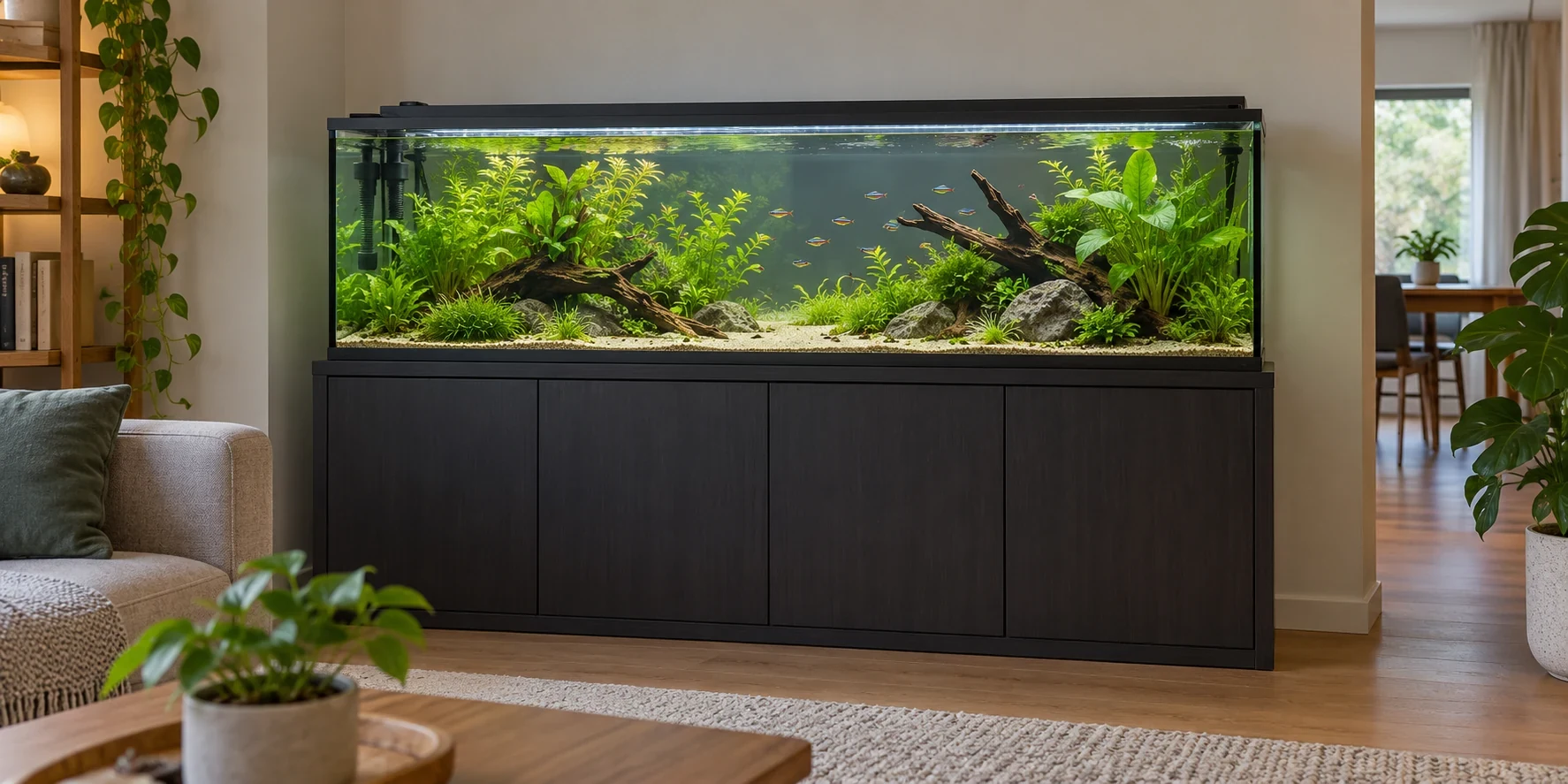
An aquarium combines water movement with animal movement and, often, plants. Its interpretation can therefore include life, growth and activity as well as the Water element. For someone who already enjoys keeping fish, the scene may have a meaning that a fountain does not provide.
The important difference is responsibility. A fountain is an object to operate and maintain. An aquarium is an environment you must keep suitable for its inhabitants. You cannot choose the number of animals solely because a number is considered lucky, or treat an unhealthy fish as an ornament that has stopped doing its symbolic job.
RSPCA guidance emphasizes suitable space, maintained filtration, stable conditions and species-specific needs. It also explains that clear-looking water does not by itself establish good water quality. The living system must come before a preferred decorative composition.
For a first aquarium, start with the species' adult needs and care requirements, then select a suitable tank and location. If that does not fit your room, time or budget, choose another expression of flow. There is no obligation to keep fish to practice feng shui.
Compare the Responsibilities Before the Symbolism
| Consideration | Recirculating fountain | Aquarium |
|---|---|---|
| Visible activity | Water rising, falling or bubbling | Water movement plus the behavior of living inhabitants |
| Main decision | Whether its scale, sound and care suit the room | Whether you can provide the particular animals' environment and long-term care |
| Ongoing attention | Water level, cleaning, leaks and the unit's operating instructions | Water quality, filtration, feeding, equipment and species-specific care |
| Changing your mind | Decommission the unit according to its instructions. | Plan responsibly for the animals; do not treat moving or emptying it as a casual decor trial. |
| Symbolic alternative | Water imagery can express a similar intention. | Imagery avoids taking on animals simply for a symbol. |
Neither column is a ranking of auspiciousness. A feature that fits one household can become an unwanted task in another. If you mainly want a quiet visual reference, an aquarium may be a much larger commitment than your original goal requires.
Why Placement Advice Can Conflict
World of Feng Shui publishes both compass-sector associations and chart-based Flying Star advice. In the former, a direction is connected with particular symbolic themes; in the latter, a recommendation depends on a house-specific analysis. Those are different inputs, even when both instructions mention water. A generic direction tip cannot stand in for a complete chart reading.
This explains why “put water in the wealth corner” is not enough information. Which method defines that corner? Is the advice for the whole dwelling or one room? Does the source discuss a decorative symbol, moving water or an aquarium? If those inputs are missing, the instruction cannot identify a precise location in your home.
If you want to follow a particular method, ask for the method's name, the home information it needs and the reasoning for the suggested position. Have the practitioner mark that position on your actual plan. Then check whether the room can accommodate the feature. A recommendation that requires placing an aquarium on unsuitable furniture still needs a practical solution.
For a simple decorative choice, you can work from the room's use without claiming a calculated feng shui result. Choose a shared living area where the feature can be seen and maintained. You do not need to invent a favorable direction to justify enjoying it there.
Check a Proposed Spot in the Room
First mark the feature's footprint, including its support. Leave the route people already use available. Check the spot while someone is sitting in nearby furniture and while cabinet doors are open. A position that works only when the room is empty is not ready.
Next consider access. Can you reach the fountain basin or aquarium equipment for cleaning and care? Can you bring water to and from it without making routine maintenance awkward? A decorative recess may frame a tank attractively while leaving too little access above it. Check the actual product's access needs before committing.
Support and surroundings also matter. For an aquarium, use support suitable for the complete filled system, not just the empty tank's appearance. RSPCA specifically advises sturdy support and a position away from direct sunlight and heat sources. For either feature, follow the manufacturer's electrical and installation instructions and have any required work handled appropriately. A room illustration cannot verify these conditions.
Finally, consider the people who share the space. Ask whether ongoing sound, reflections or equipment would be welcome. If a feature is wanted by one person and continually irritates another, its symbolic meaning does not settle the household decision.
A Fish Tank Needs Preparation Before Fish Arrive
RSPCA recommends establishing a new aquarium through fishless cycling so that the filter's bacterial system can develop before animals are added. Water-quality test results, interpreted with an applicable setup guide, determine readiness; appearance or a decorative deadline cannot establish it. Its guidance also discusses filtration, water conditions and the requirements of the fish you choose.
Use RSPCA’s aquarium setup guidance and suitable specialist advice to plan that setup, including adult size, compatible inhabitants, temperature and ongoing water-quality checks. This is not a step to skip because the tank occupies a supposedly favorable sector. A feng shui article cannot supply a universal stocking recipe for every species and tank.
If equipment noise becomes a problem, solve the installation or location issue with appropriate advice rather than switching off essential life-support equipment for quiet. If you are away, arrange continuing care. If you cannot sustain the commitment, plan a responsible rehoming route instead of treating fish as expendable decor.
A Dry Symbol Can Express the Intention
World of Feng Shui's directional guide explicitly allows water imagery as a symbolic alternative when a real feature is not practical. You might choose a river scene for continuity, or a quieter image of ripples if that is the experience you want to bring to the room.
Look at the image from where you will live with it. A dramatic waterfall might feel lively in a shared sitting area and distracting beside a work surface. The preference is yours; no particular photograph becomes a guaranteed prosperity device. Use the image to make the chosen idea present without creating a new maintenance task.
You could also decide that the room already has enough visual activity. Choosing nothing is coherent when adding water would obstruct movement, burden the household or require animal care you do not want.
Keep the Meaning Proportional to the Commitment
A fountain can make circulation visible through its repeated return of water. An aquarium can add living movement to that idea, with responsibilities that extend well beyond decoration. Both can carry feng shui symbolism, but neither needs to be treated as a promise of financial change.
Choose the meaning you value, then check the room and the ongoing work. A modest feature you can care for, or an image you enjoy seeing, is a more considered choice than a complicated installation acquired solely because it was called lucky.