Design for better communication by giving people a comfortable way to face one another, a clear way to join or leave, and some control over interruptions. Start with the conversations your household actually wants to have. A brief kitchen check-in, a relaxed evening with friends and a private discussion need different settings.
Furniture can make those moments easier to arrange. It cannot make someone listen, resolve a disagreement or replace a needed boundary. The useful result is a home where talking does not always mean moving a pile, shouting over a screen or blocking the route to another room.
Identify the Conversation Before Moving the Sofa
Choose one recurring situation that feels awkward. Perhaps everyone gathers around the kitchen island while one person cooks, or the living room has plenty of seats but they all face the television. Describe what happens rather than labeling the whole home unwelcoming.
Draw the room's openings, fixed furniture and main walking routes. Mark where each person sits or stands during that conversation. Include the person arriving late, carrying a drink or needing to leave. If their route goes directly between two speakers, the layout is part of the interruption.
Ask the people involved what they prefer. Someone may find facing a person across a table comfortable; someone else may prefer sitting at an angle. A person who needs to see a speaker's face clearly may have a different priority from someone who wants a less direct position. Make room for those requirements before choosing a symmetrical arrangement.
Keep more than one setting available if possible. You do not need a special room for each use. Two dining chairs can become a quieter pair of seats after a meal, while the sofa remains available for a larger group.
Arrange a Group That Can See One Another
Feng shui practitioner Anjie Cho recommends arranging living-room seats so people face others and trying each position to see whether it is comfortable for lingering and talking. She also suggests minimizing seats with their backs to the door. These are placement preferences to test, not proof that a particular shape improves relationships.
Begin with the seat the household uses most, then turn one other seat towards it. Sit in both positions. Can you see the other person's face without twisting? Is there a place to set down a cup without leaning across their body? Does the arrangement still work when someone uses the route behind or beside it?
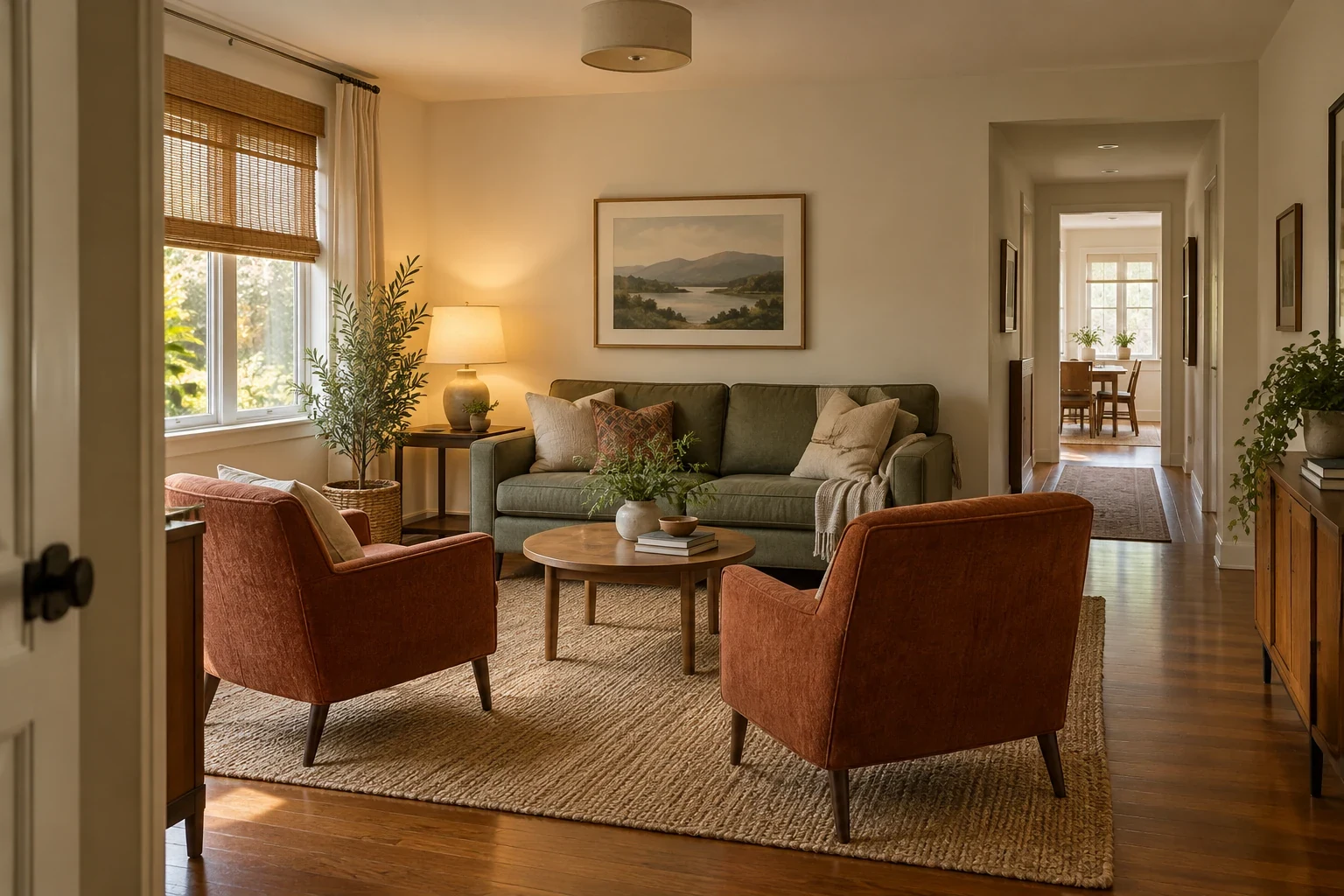
A shallow U-shaped group can work in a wider room. In a narrow room, a sofa and one angled chair may do more than a crowded collection of matching pieces. The main scene shows a small group with a route outside it. Notice the relationship between the seats and the passage, rather than copying the exact furniture.
Keep the group close enough for its users to talk comfortably at their normal volume, then test it during ordinary household noise. There is no single seating distance that suits every voice, hearing need and room. Move a chair closer before assuming you need another item of furniture.
Keep Joining and Leaving Easy
An apparently intimate group can become uncomfortable if one person is trapped between a table and a wall. Open a way into the seating area that does not require everyone to stand. Check with the seats occupied and with any footrest or recliner in use.
Place the main route around the group when the room allows it. In an open-plan space, the back of a sofa can mark the sitting area's edge, but it should not create a squeeze against the dining table. Try walking through while another person sits with their chair pulled out.
Do not add a tall divider to fix every interruption. It may block daylight or make it difficult to notice someone approaching. A change in furniture orientation or a small clear landing surface can identify the area without enclosing it.
Likewise, avoid treating a seat with its back towards the entrance as unusable. If that position is necessary, ask its user whether a different angle feels better. A practical compromise is preferable to moving the entire room into a less workable arrangement to satisfy an idealized diagram.
Provide an Alternative to Direct Face-to-face Seating
Not every conversation needs the same degree of attention or formality. For some households, a small table with chairs at adjacent sides feels easier for a routine check-in than chairs lined up directly opposite. A pair of seats turned slightly towards each other can also work.
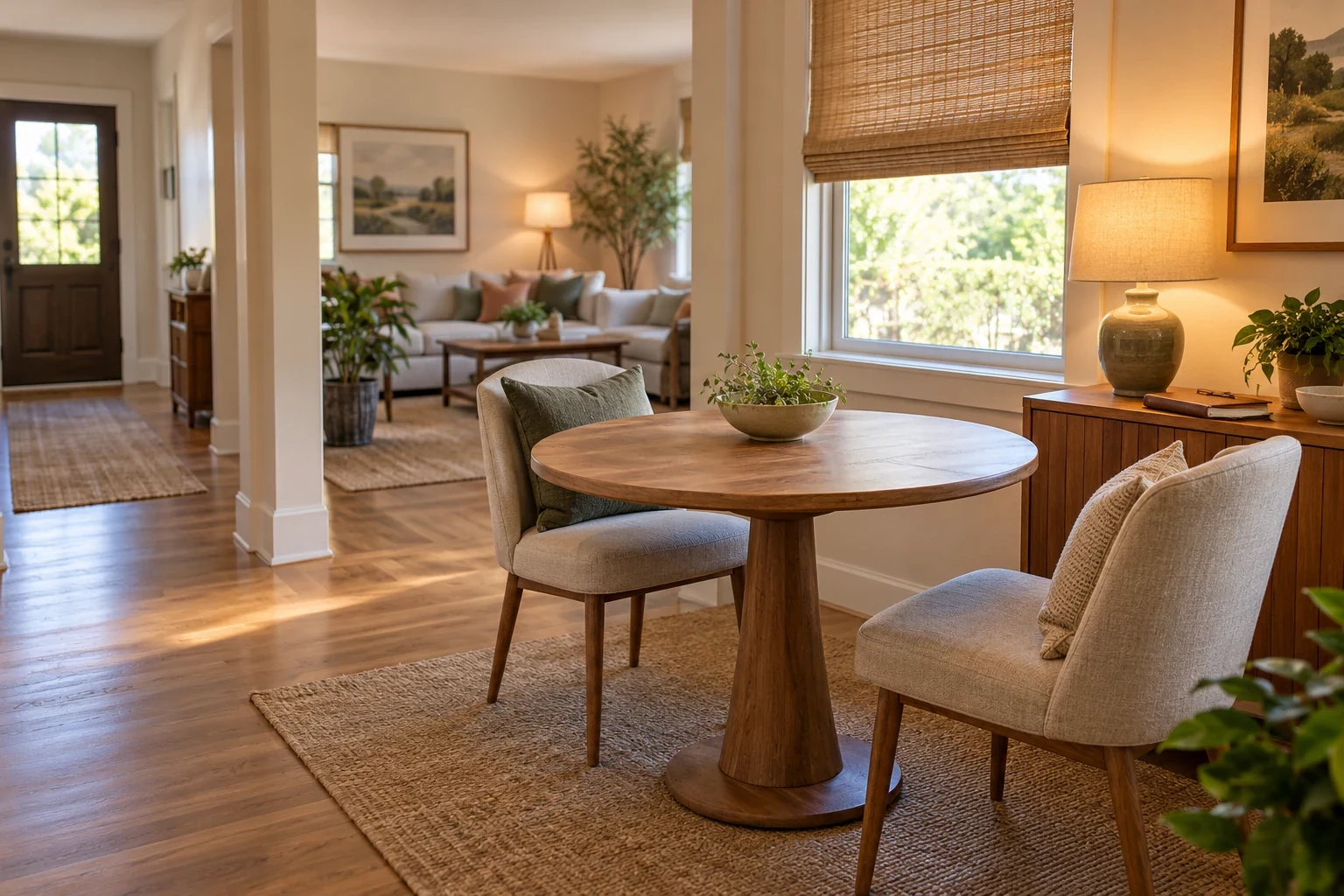
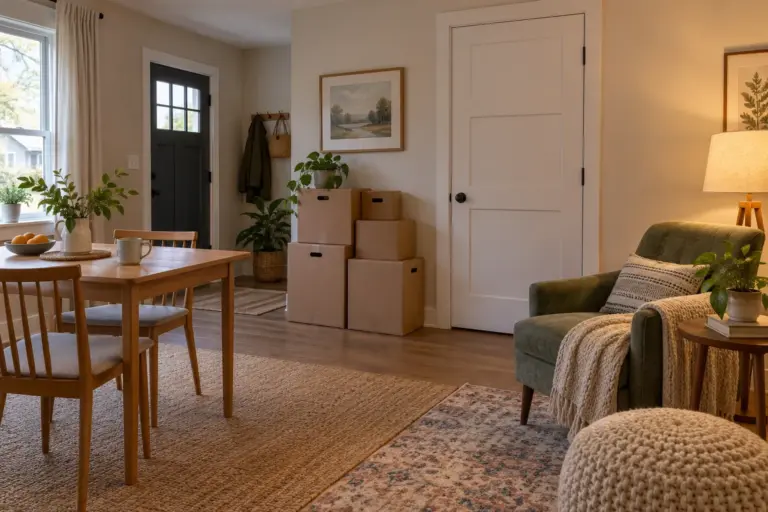
The smaller scene shows a table-based arrangement in a multipurpose corner. Its value is that both users have a surface and an understandable place to sit. It is not a prescription for discussing difficult subjects in a public part of the home.
For a private conversation, ask whether others can hear from the hallway or next room. A folding screen changes the view, but it does not make speech confidential. Choose a more suitable room or a quieter time when needed. The person who wants privacy should not have to accept an exposed seat because it is considered the room's best feng shui position.
Let someone decline or end a conversation. An easy route out, somewhere to put a drink and a chair that can move are small design choices that support that freedom. They do not substitute for respecting it.
Make the Dining Table and Kitchen Work for Their Real Roles
At a dining table, check what sits between faces. A tall display or an accumulation of parcels can interrupt the view even when the chairs are well placed. Move temporary storage elsewhere and try a lower centerpiece if you want one.
Keep places available for the people who eat there regularly. If one chair is permanently occupied by laundry, decide where that laundry should go rather than repeatedly moving it to another person's seat. A clear table is useful only if the room has a workable destination for the objects removed from it.
In the kitchen, distinguish a quick exchange from a place to linger. Do not arrange visitors where they obstruct the person handling hot food or opening appliances. A chair on the edge of an adjoining dining area may allow conversation without putting another body in the cooking route.
For a household notice point, choose information that actually requires shared attention: an appointment, a shopping need or an agreed plan. Keep it visible in the place where people already pause. A wall filled with old notes is harder to use than a small current list, regardless of how attractive the board is.
Reduce the Interruptions You Can Identify
Try the room at the time it is normally used. Listen for the television, a speaker, an appliance or a game running nearby. Decide which of those can be paused, moved or scheduled differently. Soft furnishings may change how a room sounds, but a rug or curtain is not a guarantee of acoustic privacy.
Check the light on faces as well as the atmosphere. If one person appears as a silhouette against a bright window, adjust a shade or change the seating angle. At night, use enough light to see one another comfortably rather than relying entirely on a decorative glow.
Agree on how phones and other screens will be used during a chosen activity. A small place to park them can help enact an agreement, but do not make the arrangement inaccessible to someone who needs a device for communication or another essential function. Work from the household's needs rather than a blanket ban.
Give Shared Space and Personal Space Distinct Boundaries
Cho's workspace guidance emphasizes a visual boundary between work and other activities when they share a room. You can adapt that idea by giving shared activities a clear setting while preserving somewhere a person can step away.
For example, in a studio apartment, the dining table might be the place for meals and check-ins, while a chair beside the bed remains a personal reading spot. Put work papers in a tray before the table changes use. The boundary comes from the arrangement and the agreement, not from pretending one room has become soundproof compartments.
In a larger home, avoid assuming every gathering must happen in the formal living room. A pair of comfortable seats near everyday activity may be used far more often. Keep that area ready enough that it does not take a complete reset to sit down together.
Test One Conversation, Then Adjust One Cause
Invite the intended users to try the new arrangement during an ordinary moment. Ask concrete questions afterwards: Could everyone see? Was a seat difficult to reach? Did the screen or walkway interrupt? Did anyone feel too exposed?
Change the cause you can name. Turn a chair, clear a surface, move a light or choose a quieter time. If the issue is a disagreement about when to talk, changing a cushion will not resolve it. A supportive home makes the logistics of communication easier while leaving the conversation itself to the people who live there.