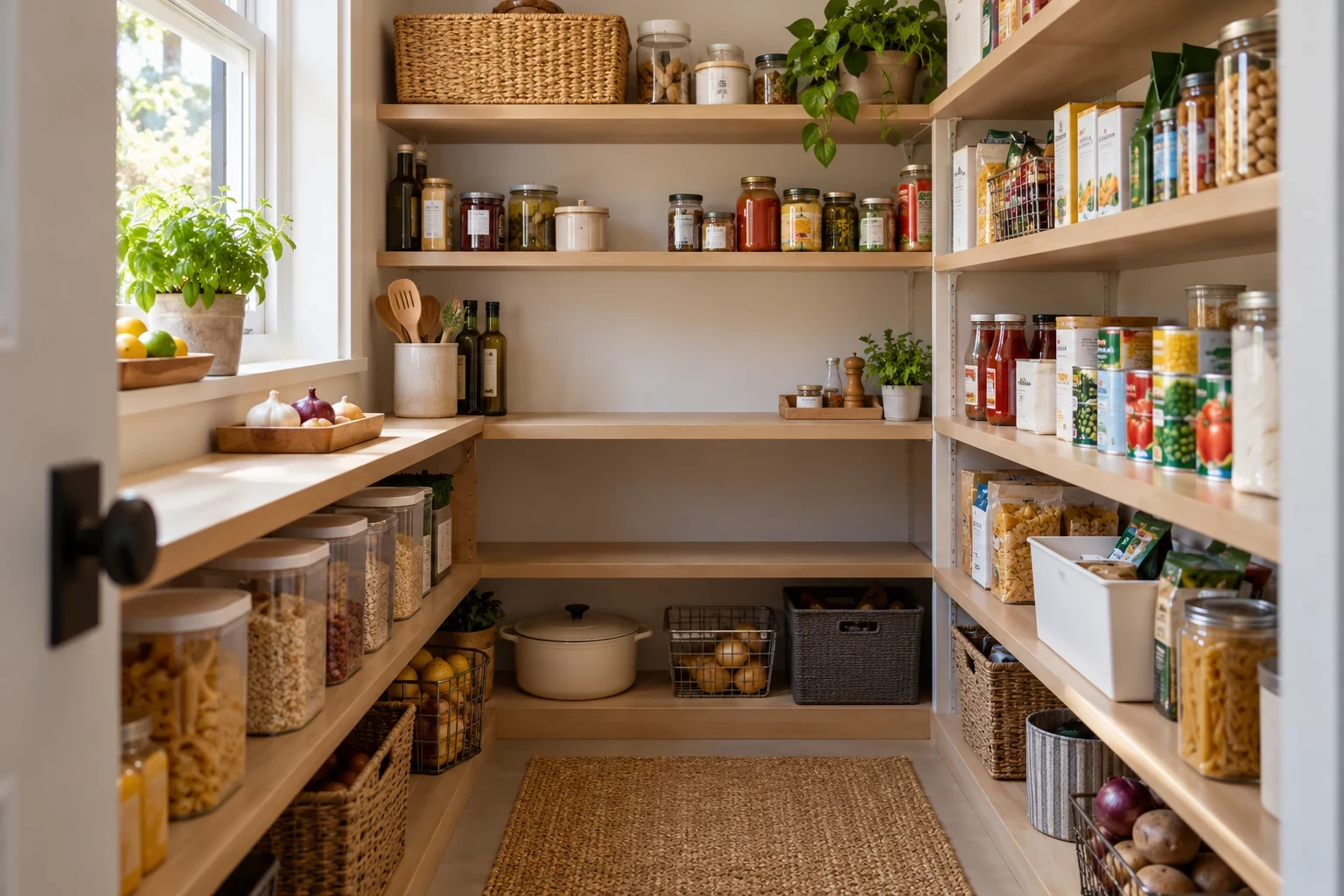
A calmer pantry lets you see what you have, take out what you need and return it without rearranging a tower of packages. Clearing it does not mean throwing away everything with an old date or decanting all your food into matching jars. It means removing the things that make storage harder to use, with the right destination for each.
Work on one shelf or category at a time so food does not sit indefinitely in an unfinished sorting project. Before you begin, make separate places for items to keep, use soon, relocate and release. Food that may be unsafe needs a different decision from an unwanted but suitable unopened product.
First, Distinguish Clearing from Discarding
FDA explains “Best if Used By” as wording about a product's best flavor and quality. It is not a universal instruction to discard every package the following day. Interpret the actual label, condition and storage history, and follow product-specific directions. Do not extend that quality-date reasoning to infant formula or ignore instructions about refrigeration.
USDA's shelf-stable guidance also distinguishes foods that can stay on a shelf from products labeled to remain refrigerated. An intact can is not automatically a pantry product, and opening a product can change its storage requirements.
Keep names, ingredients, allergens, dates and identifying codes with the foods you retain. A neat unlabeled jar is less useful than an identifiable original packet. If you cannot establish a product's identity or safety, do not taste it as an experiment or pass it to someone else.
1. Cans and Jars with Unsafe Packaging Damage
Remove leaking, bulging or badly damaged containers from the usable food supply. USDA specifically warns about deeply dented cans, including dents affecting seams, and about other suspicious container conditions. A small superficial dent is not the same assessment as a deep seam injury.
Do not open or taste suspicious contents to decide whether they deserve the shelf. Follow appropriate disposal or manufacturer guidance, keeping the item away from children, pets and anyone who might mistake it for usable food. Donation is not an alternative destination for doubtful food.
2. Mystery Foods in Unidentifiable Containers
Clear jars, bags and tubs whose contents you cannot reliably identify. A powder's appearance is not enough to distinguish its ingredients or establish an allergen status. If you can recover the original information with confidence, restore an adequate label; otherwise keep it out of the usable supply while you resolve the question.
For future decanting, retain necessary product information and identifying details. You do not have to preserve a bulky outer box on the working shelf if a suitable record accompanies the correctly stored food.
3. Products Matching a Recall Notice
Set aside a product if its exact brand, description and identifying lot match an applicable recall. Follow the notice's instructions about use, return or disposal rather than assuming it is acceptable because the package is unopened.
Check the manufacturer's or relevant official food-safety notice, not a vague social-media warning about a similar product. Keep the identifying information available until the matter is resolved, and do not move a recalled item into a donation box to clear the pantry faster.
4. Food with Evident Spoilage or Contamination
Remove food with a clear problem, such as visible mold or an abnormal change that makes its suitability doubtful. FDA advises examining foods for noticeable changes in color, consistency or texture when considering products beyond a quality date. If you have questions, contact the producer rather than treating the date alone as an answer.
Do not assume an absence of visible change proves safety, particularly where storage history or packaging is in doubt. Clean the affected storage location appropriately before returning suitable food, and address any recurring source of contamination.
5. Products That Belong in the Refrigerator
Read the storage instructions on both unopened and opened products. Move an item to its correct location only if its storage history still supports using it; refrigeration now does not undo an unknown period of unsuitable storage.
USDA notes that some canned foods are labeled “Keep Refrigerated,” and that opening shelf-stable products can change what they require. If you are unsure how an item has been handled, obtain the appropriate food-specific advice rather than preserving it for the sake of avoiding waste.
6. Neglected Food That Needs a Deliberate Quality Decision
Separate older products from ordinary stock long enough to decide what to do. Read the actual date wording and instructions, inspect relevant condition and ask whether the household will realistically use the item. This is a review category, not an automatic disposal category.
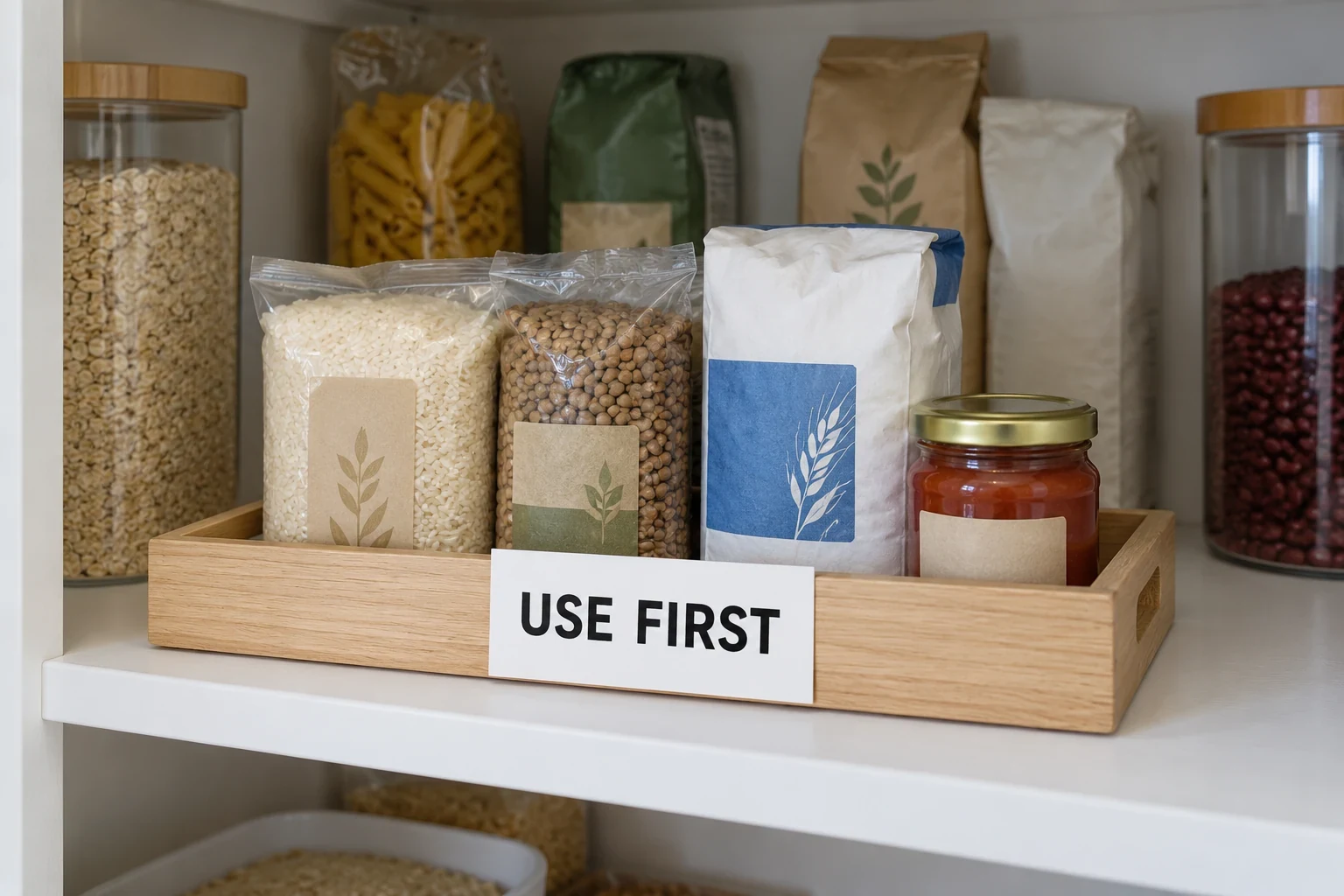
When an item remains suitable and wanted, give it a clear use-first position and an actual meal plan. If you no longer want it, check whether an appropriate recipient accepts that product and condition. Do not make every past date synonymous with danger or every older item a donation candidate.
7. Several Partly Used Packets of the Same Staple
Bring the packets together and find out why several are open. Perhaps the first was hidden behind something else, or different users could not find the same product. Put the suitable current packet where it can be found and identify the reserves separately.
Do not pour everything together indiscriminately. Check that the contents and relevant product information match, and avoid losing dates or allergen identity. A larger mixed jar can conceal the very information needed to use the food sensibly.
8. Unopened Foods Nobody Intends to Eat
A gift set, bulk bargain or ingredient for an abandoned recipe can remain perfectly wanted by someone else while having no role in your pantry. Ask the household before releasing it, especially where different diets are involved.
If it is suitable to pass on, confirm a recipient and their acceptance conditions. Then complete the handover. An indefinite donation box that blocks the pantry is another form of storage, not a finished decision.
9. Empty Retail Boxes That Conceal What Remains
Clear empty cereal cartons, snack boxes and other packaging that has outlived its job. Before removing an outer box that still contains food, retain any information needed for identity, ingredients, preparation, storage and traceability.
If individual portions are suitable for separate storage, choose a shallow container that lets you see and retrieve them. Do not leave a tall box on the shelf simply because one small packet remains at its bottom.
10. Excess Empty Jars and Mismatched Lids
Gather storage containers where you can check their condition, intended use and matching lids. Keep the number that has a realistic job and relocate any justified extras away from the food-retrieval area. Release damaged or unusable pieces through a suitable route.
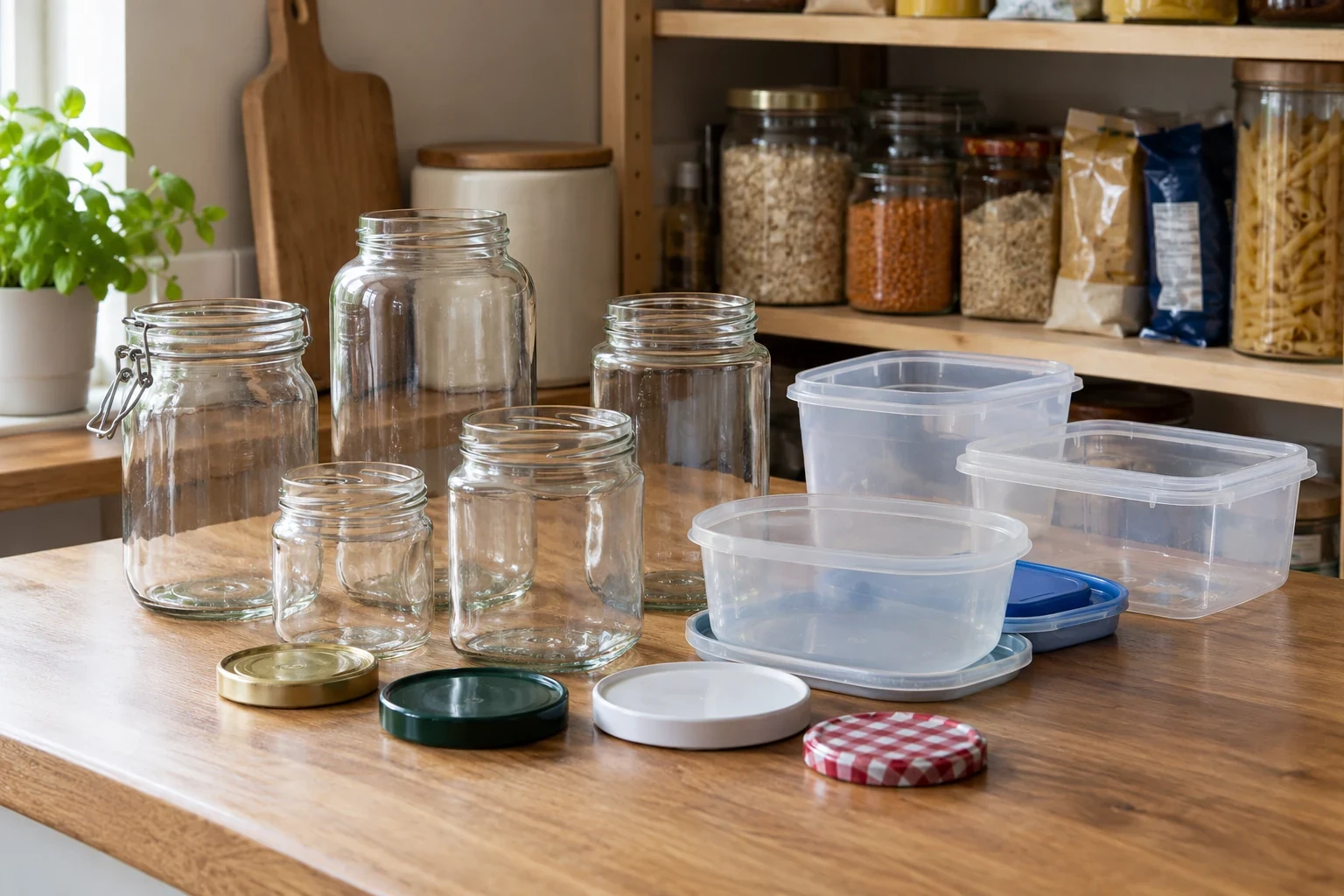
The container scene shows how empty packaging can occupy space needed by actual food. A collection of jars is not a pantry improvement until it helps you store identifiable food appropriately. Resist buying a matching set before measuring what you need to contain.
11. Cleaning Products and Unrelated Household Supplies
Move cleaning products, tools and other nonfood supplies to an appropriate separate location, following their storage instructions. Do not make food shelves the default overflow for anything without another home.
If a spill or other incident may have affected food, assess that concern separately before returning it to use. Clearing a bottle from the shelf does not establish that nearby contents remain suitable. Keep original labels and secure products appropriately for those who can access the home.
12. Appliances That Block the Working Stock
A bulky appliance used rarely may occupy the easiest shelf while everyday food is pushed behind it. Decide whether it belongs closer to its actual use, in suitable occasional storage or with a new owner if it is no longer wanted.
If it must remain, plan a location where its weight, retrieval and surrounding storage work. Do not move a heavy object high up merely to create a calmer-looking middle shelf. The pantry should be usable when a person actually takes something out.
13. Paperwork That Belongs Elsewhere
Remove receipts, old shopping lists, unrelated manuals and loose recipe printouts that have become a shelf lining or a pile beside the food. Keep the current meal plan or shopping list where the household will consult it, and give retained records an appropriate home.
Preserve product information that is still necessary. The distinction is between useful food identity or instructions and a general paper archive that has drifted into the pantry because it offered an empty corner.
14. Shopping Bags Without a Storage Limit
Keep a practical number of reusable or other shopping bags in a suitable place near their actual use. Fold or contain them so they do not spread across food shelves. Release excess bags through the available local route rather than repeatedly compressing them into a larger pile.
If bags are kept here because groceries arrive here, provide one contained location that does not interrupt access. The aim is to make the return routine work, not move the same unbounded accumulation to another room.
15. Organizers That Make Retrieval Harder
Remove or reposition an organizer if it blocks labels, wastes the available depth or requires lifting a large group to reach one item. Test a shelf riser, turntable or bin with your real packages before deciding it is useful.
Keep equipment that solves a named problem. For example, a shallow tray can bring small current ingredients forward without concealing everything behind high sides. An empty organizer does not need a place of honor simply because you bought it for pantry order.
Put Suitable Food Back Around Actual Use
Group items by a system the household understands, such as everyday staples, breakfast supplies or ingredients used together. Put relevant older stock ahead of replacements while retaining labels and the necessary storage conditions. Keep special dietary foods identifiable rather than merging them into an attractive general display.
Give emergency reserves a deliberate location and a way to review and rotate them. They are not redundant simply because they are not used every week. Similarly, seasonal ingredients can remain if you have a real plan for them and suitable storage.
The use-first scene shows a small current selection near the front of a working shelf. It is a cue to use appropriate stock, not permission to eat questionable food. Keep the area small enough that it does not become a second neglected pantry within the first.
Finish by retrieving the ingredients for one ordinary meal and putting them back. If the new arrangement still requires moving unrelated objects, adjust that specific location. A calmer pantry holds suitable, identifiable food in a system people can use; it does not need an unnecessary purge or a perfectly uniform row of jars.