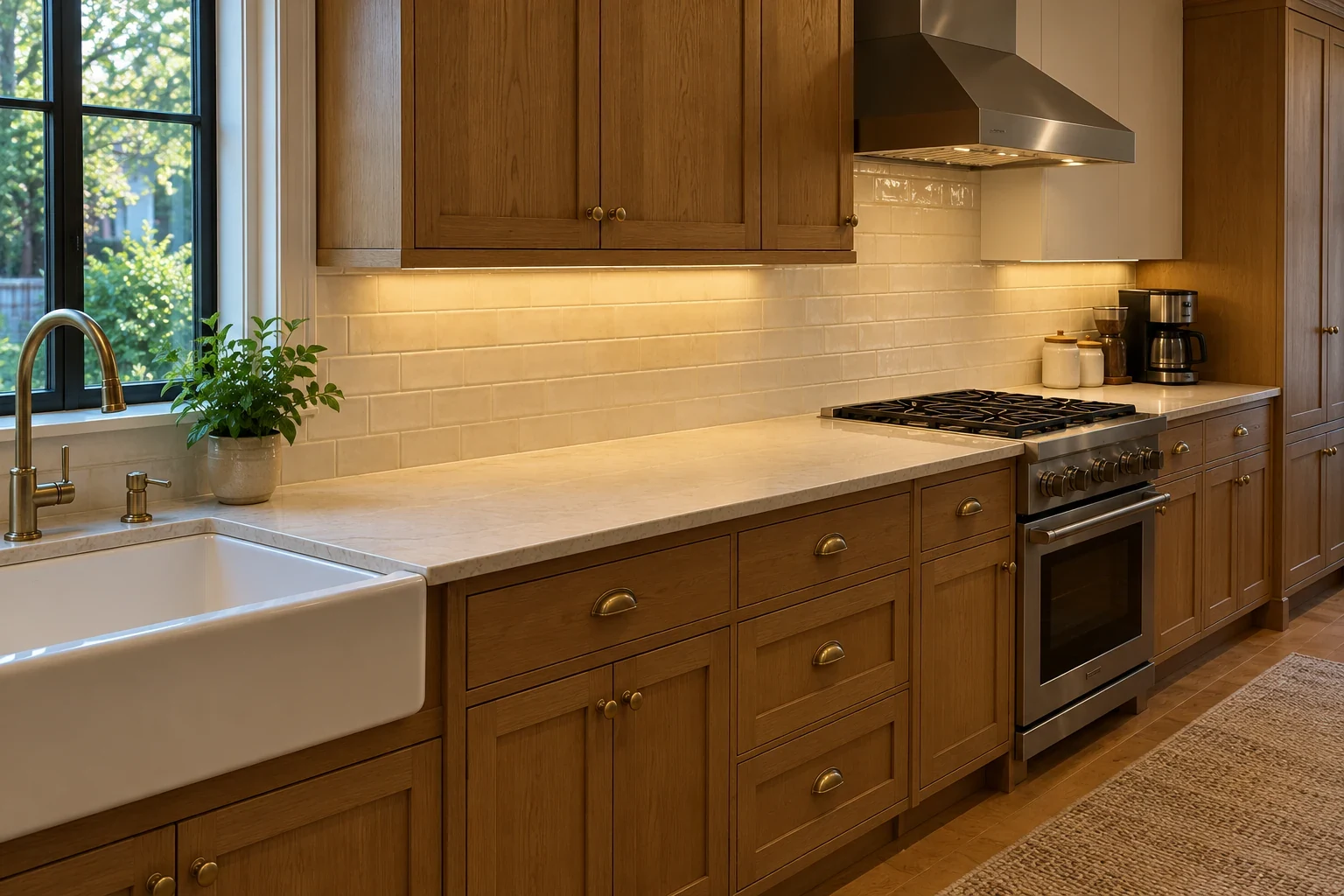
Start by giving one stretch of counter a job: preparing food. Then give the things occupying it a destination they can return to without a major rearrangement. A clear counter stays useful when the kitchen's storage and daily routines support it; simply removing everything for a photograph rarely lasts.
Look at the sink, stove, outlets, cabinet doors and the route people take through your kitchen. Where do you actually put down groceries, make breakfast and chop vegetables? Protect enough working surface for those activities before deciding how empty the room ought to look. Feng shui can frame that space as an invitation to movement and nourishment, without turning an ordinary dish on the counter into a prediction about your luck.
Find the Surface You Need Most
Before moving anything, prepare a typical snack or drink and notice what you have to shift. A toaster may be used daily but still sit in the only convenient preparation space. A fruit bowl may be welcome yet prevent you from setting down a chopping board. Identify the specific conflict rather than calling the whole kitchen cluttered.
Choose a continuous preparation stretch near the activities it serves. The point is not an exact number of inches: it is whether your board, ingredients and usual tools fit without balancing things across the sink or an appliance. Check the area with your actual equipment while everything is switched off and cool.
Also identify a landing place for groceries and a place for dirty dishes. If the only cleared surface must serve all three jobs at once, it will fill again quickly. In a tiny kitchen, the same surface can change jobs at different times. Unpack the shopping first, put it away, and then restore the preparation area before cooking.
Use Feng Shui as a Reason for Useful Space
Anjie Cho's kitchen-clearing advice favors clear surfaces and a small selection of things used and loved daily. Her own preferred item count is a design choice, not a rule every household must satisfy. Someone who uses several accessible appliances may need a different arrangement from someone who mainly prepares simple meals.
In her separate discussion of clutter, Cho distinguishes feng shui from decluttering and asks whether belongings hinder life or become burdensome reminders. That distinction is useful here. A counter with a daily-use mixer can be functional; a bare counter that requires lifting the mixer from an inaccessible cupboard every morning may serve its owner poorly.
Aim for a kitchen that supports what you do. Empty space has a purpose when it lets you begin a task, clean a surface or notice what needs attention. You do not need to make the room look unused.
Clear One Working Section Without Creating Another Pile
Choose a time when you can finish the selected section. Start with food, dirty dishes and items belonging elsewhere. Put food in its appropriate storage, move dishes into the normal washing process, and carry non-kitchen items to their real homes. Do not establish a new permanent “sort later” pile on the dining table.
Next, pick up each remaining object and ask what it does here. Keep four destinations available: stays in this working zone, moves to kitchen storage, belongs in another room, or leaves the household through an appropriate route. An item that needs repair or an ownership decision should have a specific next step, not an indefinite counter address.
Clean the surface using the care instructions for its material. Then return only the objects that need to remain. Place your usual chopping board and a few meal ingredients on the cleared stretch to check whether it works. If those cannot fit, the arrangement needs another decision; the cleaning alone has not completed the task.
For example, a counter beside the sink might hold a knife block, mail, supplements, a blender and a vase. The mail goes to the household paper station, supplements to a suitable place agreed with their user, the vase elsewhere and the seldom-used blender into reachable storage. The remaining tool storage should sit outside the main preparation footprint. The result is not merely fewer things: it is a place to make lunch.
Decide Which Appliances Earn a Permanent Position
Frequency matters, but it is only one consideration. Look at the appliance's weight, how safely you can retrieve it, where it operates and what its instructions require around it. Do not hide an appliance in a cupboard and then run it there unless its manufacturer expressly permits that use.
| What you find | A practical choice | What to test |
|---|---|---|
| Used most days and easy to reach | Give it a stable working position outside the main preparation stretch. | Its operating space, outlet and cleanup route |
| Used occasionally and easy to move | Store it where you can retrieve it without emptying a cabinet. | Whether its attachments remain together |
| Heavy or difficult for its user to lift | Consider keeping it accessible and freeing a different surface. | The user's actual reach and movement |
| Kept for an imagined future routine | Decide whether it deserves accessible storage or should leave. | Whether someone in the household genuinely wants it |
A tray can define a coffee station, but it does not create extra capacity. If you must move the whole tray every time you cook, try a different station. Keep appliance cords out of the walking route and away from the places where food or hot equipment is handled.
Make Storage Easy Enough to Use Every Day
A counter often fills because returning an object is harder than leaving it out. Open the cupboard that should receive your mixing bowl. If you must lift a stack of unrelated cookware before putting it away, the destination exists only on paper.
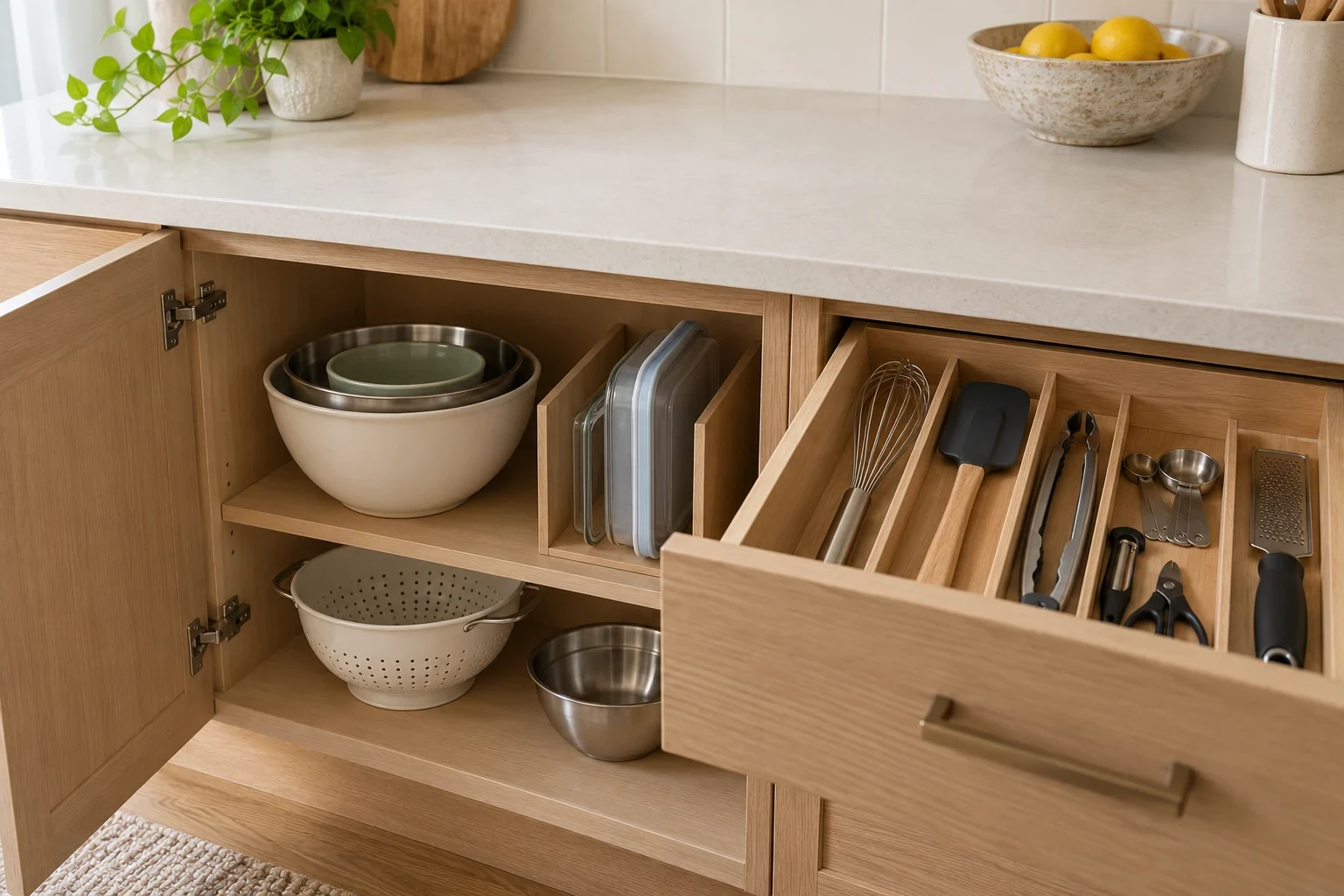
Group the parts of a task together: lunch containers with their matching lids, coffee supplies near the chosen coffee position, and preparation tools near the usable work area. Test the cabinet door and drawer fully open. A beautifully arranged basket is not useful if it blocks access to the things behind it.
The open cabinet shows one useful arrangement: nested bowls beside upright lids, with preparation tools in the adjacent drawer. Keep each group within reach without stacking unrelated things on top.
Use existing shelves and containers first. Before buying organizers, check the internal dimensions and the objects they must hold. An extra bin can reduce usable space if its thick sides or lid make retrieval awkward. Leave enough room that returning something does not require precise stacking after every meal.
If storage is genuinely full, choose what the kitchen will carry. Moving everything into overfilled cupboards usually postpones the same problem. Discuss duplicate or shared items with the people who use them rather than quietly removing someone else's equipment.
Stop Non-kitchen Arrivals at Their Source
Notice why the mail, keys, school forms or shopping bags arrive here. The kitchen may be the first well-lit surface after the entrance. Instead of asking everyone to remember a new rule, provide a workable alternative along the arrival route.
A small paper inbox outside the preparation zone can collect incoming papers temporarily. Give it a regular review time and keep food preparation separate. Keys need a consistent place their users can reach. Shopping bags need a storage location after unpacking, rather than another basket that permanently occupies the counter.
If you work or study at the kitchen table, define the changeover. Put work materials in a portable case or drawer before the next meal. That is a practical boundary between activities, not a demand to eliminate every sign of household life.
Build the Reset Around an Existing Moment
Choose a reliable point in the day, such as after the last meal, and restore the preparation stretch. Put away food, move dishes into the agreed washing process, return tools and deal with loose objects whose destinations are already known. Check that the surface is ready for the next task.
Keep the reset small enough to repeat. If it regularly requires emptying cupboards or sorting a week's correspondence, return to the storage or intake decision that is failing. Cleaning harder will not solve a missing destination.
For shared kitchens, agree on a visible result: “This stretch is clear enough for the chopping board each morning.” That is easier to follow than “Keep everything tidy,” which may mean different things to different people. Make room for different needs, including an appliance that someone must keep within easy reach.
When the Counter Fills Again, Diagnose the Return
Look at what has returned before blaming the household. Clean dishes may need an easier cupboard arrangement. Food packets may need a defined pantry shelf. A daily appliance in the wrong location may need a permanent station. Paper may need a decision system elsewhere.
Try one change at a time and use the kitchen through several normal meals. Keep the arrangement that makes starting, cooking and clearing easier. A counter that stays open for its intended work is a successful result, even when the rest of the kitchen still looks like a home where people eat.