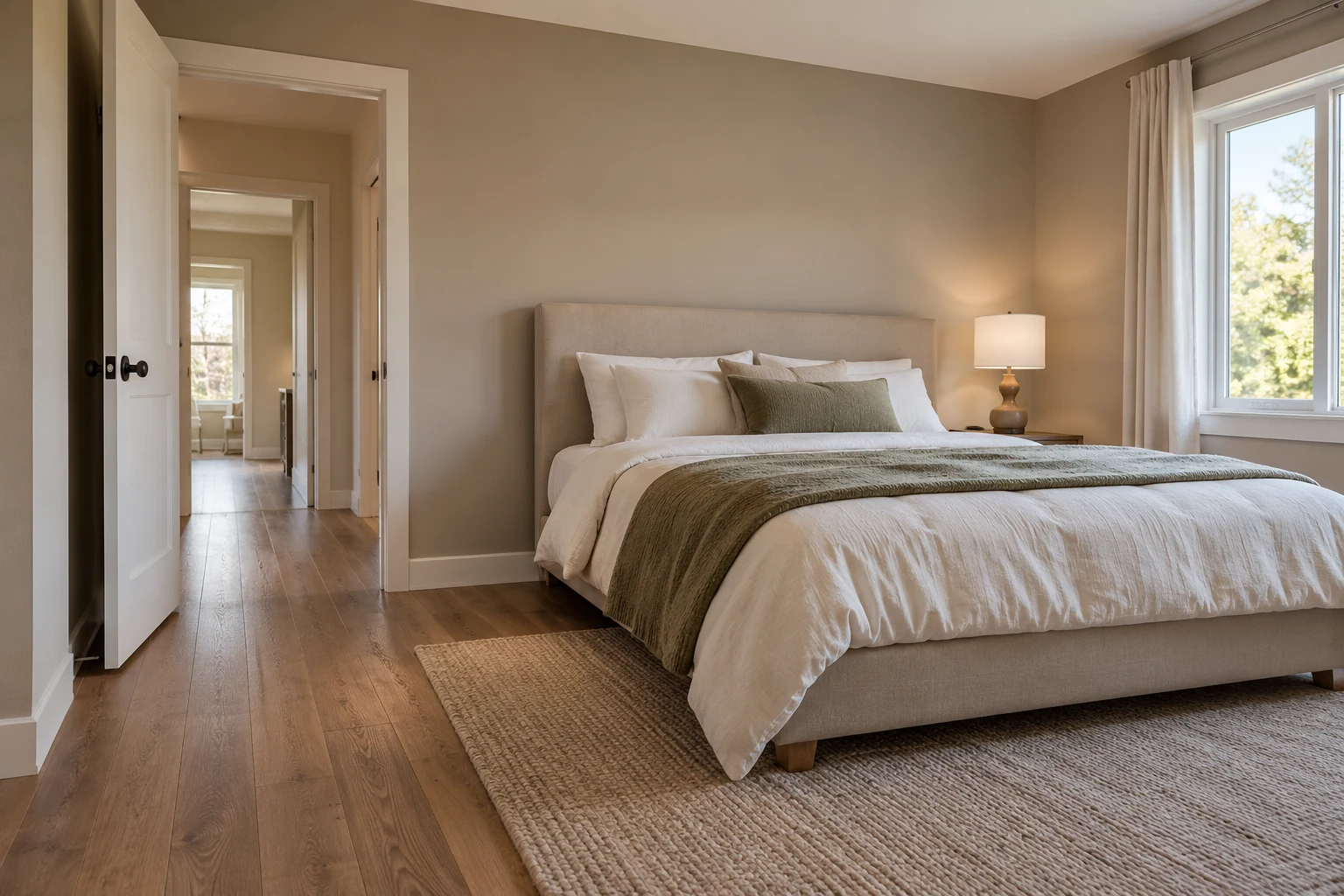
A useful starting point for feng shui bed placement is a bed from which you can see the bedroom door while lying down or resting against the headboard, without lying directly in line with that door. That is Mindful Design School’s BTB commanding position guidance—not a reason to put the bed where a door cannot open or a sleeper cannot get out. First, map the room and identify positions that actually fit. Then compare the door view, headboard position, window use and access for everyone who sleeps there. If no workable position offers a door view, a mirror is an optional fallback, not a requirement. Treat the arrangement as a reversible household trial.
Map the Room Before Moving the Bed
Make a quick floor sketch before attempting a heavy move. Measure the room and the bed’s full footprint, including its headboard. Mark every door and the space it needs to swing fully open; mark windows and how you operate them. Add fixed fixtures, movable furniture and the routes people take from the entry to the bed and window. Finally, note who actually uses the bed. A position that fits on paper may leave too little room for one person to get in.
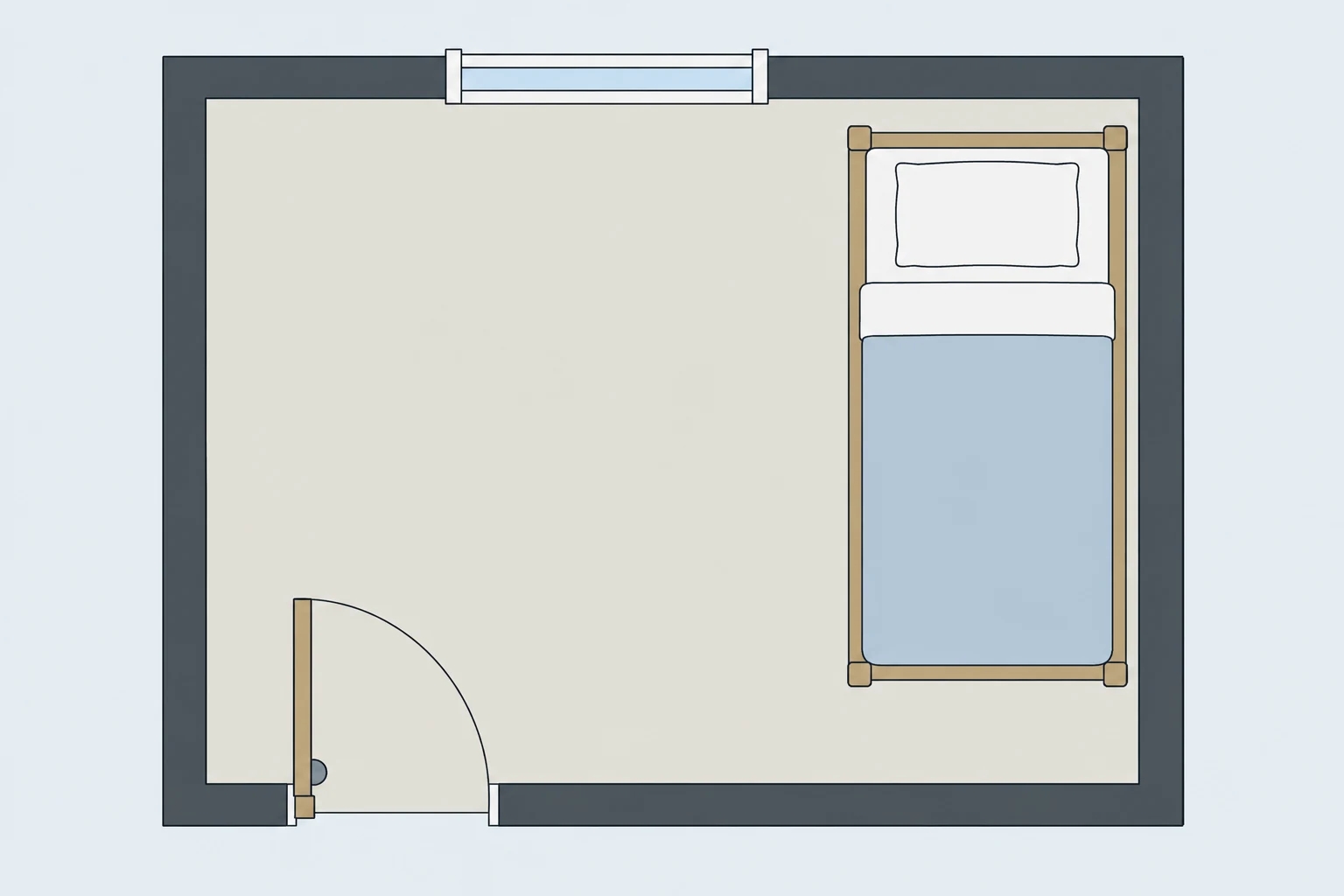
Use one narrow rectangular room as an example throughout this guide. Its bedroom entry is near the southwest corner and swings inward against the west wall. A window is on the north wall, the east wall is uninterrupted, and a large movable dresser occupies part of the west wall. The bed is shared by two adults. The sketch does not decide the placement by itself: the residents still need to measure clearances and test what they can see and reach.
Three possible headboard positions emerge:
- Candidate A: against the east wall. This offers a solid wall behind the bedhead. The bed extends toward the west, where the dresser initially crowds the route around its foot. A may become workable if the dresser can be relocated or removed and both sleepers then have usable access.
- Candidate B: below the north window. The dresser stays. This is workable only if the headboard and sleepers leave the window usable, both people can reach their sides of the bed, and the routes from the entry remain clear.
- Candidate C: against the west wall beside the entry. The bed conflicts with the inward door swing. Exclude it rather than accepting a door that cannot open fully.
Mindful Design School prefers a solid wall behind the head of the bed and calls a bed against a window less ideal. Those are practitioner preferences, not proof that B is impossible. In either position, check the separate, observable issue of headboard stability: the school advises a solid headboard securely fastened to the bed rather than freestanding or attached only to the wall. For B, actually open and use the north window; for A, test the space left around the bed after changing the dresser arrangement. A wall preference cannot settle either question for you.
Check the Door View from Where You Actually Rest
Mindful Design School describes the BTB commanding position in terms of what the sleeper sees: the bedroom’s main door should be visible while they are lying in bed or resting back against the headboard, without the bed being directly in line with it. The test is from your actual sleeping-head position, not from the doorway, the middle of the room or the foot of an empty bed.
For each candidate that fits, sit where your head will rest, then recline as you normally would. Can you see the door itself? Would you have to twist or sit up to find it? Look again with the usual bedroom furniture in place; a tall item can change a view that looked clear on the sketch. Also check whether your resting position is directly in the door’s line rather than merely able to see it at an angle. If two people share the bed, have each person check from their own side.
In the example room, A points the sleepers toward the west, with the southwest entry potentially visible on a diagonal. B points them toward the south, with that entry potentially visible on a different diagonal. Neither view is established by those descriptions alone: the bed’s measured location, headboard and furnishings determine what the sleepers actually see. Record a pass or fail for each position after testing from the bed. C remains excluded because of the door swing, regardless of its possible view.
This room-door check should not be mistaken for a compass calculation. The Feng Shui Society describes classical Compass School as involving numerical calculations based on the direction a building faces. Here, the decision is narrower: applying the BTB door-view guidance to possible positions within one bedroom. You do not need to assign the bed a personal lucky direction to perform that test.
A door view is useful in this guide only if the position also passes the physical checks. If A gives a clear diagonal view but traps one sleeper, it has not won. If B gives a view but makes the window unusable, the view does not erase that problem. Keep the results separate so you can tell which condition needs a change.
Choose the Position People Can Actually Use
Return to the sketch with the candidates narrowed down. Open the southwest entry through its full swing, then walk from it to each side of the proposed bed. Walk the usual route to the north window, too. Have each actual sleeper approach their side, get in and get out. A gap that looks adequate while everyone stands still may not work when someone turns beside a dresser or leaves the bed.
For the shared adult bed in the example, access to both sides is a practical requirement: neither person should depend on the other to move before they can get out. Mindful Design School likewise advises keeping both sides easily accessible for adults in a relationship and asks readers to consider whether a partner could enter or leave a side pressed against a wall. The door view matters, but it does not compensate for a trapped partner.
At first, A fails an access test because the large west-wall dresser crowds the route past the bed’s foot. Test a furniture change before rejecting the east-wall position: can that movable dresser go elsewhere or leave the bedroom, without creating a new obstruction? Mindful Design School recommends removing or rearranging furniture that blocks the path to the bed. In a tight-room example, it also acknowledges that a large dresser and bed may call for different furniture choices. That does not mean buying something larger or replacing furniture immediately. First see what the room can do with the items already there.
Suppose removing the dresser gives both sleepers a clear route to their sides of A. If its headboard is secure and the reclined door-view test passes, A is the stronger choice for this household: it combines the school’s solid-wall preference with functioning access. B remains an alternative, not a failure. If A still leaves one person unable to get in and out comfortably, choose B only if its headboard is secure, the north window remains operable, both occupants can move around the bed, and its entry route stays clear. C does not return to the shortlist; the door-swing conflict has not changed.
The number and needs of sleepers change the access judgment. A single occupant may choose a layout without the same two-sided access needed by the two adults sharing the example bed. Mindful Design School gives a different example for a younger child: nestling a bed against a wall can help a child under about 12 feel more secure. In a child’s room, choose that position if it suits the actual child’s access and preferences; in the example room, keep both sides accessible for the adults.
The decision order is therefore practical as well as traditional: preserve the full door swing, a stable bed setup and access for the people who use it. Among positions that pass, compare the solid-wall preference, window use and door view. Do not force a preferred wall or view into space the room cannot accommodate.
Use a Mirror Only When a Workable Bed Position Cannot Show the Door
Start with the best physically workable bed position. Mindful Design School prefers moving the bed into a door-visible position when that is feasible, rather than relying on a mirror. In the example room, if A passes its reclined diagonal-view test after the dresser is removed, it needs no mirror. Adding one would not solve an access or stability problem that the layout itself should address.
A mirror becomes relevant under a narrower condition: in another room, or after discovering an obstruction you could not account for on the sketch, no safe, usable bed position permits a view of the bedroom door. Mindful Design School describes using a mirror to reflect the door when a bedroom’s configuration prevents a door-visible bed position. It is an optional BTB fallback for the view, not a substitute for a fully opening door or a walkable route.
If you want to try it, first settle on the bed position that works for the occupants and openings. Place a stable mirror where its reflection shows the door from the actual sleeping-head position. Recline and check it yourself: seeing the door in a mirror from the room’s center, or assuming the angles work from a floor sketch, is not the same test. Make sure the mirror’s placement does not narrow a walking route or interfere with the door or window.
Comfort can decide against this fallback. Mindful Design School treats bedroom mirrors as personal and suggests covering one if its presence feels disruptive. You can skip the mirror from the outset, or cover or remove it after trying it. Prioritize a bed arrangement with clear access and usable openings over a reflected door that requires an obstruction or a mirror you dislike.
Trial the Arrangement, Then Decide Whether to Keep It
Before changing the room, jot down what is awkward now: who has trouble reaching the bed, whether the window is easy to use, and how the occupants feel about the arrangement. Agree on when to review the new setup. Those notes give the household something concrete to compare without treating the first move as permanent.
For the example room, trial A after removing the dresser. Open the southwest entry all the way against the west wall and operate the north window. Have each sleeper walk in, reach their side, enter the bed and leave it. Check that the headboard is securely fastened to the bed. Then have both people recline in their usual positions and recheck the diagonal view of the entry. These are separate passes: seeing the door does not establish that the route works.
Suppose the trial reveals a missed detail. With the dresser gone, a movable bedside stool still pinches one sleeper’s route around A. Remove the stool from the bedroom without creating a new obstruction, then have that sleeper repeat the walk, get-in and get-out test. In this hypothetical trial, the route now works. Both adults can reach their sides and enter and leave the bed; the southwest entry opens fully, the north window operates, the headboard remains securely fastened to the bed, and each sleeper can see the entry on a diagonal when reclined. Keep A for the agreed trial period. B remains the fallback if everyday use reveals a problem; C remains excluded because it blocks the door swing.
At the agreed review, keep the arrangement if its everyday use and the residents’ preferences support it; revise it if a route, opening or occupant still has a problem. The Feng Shui Society cautions that feng shui cannot guarantee wealth, health or happiness. Bed placement is not treatment for a sleep problem, either: Mindful Design School advises discussing actual sleep issues with a trusted healthcare professional. The useful outcome of this trial is a position your household can live with, informed by the BTB guidance and tested in the real room.