After a move, do both selectively: find a workable home for belongings you still use or value, and release items that no longer fit your life. A useful object sitting in a box is not automatically clutter to discard. An object you do not want is not worth keeping merely because a new organizer could contain it.
Begin by restoring ordinary life, then make decisions with the new home's real limits in view. A large purge while you are tired can remove things you need; buying storage for every box can preserve problems you intended to leave behind. You need a way to tell those situations apart.
Restore the Functions You Need This Week
Choose the essentials for sleeping, washing, preparing food, dressing and any work or care that cannot wait. Clear routes between those areas and place their basic supplies where they will be used. Do not start by perfecting the least-used cupboard simply because it is easy to organize.
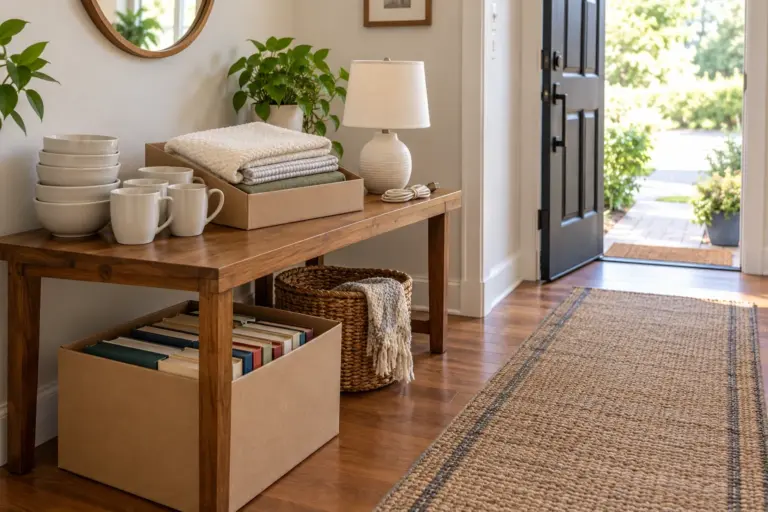
For example, make the bed usable before deciding which old display objects deserve its surrounding shelves. Give everyday crockery a reachable location before arranging occasional serving pieces. Establishing those functions reveals which storage locations are genuinely spare.
Mindful Design's moving guidance treats a new home as an opportunity for a fresh start. You can use that perspective as a reason to reconsider arrangements rather than automatically reproduce the old home. It is not an instruction to replace everything or a claim that the previous occupants' energy determines your belongings' future.
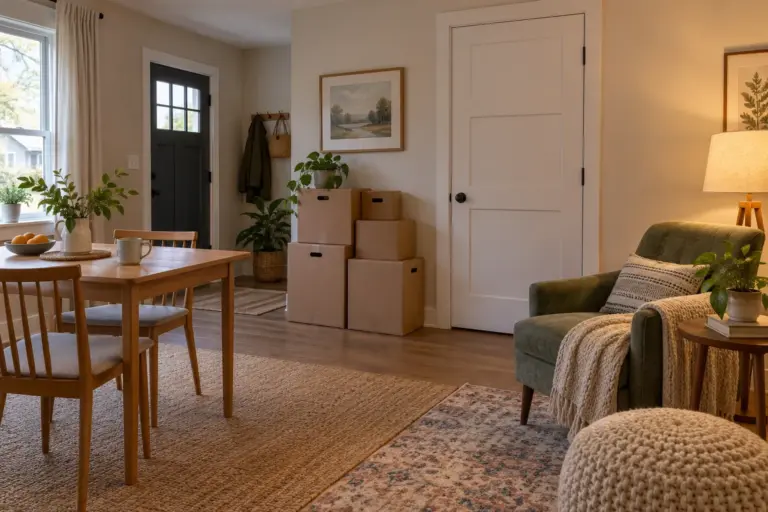
Keep unopened boxes contained outside necessary routes where possible. If there is no spare room, choose a modest temporary area and work through it in manageable sessions. A contained process is more useful than spreading every possession across the floor at once.
Ask Whether the Item Has a Current Role
Take one item or coherent group, such as everyday cooking tools, rather than trying to decide the whole household at once. Ask what it does, who uses it and when it is likely to be needed. Value can include pleasure or memory; it does not have to mean frequent practical use.
Then identify the actual reason it has not been unpacked. Perhaps its usual cupboard does not exist here, it belongs near an activity you have not set up yet, or you no longer want it. Those are different decisions.
A useful pan without a kitchen location needs a placement test. A duplicate tool nobody wants may need a new owner. A fragile inherited object may deserve protective storage while you consider its future. Avoid using the same answer for all three merely because they arrived in similar boxes.
If an item is damaged, incomplete or potentially unsafe, keep that issue separate from visual clutter. Identify it and follow appropriate product or local disposal guidance before using or passing it on. Neat storage does not establish that something is safe.
Test a Real Home Before Purchasing More Storage
A home for an object is a place where it can be retrieved, used and returned. Try the whole sequence. If you must move three unrelated boxes whenever you need it, you have found capacity, but not necessarily a useful location.
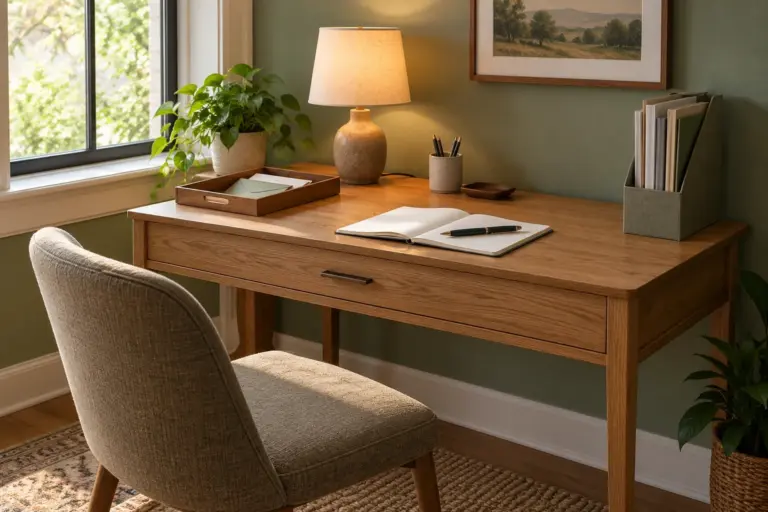
Put frequently used things near their actual activity. A home office may now share the dining area, for example, so the old upstairs stationery cupboard may no longer be appropriate. A small current-work container near the table might serve better than recreating the previous room's storage system.
Anjie Cho discusses visual boundaries when work shares another room. You can apply that idea through a definite location for active work and a clear way to put it aside. The boundary need not be a new cabinet if a suitable shelf or tray already does the job.
Try existing furniture and containers before ordering organizers. Measure the available space and check doors, access and the item itself. A storage purchase should solve a named retrieval problem, not postpone deciding whether the contents belong in the home.
Use a Small Set of Honest Decisions
You can sort decisions into four practical outcomes without making every possession fit a permanent taxonomy.
| Decision | What it means now | Next action |
|---|---|---|
| Keep and place | Its role is clear and a location works | Put it there and test returning it |
| Keep for a defined future use | You can name the use and appropriate storage | Store with that use identifiable |
| Repair or complete | It has value if a specific problem is resolved | Record the missing action and a review date |
| Release | It is no longer wanted or cannot reasonably serve here | Choose a suitable donation, sale, recycling or disposal route |
Do not make “repair” an indefinite holding answer. Identify the part, skill, time or cost required. If you cannot name a plausible next step, revisit whether you actually want the repaired item.
Likewise, a future use should be more than a vague possibility. Seasonal clothing, an annual celebration item and equipment for an already planned activity have a clearer role than supplies for every hobby you might someday try. You can still choose to keep an uncertain item, but acknowledge the space that choice reserves.
Handle Duplicates, Sentimental Items and Shared Belongings Differently
For duplicates, compare actual use. Two similar items may serve different people or tasks; they are not waste simply because they look alike. Conversely, several unused substitutes may survive only because the preferred one was hard to find in the old home. Unpack the useful set and see what role remains for the others.
For sentimental belongings, separate the memory from the storage decision without insisting they must be separated emotionally. You might display one object, protect a small group or keep a record alongside the item. A photograph is an option, not an obligation to discard the original.
For shared belongings, agree before releasing them. One person's unused tool may be another's occasional essential. Set aside a specific question for the owner rather than making them defend every item during a whole-house purge.
If a move follows loss, separation or another difficult change, allow some decisions more time. A bounded temporary location can preserve that flexibility without occupying the routes and surfaces needed for daily life. The useful limit is a clear place and a review point, not a moral judgment about how quickly you should let go.
Give Uncertainty a Boundary and an End Point
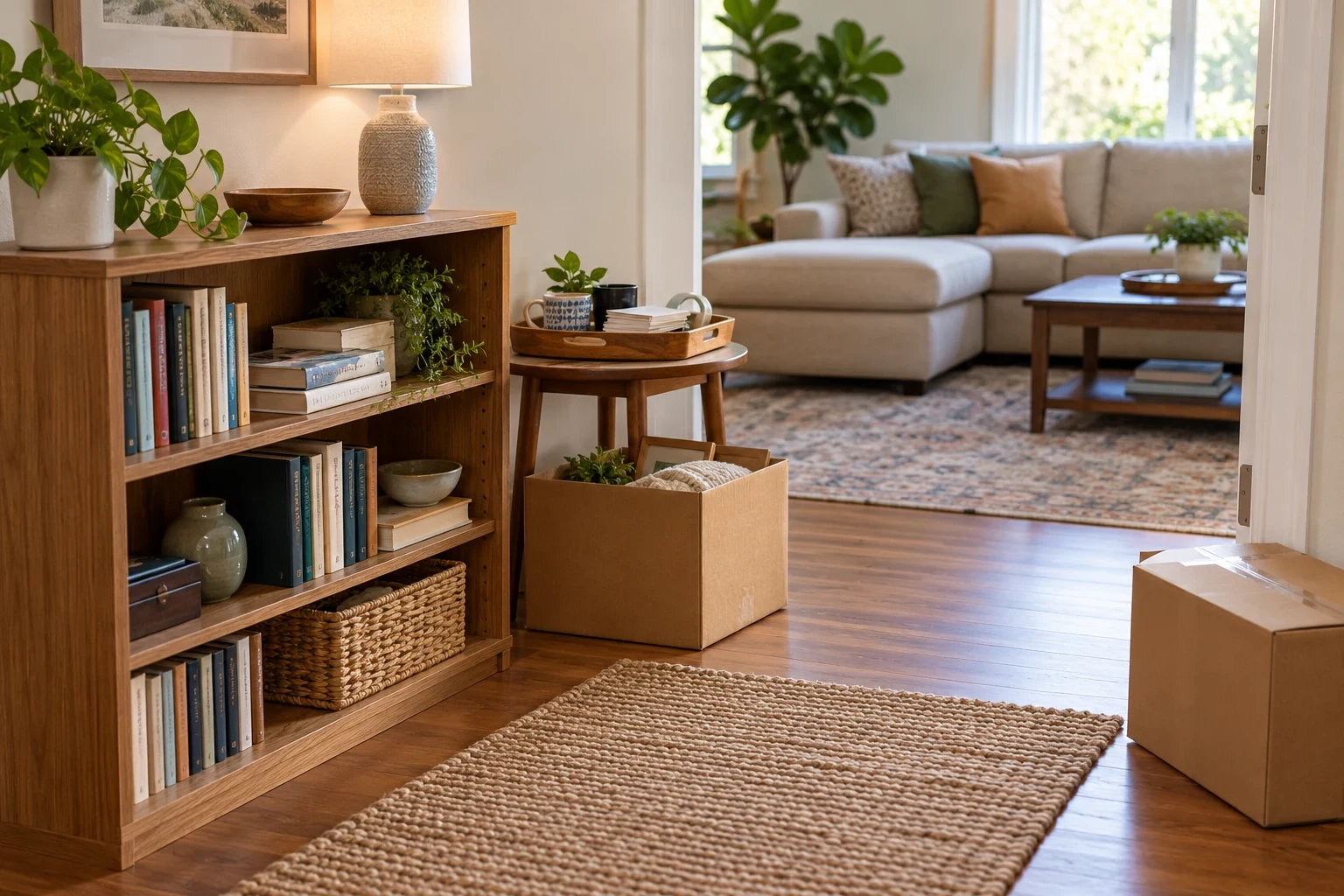
Choose one manageable location for items awaiting a decision. Keep its contents identifiable, and record why each unresolved group is there. A box marked with its actual contents and question is easier to revisit than another anonymous “miscellaneous” carton.
Pick a review date suited to the decision. For example, review extra kitchen pieces after you have cooked ordinary meals in the new space. Review seasonal equipment when its season arrives. These are author-chosen trial periods, not universal decluttering deadlines.
If the temporary area fills, finish some decisions before expanding it. Otherwise, the boundary quietly becomes another storage room. At review, ask what you learned: did the object get used, was it missed, or did the new arrangement work without it?
The body scene shows a contained sorting area beside functioning storage, rather than a floor covered in every belonging. Its purpose is to keep the process separate from the parts of the home already needed for living.
Complete the Release Instead of Moving the Pile
Confirm what a donation organization accepts before packing a delivery. Keep sale items limited to those you are willing to photograph, list and hand over. Follow suitable local routes for products that cannot go in ordinary waste, and check the relevant instructions for items containing batteries or personal data.
Do not pass an unsafe or unidentifiable item to someone else simply to clear your floor. If a recipient needs instructions, parts or a label to use it properly, preserve those with it. A release is complete when the item reaches its suitable destination, not when it moves from a cupboard to the hall.
Finally, revisit the newly placed essentials. Can you find what you need and return it without effortful rearranging? Keep the belongings that support your actual life, make room for those you deliberately value, and release the ones you have decided to leave behind. The new home becomes usable through those specific decisions, rather than through either maximum purging or maximum storage.