Feng shui does not give a single verdict on a flag lot. One practitioner reads its long, narrow approach as limiting incoming chi and opportunity; another says the lot shape is not inherently good or bad. A useful evaluation therefore starts with the actual route from the street to the door the household uses, then separates what that arrival feels like from what the records permit and what the driveway can safely accommodate. A clearer entrance may improve wayfinding. It cannot, by itself, establish access rights, emergency-vehicle access or a prediction about the household’s fortunes.
What the Flag and Stem Actually Describe
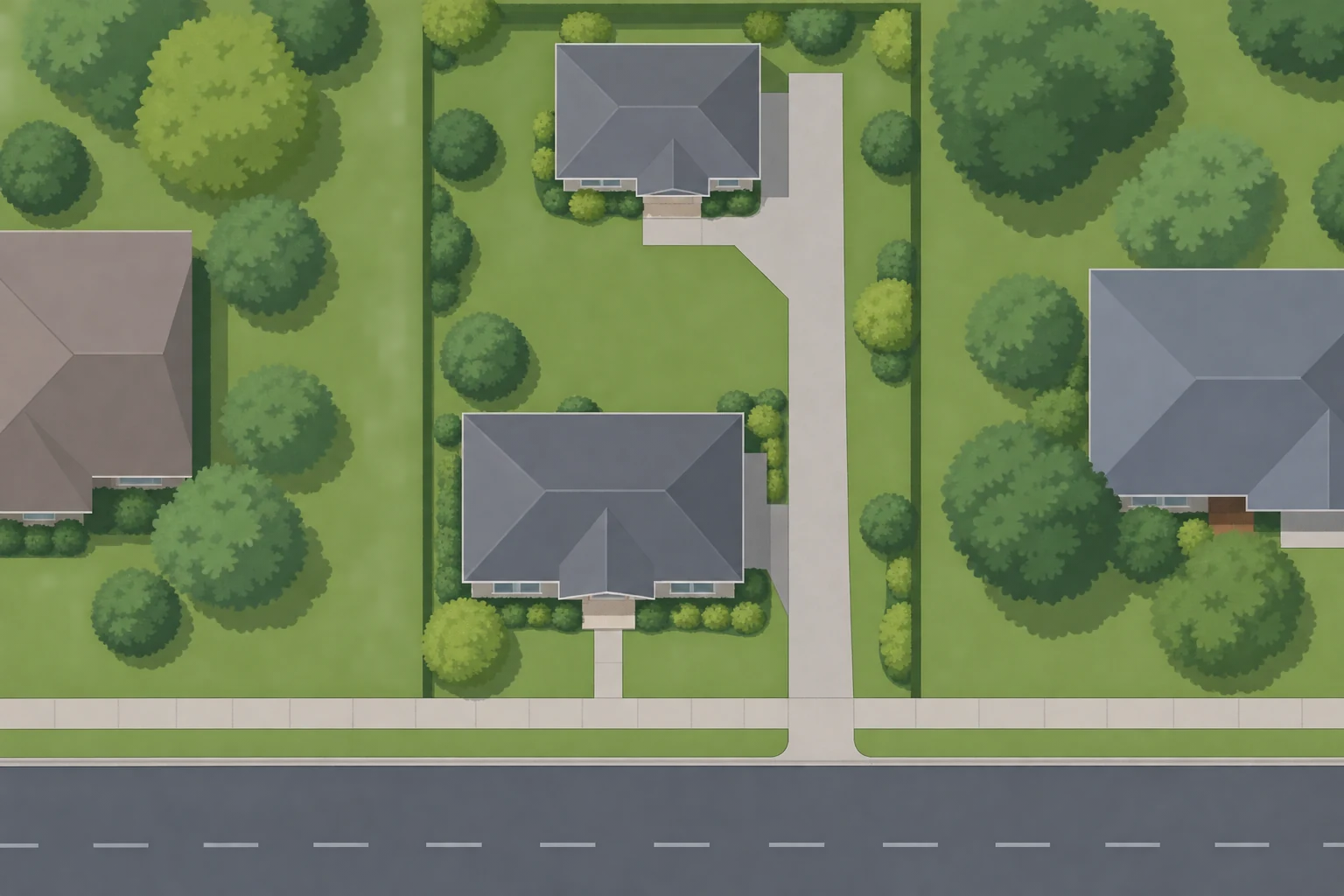
Picture a rear home with another parcel between it and the street. The broader area containing the rear home is the flag; the long, narrow connection toward the street is the staff or stem. The point where that connection meets the street is the driveway mouth. Luminous Spaces describes the familiar arrangement as a home that does not front the road, reached by a long driveway past a parcel in front. North Salt Lake, Utah, uses a more specific definition for its local code: a flag or L-shaped lot has a staff portion contiguous with its flag portion.
That picture describes geometry, not every detail of access. A stem shown within a parcel boundary does not, on its own, tell a reader all the terms governing its use or give unlimited permission to change it. Conversely, people may reach rear homes along a shared driveway or access road serving more than one house; Luminous Spaces notes that possibility too. Such a route is not necessarily one rear owner’s exclusive flag stem. Its location, ownership, rights of use and arrangements for upkeep need to be understood separately.
It helps to keep four questions apart:
- Where is the home? The rear flag area may sit out of immediate view from the street.
- How does someone find it? A visitor needs to identify the driveway mouth, follow the intended route and recognize the correct door.
- What may people do on the route? Existing use and permission to make alterations are different questions.
- Does the route work physically? The street connection, surface, drainage, parking, turning and emergency access have to be considered as working conditions, not features of a lot-shape diagram.
The rear position may appeal to a household seeking a more private-feeling setting. That is a preference, not a conclusion that the approach is clear, legally settled or physically adequate. Equally, a hidden entrance need not make the home undesirable. The shape tells you where to look; it does not settle what you will find.
Why Feng Shui Practitioners Can Read the Same Lot Differently
Luminous Spaces gives one distinctly cautious feng shui reading: it interprets living on a flag lot as limiting the chi reaching the home and, in its terminology, the opportunities coming with it. On that reading, the long approach is not just a driveway. It is part of how the home receives what the practitioner calls chi, so a narrow or easily missed entry draws attention.
Kartar Diamond states the counterpoint plainly: a flag lot is not inherently good or bad. These positions should not be blended into a supposed consensus. They show why a reader cannot derive a universal ranking from the outline of a parcel. The cautious interpretation may prompt closer attention to an obscure approach; the no-inherent-verdict interpretation leaves the assessment open until the particular place is considered.
The front door also matters within feng shui’s own vocabulary. The Feng Shui Society describes it as the “Mouth or Gate of Chii.” That gives a practitioner a reason to look beyond the street-facing outline: someone has to reach the rear house and find the entrance the household actually uses. A conspicuous feature at the driveway mouth would be of limited help if the route then seemed to end at the wrong building or left the used door unclear. That last point is an inference about wayfinding, not a claim that the Society has measured the effects of a driveway.
Three different kinds of judgment can operate at once. Practitioner interpretation concerns the symbolic meaning assigned to the approach and door. Observation concerns whether someone can identify and follow the route in ordinary use. Household preference concerns whether the rear setting feels welcome, private or inconvenient to the people living there. None is a substitute for another. In particular, Luminous Spaces’ language about opportunities is its interpretation of chi; it is not evidence that a flag-lot address predicts income, health, luck or resale price.
Luminous Spaces proposes lighting, flags and moving objects along the drive as ways to attract chi in its practice. Those are symbolic proposals, not required decorations. A reader might appreciate the intention—making an approach feel noticed and connected—without installing anything. Whether an existing light can simply be used, or whether a new object could be placed without glare, obstruction or a permissions problem, is a different question. Neither practitioner position authorizes a change to a driveway.
Follow the Arrival from Street Mouth to Front Door
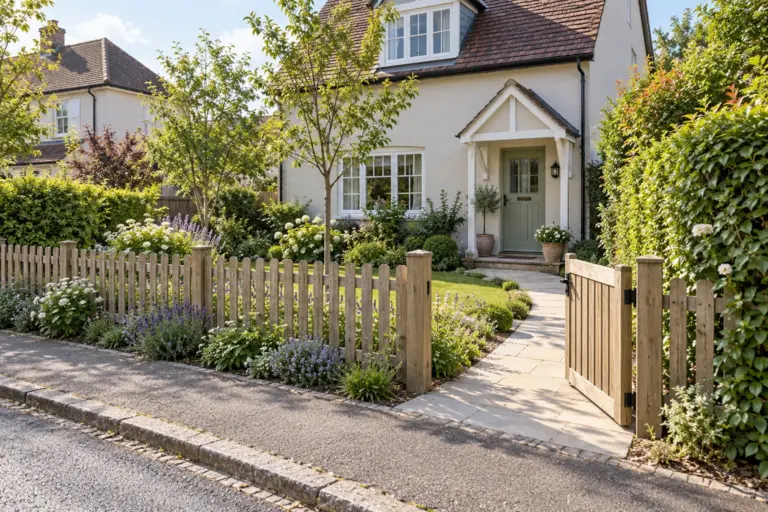
To understand the hidden approach, trace the trip in the order an arrival encounters it: street mouth → permitted route → rear house → door actually used. Begin from a safe, permitted position, not by standing in the street or obstructing vehicles. Can an unfamiliar person identify which opening leads to the rear address? Is the address readable there? After entering the approach, does the route remain understandable, and is it clear where it ends? At the house, which door does the household use, and could someone mistake a door on the street-front parcel for their destination?
This is an assessment of wayfinding, not an invitation to estimate a legal driveway width or traffic sightline by eye. Note existing parking and turning locations because they affect how people arrive and leave, but keep them distinct from the pedestrian question of finding the door. Daylight may make an address and route apparent while an appropriate evening arrival depends more on the lighting already in place. A first-time visitor’s hesitation can be informative even when the route itself is unobstructed.
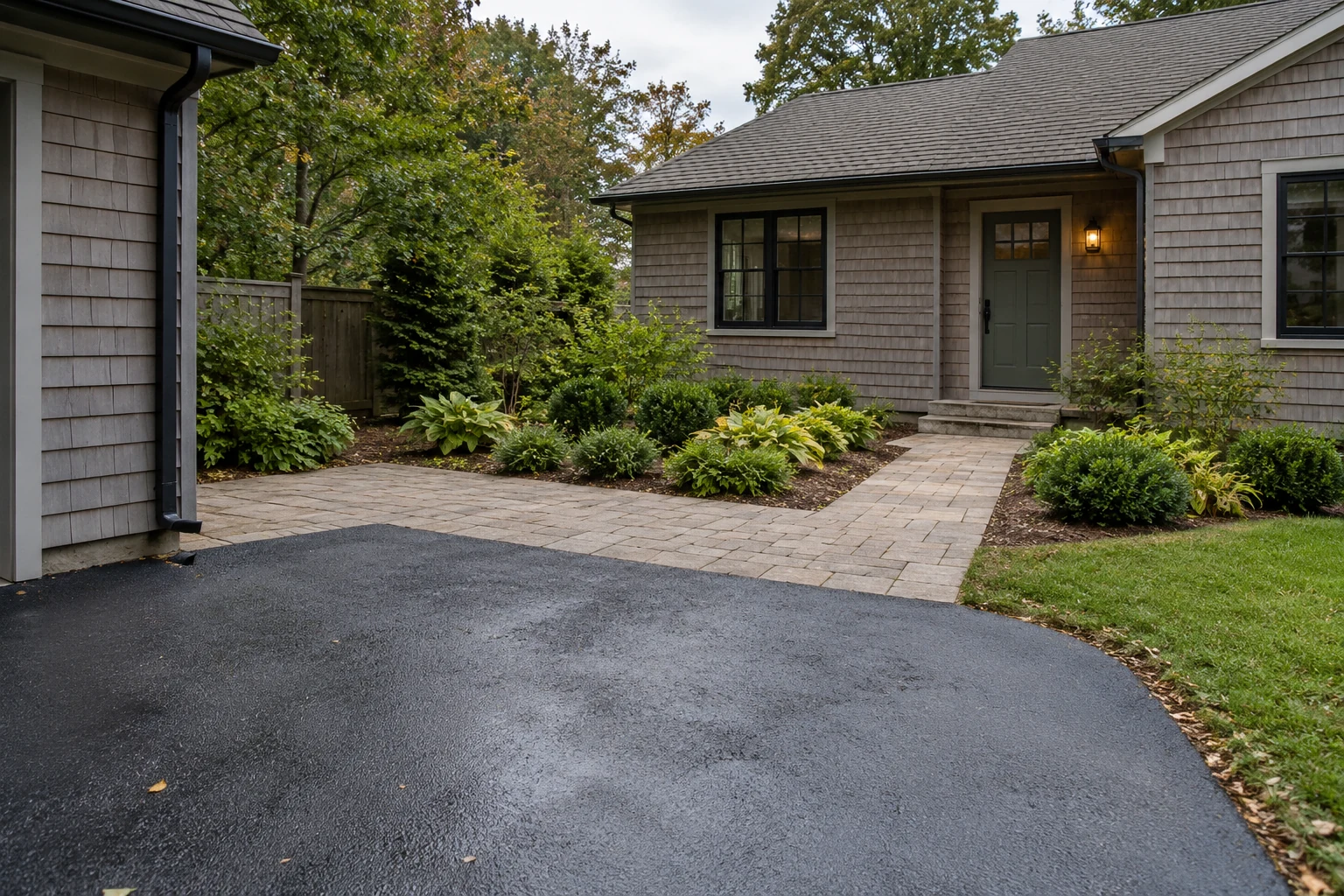
Consider a hypothetical existing owner. Their rear home lies behind a street-front parcel. One long private approach leads to it; this example has no shared fork. An existing, approved address marker at the driveway mouth is dirty and harder to read. The route is open, yet a first-time visitor hesitates before entering. Those stipulated facts identify a plausible wayfinding issue. They do not identify a driveway defect or prove that every other access condition is satisfactory.
From safe, permitted positions, the owner records what an arrival can see: the driveway mouth and address, the existing route under normal arrival conditions, the rear house and its used front door. They also note where the route ends and where the known existing parking and turning occur. They do not stand in traffic, block a vehicle, infer legal dimensions from an impression of width or declare the road exit and emergency route compliant. This record is useful because it locates the hesitation: at the address, along the stem or at the final door. Those are different problems and would call for different responses.
North Salt Lake’s flag-lot provision illustrates why entrance identification deserves attention: its local code calls for the building address to be posted conspicuously at the driveway entrance and maintained where vegetation, walls and other features do not obstruct it. That is a municipal example, not an address-sign rule for every flag lot. For the hypothetical owner, the relevant observation is narrower: an already approved marker exists but is difficult to read. The next question is whether improving its legibility is permitted, not whether a new sign should be added.
A walk can also expose a less obvious mismatch: a visitor may follow the correct driveway yet be drawn toward the street-front house, an apparent side entrance or parking that obscures the final approach. Recording the route all the way to the used door avoids declaring the entrance “clear” merely because the driveway mouth is visible. At the same time, a successful walk establishes only that this pedestrian arrival worked under the observed conditions. It says nothing conclusive about a driver leaving the road connection or a fire vehicle reaching the house.
Establish the Right to Use and Change the Approach
Before proposing an alteration, distinguish using a route from changing it. The relevant questions are who owns each part, what recorded title or easement terms allow people to use, whether those terms cover the intended use, who can approve an alteration and who is responsible for shared upkeep. Regular, familiar use of a shared drive does not itself answer whether a resident may move a marker, install a fixture, alter planting or change the surface. Nor does a stem drawn within a parcel remove the need to understand the applicable records.
For a private stem, the owner still needs to understand the recorded property position and any relevant access or maintenance terms before treating proposed work as theirs to carry out. For a shared approach, the distinction becomes especially visible: several households may use the same route while permission to alter it and responsibility for repairs are allocated separately. A prospective buyer needs the actual title, easements and shared agreements reviewed with an appropriate property solicitor, conveyancer or other qualified local property professional, rather than relying on how easy an invited walk feels.
Somerset Council advises people selecting a self-build plot to check legal restrictions before buying land and names easements allowing access for utilities or neighbouring land among the matters to consider. That is advice in a local plot-selection context, not a UK-wide opinion about any particular rear home’s easement. North Salt Lake’s code provides another location-specific example: for shared driveways within its flag-lot rules, it calls for a platted cross-easement access and maintenance agreement. It also requires local fire-protection-agency review of flag-lot emergency-vehicle access. Neither provision should be transplanted into a universal requirement for every flag lot.
Treat the hosted North Salt Lake code as a prompt to check the applicable municipality’s current official rules and records, not as authority to act elsewhere. Local codes and the facts of a recorded parcel govern the real question. No dimension or approval process from one locality can settle another locality’s driveway.
Legal use and emergency access also remain separate. A visitor who reaches the front door on foot has not tested what a fire apparatus can do, and a recorded right of passage alone does not demonstrate that the physical route meets applicable emergency requirements. If either issue is unresolved, the answer is not to disguise the entrance with landscaping or decorate it first. The answer is to obtain the relevant record review and, where needed, ask the appropriate local authority or qualified professional about emergency access.
Assess the Driveway as a Working Access Route
A route can be easy to follow and still raise a physical question. At the road connection, consider the view in both directions when leaving and where vehicles can actually park and turn. Somerset Council’s self-build plot guidance identifies clear views both ways, space to enter and exit in a forward gear, and safe parking and turning space as access considerations. These are local plot-selection points, not a universal specification or proof that forward movement is required at every existing home. They explain why the street mouth and the far end of the approach belong in the same assessment: a driver needs a workable arrival and departure.
Along the route, observations worth recording include slope, uneven or deteriorating surface, pooled water, apparent drainage trouble and places where ordinary maintenance is needed. Consider snow where relevant and whether the route remains unobstructed for emergency access. North Salt Lake’s local flag-lot code addresses drainage and continuing maintenance, and separately calls for upkeep and adequate snow removal so emergency service vehicles have free access. Its surface rule is a local rule, not general advice that every flag-lot driveway must be rebuilt in that material.
An owner can document a puddle after rain or note that a parked car occupies a turning area. Observation is not the same as deciding the drainage design, safe road-exit visibility, turning needs or fire-apparatus access. Those questions may require a qualified local drainage, highway or fire-access review, alongside property-record review where rights or responsibilities are involved. An approach that looks open on a quiet day is not thereby certified compliant.
The priority changes if there is a current problem. If water is pooling, the surface is defective, the route is blocked or necessary turning remains uncertain, defer decorative changes and get appropriate qualified local assessment. Do not treat a new ornament as a fix, improvise a drain or remove vegetation without establishing permission and the relevant physical consequences. The hypothetical owner introduced above has no separately identified urgent defect in the stipulated facts. That absence allows a limited wayfinding trial; it is not a declaration that local road, drainage, turning or emergency checks and records can be skipped for a property decision.
Make a Permitted, Reversible Wayfinding Improvement
Return to the hypothetical owner whose visitor hesitates at the dirty driveway-mouth marker. In this fictional case, the owner has had the property record and relevant access and maintenance paperwork reviewed with an appropriate property professional. There is no unresolved question about using the existing route or the owner’s permission to clean the existing approved marker and normally operate the installed route lights. This is a stipulation for the example, not verification of a real parcel and not permission for new works.
The owner cleans only that marker using a permitted, suitable method. At an appropriate evening time, they use the installed route lights through their existing controls. The fixtures stay where they are. There is no new gate, relocated sign, rewiring, planting, ornament, widening or vegetation removal. The response is deliberately matched to the observed issue: the route is open, but its address is hard to read.
An invited first-time visitor then arrives from a safe, permitted point in daylight. Without directions, they read the now-legible address, follow the existing private approach and reach the correct rear front door without entering a street-front door. The household opens the door it normally uses, handles an ordinary bag and returns along the route. Existing parking, turning and vehicle and emergency paths remain unobstructed. The equivalent visit at an appropriate evening time, with the existing route lights in normal use, also succeeds.
In this stipulated example, both wayfinding trials pass, and the owner prefers the clearer arrival. The proportionate decision is to keep the approved marker legible through permitted maintenance and continue normal use of the existing lights. That is a completed check of a visitor’s ability to find the house and the household’s preference. It is not a driving test, an assessment of oncoming-road visibility, an emergency-vehicle trial or a certificate of legal access. The visitor did not need to stand in the road to make the check, and neither should the owner.
For another property, the appropriate response depends on where its arrival breaks down. A permitted, visible entrance marker may resolve uncertainty at the mouth; a legible existing route may carry someone toward the house; a recognizable used door may resolve hesitation at the end. Those are possible wayfinding aims, not automatic instructions to install three new features. Any proposed marker, lighting or symbolic moving object needs the relevant permission and a location that does not create glare, hide road views or encroach on the vehicle and emergency path. Luminous Spaces presents lights and moving elements as a feng shui adjustment. Ordinary clarity may be achieved without them, and symbolic appeal does not override access conditions.
The reversible principle is useful precisely because its result can be stated modestly. If maintaining an existing marker and using existing lights solves a demonstrated arrival problem, keep doing that while the underlying permissions and physical conditions remain sound. If the route itself is blocked or defective, better identification is not the remedy.
Decide What the Evidence Permits for an Owner or Buyer
The hypothetical owner has a narrow, favorable result: an approved marker is readable again, existing lights are used normally, and an invited first-time visitor reaches the used door in daylight and evening without guidance. With the stipulated permissions in place, retaining that maintenance and lighting practice fits the problem observed. Nothing in that result proves a particular road exit, drainage arrangement or emergency route adequate for a real property.
Now consider a different, hypothetical prospective buyer. The rear home appeals because it feels private, and an invited daytime walk along its approach seems easy. In this case, however, the access is shared. The records have not yet shown clearly which portions may be used or altered, and responsibility for maintenance remains unclear. Even if an existing address marker and lights make the house simple to find, they cannot answer those outstanding questions. Permission to use a familiar shared route must not be assumed to include permission to alter it.
For that buyer, the conditional decision is to pause the property decision and decorative changes. Have the recorded title, easements and shared agreements reviewed with an appropriate property solicitor or conveyancer. Seek local planning, highway, fire or drainage input as the actual road connection, emergency-access or physical questions require. Somerset’s plot-selection guidance reinforces the value of checking legal restrictions and road-access conditions before a land purchase, but it does not decide this hypothetical buyer’s rights.
If the records confirm the needed access and maintenance allocation, and the necessary local physical questions are satisfactorily resolved, the buyer can reconsider the home on its merits—including the privacy they liked. If a material restriction or defect remains, no flag, light or other ornament cures it. That is not a finding that the home is inherently bad or unbuyable; it is a reason not to substitute an attractive arrival for missing evidence.
The three outcomes should stay distinct. A wayfinding problem with permission for a modest existing-feature fix can justify keeping that fix once it demonstrably works. Unresolved shared rights or upkeep justify a pause while the documents are reviewed. A blocked, unsafe or defective approach calls for physical review before decoration. Revisit even a settled assessment when shared users or parking patterns change, plants grow across identification or views, lights fail, or a storm changes the surface. The aim is a route that remains understandable and workable under the applicable rights and local conditions—not a universal driveway dimension or a promise about fortune or property value.