An inherited cabinet, a vintage chair and a thrifted bowl do not arrive in your home with the same meaning. One may recall a person you love; another may simply suit your room and budget. Feng shui practitioners differ in how they discuss the history of used belongings, so “old” is not enough information to decide that an object is good or bad for your home.
Begin with the item and its intended place. Does it fit without obstructing the room? Is it in a condition you can use or realistically repair? Do you welcome the associations it brings? Those questions help you make a deliberate choice while keeping claims about predecessor qi separate from observable condition and personal feeling.
Why the Ownership Categories Overlap
“Inherited” describes how an item came to you. “Vintage” describes its age or style in ordinary use. “Secondhand” describes previous ownership. A single sideboard can be all three, while a nearly new sofa from a friend is secondhand without being vintage.
These labels cannot tell you how you will feel about the object. A well-loved family piece may carry reassuring associations, or it may be linked to an obligation you did not choose. An unknown previous owner can leave a gap in the story without leaving any reason to assume something frightening happened.
Separate what you know from what you imagine. Write down the known history, visible condition and current purpose in plain language. “This was my aunt's sewing table; the drawer sticks; I want to use it for correspondence” is a more useful starting point than “This has old energy.” It identifies a memory, a practical issue and a possible place in your present life.
What Practitioners Mean by Predecessor Qi
Amanda Gibby Peters of Simple Shui describes predecessor chi as an influence associated with the previous owner or place. Her discussion encourages asking about ownership history and offers clearing practices for items entering a new home. This is a practitioner belief about retained influence, not evidence that a former owner's finances, illness or relationship history can be transmitted through furniture.
You do not have to dismiss the importance of history to keep that distinction. Knowing that a table belonged to someone you loved may change your experience of using it. That personal association is meaningful without proving that the wood stores a measurable account of the owner's life.
The written notes for the Holistic Spaces episode on secondhand items explicitly include both positive possibilities and a more nuanced approach to “good” and “bad.” They do not support a blanket ban on used belongings. A useful approach leaves room for appreciation, uncertainty and a decision that suits the current household.
An Heirloom Can Belong Without Becoming a Remedy
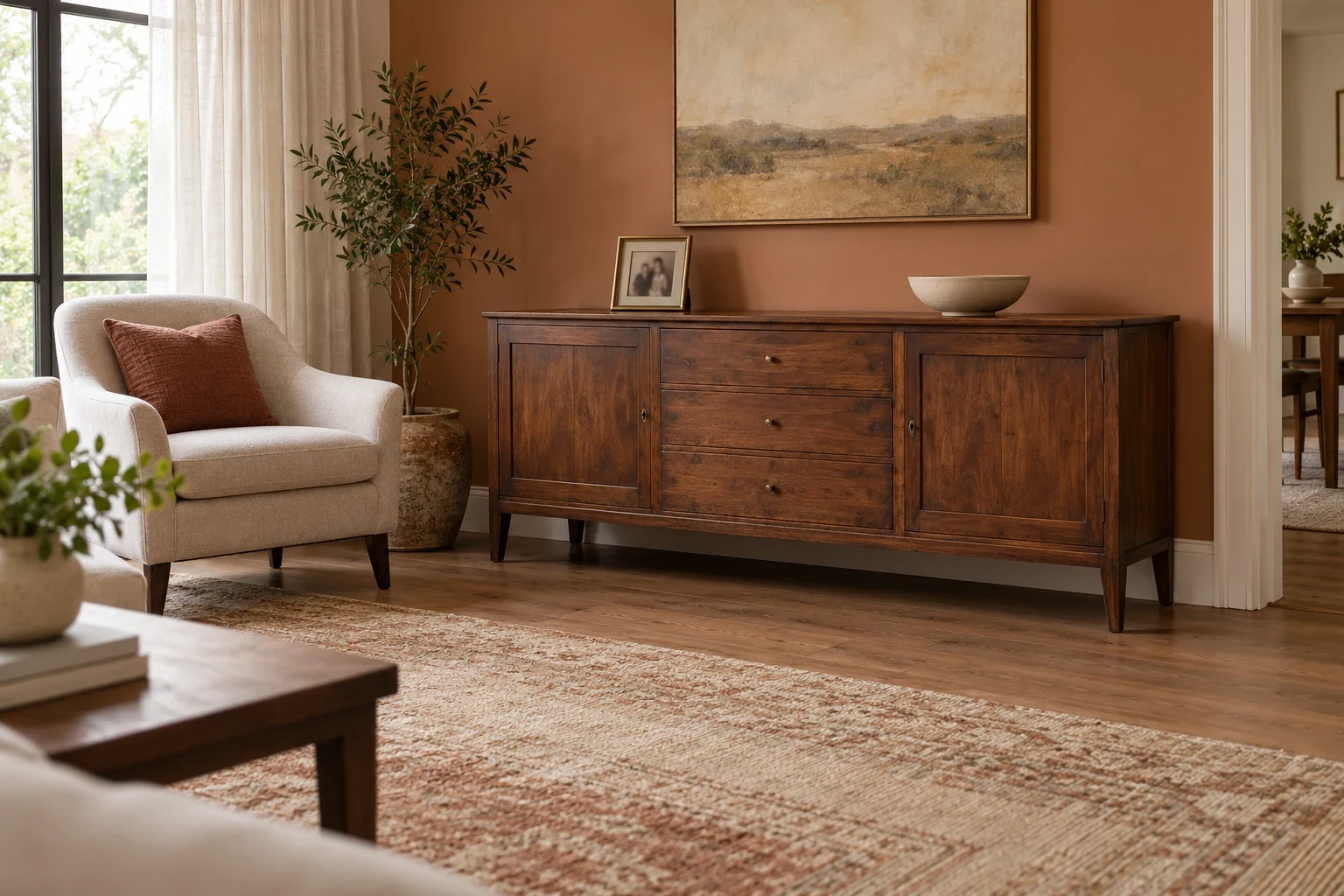
Illustrated room study: an older walnut sideboard sits against the living-room wall with a photograph and a bowl. Its surface and the route in front are available for ordinary use.
An object does not have to perform a symbolic correction to deserve space in your home. It can be a useful table, a beautiful bowl or a reminder of someone important. Making that distinction can relieve the pressure to justify every inherited thing through a feng shui rule.
In her advice about broken adjustment objects, Anjie Cho distinguishes things chosen for an intentional feng shui adjustment from other belongings. She generally prefers something new for a fresh adjustment and discusses clearing when a secondhand object is used in that role. That is narrower than saying all household furniture must be new.
If you are following a practitioner's specific ritual instruction, ask whether their requirement concerns that adjustment object or the room's ordinary furnishings. Do not turn a rule for one deliberate practice into an instruction to replace your family furniture. If you are simply deciding whether a comfortable old chair belongs, start with its actual use and your response to it.
Let the Room Test the Piece
Illustrative plan: the sideboard has a footprint, an opening area for doors and drawers, and a separate walking route in front. The drawing is not to scale; it shows the spaces to test in your room.
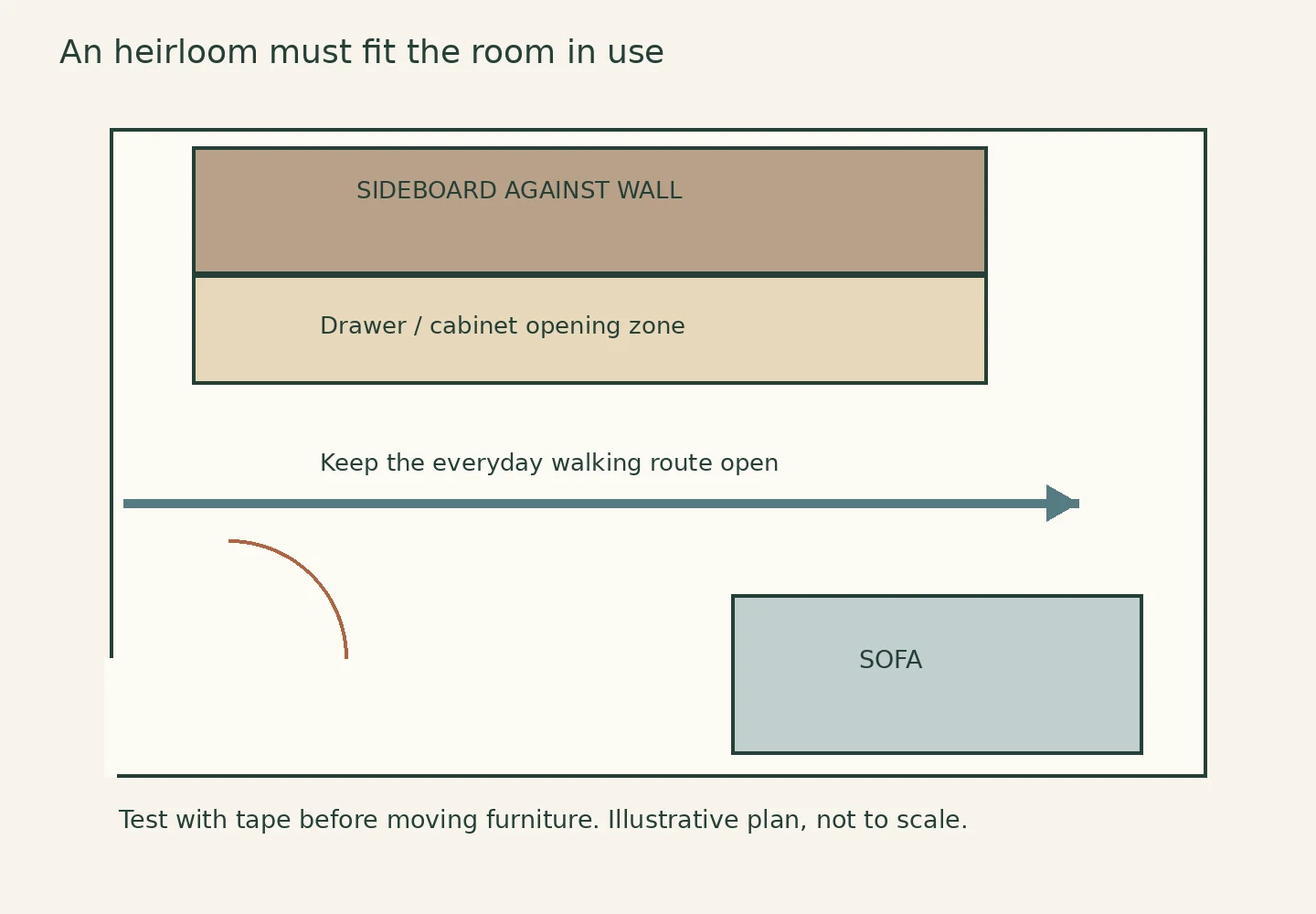
Measure the item before moving it. Mark its footprint with removable tape only if the floor finish tolerates it; otherwise use a measured paper plan. Add the space its doors and drawers need when fully opened. Walk the usual route past the marked area with the sort of bag or laundry basket you normally carry. Open nearby room doors and check whether they conflict with the proposed position.
For a dining table or chair, include its in-use position. A chair tucked under a table occupies less space than a person pulling it out and sitting down. A cabinet that fits against a wall may still make the room difficult if its drawers open into the only walking route. Test the action, not just the closed outline.
Condition deserves a separate decision. Look for looseness, damage, an unstable base or a function that does not work. For a valuable, delicate or unfamiliar item, get suitable conservation or repair advice before treating it. Do not assume that an energetic clearing addresses a structural problem or that an unknown finish can tolerate a suggested cleaner.
If the piece is too large, try a different room or a different role only if it genuinely works there. A cabinet should not become a permanent obstacle in a corridor because its original intended room could not hold it. A smaller keepsake may be a better way to carry the memory into a compact home.
Decide What You Want to Carry Forward
Consider the object's place in your current life, including how others sharing the room feel about it. A decision can be respectful without preserving every item exactly where it stood before.
| What you find | A possible next step | What that decision does not imply |
|---|---|---|
| You love the item and it works in the room | Keep it and give it a usable position. | That age alone makes it auspicious |
| You value it but a part needs repair | Get an appropriate assessment and decide whether repair is feasible. | That a ritual repairs physical damage |
| You like it but do not know its history | Check condition and fit; decide whether the uncertainty actually troubles you. | That an unknown story must be a harmful one |
| You feel obliged to display it | Consider another family member, a smaller keepsake or a different form of remembrance. | That declining the item rejects the person |
| It is unwanted and obstructs daily life | Choose a responsible destination within your ownership rights. | That it has caused your household's difficulties |
You may need time to make an inherited-item decision, especially when other relatives are involved. A temporary holding place with a clear review date can be more workable than either hurried disposal or indefinite storage across the living-room floor. The date is an organizing choice, not a feng shui deadline.
If You Want a Symbolic Fresh Start
A small intention practice can mark the change of ownership if it fits your beliefs. Peters includes speaking a new intention to the item among her suggestions. You could simply acknowledge where it came from, decide how you want to use it now and place it thoughtfully. This does not require smoke, water, salt or a purchase.
Keep physical care separate. Clean only in a way appropriate to the material and finish; when those are unknown, identify them or seek suitable advice before applying products. You can make a symbolic welcome without treating the surface at all. Uncertainty about cleaning is not a reason to experiment on an irreplaceable object.
A fresh start is also not a promise that you will stop feeling an unwanted association. If a piece repeatedly recalls something distressing and you do not want it in your daily space, you can choose another home for it. You do not need to prove that its energy is objectively harmful to set a personal boundary.
Three Objects, Three Different Decisions
For example, suppose you inherit a grandmother's sideboard. You like its history, its drawers work and the taped plan leaves a clear route. Keeping it as everyday storage makes sense. A framed photograph nearby can preserve the connection without turning the whole wall into a display you must maintain unchanged.
Now imagine finding a used dining table with an unknown owner history. The useful questions are whether you want it, whether it is sound and whether it fits with chairs pulled out. You can ask the seller about condition and repairs without investigating the previous owner's private life. Missing biography does not establish bad luck.
Finally, imagine receiving a large chair associated with a difficult period. It occupies the only place for a desk and you dislike seeing it. Photographing it, offering it to a willing relative or arranging another appropriate destination may serve you better than repeatedly trying to make it feel “cleared.” These are illustrative choices, not diagnoses of objects or people.
Keep the Story That Matters, with Room to Live
A home can hold old and new objects together. What matters for this decision is the particular object, the room's constraints and the meaning you choose to give it now. You can respect a tradition's language about predecessor qi while declining predictions about inherited misfortune.
Keep what you welcome and can use, repair what is worth repairing, and make considered decisions about the rest. An heirloom earns its place through the relationship you want with it and the life the room must support.