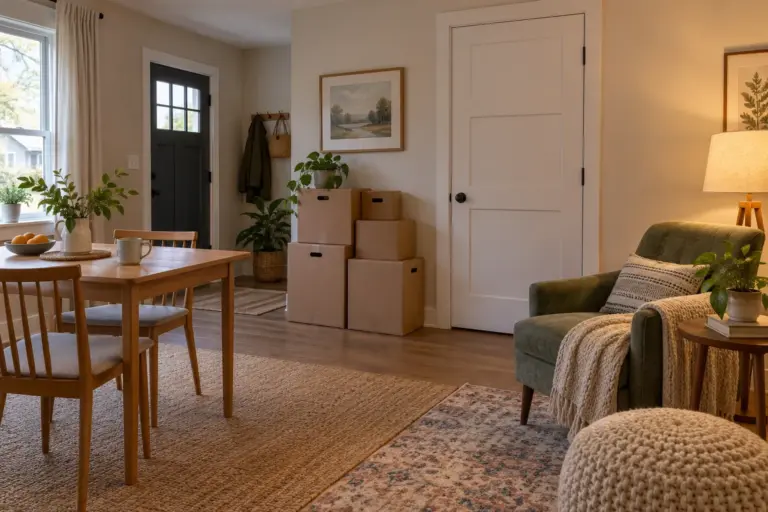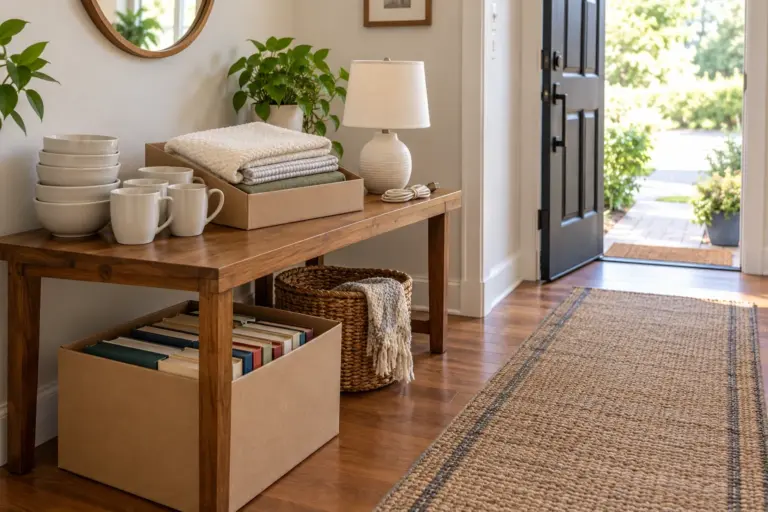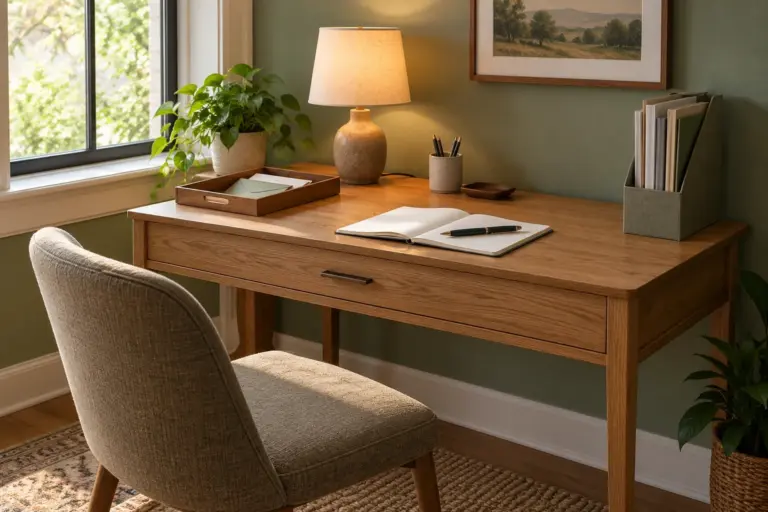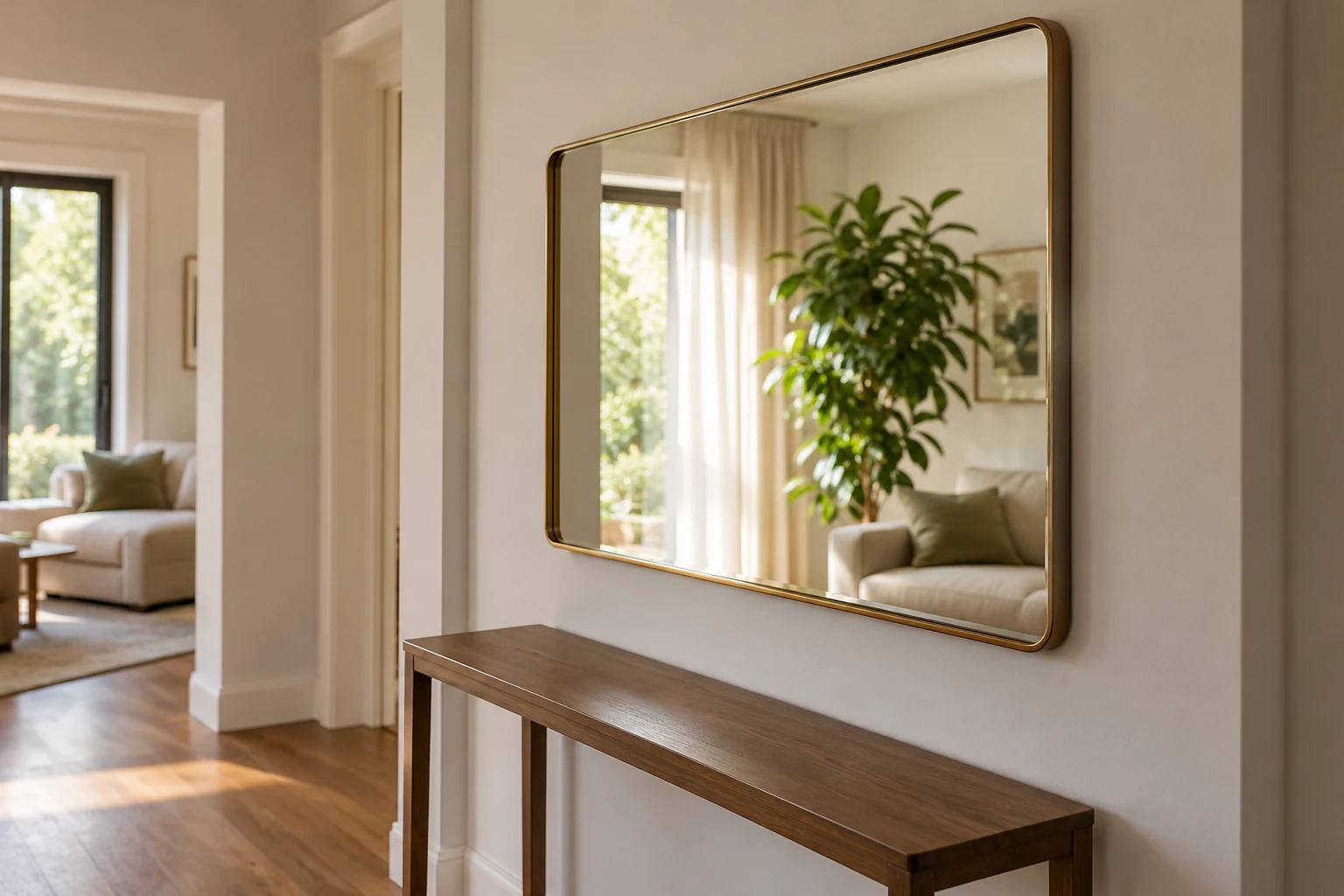
Use a mirror intentionally by deciding what you want to see in it, checking that view from the place you actually use, and keeping the change only if it fits daily life. For feng shui mirror placement, that might mean seeing a door from a fixed seat, reflecting daylight that already enters a room, or changing the view of a compact space. None of those jobs requires a mirror in every room. Start with one place and one purpose, then test what happens there.
Choose the View Before Choosing a Location
Look at the room before choosing a wall, shelf or desk corner. Where is the main door? Which windows admit daylight? Where do you normally sit or rest? Note furniture that cannot readily move, surfaces you need to use, and the routes people take through the room. A mirror that looks promising from the doorway may have little value from the chair where you work—or may occupy the space needed to pass behind it.
If your purpose is to see an entrance, name the actual door and the position from which you want its image. First ask whether a feasible furniture move would give you a direct view without compromising the room. If it would, you may not need a mirror. If the desk or bed cannot reasonably move, a reflected door view becomes an option to test rather than an automatic remedy.
Mindful Design School suggests arranging a mirror so the door’s reflection is visible while sitting at a desk. In its guidance for a bed that cannot be moved into its preferred position, it likewise presents a reflected door view as a fallback. These are suggestions from the school’s BTB approach, not a rule shared by every feng shui method. The image of a door in a mirror is something you can observe; what significance you give that image, and whether you like having it there, are separate questions.
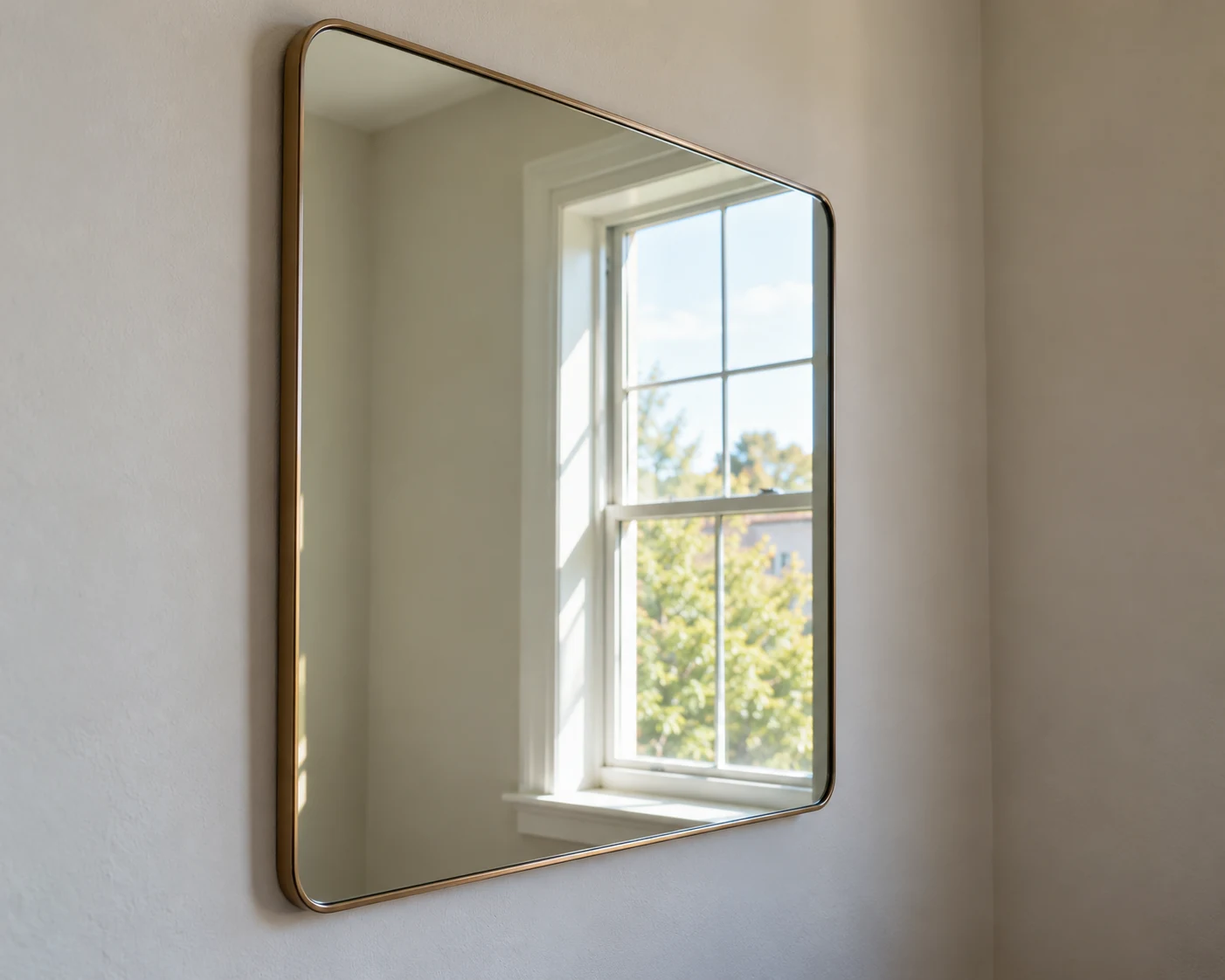
A mirror can have a different job. If you want more daylight in the view from a usual seat, identify the window supplying light and the part of the room you hope to see illuminated or reflected. Mindful Design School says a well-placed mirror can bounce natural light around a small space, making it feel brighter and bigger. That is a reason to test an existing source of daylight, not to expect a mirror to produce light on its own.
Or you may want a compact room to feel visually more open. In that case, name the scene you would welcome in the reflection: perhaps an uncluttered part of the room rather than the busiest passage. Choose one of these purposes before moving anything. “Put a lucky mirror somewhere” gives you no particular view to check and no useful way to decide whether the placement worked.
Check the Reflection from the Position That Matters
The test is not whether a mirror generally faces a door or window. It is whether it shows the intended image from your normal position. Identify three points: what you want to see, where the mirror could safely sit, and where your eyes will be when you use the space. Change your viewing position, and the reflection may change with it.
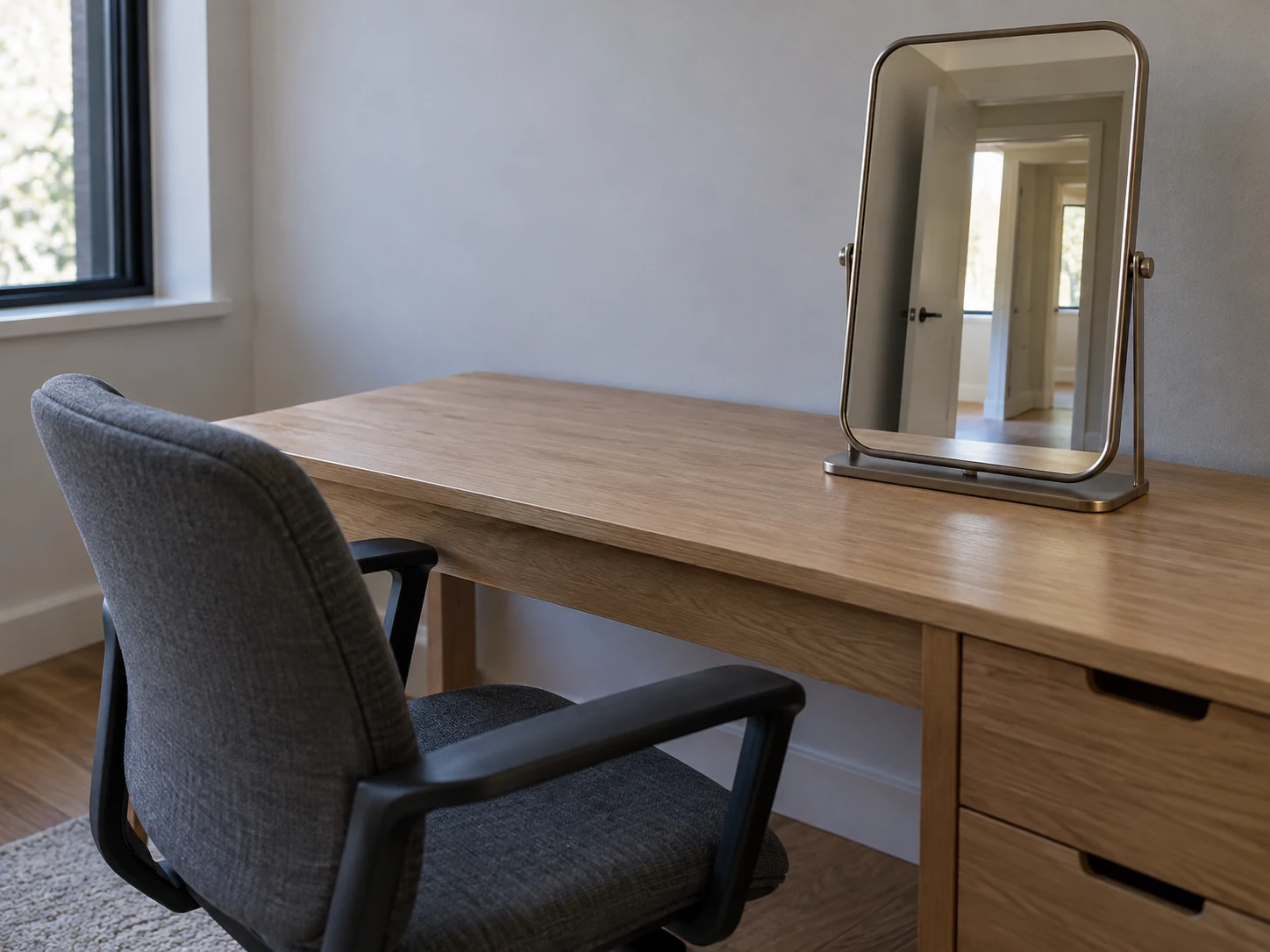
At a desk, sit as you ordinarily work, with the chair and screen in their usual places. Look at the proposed mirror position from there. Can you identify the actual room door in its reflection without turning around? A window, a strip of wall, or an indistinct bright patch does not accomplish that particular job, even if the mirror looks well positioned when you stand up. Mindful Design School’s desk suggestion specifically concerns a door reflection visible while sitting at the desk.
For a bed, check from your usual reclined or resting-back position. Do not judge the view while standing across the bedroom: that answers a different question. If an existing mirror is under consideration, determine whether you can see the mirror from the bed and whether it captures the image of the bedroom’s main door. Those are the conditions Mindful Design School gives for its bedroom-door workaround. Whether you want that reflection while resting is a further decision, not something the sightline test settles.
For daylight, start with the window that already supplies it. From your usual seat or approach, look at what the mirror actually shows at the time you use the room. Does it bring a useful lit scene into view, or does it mostly show an area you would rather not see? Check the difference under the room’s ordinary conditions, rather than judging it at an unusually bright moment. A mirror can redirect available natural light and change how spacious a room feels; it cannot create a daylight supply or add physical floor space. Mindful Design School’s small-home guidance supports the possibility of a brighter, bigger feeling room, not a measured gain in space.
The same observation works for a compact entry. Mindful Design School gives a mirror with a small ledge for keys or a plant as one possible small-space idea. Use it only if there is room, you control the location, and the reflection improves the view from your normal approach. You need not add a ledge to use a mirror. More importantly, a pleasing reflected scene cannot stand in for a clear entry: if either object would narrow the passage or interfere with the door, leave it out.
Use a Clear Mirror in a Stable, Usable Spot
Once you know the view you want, see whether a mirror you already have can provide it. For ordinary interior use, Mindful Design School generally recommends a flat, unbroken mirror without distortion. That gives you a straightforward image to evaluate. Its advice does not require you to buy a particular ritual shape or material to conduct this room-level test.
Compare possible spots by what they permit you to keep doing. Is the location yours to use? Does the mirror have a secure position using its designed support? Will it remain steady during normal activity? A desk surface may offer an easy reversible trial for a small mirror in its designed stand—but only if the stand has clear, stable space away from the edge. A surface that is already needed for a screen, writing or other work may not have that space.
Then check the surrounding room, not just the reflection. Can the door open fully? Can people follow their usual walking route? Is the mirror out of the area where someone would brush past it? Does it leave the entry, screen and working surface usable? A perfect door image is not an improvement if reaching it makes the desk difficult to work at or the entry difficult to use.
If the desired angle depends on uncertain installation, pause rather than treating a proposed mounting spot as a ready trial. Likewise, do not improvise a leaning pane of glass or an unsupported floor-mirror position to see whether the idea might work. The choice here is between feasible, stable positions you can use now and an idea to set aside—not between a good reflection and basic room function.
You can also stop without replacing anything. If the mirror available to you is broken or distorts the view, it will not make a clear test of the intended image. If the only feasible location takes over a necessary surface, the useful outcome may be to keep that surface as it is. A placement earns its place by providing the chosen view and allowing the room to work.
Decide Separately Whether a Bedroom Mirror Suits the Occupant
A bedroom door reflection has a narrower place in this decision. Mindful Design School says moving the bed is preferable if that is possible; its mirror suggestion applies when the bed cannot be put in the position the school recommends. Before trying a mirror, then, ask whether a feasible bed position already gives you the door view without spoiling access or everyday use. If it does, the fallback may be unnecessary. This is not a request to rearrange the bedroom at any cost.
If moving the bed is not feasible and you want to test the BTB fallback, consider an existing mirror in a stable, permitted position. From your normal resting position, you must be able to see it, and its reflection must include the bedroom’s main door. Check that its position leaves the route through the bedroom clear. If the view requires an unstable placement or an installation you have not resolved, do not use that as a trial. The school’s specified door image is a testable condition, but meeting it does not yet make the mirror a good choice for you.
Bedroom preference deserves its own decision because the space is used differently from a desk. Mindful Design School acknowledges beliefs against bedroom mirrors alongside its BTB guidance and advises paying attention to how you feel about a mirror there. It says covering an existing mirror can make sense if you find it disruptive. If you dislike the reflection, you can cover a mirror already in the room or omit a proposed one, even when it shows the door perfectly. You do not need to prove that your discomfort follows a universal feng shui rule before acting on it.
The Feng Shui Society notes that individual situations call for selective analysis and that consultants may make different suggestions. That is another reason to treat a bedroom mirror as a conditional choice, not a requirement for every bed. A resident who welcomes the view, has a suitable existing mirror and can keep the route clear may choose it; a resident who dislikes it can decline it. Neither decision establishes a sleep or health effect.
Try One Adjustment, Then Keep, Change or Omit It
Consider this hypothetical desk trial. A resident works at a wall-facing desk. The main room door is behind and to the side, and the resident would like to see its image without turning around. Moving the desk would block the room’s walking route, so a direct view is not a workable alternative in this example.
The resident has a small mirror already available in its secure, designed stand. There is stable, clear space on the desk away from the edge and the walking route. Before making an adjustment, the resident sits in the normal working posture and looks: the mirror reflects only the window, not the door. It may show an appealing patch of light, but it fails the stated door-view purpose. Calling it a door mirror because of where it sits would not change what it shows.
The resident then adjusts that same mirror on the clear desk space and sits down again in the usual posture. This time, the reflection includes the actual main room door. The resident checks more than the image: the stand remains stable; the mirror does not obstruct the screen or working area; the door still operates fully; and the walking route remains clear. The reflected view also feels acceptable to the person using the desk. In this illustrative trial, every check passes, so the resident keeps the adjusted view.
That keep decision depends on the checks, not on the mirror’s mere presence. If no stable angle and clear desk space could provide the door image, the resident could omit the mirror or keep the usable desk without that cue. The fact that moving the desk blocks the route does not oblige them to accept a precarious mirror instead.
Apply the same bounded decision to other purposes. For daylight, compare the reflection from your usual seat at the time you normally use the room. Keep the placement if the desired lit scene or difference is noticeable and the mirror leaves the room usable; otherwise adjust a feasible existing position or omit it. For a compact-room view, look from the usual approach and keep it only if the reflected scene improves your experience without crowding the entry. A mirror that shows an unwanted scene or occupies needed space has not met that purpose.
For a bed, the door may be visible while the reflection is still unwelcome. In that case, cover an existing mirror you find disruptive or omit the proposed one. These outcomes are not failures of the test: they answer the comfort question that a sightline alone cannot answer.
An intentional mirror has an observable job, a place that leaves the room usable, and a reflection the occupant accepts. It is not a mandatory object for every room or a promise about what will happen after it is placed. As the Feng Shui Society cautions, feng shui cannot guarantee wealth, health or happiness. Keep the view that works in your room; change or omit the one that does not.