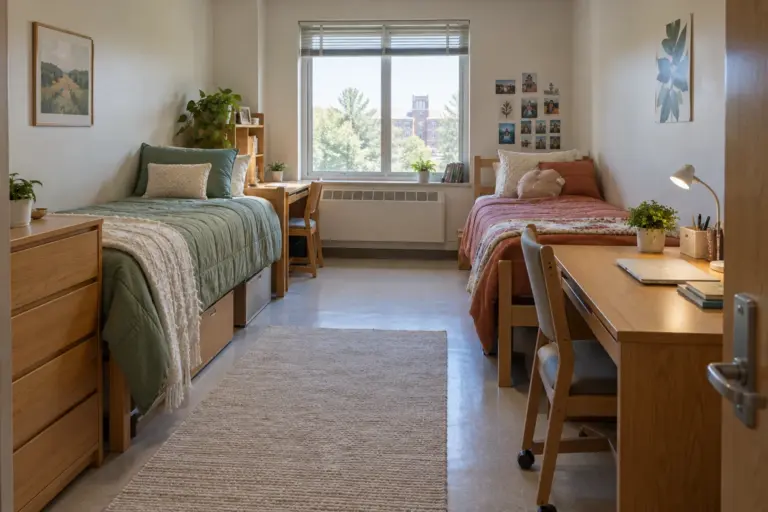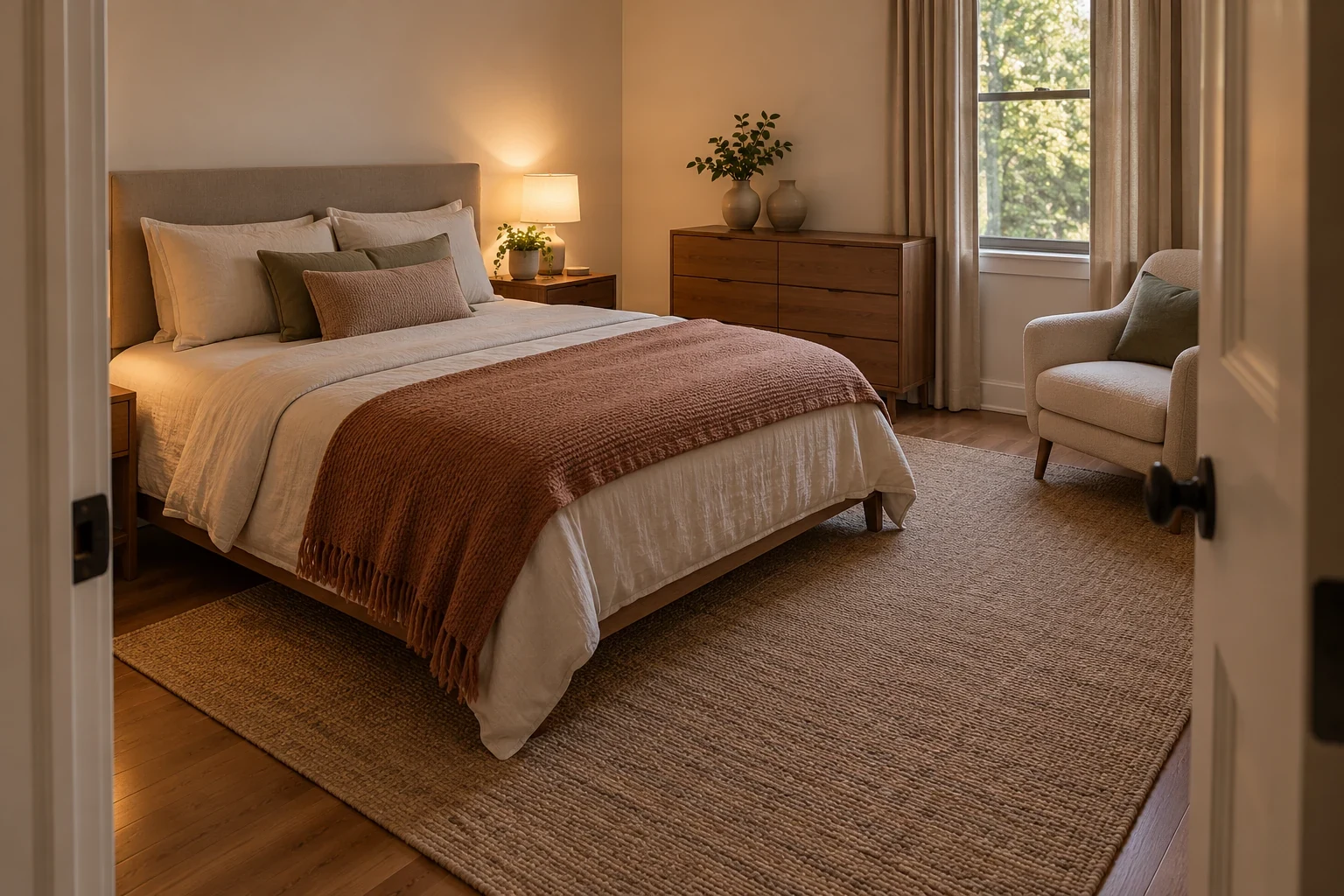
If the love corner of your home's feng shui map falls in a roommate's bedroom, respect that room as their private space. You do not need to enter it, change their belongings or ask them to maintain a symbol on your behalf. First identify which mapping method you are using. Then, if it suits that method, work thoughtfully within your own room instead.
A map location is not evidence that your roommate controls your relationships or that your home is unsuitable for you. The practical task is to choose a consistent way of using feng shui without crossing another person's boundaries.
Check What You Mean by the Love Corner
Two common explanations can produce different locations. In an entry-aligned bagua, the relationships area is at the far right when you look into the mapped space from its entry wall. In a compass-sector approach, advice may identify a geographic direction instead.
Anjie Cho's bagua explanation aligns the map's bottom edge with the entry wall and allows the map to be applied at different scales, including a home or room. By contrast, the World of Feng Shui Eight Aspirations guide begins by taking compass directions for the home and marking them on a plan.
Do not treat “far right” and “southwest” as interchangeable labels. Your entry wall may face a different direction, so the same instructions cannot simply be overlaid as if they agree. If you are following a practitioner's assessment, ask which method and scale they used before adding another map from the internet.
The examples below use an entry-aligned map. They show a room-scale option within that approach, not a correction to a compass reading or a rule shared by every feng shui school.
Leave the Whole-home Map Honest
Suppose the home's entry is on the near side of a simple rectangular plan. With the entry-aligned grid in place, the relationships area falls in the far-right part of the dwelling. Your roommate's private bedroom happens to occupy that part.
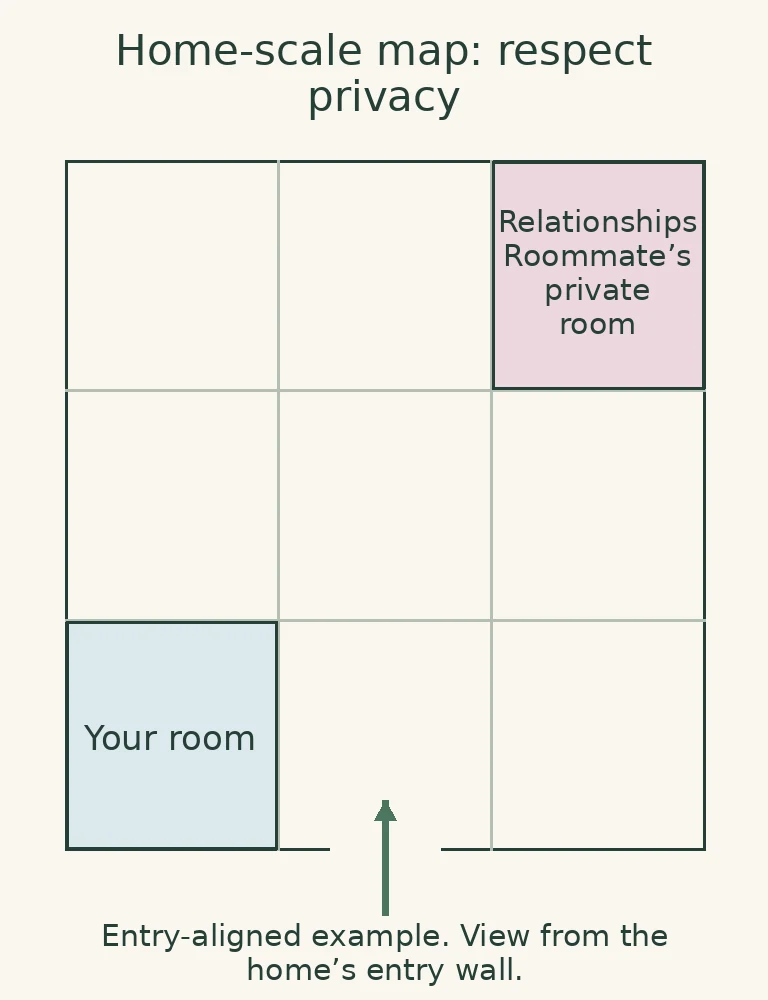
Keep that result on the home drawing. Do not rotate the drawing, choose a different door or move the relationships label simply to make it land in a space you control. That would change the inputs to get the desired answer.
The home-scale diagram shows the relationships area in the roommate's room and your room elsewhere. It does not imply that the shaded room is missing, damaged or responsible for anyone's romantic life. It simply identifies where this particular map places the area.
You can acknowledge that location without doing anything inside it. Private space can remain private even when a symbolic map includes it.
Apply a Separate Room-scale Map to Your Own Room
If you choose Cho's entry-aligned room practice, begin with a simple drawing of your room's usable outline. Mark its actual entrance, windows, fixed features and furniture. Use your room's doorway as the viewpoint, rather than the dwelling's front door.
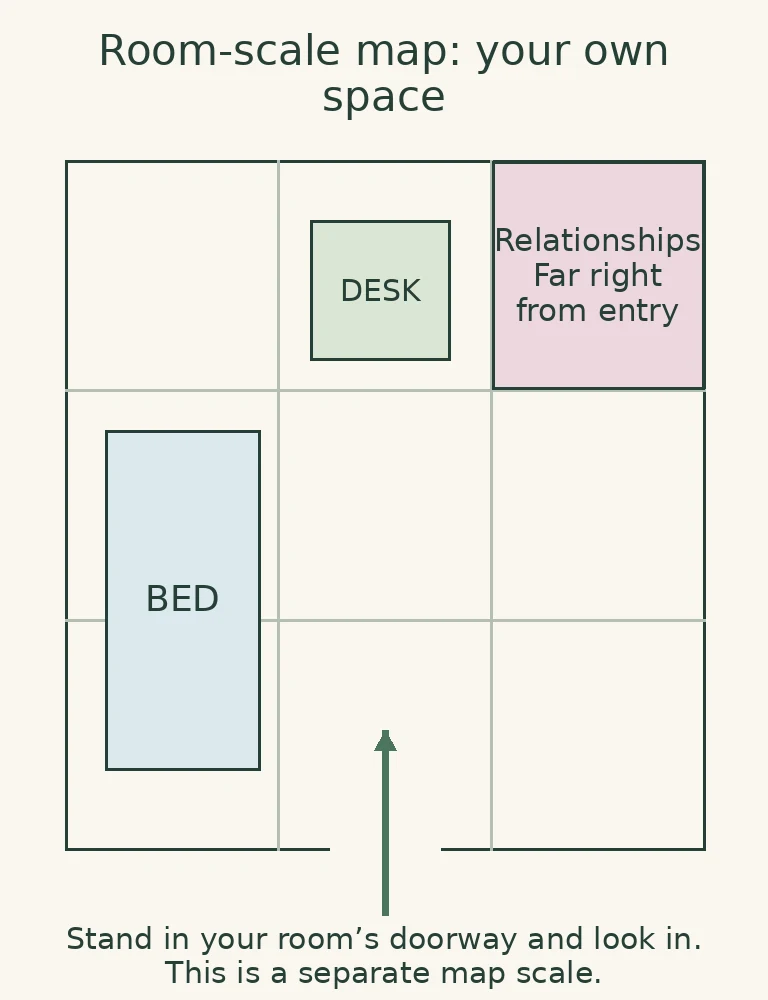
Stand in that doorway and look into the room. Put the grid's bottom edge along the wall containing the room entrance. Divide the outline into three roughly equal parts across and three from near to far. The relationships area is the far-right portion of that room-scale grid.
The room drawing illustrates this operation. Its pink area is separate from the pink area on the whole-home plan because the mapped space has changed. Your own room has not moved, and your roommate's bedroom has not been relabeled. You are applying the same entry-alignment method at another scale.
The result does not require rebuilding the furniture arrangement. A bed, desk or storage unit may already use that portion appropriately. Start with what is there and the room's real needs before adding any decorative object.
Choose a Small Change You Can Comfortably Maintain
Treat relationships as a theme for reflection rather than an instruction to buy a romantic display. Ask whether your room welcomes your own rest and daily care, whether your belongings are accessible and whether the space reflects the life you actually want to live there.
If you enjoy a symbolic gesture, choose something meaningful and suitable for its position: a picture you like, a small personal object or a deliberately clear section of a shelf. Keep access, stability and the furniture's function intact. Do not put an object on the floor where it becomes a trip hazard just to hit the mapped area precisely.
If pairs of objects appeal to you as a personal relationship symbol, keep the gesture optional. You do not need to duplicate every lamp, cushion or cup. Choose a pair only if you like it and have an appropriate place; a cramped arrangement of two unwanted ornaments is not a useful improvement.
You can also choose no additional object. Tidying a usable surface or resolving a practical irritation in your own room is a valid personal action without assigning it a promised romantic result.
Do Not Turn a Map Into a Roommate Obligation
Avoid asking your roommate to display a pair of objects, remove a photograph or keep a particular color because you believe your relationship area lies in their room. Their bedroom is not a shared installation you are entitled to manage.
If they independently want to discuss feng shui, ask whether they would like to hear the idea and accept a refusal. Any change in their room should be their voluntary choice. A temporary invitation to visit is not permission to rearrange or inspect their private belongings.
For shared areas, discuss ordinary household effects directly. “Could we move these bags so the hall is easier to use?” is a clear request about common space. “Your clutter is damaging my love life” assigns an unsupported burden and makes a practical discussion much harder.
The relationship already present in the home includes respect for privacy, consent and shared responsibilities. Those deserve attention regardless of the map.
Handle Awkward Room Shapes Without Forcing Precision
An alcove, built-in wardrobe or irregular outline can make a simple grid less obvious. Decide what boundary your chosen method uses before interpreting the result. A rough sketch is enough to reveal the uncertainty; you do not have to pretend that a few inches establish a major verdict.
If the mapped area falls inside a closet, preserve the closet's proper use. Keep needed belongings accessible and appropriate to the storage conditions. You do not have to hide a decorative cure inside it or remove useful storage to create an empty corner.
If the far-right area is a window or a necessary route, keep it functioning as one. Choose any suitable nearby personal gesture as an acknowledgment, while being honest that it is nearby rather than geometrically identical. The room's safety and use do not become secondary to placing a token on a precise point.
For an unusually shaped dwelling, several entrances or a practitioner-specific method, seek an explanation of the inputs rather than inventing a hybrid rule. You can still make ordinary improvements in your own room while the mapping question remains unresolved.
Keep a Compass Reading Separate
If your original concern came from a compass-based consultation, a doorway-aligned room map does not overturn that reading. Ask the practitioner how their approach treats rented rooms, shared dwellings and the parts of the home you do not control.
You may decide to use entry-aligned room symbolism as a separate personal practice, but name that choice clearly. Do not claim that changing methods has moved a geographic sector or corrected a building analysis. Consistency makes the advice easier to understand and prevents a search through multiple maps for whichever result seems most reassuring.
Be cautious about claims that a roommate's room location guarantees loneliness, conflict or a particular partner. The map alone cannot establish those outcomes. It also cannot tell you what another person thinks or replace the practical work of communication and relationships outside the home.
Judge the Change by Daily Life
After a small adjustment in your own space, notice whether the room is more usable and personally comfortable. Can you rest, reach your belongings and maintain the arrangement without effort? Did the decision preserve a good shared living environment?
If the symbolic exercise increases worry or leads to repeated remapping, set the map aside and return to the concrete room. You do not have to solve the entire dwelling to make your own area work. A clear method, a modest personal choice and respect for the people sharing the home provide a practical way forward.