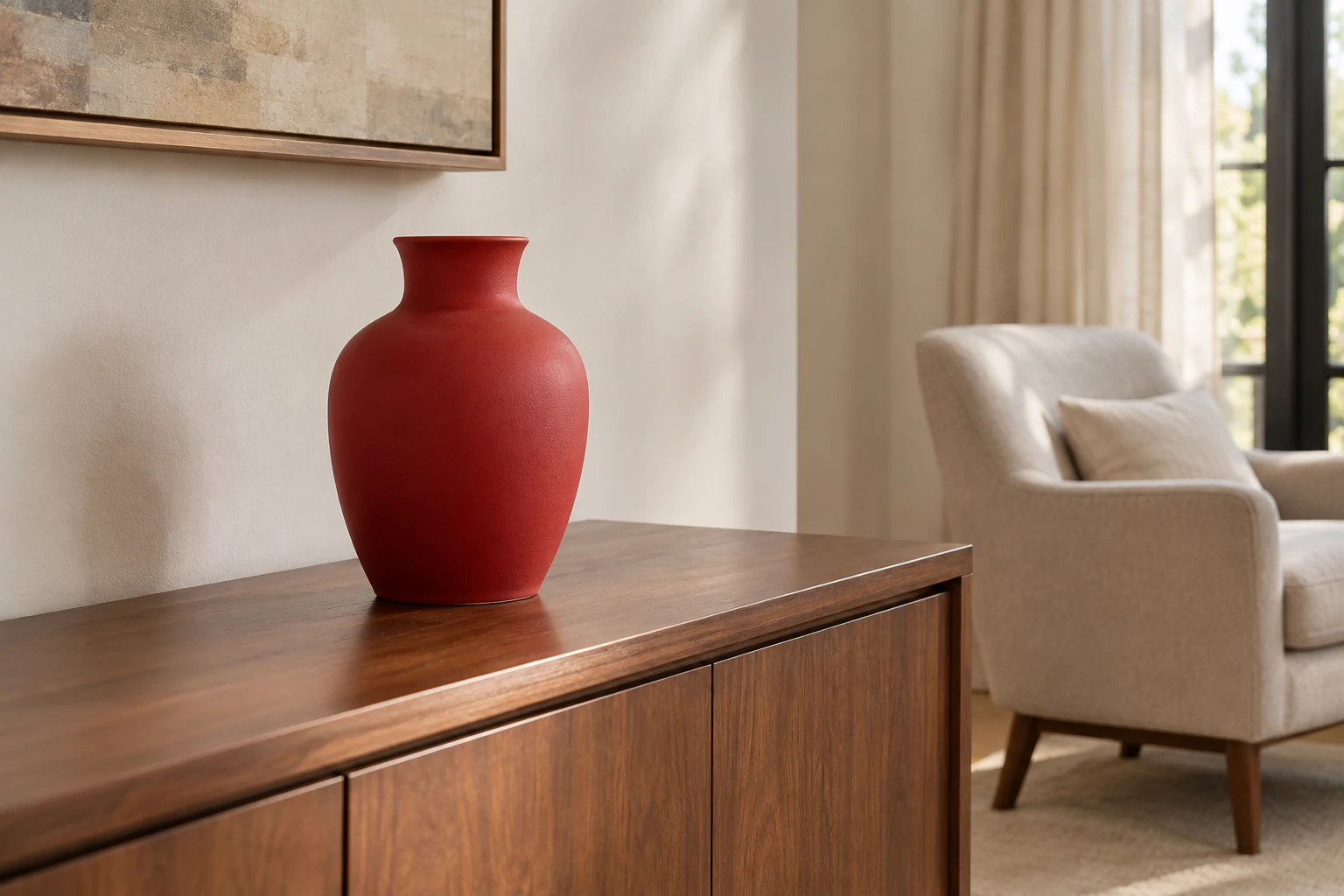
In the five-element framework described by the International Feng Shui Guild, red represents Fire, one of Wood, Fire, Earth, Metal and Water. It is a color correspondence, not a claim that a red object behaves like a flame. Red can also carry meanings beyond that framework: the Metropolitan Museum of Art describes its traditional association with good fortune and happiness in Chinese culture, while the Guild’s Bagua mapping links red to Li, South, and fame and reputation. Those meanings answer different questions. If you are considering red décor, the useful question is not simply where red “belongs,” but which meaning you intend—and whether the amount of red suits the room and its users.
Why Red Represents Fire Without Being a Flame
The International Feng Shui Guild names Wood, Fire, Earth, Metal and Water as the five elements and identifies red as a representation of Fire. That is the central answer to what red means in this feng shui framework. It does not mean that every red item is made of fire, that it gives off heat, or that the presence of red tells you how much Fire a room contains.
It helps to understand representation as the link between the color and the element. The Guild describes several ways an element can be represented: through color, shape, a literal object, or an art object depicting it. These are different ways of referring to an element, not interchangeable physical properties. You can recognize the Fire association in a color without introducing an actual flame.
Consider an author-selected red fabric cushion. Its fabric remains fabric; in this framework, its red color is what makes it a possible Fire accent. Now compare it with an unlit candle, an object that refers to fire by its intended use, or a picture of a flame, which depicts fire. The cushion, the unlit candle and the picture refer to fire in different ways. None introduces a real flame in this example, and calling one of them a Fire representation does not make the cushion hot or the unlit candle a source of flame or heat. This comparison illustrates the Guild’s distinction between color, literal object and depiction; it is not a suggestion to light candles or add fire to a room.

That distinction matters when advice compresses a symbolic idea into a phrase such as “add Fire.” If the proposed addition is a red cushion, the actual change is a cushion with a particular color, size and place in the room. Its symbolic description does not replace those ordinary facts. A household can understand why someone calls it a Fire accent while still asking whether anyone wants that cushion on the sofa.
Nor does the correspondence diagnose the room. Knowing that red represents Fire does not, by itself, establish that a particular space lacks Fire, needs more red, or has reached an ideal elemental balance. The Guild’s color association explains what the red can signify within its framework. Whether to use the color, and how visibly, is a separate choice. Keeping those questions apart lets a home reader take the traditional term seriously without mistaking a label for a measurement.
Good Fortune Is a Cultural Meaning, Not a Forecast
Red’s Fire correspondence is not its only meaning. The Metropolitan Museum of Art says that in Chinese culture red traditionally symbolizes good fortune and happiness; its account also notes red’s traditional correspondence with the element of fire. The two ideas can appear together, but they are not the same claim. “Red represents Fire” identifies an element correspondence. “Red symbolizes good fortune and happiness” describes a broader cultural association.
A symbol can be meaningful without predicting what will happen to a person who displays it. A culturally meaningful red object might matter to someone because of the object, its setting and the associations they bring to it. An ordinary red cushion might instead have been chosen chiefly because its color works with the furniture. Those are explanatory possibilities, not rules assigning one meaning to every object or every person. Neither the museum’s description nor the presence of a red item establishes that its owner’s finances, health or happiness will change.
Context also keeps us from treating “the meaning of red” as one fixed definition. The Met notes that after the founding of the People’s Republic of China in 1949, red also came to represent the communist revolution. That observation does not erase the good-fortune association; it shows why the object and context matter when interpreting a use of red. A political representation, a culturally meaningful object and a home accent need not be read in the same way. For a home reader, the practical distinction is simple: recognizing a traditional association leaves room to ask what a particular red object means here.
Where the Li and Fame Association Fits
Some red advice is more specific than either the general Fire correspondence or the Met’s account of cultural symbolism. In the International Feng Shui Guild’s Bagua mapping, fame and reputation appear with Li, “back center,” South, the element Fire and the color red. That is a named set of associations in a practitioner mapping. It gives context for why advice about red might mention reputation rather than only Fire or good fortune.
The levels should remain distinct. Red can represent Fire without a speaker making any claim about fame. A red object can have a good-fortune association without someone applying the Guild’s Bagua mapping to a room. And the mapping’s reference to fame and reputation does not redefine every use of red as a reputation-related choice. Asking which level an adviser means is more informative than treating all three as one instruction.
In particular, the Guild’s listing of “back center” and South together should not be turned into the unsupported rule that the back center of every room is geographic South. The cited mapping identifies its associations; it does not establish one universal room grid for every school, tell a reader where true South lies, or require red in a prescribed spot. Explaining that boundary does not require a compass exercise. It means a reader can understand the vocabulary without converting the entry into a placement command.
Suppose someone says, “Use red for reputation.” They may be invoking the Guild’s Li association, in which red, Fire and fame or reputation appear together. That is a useful interpretation of the advice, not evidence that placing a red item will change how other people regard its owner. Before acting, a home reader can ask whether the advice is describing a mapped correspondence or proposing an actual change to the room. The first question concerns what the symbol means; the second requires considering the room and the people using it.
Choosing an Amount That Suits the Room
The International Feng Shui Guild includes hues of red among representations of Fire. A muted red is still a red hue, so choosing it instead of a vivid red does not require abandoning the color association. How prominent the accent should look, however, is a design decision rather than a calculation supplied by that association. A cushion, throw or other accent can vary in visible area without acquiring a different elemental label solely because it is larger.
There is no basis in the cited guidance for covering one-fifth of a room in red. The Guild says the amounts of the elements in a space will rarely be equal—20 percent each. That observation rules out treating “five elements” as an instruction to give each an equal visible share. It supplies no replacement percentage, and it does not require all five elements to appear as equal areas of color.
Start instead with what the room is for, what colors and furnishings are already there, and what its users want to see during ordinary activities. Someone may choose red for its appearance, its meaning, both, or neither. A small accent can express the color correspondence without a room-filling treatment; it is an option, not a universal intensity rule. The limit on expected results matters too: the Feng Shui Society says feng shui cannot guarantee wealth, health or happiness. Neither red’s cultural good-fortune symbolism nor a red accent turns a household preference into such a guarantee.
A Reversible Choice in a Shared Room
Here is a hypothetical preference example, not an observed intervention. Two adults share a room with a neutral sofa and an existing wood table. They use the room for daytime conversation and evening reading. They are interested in an optional red Fire accent, understanding red’s color correspondence as described by the International Feng Shui Guild, but neither wants that idea to override how the room works. They already own two possible accents: a large red throw and one muted red cushion. There is no purchase, paint test or plan to introduce a real flame.
The existing palette and uses give them a way to compare the two choices. First, they lay the large throw across the sofa. In this stipulated example, its visible area makes red more prominent than either adult wants while they talk or read there. That verdict is about their preference in this room—not a finding that large red objects are inherently wrong or that the throw has too much Fire. They take it off and restore their usual throw. The room can return to its prior arrangement without any lasting change.
Next, they try their already-owned muted red cushion in an ordinary usable seat. Its hue can still serve as a red color representation of Fire; the Guild’s inclusion of red hues does not require them to choose the most vivid option. They position it without taking away seating they need or blocking controls or routes through the room. Those conditions matter independently of symbolism. A cushion that gets in the way would not become more suitable merely because it has a traditional color association.
With their normal available lighting, the two adults sit, talk and read at daytime and evening times. They are not testing whether red changes arousal, conversation or reading ability. They are looking at the smaller accent during the activities for which they already use the room and deciding whether they like living with it. In the example as stipulated, both prefer the cushion to the large throw, and the seating, controls and routes remain usable. They keep one cushion. The decision follows from their shared preference and the room’s ordinary function, with the Fire association available as an additional meaning.
There is an equally reasonable alternative verdict. If neither red candidate suited both users, they could remove both and leave the room as it was. That would be a no-change preference decision, not a symbolic failure. In the version where they keep the cushion, they have not measured the room’s elemental balance or shown that its Fire is now “correct.” Nor has the example established improved health, conversation, fortune or reputation. Its point is narrower and more usable: the symbolic color cue can be tried at a scale the household likes, while the physical room remains functional and the choice remains reversible.
How to Interpret the Next Red Recommendation
When you next hear advice to use red, first ask what it means: the Fire color correspondence, a cultural meaning attached to an object and context, or a particular Bagua association such as the Guild’s Li mapping? Then separate what red means to your household from whether its amount and location suit the room’s everyday use. In the hypothetical room, the large throw is rejected and one existing muted red cushion stays because both adults prefer it and the room remains usable—not because they found a required direction or secured a life transformation.