A T-junction house does not automatically need a remedy. First confirm that a road ends facing the property, rather than merely running beside it. Then notice whether the approach actually affects the used entrance or an occupied room. If the view is bothersome, a permitted, reversible indoor adjustment may be enough. Outdoor screening is an option only where the owner has authority and local roadside, property and planting conditions allow it. A visual remedy cannot resolve a traffic hazard.
Check Whether the Road Actually Ends Facing the Home
Start with a rough site sketch, not a feng shui label on a listing. Draw the road that ends, the road it meets, and the property beyond that meeting point:
`text
Receiving property
[house] [front door]
[entry path]
[road-facing window]
================================= Road along the frontage
| Road that ends at the T
`
The vertical road is the stem of the T. It ends at the road running along the property’s frontage; the property beyond is on the receiving side. The sketch is not a scale drawing or a road-safety assessment. Its job is to make the alignment clear before anyone proposes a change.
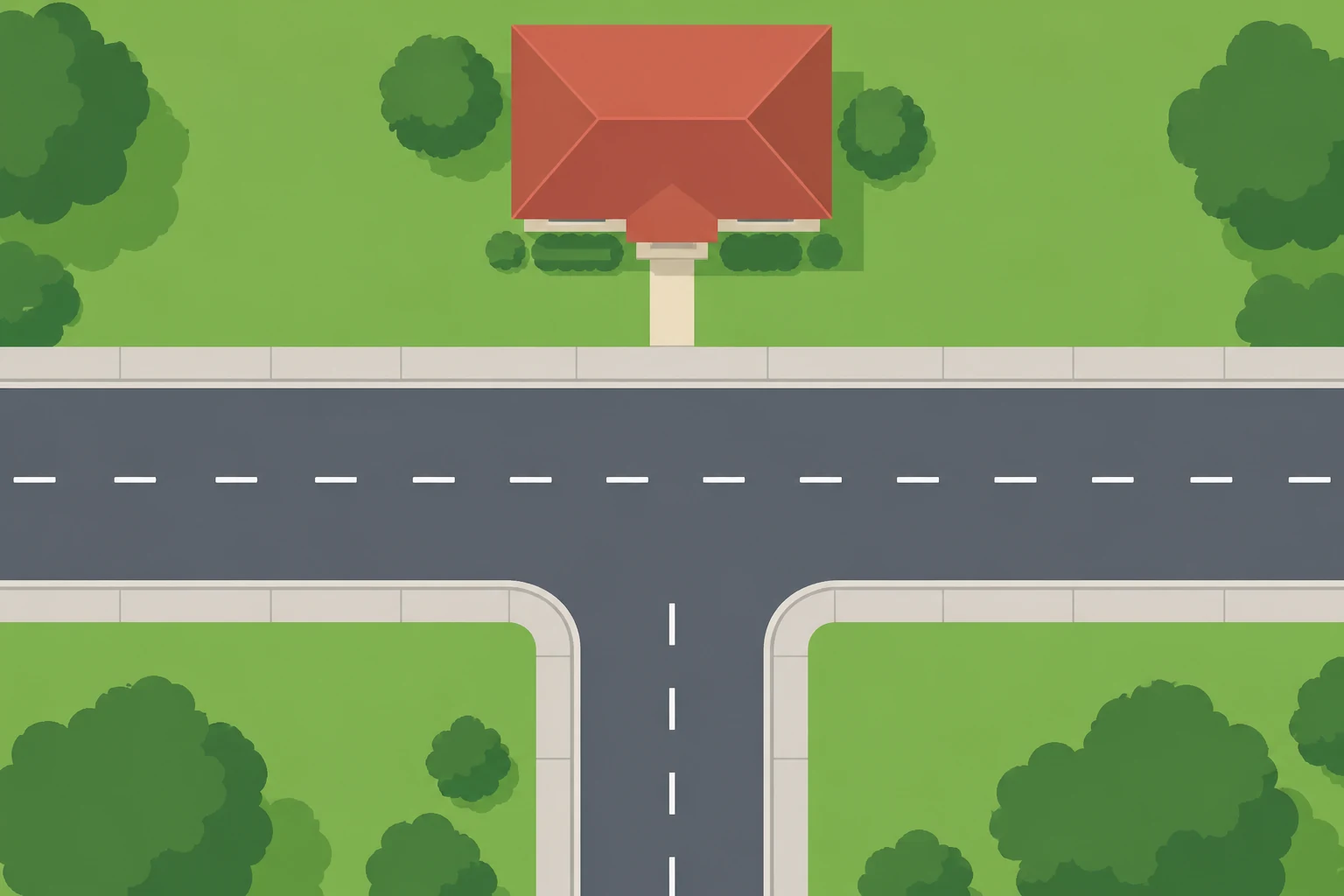
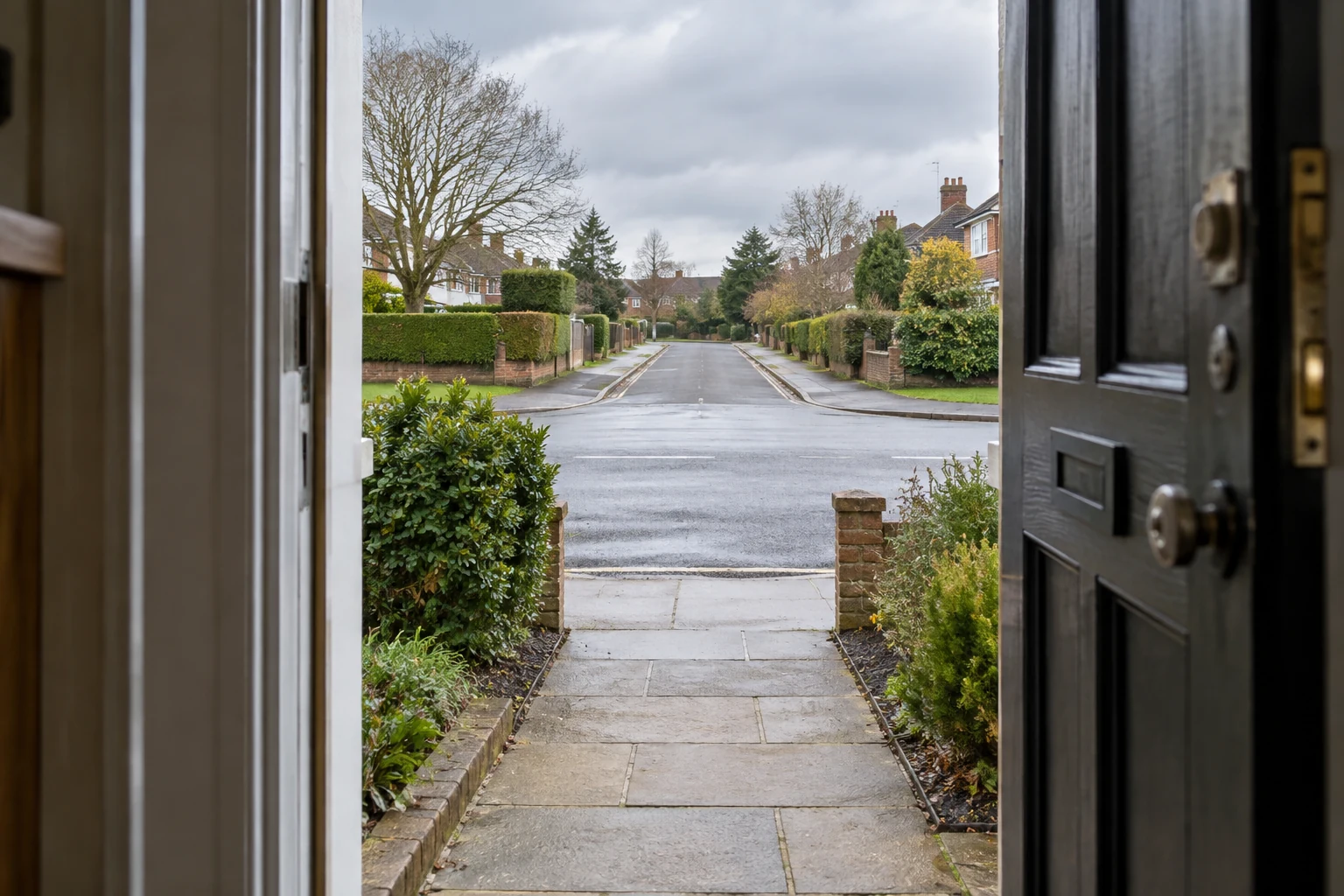
Now add the details the first sketch leaves out. Mark the door people actually use, the path to it, and windows in rooms where people spend time. Draw the direction those openings face. A road can point toward the property without lining up precisely with the front door. Conversely, an entry path or sitting-room window can give occupants a strong view down the approaching road even when the door is offset. Property alignment and a direct door sightline are related, but they are not the same observation.
Do not use “T-junction house” for every home near an intersection. A road that continues past the side of the home is a different layout. A corner lot may face two roads without sitting beyond a terminating stem. If the stem ends across the frontage but the used door angles away, record both facts: the property receives the road’s alignment, while that particular doorway does not face it directly. These distinctions matter because a change aimed at the front-door view is of little use if the actual annoyance is at a different window—or if there is no bothersome view at all.
Consider an explicitly hypothetical rented home on the receiving side of a T. Its entrance, entry path and an existing sitting-room window face the terminating road. It already has a permitted curtain at that window and a working entry/path light. The tenant can use the curtain and choose a seat, but has no permission to change the boundary, plant communal ground or build a barrier. Those limits are part of the decision, not an obstacle to work around with an unapproved project.
On your sketch, you can also note whether the approaching road looks long or short, wide or narrow, straight or angled toward the frontage. Note which entrance is used and when people use the road-facing rooms. These are descriptions that help explain an experienced view. They are not numbers to feed into a homemade crash-risk calculation. Neither a straight line on paper nor an angled door establishes how drivers behave at that location.
Understand the Feng Shui Concern Without Treating It as a Forecast
Blue Mountain Feng Shui Institute describes the traditional concern as a road pointing directly toward a home’s front door, with energy, or qi, potentially flowing too fast. In ordinary visual terms, the approaching roadway may feel like a forceful line aimed at an entrance. Someone who notices that effect might prefer a gentler view from the door or from a frequently used room. This is a practitioner’s interpretation of a setting, not a measurement of traffic or a prediction about the residents.
Feng shui practitioner Maureen Calamia gives a house at a T-intersection as an example in discussing a front yard she considers overly yang. That language belongs to a traditional way of interpreting a property’s character. It should not be turned into a diagnosis of the yard, the house or its occupants. Nor does it show that people living there will experience the harm suggested by the practitioner’s description.
Even within the practitioner discussion, a map label does not settle the question. Blue Mountain says T-junctions differ, pointing to the approaching street’s length, width and straightness as factors in its assessment, and acknowledges that some may not concern an occupant. Its suggestion to pay attention to passing cars from the doorway is useful here as a question about experience: Does this view bother you? Observe from a safe place on the property or indoors, rather than treating a doorway observation as a reason to step into the road.
That leaves three different kinds of statement:
- A feng shui reading interprets a direct approach, fast qi or yang character according to a tradition.
- An occupant’s report identifies something they notice, such as headlights visible from a particular seat.
- A roadway-safety concern calls for relevant local assessment; it cannot be settled by how balanced a room feels.
The first may explain why someone wants to soften a sightline. The second can guide a small, testable adjustment. Neither establishes the third. Qi terminology and the home’s position do not, by themselves, predict a crash, illness, financial outcome or luck. An occupant may also like the open view and want no change. That is a legitimate preference, not a failure to apply a remedy.
For the hypothetical renter, the useful question is therefore narrower than “Is this a bad T-junction?” The stem really does face the property, and both the used entrance and sitting-room window face its approach. The next question is what happens in ordinary use of those spaces. If a particular evening view is distracting, the tenant has one existing, permitted feature that can change that view without making claims about the road itself.
Observe What the Frontage Is Like in Ordinary Use
Observe from a safe indoor position or a place you are allowed to use on the property. Sit where household members normally sit; look from the used entrance and along the normal arrival route. Notice which part of the approaching road is visible, whether vehicles appear to come straight toward the window or at an angle, and what occupants see as they enter and leave. Repeat the observation at the times that matter to the household rather than judging the home from a single daytime glance.
Keep the observations specific. “Headlights draw my attention from this chair during ordinary evening traffic” describes a testable visual problem. “I want more privacy when I use this room” identifies a different reason to consider a window covering. “I hear traffic” is a sound concern, not evidence that a change to the view will address it. A road that seems fast is worth taking seriously as a prompt for advice, but an impression is not a measured speed or a crash-risk estimate.
In the hypothetical rental, ordinary arriving and passing headlights catch the resident’s eye from the sitting-room seat in the evening. The resident can see the distraction from normal use of the room; there is no need to reenact a driving event, stand in the roadway or collect observations from traffic. No vehicle speeds, crash history, sound levels or pollution levels have been measured in this example, and no diagnosed health issue is assumed. The supported conclusion is modest but useful: this occupant dislikes this visible headlight sightline at this time.
Check the entrance separately. Is the used path clear in ordinary arrival? Does the available view from the door help someone use that entrance? Does a window covering proposed for a room also obscure a view needed elsewhere? These are everyday usability questions. They help prevent a visual adjustment from making the home harder to use, but they do not measure driver visibility at the intersection. The latter is a roadside question requiring appropriate local review before anything outdoors is placed.
If someone reports vehicles leaving the road, or the approach appears fast enough to raise a genuine safety concern, seek advice from the local road or transportation authority and, where appropriate, a qualified property professional. Do not answer that concern with a decorative barrier, homemade traffic device or planting chosen to look protective. A room can feel calmer after its view changes while the possible road hazard remains exactly as it was. Likewise, a quieter-looking approach or an angled door cannot be ranked as safer on these observations alone.
This distinction also helps avoid asking one remedy to do several jobs. A curtain can be tried for visible glare or an unwanted view. Its effect on that view says nothing about acoustic performance, air filtration or vehicle protection. If the main complaint is sound, particles or a reported vehicle incident rather than visible headlights, do not treat a successful sightline change as evidence that the other issue has been solved.
Try a Reversible Change to the View First
The rental has a clear, limited trial available: adjust only the existing permitted curtain at the sitting-room window. Do it during comparable periods of ordinary evening traffic, when the resident would normally use the seat. Position the curtain to cover the part of the road view that makes the headlights distracting, without assuming that every inch of glass must be covered.
Before comparing the result, preserve the room’s functions. The resident must still be able to operate the window and retain any needed opening or ventilation function. The curtain setting must not obscure a front-door view needed for arrival, interfere with the working entry/path light, narrow access or get in the way of door openings. These are conditions on the trial, not details to check only after deciding the new view looks better.
Then make the comparison from normal use of the room. Sit in the usual seat with the usual evening view and notice the visible headlight intrusion. Use the adjusted curtain during comparable ordinary traffic and ask whether that intrusion is less bothersome and whether the resident prefers the room that way. Afterward, actually use the entry and path, operate the relevant window controls and door openings, and return to the seat. A setting that looks good from one chair but frustrates the next ordinary task has not passed the trial.
In this stipulated example, the resident finds the visible light distraction less bothersome with the curtain adjusted. The entry, path, window controls, needed openings, door use and access all still work. The tenant can therefore keep that curtain position when those conditions continue to hold. This is a completed preference-and-usability decision, not a claim that the property has been made safe from traffic.
There is also a clear recovery route. If the curtain blocks necessary visibility, access or window use, restore its earlier position. Do the same if it simply does not improve the occupant’s experience. If the household can choose another usable seat without creating a new access problem, that is a separate reversible option when the curtain fails or is unwanted. The existing working entry/path light and a clear route support ordinary arrival; they are not magical cures, and this trial calls for no new wiring or purchase.
Most importantly, identify what did not change. The road still ends facing the property. Drivers’ behavior is unaffected. Unmeasured crash, noise and particle risks have not been reduced or assessed by moving fabric across a window. The resident has tested a personal visual preference within the authority available to a tenant. That is enough reason to keep a useful setting; it is not a reason to declare the intersection harmless.
Resolve Roadside Visibility Before Considering an Outdoor Screen
An outdoor screen introduces conditions that an indoor curtain does not. A tree, hedge or fence might interrupt a resident’s view of the approaching road while also interrupting a driver’s view at the intersection. For that reason, do not choose a planting position by looking only from the sitting-room window or front door. Road and property constraints come before any proposed placement.
The U.S. Federal Highway Administration (FHWA) recommends locating trees and utility poles so they do not restrict drivers’ sight. It also discusses keeping intersection sight triangles clear of visual obstructions; one U.S. example addresses obstructions between three and ten feet vertically. That example is not a worldwide garden rule, a complete local sightline test or permission to plant something shorter. A proposed screen needs the rules and assessment applicable to its actual intersection.
Sightlines are only one part of the location question. A proposed patch may affect a public route, sit outside the owner’s boundary, or fall within a right-of-way. The owner’s wish to change the view from the house does not establish authority over that ground. Nor should an owner assume that a location acceptable for pedestrian access is acceptable for roadside safety. These are distinct checks to put to the appropriate local road and property authorities before work starts.
FHWA describes a clear zone as relatively flat, unobstructed space beyond the traveled way where a driver who leaves the road can stop or regain control. It says the desired minimum width depends on traffic volume, speed and roadside geometry. That concept concerns recovery space, not whether a tree looks pleasantly placed from the doorway. It supplies no universal planting setback for this home.
FHWA separately discusses horizontal clearance: roadside elements such as mature trees and landscaping can affect a driver’s speed or lane position if they are too close to the road edge. Horizontal clearance and clear-zone recovery space are not interchangeable dimensional tests. Both are reasons to obtain local assessment rather than translating a general discussion into a guessed distance on a garden sketch.
Accordingly, before an owner places any plant, fence or screen, obtain appropriate local road and property review of intersection sight triangles, public routes, the boundary or right-of-way, roadside recovery space and horizontal-clearance conditions. Never obstruct an intersection sightline or required road space to obtain a feng shui visual effect. If the concern involves vehicles leaving the road, a proposed barrier, structural work or roadway treatment belongs with the relevant authority and qualified designer. Shrubs are not vehicle containment, and an improvised obstruction is not a traffic-safety remedy.
For the renter, this gate ends the outdoor discussion for now: the tenant lacks permission to change the boundary or plant communal ground. There is no need to search for a smaller hedge that appears less intrusive. For an owner, the gate determines whether it is worth examining a planting site at all.
Consider Planting Only Where the Site and Permissions Allow It
If the street view bothers occupants and a suitable location has passed local road and property review, planting may offer a limited visual option. Blue Mountain Feng Shui Institute proposes a tree that blocks the view of the street without closing off the general open view. It also cautions against putting the tree so close to the door that it blocks the doorway view and normal approach to the home. This is practitioner advice about the experience of the entrance, not evidence that a tree stops vehicles.
Translate that proposal into a modest aim: from a particular occupied position, could a compliant planting location soften the unwanted road sightline while leaving the broader view, a usable front-door route and needed visibility intact? If the answer requires crowding the door, concealing the entry path or occupying an unapproved roadside position, the proposal does not fit. An indoor adjustment or no change is preferable to forcing an outdoor screen into the wrong place.
An owner who controls a reviewed candidate patch still needs to check whether a tree fits there as it matures. Arbor Day advises matching a tree’s expected mature height and spread to the site’s constraints and avoiding locations that will eventually conflict with utility lines. A space that appears open around a young plant is not necessarily open for its mature canopy and spread. Assess the real light, soil and site conditions as well as the continuing use and visibility of the entrance, rather than selecting a plant solely for the size it has on purchase day.
Utilities add a separate stop point. Minnesota Extension advises locating underground and overhead utilities and confirming that a planting location is safe. Do that before any digging or commitment to a spot. Unknown utilities are not a reason to guess a shallower hole or a shorter species; they mean the candidate site has not yet been established as suitable. These checks do not produce a universal species recommendation or planting distance.
The alternatives become clearer when applied to actual authority and site information:
- The hypothetical tenant: No boundary alteration, communal-ground planting or barrier is authorized. The completed curtain trial is the available visual response; the tenant does not plant.
- An owner with a patch on an intersection sightline: Withhold planting pending qualified local review. Do not move the proposal a little to one side and assume the sightline problem has disappeared.
- An owner with unknown utilities: Locate them and confirm the site is safe before considering that patch further. Other site and roadside checks still apply.
- An owner with no compliant patch: Omit the planting. A smaller, unverified hedge is not an automatic workaround.
Only a suitable, locally approved location supports the limited aim of screening a view. Even there, describe the result as a change to what occupants see, not an engineered crash barrier or a promise of reduced sound or particles. The option remains conditional; buying a tree is not the compulsory next step after noticing a T-junction.
Choose the Response That Fits What You Know
For the hypothetical rental, the verdict is specific. The straight stem of the T ends facing the property, and the used entrance and sitting-room window face that approach. Ordinary evening headlights distract the resident from the used seat. The tenant can adjust the existing curtain and choose seating, but cannot authorize outdoor planting or boundary work. The preferred curtain position reduced the visible annoyance and passed the entry, path, window, opening and door-use checks. Keep that position while it remains useful; plant nothing without permission and the necessary site review. The curtain has not changed street geometry, driver behavior or road safety.
A different receiving-end property may need no visual intervention. Suppose its used door angles away from the approach and its occupants are not bothered by the ordinary view from the spaces they use. The property may still meet the geometry test, but there is no stated visual problem for a screen to solve. Choosing no change is a reasonable preference decision. It is not a certificate that the road is safe, and the angled door does not establish a lower crash-risk ranking.
A directly exposed home with a genuine road-safety concern requires a different first action. If there is a report of vehicles leaving the road or a concerning approach that warrants investigation, seek local transportation and property-professional assessment before making outdoor changes. Keep any feng shui preference for a softer view separate from that assessment. Neither a successful curtain trial nor a tree proposal can answer what roadway action, if any, is appropriate.
Revisit the household choice if traffic timing changes, different occupants use the room, window or ventilation needs change, or furniture and room use move the occupied sightline. Keep a reversible adjustment only while it works for the people and functions involved. No curtain, planting or symbolic remedy guarantees safety, health, wealth or other life outcomes.