Choose an outdoor tree by deciding what you want it to do, finding a species suited to your local growing conditions, and pairing its mature form with a place that keeps the entrance usable. A tree that looks well placed while it is small may eventually crowd a path, roof or neighboring plants. A promising patch of ground is not ready for planting until the relevant services and clearances have been checked. Tree placement and species belong in the same decision.
Feng shui can add a useful question about how people experience the approach to the front door. It cannot replace the checks that determine whether a tree will grow at a site or whether digging there is safe. Practitioner Anjie Cho raises a concern about a small tree or bush immediately blocking an entry door, but says the judgment depends on personal circumstances. She does not advise automatically cutting down an existing tree. Her interpretation is a way to consider the entrance, not a measured energy effect, a guaranteed result or a rule that every tree near a house is undesirable.
Start with one main job for the tree: perhaps shade for an outdoor seat, screening from a neighboring view, or visual framing for a yard. The Arbor Day Foundation identifies shade and screening among common reasons people plant trees, and advises comparing a tree’s mature height, spread and natural shape with what the site can hold. A tree chosen for year-round screening need not be the one you would choose for seasonal shade. Nor does one tree have to perform every possible job.
This guide follows one hypothetical front yard throughout. Its owner wants seasonal shade for an existing seat without making the front path or door harder to use. Two possible spots look available at first: P, a narrow strip beside the entry, and Q, a side garden outside the usual arrival route. The example shows how to reject an attractive-looking but cramped position, compare locally checked tree profiles, and withhold permission to dig until a preferred spot has been properly cleared. Its anonymous profiles are decision examples—not species recommendations for your yard.
Read the Yard Before Choosing a Tree
Write down the tree’s primary purpose before shopping. “Shade for the seat during the season we use it” gives you something to test against a proposed canopy and position. “A screen throughout the year” calls for a different comparison. If the real aim is to frame a view of the house, ask where the tree would appear from the path as well as from the street. You may value several effects, but rank them: an appealing tree cannot be judged a success at the intended job if it never shades the seat you meant to shade.
Then walk the ordinary route through the yard. Approach as a visitor would, follow the established path, and see how the front door opens and how people pass through it. Stand at the seat and look toward possible planting areas. Do this with the yard as it is, including existing planting, rather than with an imagined empty lot. The Arbor Day Foundation recommends mapping buildings, walkways and utilities before settling on a tree position.
A simple sketch and accompanying notes are enough if they preserve the constraints:
- Draw the house and roof outline, front door and its swing or operating space, established paths, usual arrival route, outdoor seat, boundaries and existing planting.
- Mark possible trunk positions and the space available above and around them for a mature canopy. Show overhead lines, not just obstacles at ground level.
- Record known or suspected buried-service routes. Label the information verified or unverified; an empty-looking patch is not evidence that it contains no services.
- For each candidate area, note sunlight, soil and drainage, available water, exposure such as drying wind, and the local climate. Add what ongoing care the household can realistically provide.
Those growing-condition notes matter as much as the drawing. University of Minnesota Extension advises selecting trees for the soil, light, climate and residential conditions of the site, including drainage, available water and sunlight. It says matching a plant’s needs to its site supports performance and longevity; it does not mean every apparently suitable tree is guaranteed to establish.
On the hypothetical sketch, mark the house, roof space, front door, established front path, seat, boundary, existing planting, overhead lines and whatever buried-service information is currently available. Label P as the narrow entry strip. Label Q as the side garden outside the arrival route, with apparent room for an appropriately sized mature canopy. The owner’s stated goal is seasonal shade at the seat; keeping the path and door usable is a condition of meeting that goal, not an optional extra.
At this first pass, neither P nor Q is approved for digging. The owner has not yet verified buried services or the clearances that apply to either spot. Keep that uncertainty on the sketch even if a nursery-sized tree seems to fit. The sketch helps identify questions for local checks; it does not answer them by itself.
Build a Local Shortlist for the Job and the Mature Space
A usable shortlist contains actual species names and, where relevant, cultivar names. Obtain them from appropriate local horticultural advice, along with reliable information on mature height and spread, natural shape, growing requirements and expected care. Record where each description came from or which local contact supplied it. Check whether the candidate is locally invasive or otherwise unsuitable. Without a location, there is no responsible universal list of trees for this choice.
Filter for growing conditions first. For each named candidate, compare its requirements with the yard’s climate, light, soil, drainage, available water and exposure. Ask whether you can meet its care needs, not merely whether a supplier sells it locally. A candidate whose water needs depend on care you cannot provide is not rescued by looking attractive beside the door. University of Minnesota Extension’s site-matching advice is the reason to make this comparison before ranking trees by appearance.
Next, compare form with the main job. The Arbor Day Foundation notes that evergreen foliage can provide year-round screening, while deciduous trees offer seasonal color, and that each species’ natural shape should match the owner’s expectations. For a seat where seasonal shade is the goal, look at the likely mature canopy in relation to the seat. Evergreen foliage is not automatically better simply because it remains present year-round. For a year-round screen, by contrast, the pattern of foliage through the year becomes a more important part of the comparison.
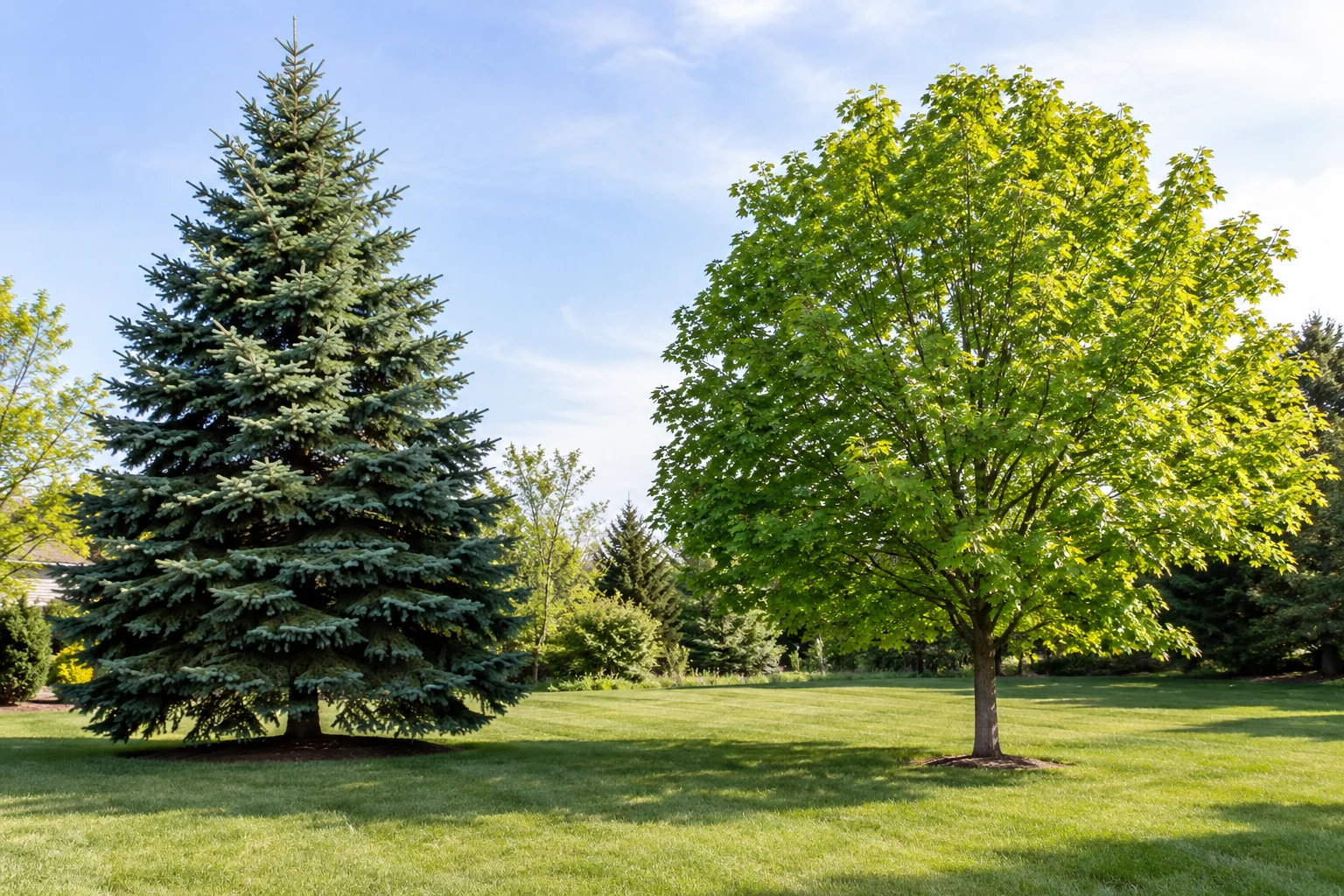
Do not reduce “mature fit” to height. Spread and canopy outline affect where shade may fall and how much space the tree occupies. The position must also allow for the developing trunk and for potential root or walking-surface concerns to be assessed locally. A narrow tree at purchase may have a mature form that defeats the purpose of a narrow planting strip. The Arbor Day Foundation specifically asks selectors to match mature height and spread to site constraints; University of Minnesota Extension likewise identifies room for mature height and width as an initial location check.
Keep unknowns visible. If fruit, litter or care would affect where you put a particular candidate, ask a local supplier or horticultural adviser about that named tree rather than assigning an unstated trait to it. If someone recommends a “native” tree, ask native to where? The Arbor Day Foundation points out that nativeness has a geographic context and that home sites are often altered from native habitats. Neither observation makes soil fit or local invasiveness irrelevant; both still need checking for the actual yard.
Here is a compact shortlist for the hypothetical front yard. A, B and C are author-defined profiles, not identified species and not botanical recommendations. In the example, local climate, light, soil and drainage, water and care requirements, and local noninvasiveness have been checked for each profile. Where a profile fails, that failure reflects those hypothetical checks—not a property to infer about any unnamed real tree.
| Profile | Locally checked characteristics in this example | Decision for this yard |
|---|---|---|
| A | A suitable deciduous form whose mature outline fits Q and can serve the seat’s seasonal-shade purpose. | Keep for a spot-by-spot check. |
| B | A locally suitable evergreen whose mature breadth would crowd both P and Q. | Reject for these two spots, despite its suitability for local growing conditions. |
| C | A compact profile whose locally checked drainage or water needs do not match this site’s conditions or the owner’s care capacity. | Reject for this yard as recorded; compact size does not fix the mismatch. |
Only A remains a candidate for the stated purpose and the available position. That does not make “A” a tree a reader could order. In a real shortlist, replace each profile with an actual species or cultivar, its local information source, its mature dimensions and shape, and the evidence behind every site-fit judgment. If the local information changes, change the shortlist rather than treating the example’s verdict as portable.
Check Structures, Roots and Services Before Approving a Spot
A viable species is only half the choice. Now ask whether a particular position can accommodate that tree as it matures. Compare the documented height, spread and shape with the roof and building, overhead lines, boundary, other planting, and any surface people must walk or maintain. Consider where the trunk would develop and whether root or structural questions at that spot need local assessment. This is a placement check, not another judgment of the sapling’s current pot size.
Look both above and below ground, but distinguish the risks. Overhead lines and roof space affect the tree’s long-term fit. Buried services also create an immediate excavation question: the Arbor Day Foundation identifies digging the planting hole as the main risk of interfering with underground lines. University of Minnesota Extension advises having underground and overhead utilities located and the position confirmed safe before planting.
Obtain service-location information through the proper local process and confirm the clearances and permissions applicable to the proposed spot before any digging. The appropriate utility, landscape or arborist guidance governs the actual location decision and safe excavation. Numbers encountered in Arbor Day Foundation guidance are contextual US rules of thumb, not worldwide codes for a reader’s property. This guide cannot determine a universal distance from a line, building or path, and a drawing cannot substitute for local confirmation.
Later root concerns are a separate question from the act of digging. The Arbor Day Foundation observes that already broken water or sewer lines can admit roots. That is narrower than a claim that roots inevitably break sound pipes, or that every tree within some fixed radius will cause a conflict. If there is a known pipe issue, a structural concern or a question about an existing tree’s roots, seek assessment suited to that actual condition. Do not guess a safe root boundary from a picture.
Apply the same discipline to a spot that otherwise looks ideal. A canopy might have enough room, and the path might remain open, while the service status is still unknown. Conversely, verified service information could rule out a seemingly spacious patch. Treat each unresolved question as an entry in the decision record rather than quietly marking it “clear.”
Stop at a provisional position if services, required clearance, permissions, or a material structural or root concern remain unresolved. Get the relevant local confirmation or qualified assessment before approving planting. No preference about appearance or feng shui can turn an unverified spot into a safe excavation site.
Use Feng Shui to Assess the Approach, Not Override the Site
Feng shui practitioner Anjie Cho describes a small bush or tree immediately blocking an entry door as potentially problematic in her practice. She also says whether it is acceptable depends on personal preference and circumstances. This is a particular entrance interpretation, not a blanket prohibition on planting near a house, a compass-direction rule or a measured prediction about what will happen to its occupants.
One practical way to use that interpretation is to ask whether the approach feels intentional and is easy to read. Can someone arriving for the first time identify the path to the front door? Can they walk it without negotiating the tree, and can the door open and be used? Those are ordinary usability questions you can check on site. They do not establish or measure an “energy flow.” A household may also like the appearance of a tree near its entry even when another household would prefer an open view; Cho’s qualification leaves room for that preference, provided the physical constraints still work.
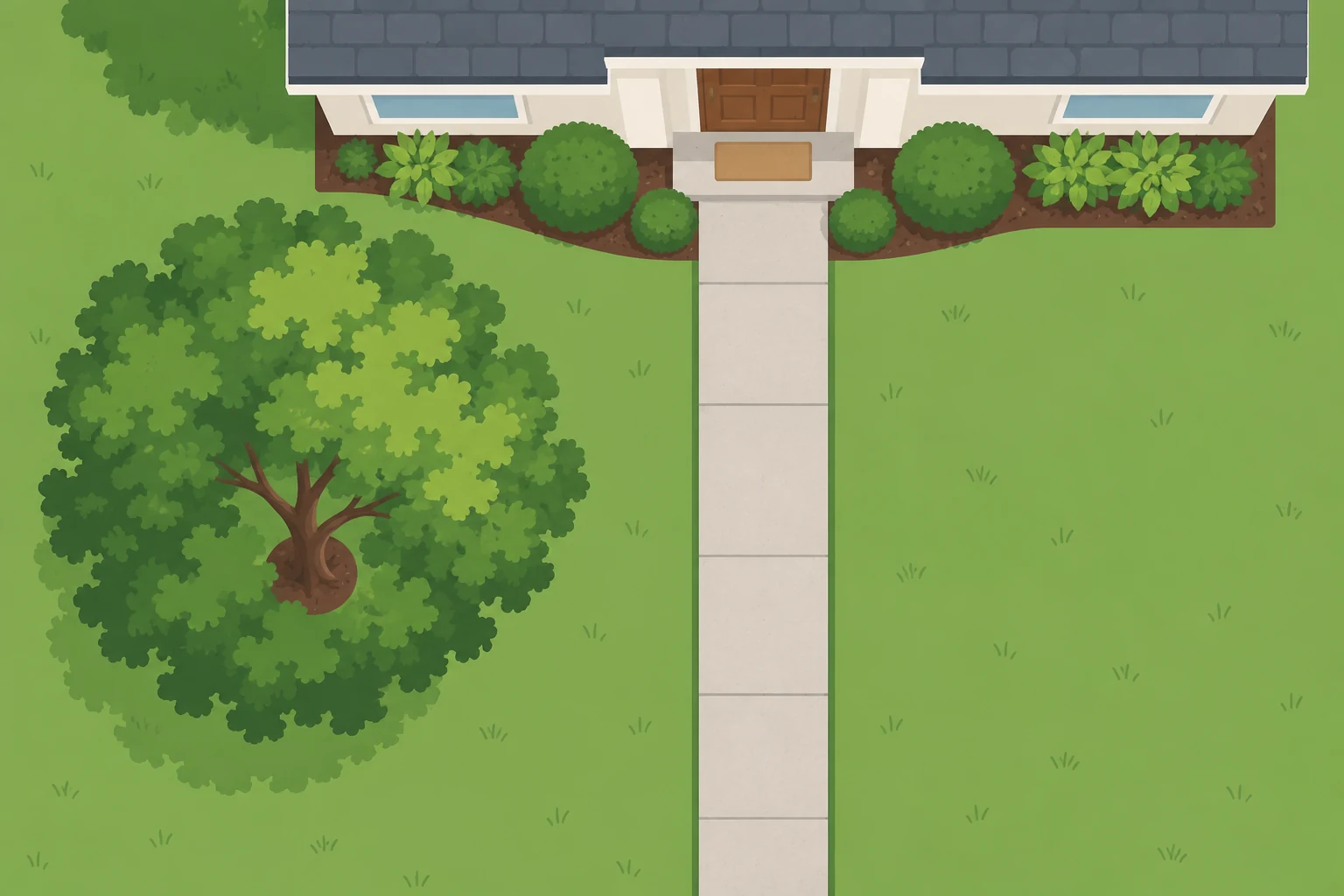
For an existing object near a door, Cho suggests making it an attractive feature or clearly distinguishing the walkway to the front door. Her feature suggestion is an interpretation about drawing attention toward the home; it is not an instruction to install lights or make a physical alteration. A visible, unobstructed existing walkway may address a confusing arrival route without moving the tree at all. Whether that is enough depends first on what is actually obstructed.
Use the entrance reading after, not instead of, the site checks. A clear approach does not prove that a candidate suits the soil or that a digging location is clear of services. Equally, a locally suitable tree does not justify a position that makes the front door difficult to reach. The point is to make the arrival route legible while letting growing conditions, mature space and safety govern the physical choice.
Pair the Shortlisted Tree with a Workable Position
Return to the hypothetical yard with the seat, established front path and two marked positions. The locally checked shortlist has left A, a deciduous profile with a mature outline that fits the side garden, as the candidate for seasonal shade. The next question is not “Where can its young trunk fit?” but “Which spot can serve the seat while accommodating its mature outline, the roof and other planting, and the route to the door?”
P, the narrow entry strip, fails that test. Even if a purchased A would fit there today, its mature form would crowd the established path and entrance. The strip is part of how people approach and use the door, not spare space merely because it has an opening in the soil. Choosing a smaller-looking tree at purchase would not change the recorded mature dimensions. P is rejected on physical fit and entrance usability; no claim about measured energy is needed to reach that verdict.
Q, the side garden outside the ordinary arrival route, is the preferred match for A. In this hypothetical, A’s locally checked growing needs match the site, and its mature canopy outline fits Q while serving the seasonal-shade goal at the seat. The pair also leaves the walking route usable and, as drawn and checked in the example, has room relative to the roof, boundary and existing planting. That reasoning is specific to A at Q: a suitable tree in an unsuitable position, or a spacious position paired with an unsuitable tree, would not pass.
The other profiles do not become good choices by changing labels on the sketch. B is locally suitable as a growing profile, but its mature breadth crowds both P and Q. Moving it between those positions does not create space. C is compact, but its locally checked drainage or water needs conflict with this yard’s conditions or feasible care. Moving it to Q does not, by itself, cure that mismatch. If different local evidence identified a genuinely suitable site and care plan for C, it could be assessed anew; that is not what this example’s record shows.
There is a crucial pause in the timeline. When P and Q were first sketched, buried-service information was unverified. Calling A at Q “preferred” did not approve digging. Before the fictional owner approves any digging at Q, this illustrative selection record assumes that the proper local service-location process and appropriate clearance confirmation have subsequently been completed for Q. This is an assumed check within the example, not a utility call performed for this article. The record explicitly changes from “unverified” to “confirmed for Q”; an unmarked or blank piece of ground would not justify that change.
With those illustrative checks, mature fit and entrance usability all passing, the example’s decision is: choose A at Q; keep P clear. For your own yard, that sentence becomes actionable only when “A” is replaced with an actual species or cultivar and your file contains its local evidence, mature footprint at the proposed spot, intended function, fit with the roof and other planting, usable entrance route, verified services and clearances, and feasible care plan.
If a boundary check, local guidance or newly verified service information rules Q out, the verdict changes: A at Q remains provisional and should not be planted there. Recompare locally suitable tree-and-spot pairs, consider another feasible position if one can be checked, or choose not to plant a tree for this purpose. A symbolic preference cannot override utility guidance, and an appealing species does not oblige you to use a yard position that fails.
Decide Whether an Existing Entrance Tree Needs Any Change
An existing tree calls for a separate decision. Do not apply the new-planting comparison as an instruction to remove it. Cho explicitly resists advising that a tree or bush be cut down for the entrance concern. A healthy, sound tree need not be removed solely because someone interprets its position as symbolically awkward. Its health, safety and any structural-root issue are different questions for a qualified local assessment, not a rating based on a photograph or on feng shui.
Consider a second hypothetical entrance. An established walkway already passes a tree and has usable physical clearance, but the arrival route is visually unclear. Assume for this example that the tree is sound and that the owner has authority over the area. Walk in as an ordinary visitor would: can you find the walkway, pass the tree comfortably and operate the door? If the route works physically, an owner-authorized, nonobstructing cue that defines the existing path—or attention to the tree as an attractive feature—may make the approach easier to recognize. Cho’s suggestions support considering a clearer walkway or feature; whether a particular cue is permitted and useful depends on the property.
If that route check passes, the conditional decision is straightforward: retain the tree and keep the usable route clear. There is no need to create a new path merely to satisfy an abstract preference for symmetry or openness. Check that any proposed visual cue itself does not obstruct passage.
The answer changes if the trunk or roots actually block the walkway or door access. Highlighting the path cannot create physical clearance. Ask the appropriate property or local professional about a feasible path solution and any tree-care or safety question. Do not treat DIY pruning, tree removal or digging a new, unverified path as an automatic feng shui remedy. A suspected hazard, declining tree health or material root conflict likewise deserves qualified local attention before deciding what to change.
Hand the Approved Choice Over to Establishment Care
Only after the actual tree and spot, required service checks, clearances and local permissions are confirmed should planting proceed under applicable local guidance. The example’s A at Q passes only because its fictional record includes those confirmations; your own unverified choice remains a plan, not permission to dig.
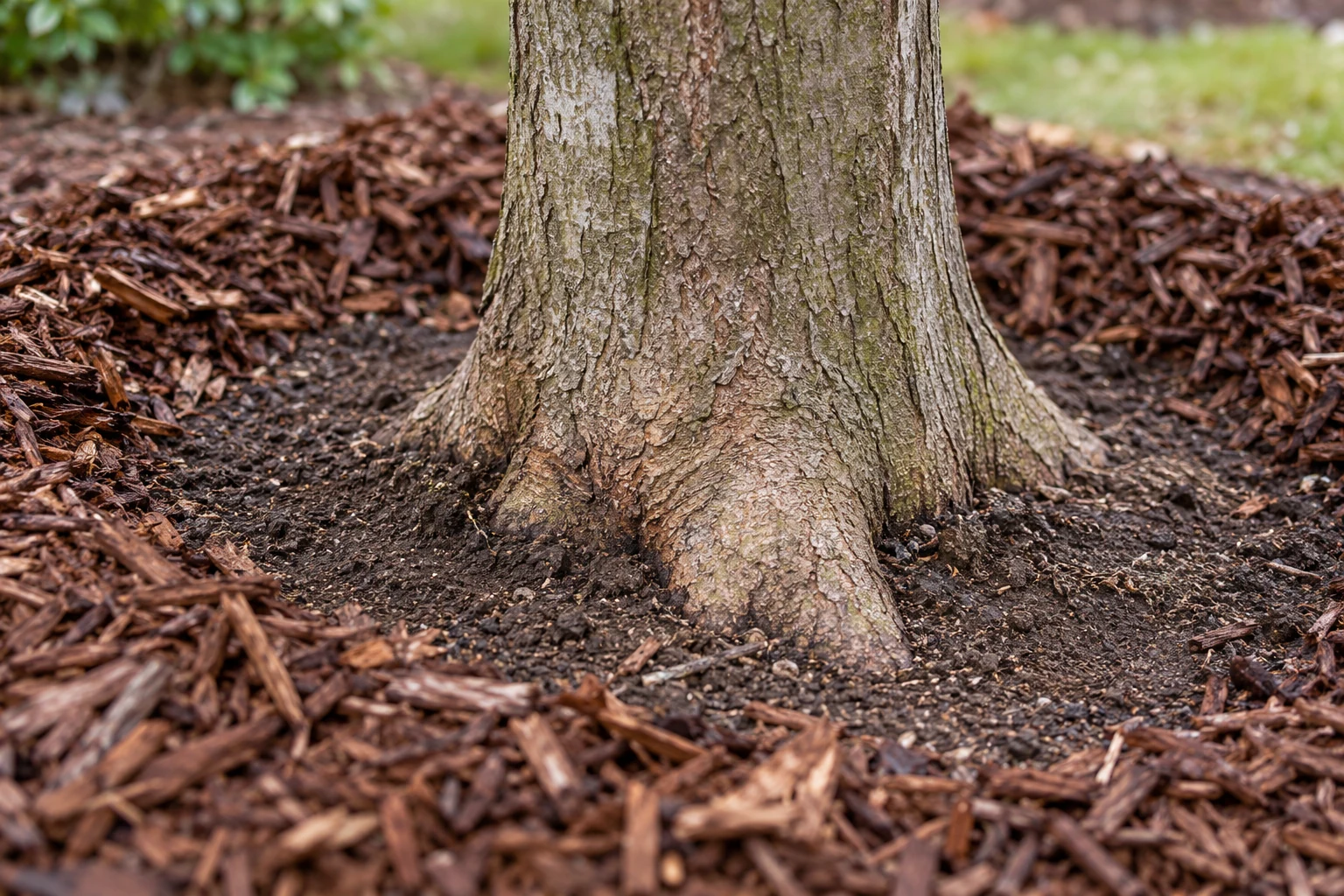
Give the chosen tree an establishment plan suited to its identified species and your locality. University of Minnesota Extension says the root flare—where the trunk widens into roots—should remain visible above the soil line. It emphasizes deep watering rather than assuming lawn sprinklers adequately water a tree, and advises keeping mulch away from the trunk instead of piling it into a “mulch volcano.” These are useful handoff checks, not a complete planting recipe or a promise that the tree will establish.
Watering needs observation rather than a fixed schedule copied from another yard. Minnesota Extension describes checking soil moisture 4–8 inches down in its guidance. Use that as an example of assessing actual soil conditions, not as a universal watering depth, amount or frequency, or proof that one check alone prevents overwatering. Let the named tree’s needs and local advice determine the care plan.
Your final decision record should be readable without the hypothetical profiles: named species or cultivar and evidence of local fit; the tree’s primary purpose; its mature height, spread and shape at the chosen position; fit with the entrance, roof, boundary and other planting; confirmed service status and required clearances; and care the household can provide. For an existing tree, record whether the route is physically usable and visually clear, or what qualified assessment is needed.
If an essential external check is missing, stop at a provisional choice. If it passes and the tree-and-location pair still serves its purpose, proceed with locally appropriate planting and care—without treating either good placement or feng shui interpretation as a guarantee of establishment or any other outcome.