A window can make a room feel bright, warm, exposed, drafty or stuffy—but those words describe an experience, not a permanent property of the room. Light that helps with one task may glare during another. Sunlight and cold glass affect comfort in different ways. A view out may come with a sightline in, while opening an operable window depends on the weather and outdoor air.
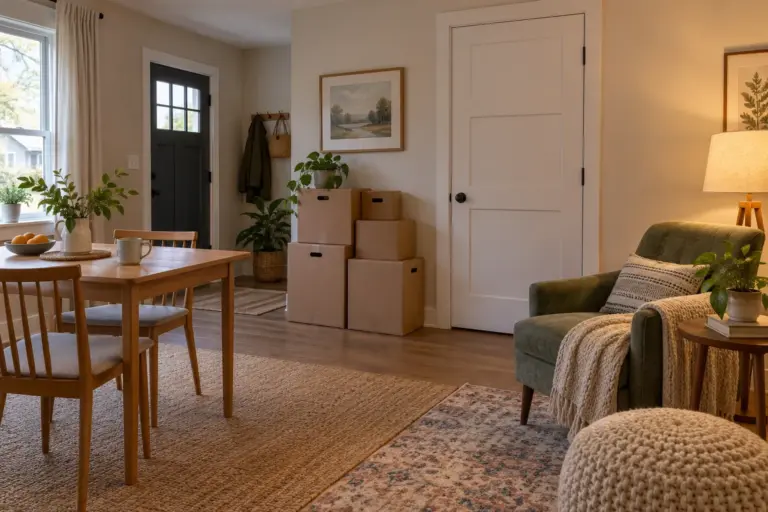
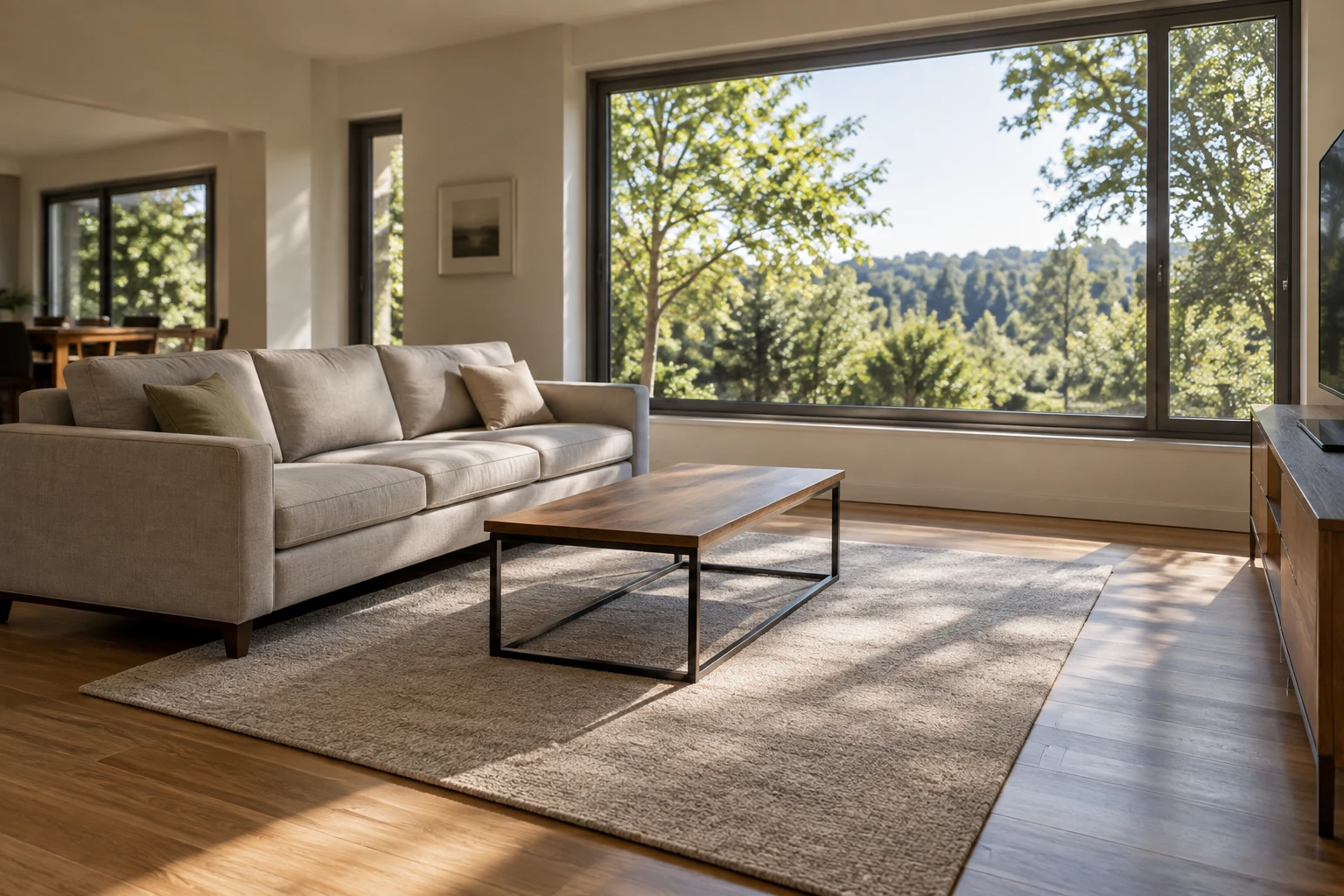
Consider one hypothetical street-facing living room throughout this article. It has a fixed window on one wall, an existing blind that can be adjusted, and a resident-owned reading chair and side table beside the window. The route from the door to the sofa runs away from that wall. Nothing about this layout calls for replacing the window or blocking the route. It gives the resident a way to ask a more useful question than “Is this a good window?”: What does this window do for this person, in this position, at this time?
When Daylight Helps—and When the Same Window Causes Glare
Daylight reaching a room is not identical to daylight serving an activity. The U.S. Department of Energy describes window type, placement and interior design as factors in how sunlight enters a home. For a reader, the next question is where that light lands: it might illuminate a page, or reflect from the page toward the reader’s eyes. Those are different experiences even though the window and chair have not moved.
In the hypothetical living room, the resident reads comfortably in the chair during the morning. Daylight reaches the same page without a troublesome reflection. Late in the afternoon, reading that page from the same chair becomes uncomfortable because light reflects from it. The stipulated observations do not show that the room has “too much daylight” overall. They show that a particular task, surface and time of day produce glare. Moving from “this room is bright” to “this page reflects light at this hour” makes the problem easier to describe and the possible change narrower.
The distinction matters for other uses of the room, too. Light that the resident likes while looking across the room need not work equally well when their gaze drops to a page. Conversely, reducing the reflection need not require making the whole room dark. In this example, the existing blind offers a reversible way to compare those outcomes: a partial adjustment might interrupt the troublesome light while leaving useful daylight and some outlook. Whether it actually does so belongs to the trial later in the article, not to an assumption about blinds in every room.
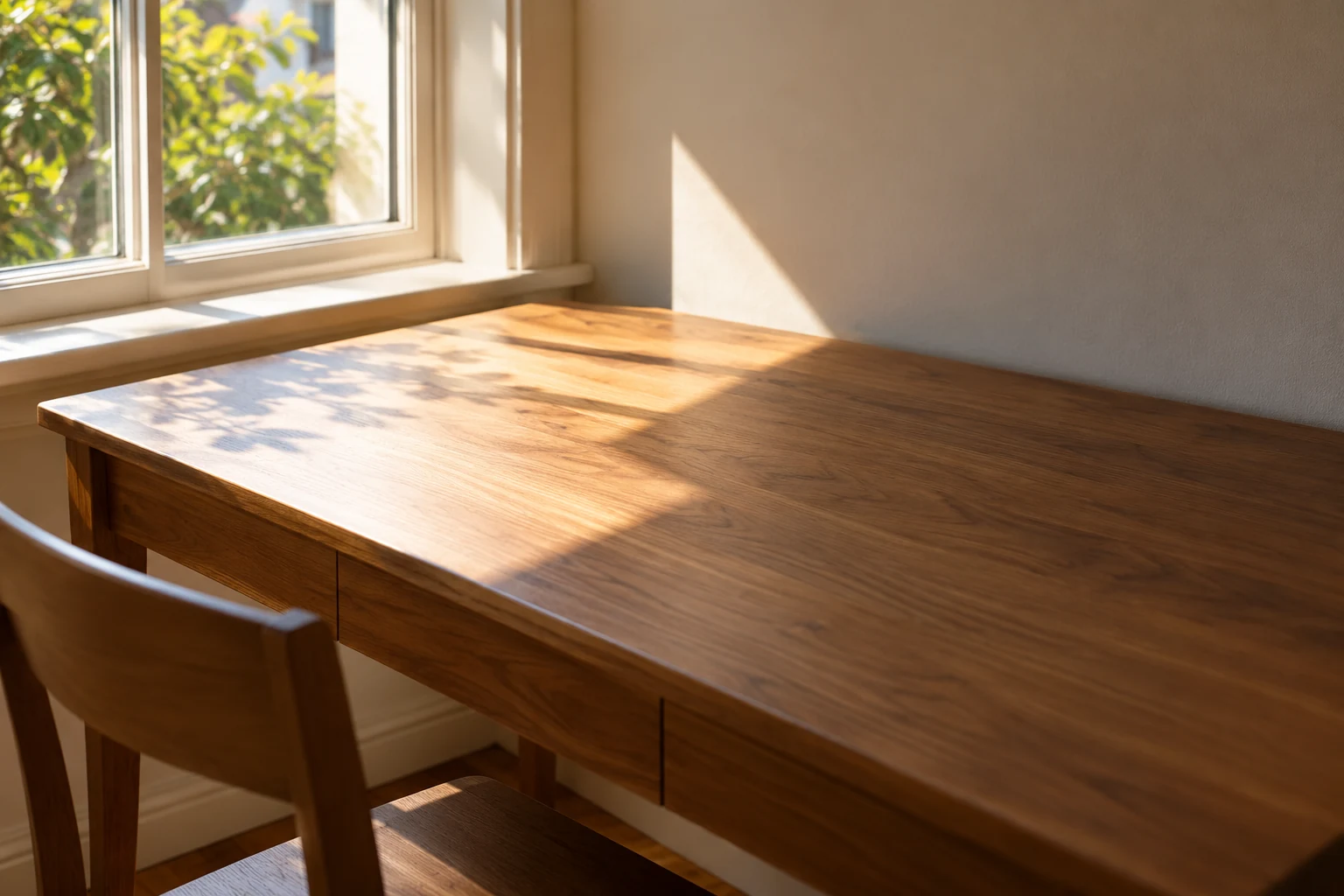
Orientation can inform that comparison without deciding it. In its daylighting discussion, the Department of Energy identifies excess heat and glare as problems with east- and west-facing windows in that example. That is not a universal ranking of directions for this reader’s home. Climate, season, hour, the task being done and the actual window’s performance all matter to what a resident experiences. A direction label alone cannot tell them whether their morning page is readable or their afternoon page reflects uncomfortably.
Daylight is also one part of a room, rather than its sole measure of quality. The UK National Design Guide includes sunlight, daylight and ventilation among qualities of internal residential space. In the hypothetical room, preserving useful light is therefore a real consideration—but so is controlling the reflection. The resident can describe both honestly: “The morning light helps me read” and “The late-afternoon reflection makes the same page difficult.” Neither observation requires declaring the window good or bad for every hour.
Why a Sunny Window Can Feel Warm and a Cold One Can Feel Drafty
Sun coming through a window and cold felt beside its glass are not opposite ratings of one feature. They involve different conditions and mechanisms. A Department of Energy window-performance guide says transmitted solar radiation can feel pleasant during cold periods, within limits, while detracting from comfort in warm weather. The same patch of sun might therefore be welcome at one time and unwelcome at another; the relevant comparison is the resident’s experience under the actual season, weather and time of day, not an enduring verdict that a sunny window is comfortable.
Now imagine a separate cold-period possibility for the hypothetical chair beside the fixed window. The resident feels chilly there although the air elsewhere in the room feels comfortable. That sensation would not, by itself, establish that the room-air temperature is low. The Department of Energy guide explains that a person exposed to a cold window surface can lose radiant heat toward that surface and feel uncomfortable even when room air is comfortable. In plain terms, the nearby cold surface changes how warm the seated person feels; a general impression of the room’s air need not capture that local experience.
A draft sensation has another possible explanation. The guide describes air cooling beside a window, descending toward the floor and being replaced by warmer air from above. That circulation can feel drafty. It does not require air to be entering through a gap. A seated person might notice moving, cooler air near their legs and reasonably call the spot “drafty,” while still not knowing what caused it.
Actual leakage remains a distinct possibility, not something to rule out from a chair. The same guide separately identifies leaking windows associated with poor installation or ineffective weather stripping as a cause of drafts. Thus “I feel a draft beside the window” is a useful observation, but not a diagnosis of the frame. Radiant heat loss, circulating air cooled by the glass and incoming air through leakage are not interchangeable explanations. Nor does a comfortable feeling in the middle of the room prove that the seat beside the glass will feel comfortable.
That distinction suggests a limited, reversible comparison rather than a repair prescription. If the chair belongs to the resident and can be moved without obstructing household routes or access to window controls, they could compare sitting farther from the glass with sitting beside it under similar cold conditions. They would record where discomfort occurs and what it feels like, not infer a measured window performance from the result. In the article’s main afternoon blind trial, however, the chair stays put: changing two things at once would obscure what that trial shows.
If the cold sensation persists, if a leak is suspected, or if the cause matters for a property decision, the appropriate next step is property or qualified assessment. Feeling cooler after moving a chair might make that position preferable; it would not prove the frame sound. Feeling drafty near the original seat would not prove it defective. The resident can use “cozy” or “drafty” as precise descriptions of a place and moment without turning them into technical findings.
When Opening a Window Helps—and When Keeping It Shut Makes More Sense
The example living room’s window is fixed. Its blind changes light and sightlines; it does not open the glass or ventilate the room. Ventilation becomes a window choice only in a different room—or at a separate opening—where an operable window exists and can appropriately be used. That distinction prevents a successful glare adjustment from being mistaken for an air-quality intervention.
For an operable window, the conditional benefit is straightforward. The U.S. Environmental Protection Agency says opening windows and doors increases the outdoor ventilation rate when weather permits. It also says natural ventilation can reduce pollutants already indoors and, if used properly, can at times help moderate indoor temperature, including when cooling is unavailable or limited. More outdoor air can therefore be relevant when indoor air needs exchanging, or when conditions make natural temperature moderation useful. Neither possibility says that a sash should always be open, or that an open sash establishes good air quality.
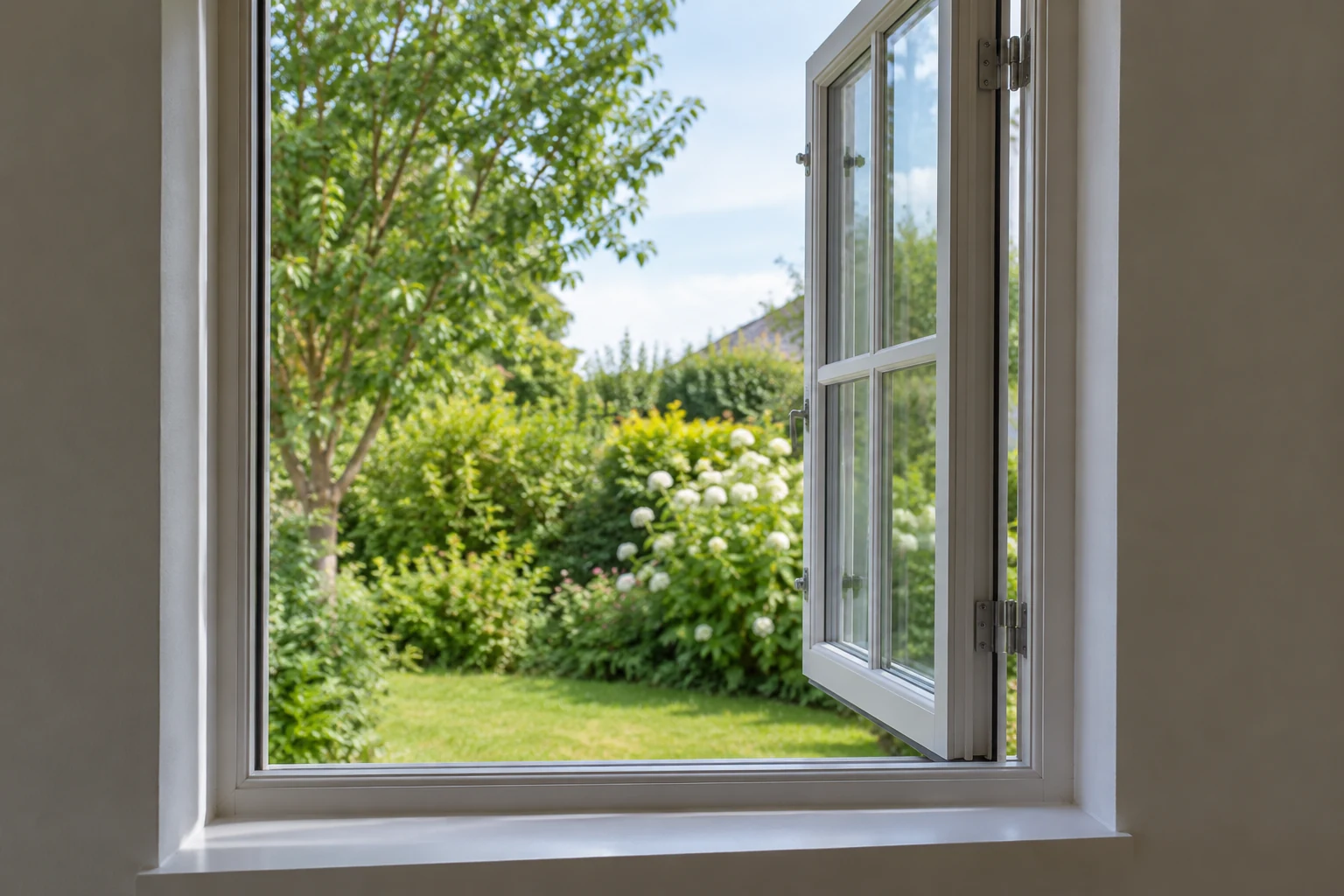
The outdoor side of that exchange matters. EPA says outdoor particulate matter can enter through open doors and windows and advises keeping windows closed when outdoor pollutants are high. If outdoor pollution or smoke is high, opening an otherwise usable window is not the sensible ventilation choice on the theory that “fresh air” is automatically better. Weather may also make opening impractical. The decision depends on actual conditions, not merely on whether the room feels stuffy.
There is a separate question before exchanging air: is there an indoor source that can be addressed? EPA says source control is the most effective solution for most home indoor-air-quality problems. If a resident can identify a source in the home, dealing with that source is a different decision from repeatedly opening a window. Ventilation may dilute pollutants already indoors under suitable conditions; it does not make an ongoing source irrelevant, and unlimited opening is not a substitute for deciding what can be changed at the source.
A resident can still make useful observations without claiming to measure air quality. They might note that a room feels stuffy at a certain time, whether a usable operable opening exists, what the weather is like and whether outdoor pollution makes opening inappropriate. If they do open an operable window under suitable conditions, they can note how the room feels afterward. Those entries describe experience and available choices. Stuffiness does not identify a pollutant, and a perceived change does not measure pollutant concentration or establish a health outcome.
For the fixed-window living room, the honest audit entry is especially simple: this window offers no opening choice. Its afternoon blind position should be judged for reading, daylight, outlook and access—not credited with ventilation. If the household has another operable opening, whether to use it remains a separate weather- and outdoor-air-dependent decision. Keeping those choices apart makes it possible to enjoy the light from a fixed window without assigning it an air-exchange function it does not have.
Looking Out, Being Seen and Hearing What Is Outside
A window creates at least two visual questions. What can the seated resident see outside? And what view might someone outside have into the room? An outward view the resident enjoys does not settle the second question. The UK National Design Guide treats privacy and daylight as considerations in internal residential space; it also describes the potential for separation from adjoining public space to give living areas a degree of privacy. These are reasons to examine a sightline, not evidence that any particular passerby sees into this hypothetical home.
In the example room, the chair offers a preferred outlook toward the street. In the evening, with indoor lights on, the seated reader feels exposed to the public-side sightline. This is a stipulated description of the reader’s experience, not a test of what every person outside can see. The resident might care about the view in the morning and still want a covering in the evening. Calling the room “exposed” captures that difference better than calling the window simply attractive or unattractive.
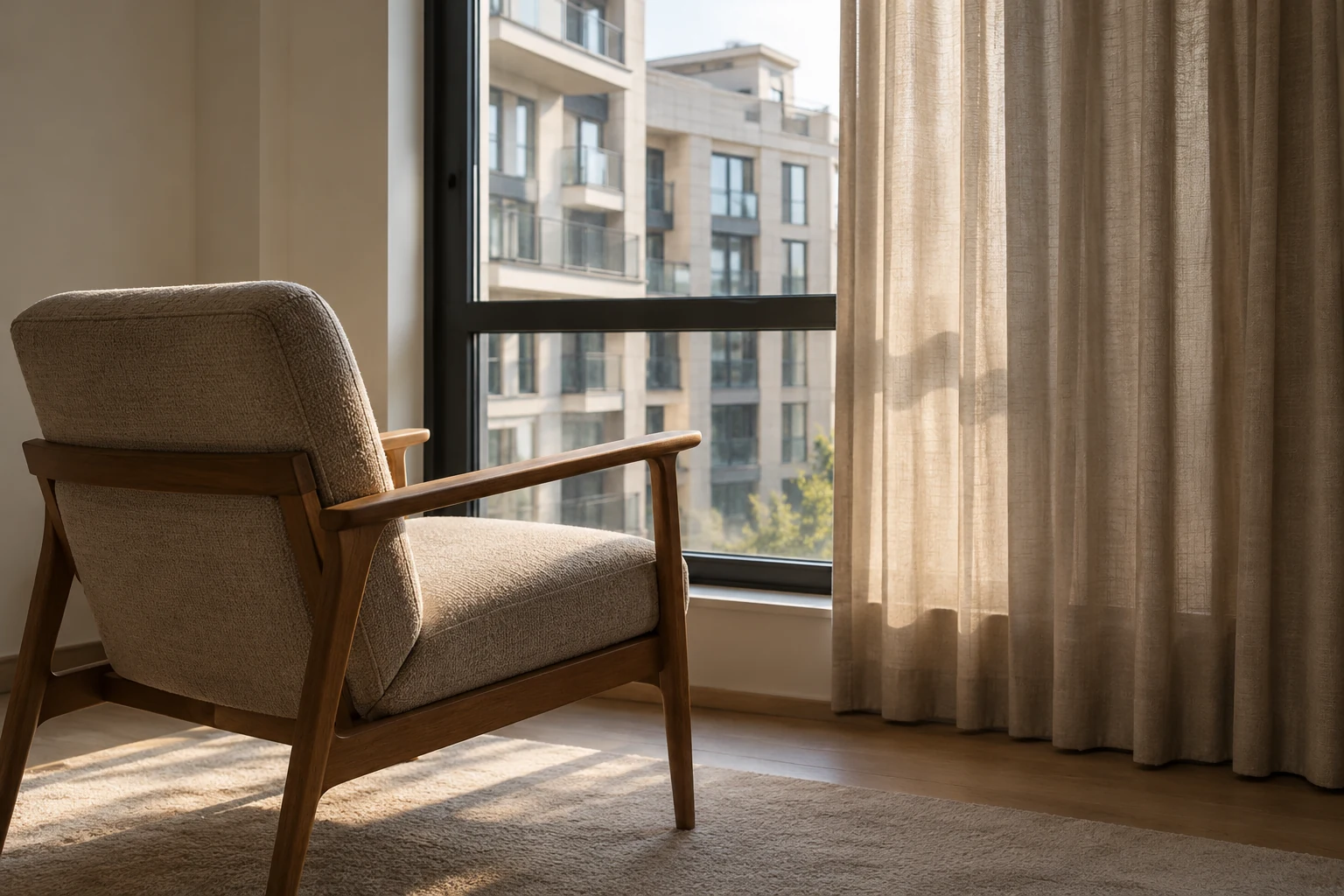
The afternoon glare problem creates its own tradeoff. Closing a blind enough to interrupt the reflection could also reduce daylight or hide the outlook the resident likes. Leaving it fully open preserves the view but, in the stipulated afternoon, leaves the page uncomfortable to read. A partial position is worth comparing because it might retain some of both; it is not automatically the best position. Evening privacy must then be considered separately. Even if a partial setting works for afternoon reading, that result cannot show that the same setting gives the reader the privacy they want after dark.
Sound adds another dimension without following either sightline. The National Design Guide includes minimizing sound pollution and providing personal control among design qualities, and notes that how a place sounds contributes to its experience. In a real room, a resident can listen from the chair while the window is closed and describe what is audible and distracting. Where a window can be opened and conditions permit, they can separately notice what changes when it is open. The example window is fixed, so there is no open-versus-closed comparison to perform there. A report that traffic is noticeable, or that one position is more pleasant to sit in, is not a measured acoustic result.
Consider a different, hypothetical courtyard-facing room as a comparison, not a promised upgrade. A sheltered outlook might show a resident something they prefer to look at, have a different inward sightline and come with different sounds. Those differences could make that room feel more like a refuge to that person. Courtyard-facing alone, however, cannot establish that its air is cleaner, its window thermally better or its sound measurably lower. It may still have inconvenient glare at a particular hour, limited airflow choices or a sightline from another position. Meanwhile, the street-facing room may be entirely usable for reading after a specific adjustment.
The practical comparison is consequently about the actual person and activity: from this chair, what is worth seeing, when does being seen matter, and which sounds draw attention? A view can be appealing without providing privacy. A covering can improve a reader’s sense of privacy while sacrificing part of that view. Neither choice can be made well by treating “street-facing” and “courtyard-facing” as complete descriptions of how the rooms feel.
A Reversible Room Audit Using a Feng Shui Lens
The Feng Shui Society presents home feng shui in terms of people responding to their environments and explicitly includes natural light and views in its discussion. That offers an interpretive lens for noticing what a room invites someone to look toward, and how its light feels in use. It sits alongside the physical distinctions above and the household’s own preferences; it does not explain radiant heat loss or establish a ventilation rate. The Society itself says feng shui cannot guarantee wealth, health or happiness.
For this window, a bounded author-designed observation audit asks five questions. What light serves the activity, and when does it interfere? Where does the person feel warmth or cold? Is ventilation possible at this window, and would opening an operable one elsewhere be appropriate under the actual weather and outdoor-air conditions? What does the seated person see, and who might see in? What is audible from that position? These questions organize a resident’s comparison; they are not an empirically validated treatment or a way to predict an outcome.
Here is the filled record for the same hypothetical reader. Entries marked for checking are deliberately not invented measurements or improvements:
| Time and activity | Observation in this hypothetical room | Decision or question |
|---|---|---|
| Morning: reading in the chair | Daylight makes the page useful to read; the resident likes the outlook. | Leave the existing blind open for this useful light. Temperature and sound still require observation under actual conditions. |
| Late afternoon: reading the same page | Light reflected from the page is uncomfortable. The chair, side table and door-to-sofa route have not changed. | Try one change to the existing blind; compare readability, remaining daylight, outlook and access. Do not attribute an air change to the fixed window. |
| Evening: seated with indoor lights on | The reader feels exposed to the public-side sightline. | Consider an evening covering position if the actual privacy conditions warrant it. Check audible surroundings as experienced; afternoon glare relief does not decide evening privacy. |
The one afternoon trial changes only the existing, permitted blind. The reader leaves the chair and side table beside the fixed window, keeps the window and door as they are, and leaves the door-to-sofa passage clear. In this stipulated trial, a partial blind position removes the troublesome reflection from the same page. The reader can now read it, while useful daylight and part of the preferred outlook remain. The blind controls remain usable, normal use of the fixed window is unaffected, and movement between the door and sofa still works. These are results specified for the example, not a prediction that another room’s blind will behave the same way.
For this reader, the decision follows the observed result: keep that partial position during the affected afternoon reading period, then reopen the blind for the useful morning light. If evening exposure matters under the actual sightline conditions, choose an evening covering position separately rather than treating afternoon glare control as proof of nighttime privacy. The trial says nothing about improved temperature, ventilation or sound.
In a real room, a failed trial should be reversed. If a partial blind still leaves glare, removes too much valued view or interferes with controls or passage, the resident can restore the original position and compare another feasible choice—such as an owned chair position only where routes and controls remain usable. Retest with the actual reader, page, hour and household constraints. A window has no single effect on a home: its value is felt through the task, conditions, sightlines and reversible choices available at the time.