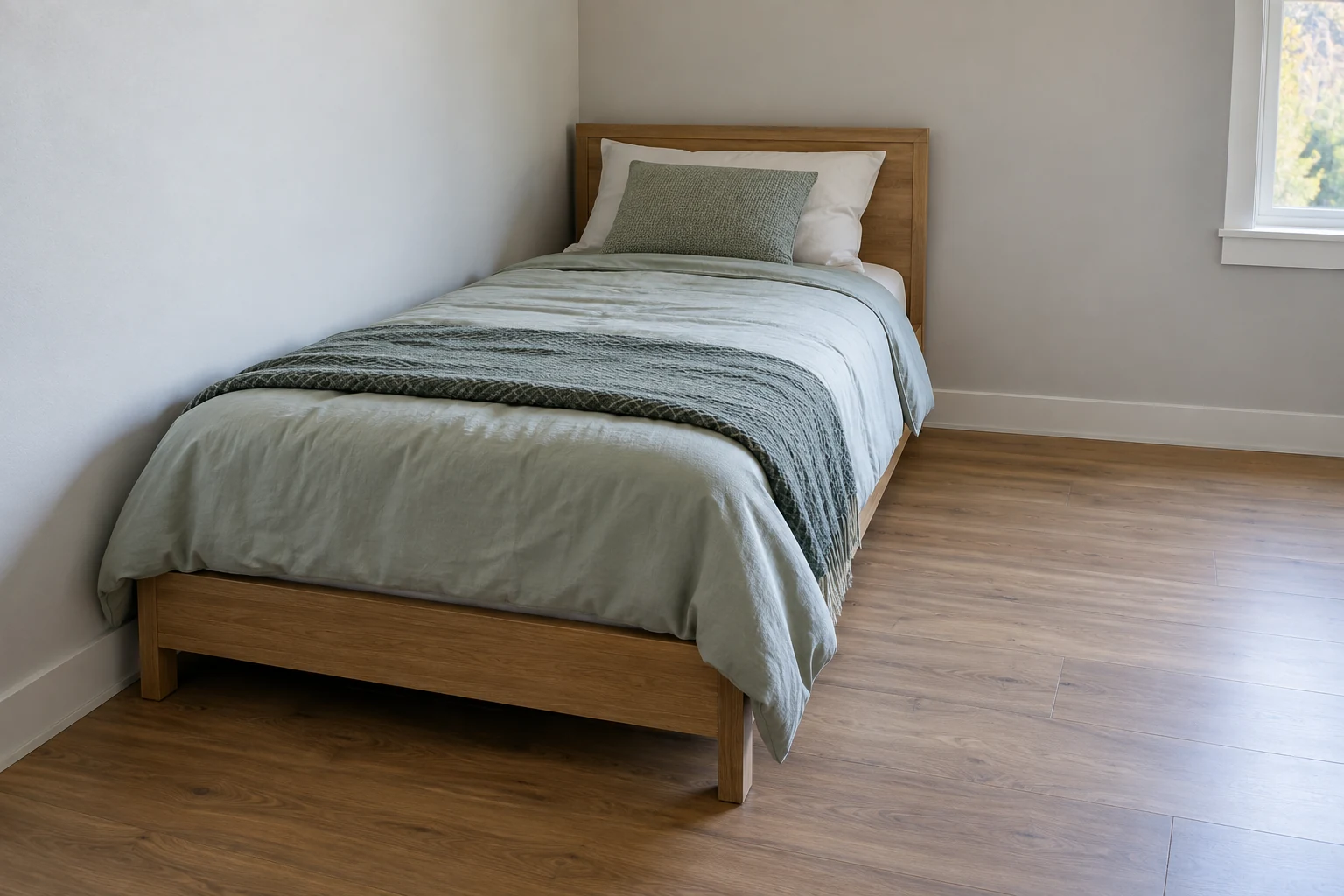
No. Putting one long side of a bed against a wall is not an absolute feng shui ban. It does, however, give up access from that side. The Feng Shui Society recommends that a bed be accessible from both sides, while expressly allowing a single bed, such as a child’s, against a wall . For two people sharing a bed, the question is whether each person can approach and leave comfortably—and whether opening the wall-side gap would make the rest of the room harder to use.
Start with the room rather than an idealized bed diagram. Who sleeps there? Where do the entrance and storage open? Which routes must remain usable? A bed can also have its head against a solid wall; that is a separate placement consideration, not a reason to press a long side against one. Feng Shui Society practitioner guidance describes a solid wall behind the head of the bed . In a tight room, you may be able to satisfy that preference while still having to choose between access beside the bed and access elsewhere.
The Long Side and the Head of the Bed Are Different Questions
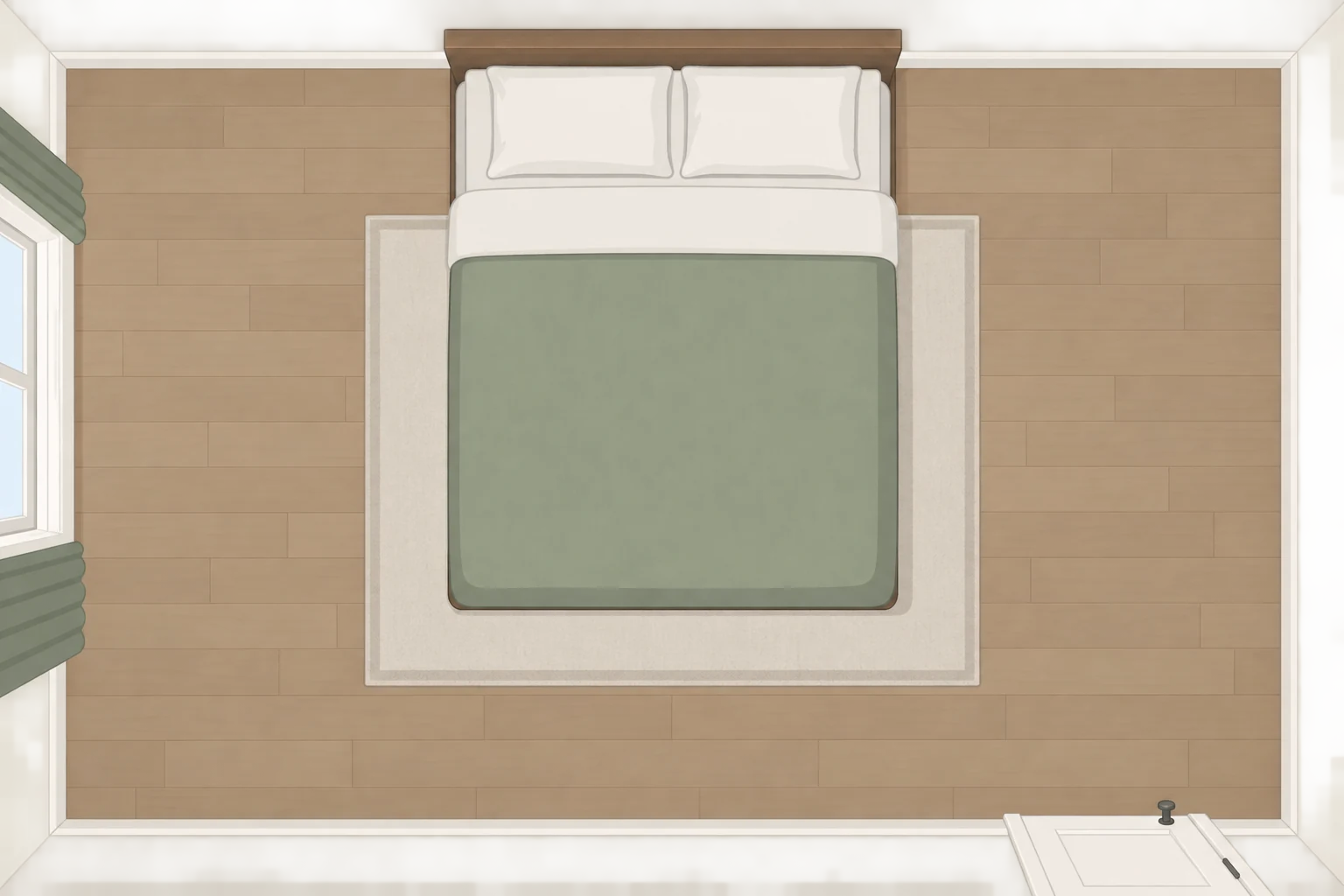
Picture the room from above, with the head of the bed at the top:
`text
solid top wall
┌──────────────────┐
left │ HEAD OF BED │
wall ───│ │
│ left long side │
│ touches wall │
└──────────────────┘
`
The head is the bed’s short edge at the top. The left long side runs from head toward foot. In this sketch, the head has a wall behind it and the left long side touches another wall. Those are two conditions that can occur at once; they are not two names for the same condition.
Feng Shui Society practitioner guidance calls for a solid wall behind the head of the bed . Separately, the Society’s bedroom guidance favors access from both sides, with an express exception for a single bed such as a child’s . Head support therefore does not settle the side-access question. Moving the bed away from the left wall might open an approach along that side without moving its head away from the top wall.
The physical distinction is useful even if you set feng shui terminology aside. A wall behind the head describes what backs the bed. A wall along a long side occupies the space where someone might otherwise stand to get in or out. Whether that missing approach matters depends on the sleepers and on what the extra bed space would displace. Neither wall contact, by itself, predicts anything about the people who sleep there.
Who Sleeps There Changes What Side Access Means
For two people sharing a bed, access along both long sides offers each person a separate way to approach and leave. If one long side touches a wall, the person sleeping there cannot step directly onto the floor beside that side. They may instead need to move toward the foot or use the other person’s side. That is the practical reason the Society’s both-sides preference has particular force for a shared bed .
It is a preference worth trying to meet, not permission to ignore the rest of the room. Suppose pulling a shared bed away from a wall gives the wall-side sleeper a gap, but takes away the route someone needs to reach the entrance. The drawing may look more balanced, yet it has not produced a usable arrangement. Likewise, if one sleeper needs a particular way out of bed, the other sleeper’s view of a symmetrical floor plan cannot stand in for that person’s actual access needs. The household’s normal use has to be part of the comparison.
A solo adult presents a different practical question: does the one open side provide an approach that works for that person, while leaving the room usable? A solo sleeper does not have to arrange independent long-side approaches for two occupants. Still, do not turn that observation into a blanket feng shui endorsement of every single-adult bed against a wall. The Society’s wording makes a narrower point: it says a single bed such as a child’s can be placed against the wall, alongside its general preference for access from both sides . It does not assess every adult, bed size, room shape or daily route.
For a child’s single bed, that express allowance answers the narrow side-wall question: wall contact is not automatically disqualifying under the cited guidance . It does not say that any placement works regardless of the door, furniture or people who use the room. Nor is it guidance about infant cots or cribs; no infant sleep-safety conclusion follows from this bed-placement exception.
The useful distinction across all three cases is between having a preferred second approach and having a workable necessary approach. Two people generally have more reason to value separate long-side access than one sleeper does. But if a proposed improvement removes access someone actually needs, it is not an improvement for that household. Judge the bed with its occupants in the room, not as an isolated rectangle on a page.
What a Move Changes in a Small Shared Room
Consider an explicitly hypothetical small room viewed from above. Two adults share a bed. Its head rests against a solid wall at the top of the room, and its left long side touches the left wall. An inward-opening entrance is at the bottom right; a wardrobe runs along the right wall.
`text
solid top wall
┌────────────────────────────┐
│ BED WARDROBE │
left │ BED WARDROBE │ right
wall │ BED WARDROBE │ wall
│ │
│ foot route entrance ↷│
└────────────────────────────┘
`
In the starting position, stipulate that this household can use the route past the foot of the bed, open the entrance and use the wardrobe normally. Those working routes matter. The arrangement is nevertheless a compromise: the sleeper against the left wall lacks an independent approach along their long side. Calling the room usable does not make that unmet preference disappear.
Now compare one possible move: pull the bed to the right far enough to open a left-side approach, while keeping its head against the top wall. The proposed gap must be more than visible on the sketch; the wall-side person would need to be able to use it. Meanwhile, the bed’s entire footprint shifts toward the wardrobe. Space gained on the left is space no longer available in the same place on the right.
Check other placement ideas separately rather than treating the new gap as an all-purpose feng shui improvement. In both stipulated positions, the head remains backed by the solid top wall. From a normal pillow position, the door remains visible and the bed is not directly in line with it. The Society’s practitioner guidance mentions a view of doors and windows together with a solid wall behind the head . A separate International Feng Shui Guild article describes a bed’s “command position” as seeing the door without being directly in line with it . That door-view description is not a rule for how wide a side gap must be.
At this point, the rightward move has a clear potential benefit: it could give the wall-side sleeper their own approach. It has not yet passed the more demanding question of whether the entrance, wardrobe and household routes still work with the bed in its new position. That answer belongs to this particular room and its users, not to the sketch alone.
Test the Real Footprint Before Keeping a New Position
For an actual comparison, use the room and bed that are there. Record the room’s usable shape and the overall bed-frame footprint, not only the mattress’s named size: a frame’s outer edge is what occupies floor space. IKEA’s commercial bed guide advises measuring the bedroom and considering mattress size and the number of people the bed must sleep . That advice supports checking fit; it supplies neither a clinical bed-size recommendation nor a universal passage width.
Mark the entrance’s full inward swing, fixed storage and the wardrobe’s normal door travel. Include access to a window if people need it. Then compare where occupants actually stand and walk in the current and proposed positions: getting out of bed, passing the foot, opening storage and using the entrance. This is an author-designed room-use test, not a dimension prescribed by the cited feng shui sources. A gap that looks open from above is not necessarily an approach the intended person can use while the room’s normal openings still operate.
Complete that comparison in the hypothetical room. In its original wall-side position, the bed leaves the foot route, entrance and wardrobe usable. Pulling it right opens a potential approach on the left, and the main entrance still opens. But the shifted footprint interferes with the wardrobe’s normal door travel or the approach needed to use it. The candidate therefore fails this household’s room-use test. Reject that move and restore the previously usable position.
That verdict has a precise limit: restoring the bed does not give the wall-side sleeper independent long-side access. It retains a usable layout with an unmet shared-bed preference because the particular move tested trades away needed wardrobe use. Head support and the stipulated door view remain available in both positions; neither is what decides this trial. Another room, a different door arrangement or different users could produce a different result.
An International Feng Shui Guild practitioner notes that small spaces such as dorms and studios often put beds or desks in less-than-ideal positions and discusses workarounds when furniture cannot be rearranged into a preferred command position . A workaround for a constraint should not be mistaken for restoring a missing physical approach to the bed. If the present bed footprint cannot accommodate both that approach and essential room use, a later rearrangement or a differently sized footprint may be worth considering—but only after checking the actual space and occupants’ needs. The comparison is not an automatic instruction to buy another bed.
Which Compromise Should You Keep?
Keep the conditions distinct when deciding. A wall-side single bed can be reasonable where its sleeper has a usable approach and the room works; the Society explicitly allows a single bed such as a child’s against a wall . For a shared bed, a usable wall-side layout can be a limited compromise when pulling it out defeats an essential route or opening. Name what remains unresolved: the wall-side person still lacks their own long-side approach.
Keep a pulled-out shared bed instead if both people can use their approaches and the entrance, storage, necessary routes, head-wall position and door view work in the occupied room. If the current wall-side position itself prevents someone’s necessary access or exit, the hypothetical room’s keep verdict does not apply. Look for another feasible arrangement or help assessing the space; consider a different bed footprint only if the fit and sleepers warrant it.
These are layout judgments, not promises about personal outcomes. The Feng Shui Society itself says feng shui cannot guarantee wealth, health or happiness . There is no basis here to say that side-wall contact causes or cures a relationship, sleep or medical problem.
So the direct answer is no: one long side against a wall is not an absolute feng shui ban. Where two people share a bed, access from both sides remains the preference when a genuinely workable layout allows it .