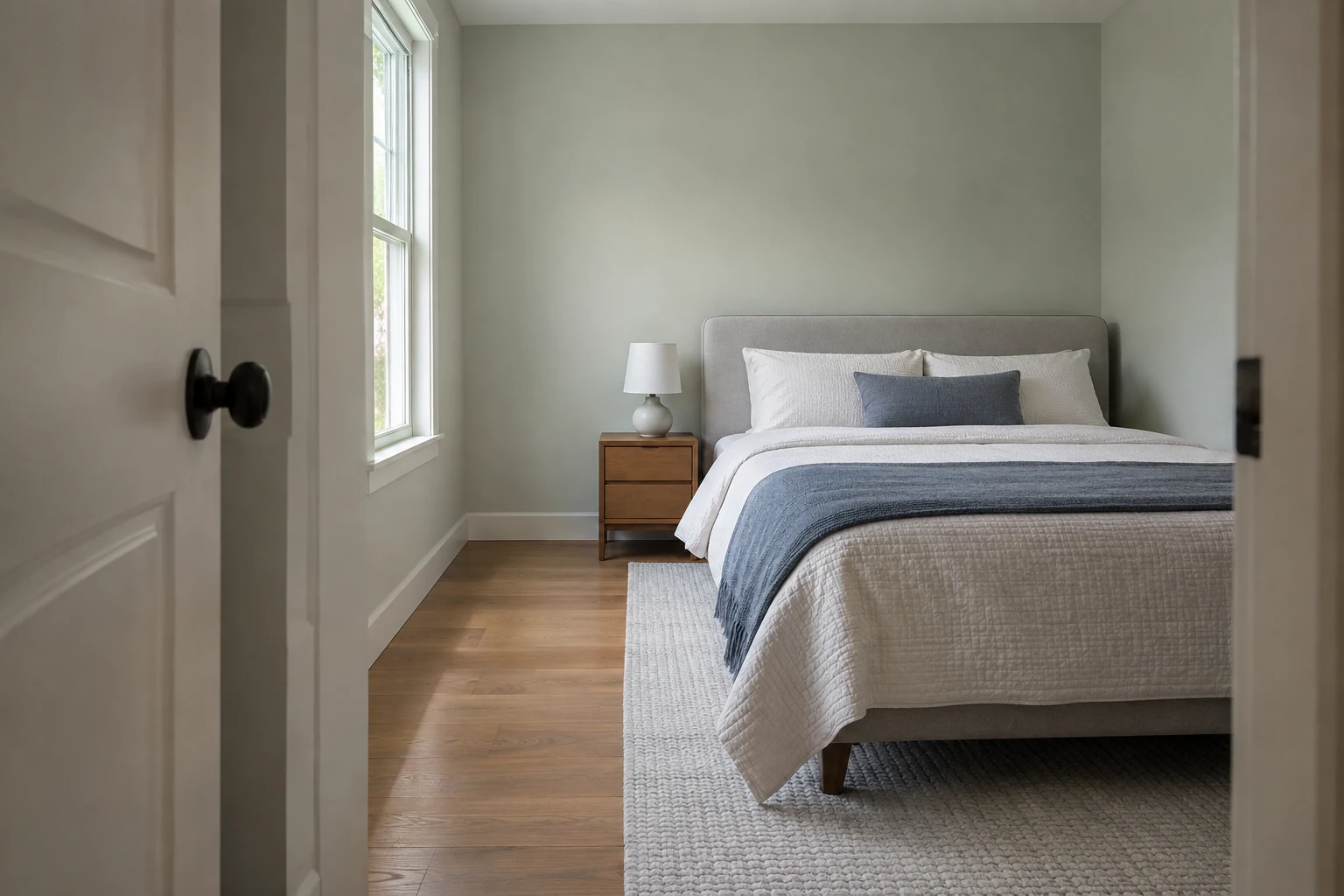
Arrange a small bedroom around its actual openings, the people who sleep there, and the routes they use. Sketch the room first, compare bed positions, then keep the arrangement that works when the door, wardrobe and bed are in use—even if it misses a feng shui preference. Feng shui offers placement guidance, not a promise that a particular layout will change your sleep or circumstances.
Draw the Room You Can Actually Use
Start with the room as it is, not an idealized rectangle with a bed drawn in the middle. On paper, mark the walls and fixed features. Add the entry door and the space it occupies when it swings inward; the window and its controls; wardrobe doors, drawers and the space needed to open them; and any furniture that must stay. Draw the routes from the entry to the bed, wardrobe and window.
Measure the whole existing bed, including its frame—not just the mattress. A headboard, projecting frame or storage drawer can change whether a position works. Record how many people sleep there and which side each person uses. IKEA advises measuring bedroom space and considering mattress size and the number of sleepers when choosing a bed; for an arrangement of furniture you already own, measuring its actual outer footprint makes that advice useful.
Here is a hypothetical room to carry through the decision. Two adults share one existing double bed. On the page, its inward-opening entry is near the bottom-right corner; a wardrobe with doors and drawers occupies the lower-left wall; a window is on the upper-right wall; and the full top wall is solid. There is no ceiling beam. “Top” and “right” describe the sketch, not compass directions. Assume the residents have checked the real dimensions and that the room is wide enough for the right-shifted bed position they will later test. That assumption makes this a worked example, not a plan guaranteed to fit another room.
Before moving anything, outline each possible full-frame footprint on the sketch. Draw the entry door’s arc and the wardrobe doors and extended drawers over those outlines. Mark where the residents’ existing accessible lamp and phone are, and check whether a proposed move leaves them reachable. South Central Ambulance Service recommends a lamp and phone within reach of the bed.
Then clear the floor route of clutter and cords, and keep cables, bedspreads and long curtains from trailing across it before trialling a move. Guy’s and St Thomas’ advises removing clutter, arranging items to avoid collisions, and preventing those textiles and cables from trailing over the floor; South Central Ambulance Service also advises a floor clear of clutter and cords. These are ordinary access and safety considerations, not feng shui rules. You now have a sketch that can rule out an obstruction before you shift a heavy frame—and a clear route on which to test what the sketch cannot show.
Choose Bed Positions Worth Testing
Use feng shui preferences to identify candidates, rather than treating any one preference as permission to block everyday access. The Feng Shui Society describes a bed against an unobstructed wall diagonally across from the door and away from a window. In separate guidance, it favors a solid wall behind the bedhead and a position from which doors and windows can be seen. It advises avoiding a position directly in line with the door, as well as sleeping under beams or sloping roofs.
On your sketch, consider those points separately. Does the head have a solid wall behind it? Can someone in bed see the entry? Is the bed directly aligned with the door? Where is the window relative to the proposed position? Finally, can the occupants use the bed and the room’s fixed openings? A position that looks persuasive as a small drawing is still only a candidate until its full frame and the people using it have been accounted for. The hypothetical room has neither a beam nor a window behind the proposed bedhead, so neither needs an invented remedy in this comparison.
Side access depends on the bed and its occupants. The Feng Shui Society expresses a preference for access from both sides, while specifically allowing a single bed, such as a child’s, to stand against a wall. That exception is not infant-cot safety guidance. Nor does it mean every adult with a single bed must create two aisles that their room cannot accommodate. In the two-adult example, however, the practical test is clear: each person needs to reach and leave their own side without climbing over the other. This is a requirement of these residents’ chosen use, not a universal measurement.
The sketch produces two plausible candidates:
| Candidate | Bed position and feng shui preferences | Question the trial must settle |
|---|---|---|
| A | The bedhead rests on the solid top wall, shifted left enough that the bed is not directly aligned with the entry. The entry remains visible. | Does the frame obstruct the lower-left wardrobe or the left sleeper’s access? |
| B | The bedhead stays on the same solid top wall, but the frame shifts right within this room’s verified usable width. The move may free the wardrobe side and leave the right-side window controls reachable. | Can both people and all openings still be used? The bed is directly aligned with the entry. |
B is not an ideal, off-doorline solution. It knowingly gives up that placement preference in exchange for a possible improvement in access. A is not automatically better because it meets more of the listed placement preferences. The wardrobe and each sleeper still have to function. An International Feng Shui Guild practitioner notes that small dorms and studios can leave beds or desks in less-than-ideal positions; that observation fits a room where not every preference can be met at once.
If your room has just one physically workable bed position, under a window, under a beam or directly in the doorline, name the specific feng shui preference it cannot meet. Keep the necessary entry and occupant access, and test the position’s real use instead of assuming a symbolic change will move a fixed fixture. If the existing bed is simply too large, a smaller one is a conditional option: consider it only if the actual replacement frame fits the room and the sleepers’ physical needs. Shrinking a mattress on a diagram does not establish either fact. For now, compare positions for the furniture you already have.
Trial the Walking Route and Every Opening
A sketch helps screen candidates; an occupied-room trial decides between them. Keep the cleared floor route clear as you move the existing bed. Use the marked frame footprint, door arc and wardrobe openings to position it, rather than estimating from the mattress edge. There is no single clearance figure to apply to every bedroom: the test is whether the particular occupants can complete the movements they need.
For each candidate, make one full use check:
- Have each adult approach their own side, get into and out of bed, then sit and stand beside it. Neither should have to climb over the other.
- Open the entry door fully. Walk the entry-to-bed route as it would be used at night, and reach the actual existing accessible lamp and phone from the bed.
- Operate the window controls. Open the wardrobe doors fully, extend its drawers, take out an everyday garment, and return it. Close and reopen the door and drawers to catch a conflict that a single glance might miss.
Apply the check to A. Its head has solid backing, the entry is visible, and the bed is away from direct door alignment. But in this stipulated room, the shift left prevents the wardrobe from opening for ordinary use and leaves the lower-left sleeper without workable side access. The residents reject A. They do not keep an inaccessible arrangement for the sake of its better-looking door position.
Restore a usable arrangement before trialling B, so an unsuccessful second move does not become the room’s default. In this example, the residents have verified enough usable width for the right shift and for both adults. They repeat the same check with the actual bed in place. Each approaches their own side, gets in and out without crossing over the other, and can sit and stand. The entry door completes its swing and the nighttime route stays open. The existing lamp and phone remain accessible; the window controls can be reached. The wardrobe door opens, its drawers extend, and an everyday garment can be retrieved and returned. B passes those stipulated use checks. Its direct alignment with the entry has not disappeared.
Your own B-shaped layout may fail. A door may swing differently, a frame may project farther, or a window control may be harder to reach. If the trial fails, return to the previous usable position while reassessing the candidates; do not force the hypothetical answer into your room. If furniture scale is the obstacle, first consider whether a less obstructive piece of existing furniture can be repositioned. Consider a physically suitable smaller bed only if its real outer frame would improve access and everyone sleeping in it would still fit. After any such change, repeat the occupied test rather than relying on the new measurements alone.
Make Storage and Required Work Fit Around the Route
Once B passes the bed and opening checks, recover usable storage without taking back the space that made it work. The International Feng Shui Guild practitioner recommends editing possessions in a small space. In the two-adult example, the residents group items used every day in accessible compartments of their existing wardrobe. They move only personally owned, out-of-use items into a known available wardrobe corner. They do not bury daily necessities or relocate someone else’s property.
The storage change earns its place through an ordinary dressing routine: retrieve a daily item, use it, put it back, and then reopen the wardrobe door and drawers. If those actions still work, retain the arrangement. If moving an item makes the daily compartment awkward or obstructs a drawer, undo that move. This is a test of accessible storage, not a requirement to make belongings invisible.
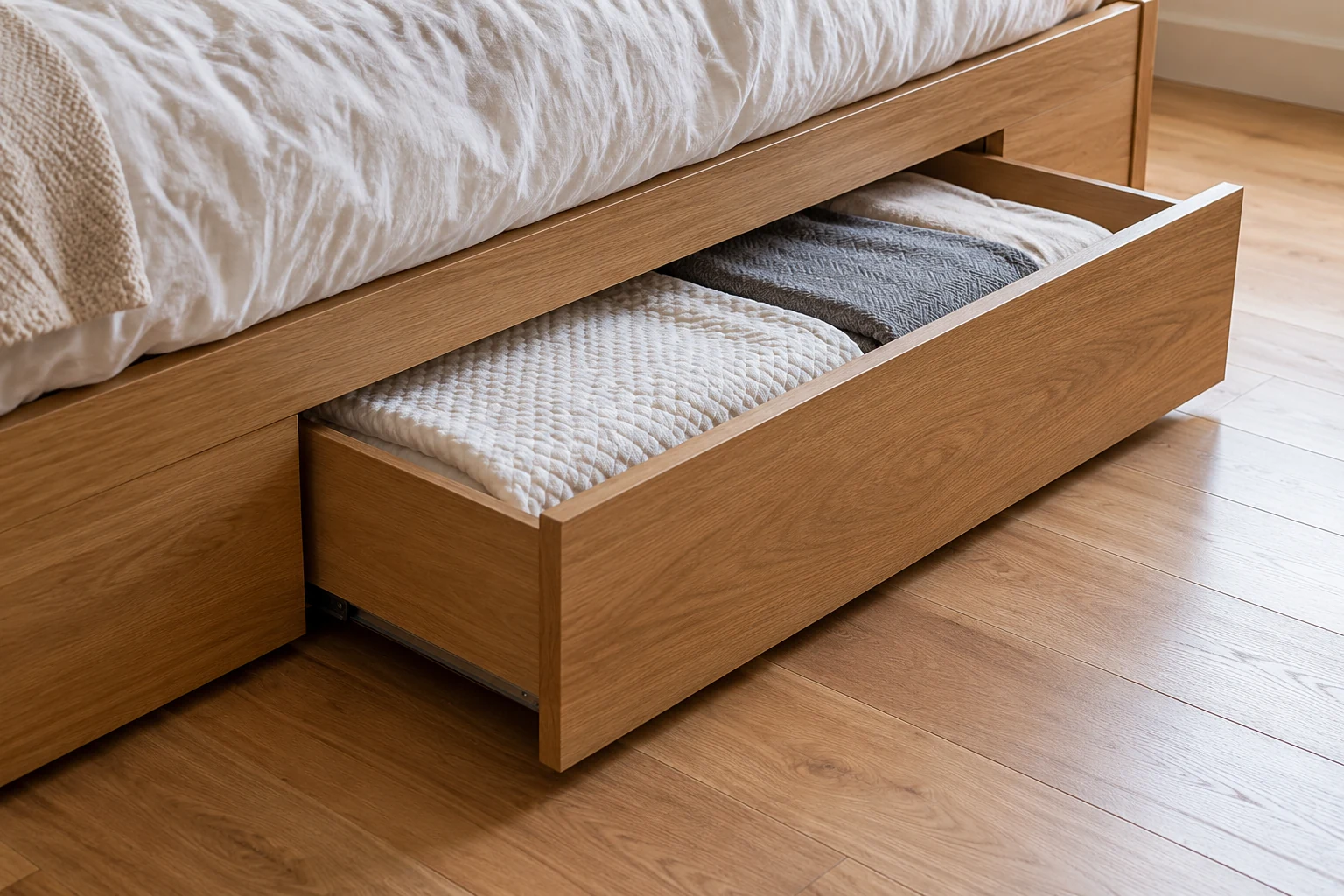
IKEA presents wardrobe organisers and under-bed storage as small-bedroom retail options. Neither is a necessary feng shui purchase, and the existence of storage space does not guarantee usable storage. An under-bed box needs reachable handles and space to pull it out; a storage bed needs room for its drawer or lift to operate without occupying a needed path. In this example, a hypothetical under-bed drawer or box would project into the bedside walk that B has restored. Reject that optional box and keep the tested storage inside the wardrobe. There is no general prohibition on under-bed storage here—only a failed access check for this room.
A separate single-adult multipurpose room presents a different constraint. Suppose its resident has an existing single bed, a fixed desk and a required work chair. The bed already allows the entry, bedside and window route to function. The problem appears when the chair is pulled out for daily work: it blocks the bed route. Buying or placing a freestanding separator would block that same route, so this resident rejects it.
After work, the resident shuts down a portable work device and stores it, with a notebook, in a known existing drawer, following the device’s own storage instructions. They return the chair fully beneath the desk; they do not cover active equipment. With the chair reset, they use their existing accessible bedside light and walk the evening entry–bed–window route. The next day, they open the drawer, retrieve the work items and pull the chair out to work, then reset it afterward. In this stipulated room, both the work routine and the evening transition pass when the chair is returned. South Central Ambulance Service’s reachable-lamp advice is an ordinary access consideration here.
The Feng Shui Society suggests keeping work-related things out of a bedroom where possible, or covered when they must remain there. Putting shut-down items in an available drawer is this resident’s practical way of making work less visible between uses. It is a household choice consistent with that practitioner preference, not a treatment for insomnia. Nor does this adult need the Society’s child-single-bed exception to justify a bed whose actual routes work.
Keep the Best Workable Compromise
The two-adult trial has a definite result. A is rejected: its solid bedhead, visible entry and better door position do not compensate for a wardrobe that cannot be used and a sleeper who cannot access their side. B is kept: it retains solid head backing and passes both adults’ bedside movements, the full door swing, nighttime route, window controls and daily wardrobe use. Both residents prefer that restored access. Its unmet feng shui preference is equally definite: the bed remains directly aligned with the entry.
For a constrained door position, an International Feng Shui Guild practitioner suggests either placing a nightstand or other object between bed and door, or moving the bed so the head is farther from the door. Those are door-related ideas to evaluate against the room, not repairs for a blocked wardrobe or every other bed problem. In this example, adding a nightstand between B and the door would narrow the path the residents need, so they do not add one. An object should not be described as universally removing direct alignment, and a suggestion to move farther from the door cannot override a failed access test.
That verdict belongs to the tested room and its occupants. If your corresponding B trial blocks a route, if someone’s access needs change, or if a fixture or the usable path changes, go back to a previously usable arrangement and compare what now fits. Likewise, where a window, beam or doorline leaves only one workable bed position, identify the traditional preference left unmet rather than claiming the fixed condition has been cured.
The filled plan is straightforward: A failed the wardrobe and left-sleeper checks; B passed the residents’ use checks and stays, with direct door alignment acknowledged. Daily belongings stay in accessible parts of the existing wardrobe, while the box that would obstruct the bedside walk is omitted. In the separate work room, the transition works only while the chair is reset and both the evening route and next-day work use continue to pass. These are observations about using particular rooms, not guaranteed outcomes of feng shui. The Feng Shui Society itself says feng shui cannot guarantee wealth, health or happiness.