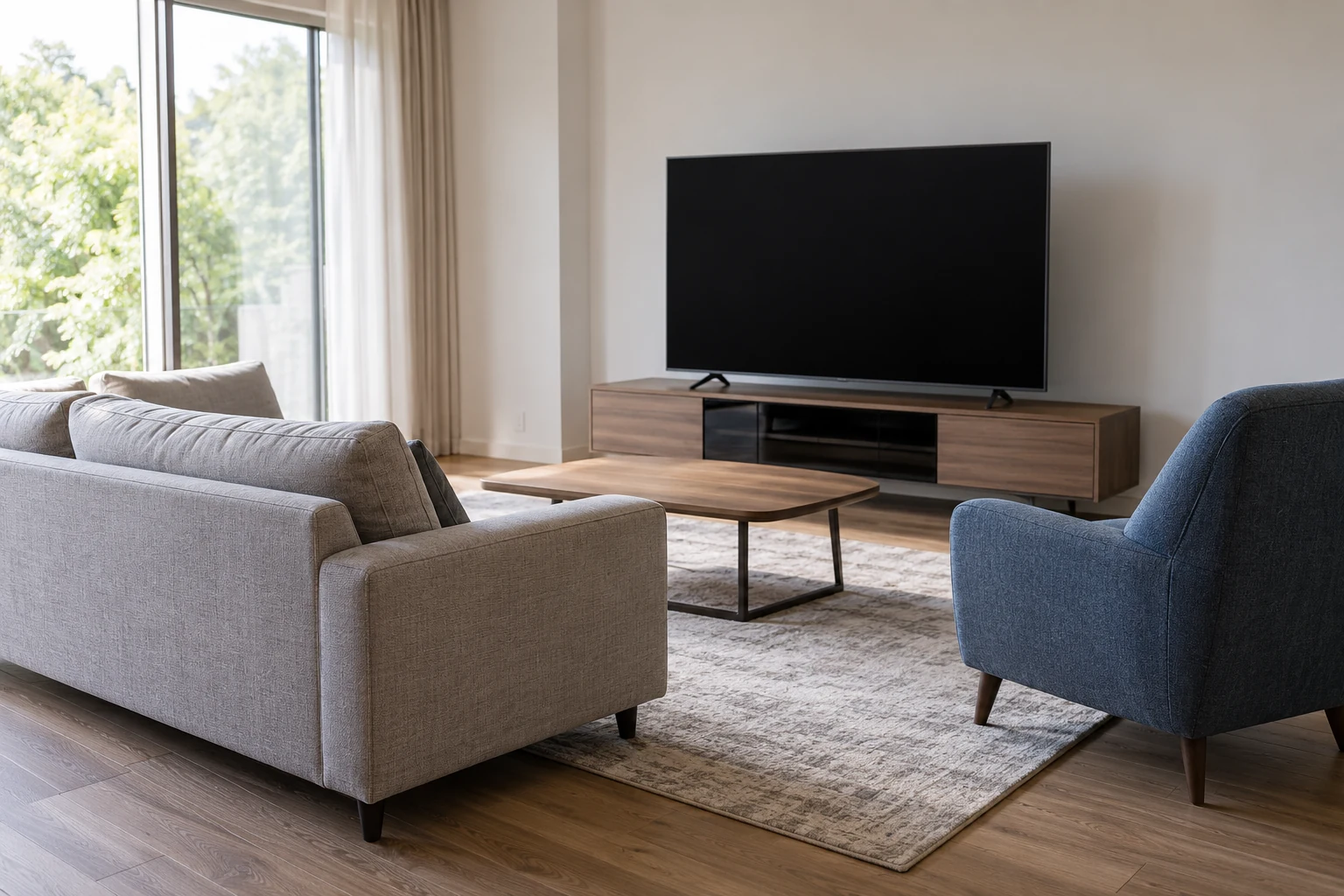
To fix a TV-dominated living room, keep the television usable and identify what it crowds out. Do all the seats face the screen, leaving nowhere comfortable to talk? Does the switched-off screen draw more attention than residents want? Or has furniture placed for viewing made it awkward to enter and cross the room? Each problem calls for a different response. Start with the smallest reversible change: turn an existing chair, give another activity a useful place in the seating group, or leave the seats alone and reconsider how the screen looks when it is off.
The test is not whether a TV is visible. It is whether the room works for the people who use it. If the space is a dedicated media room and everyone wants seating directed toward the screen, a TV-centered layout needs no fix. In a mixed-use room, protect the viewing seats people actually need while making room for their other activities.
Find Out What the TV Is Dominating
Observe the room during ordinary use before moving anything. From each regular seat, notice where an occupant faces without turning furniture. When the TV is off, notice what catches your eye from those same seats. Then watch how people enter, reach the window, and pass through the room. These observations separate three problems that can look similar in an empty-room sketch:
- Seat direction: Every useful seat faces the TV, but residents also want to sit where they can see one another.
- Off-screen attention: Seating and movement already work, but residents dislike how prominent the switched-off screen looks.
- Blocked routes: Furniture arranged for viewing interferes with a doorway or a normal walking path.
A room can have more than one problem, but the first change should address an actual use that is failing. Turning a chair will not necessarily alter the appearance of a dark screen. Putting art near the TV will not clear an obstructed door.
A practitioner writing for the International Feng Shui Guild cautions that, outside a room specifically intended for media, orienting all furniture toward a large TV can make viewing the room’s dominant activity. That is a useful layout interpretation, not a prediction that the occupants will watch more or interact less. The practitioner expressly makes an exception for a media room. A visible TV, by itself, does not establish that anything is wrong.
Consider the following hypothetical rented living room throughout this guide. It is rectangular, with a fixed TV on the left wall and a sofa against the right wall facing it. A movable armchair starts beside the sofa, also facing the TV. A window is on the top wall; the entry is at the bottom, where the door swings into the room and people normally pass along the bottom edge. The existing coffee table remains within the central seating area. These are stipulated example inputs, not measurements or observations from a tested home.
In that starting arrangement, the TV is the direction of both seats. That suggests a seating question, but does not yet answer it: perhaps both seats are needed for watching, or perhaps one could serve another use. The bottom route also limits where a chair can go. The screen’s visibility is a separate question; moving a seat need not make the TV disappear.
Decide What the Room Must Do Besides Show TV
Ask the people who use the room to agree on its ordinary priorities. How often do they watch? Who needs a comfortable view at the same time? What do they want to do before or after viewing—talk, read, or simply move through the room? “Make the room less TV-centered” is hard to test. “Keep two comfortable viewing places and make one existing chair useful for conversation and reading” gives a move a clear purpose.
In the hypothetical rental, both residents watch together from the sofa in the evening. They want to talk face-to-face before watching, and one resident uses the armchair and window-side light for daytime reading. The sofa’s existing, comfortable two-person TV view therefore stays. The armchair does not need to serve as a third TV seat. Its possible job is to face a person on the sofa and offer a reading position.
Agreeing on that division matters. If someone regularly watches from the armchair, turning it away from the TV could trade one genuine need for another. In a different household where viewing is the chief intended activity, keeping all usable seats oriented toward the screen may be the right decision. A preference for face-to-face seating is a room-use goal, not evidence that a furniture change will improve anyone’s relationship.
Next, record what cannot change. In this rental, there is no permission to move the TV, alter its mounting or cables, make holes, or undertake permission-dependent work. The armchair can move without adding cords. The entry door must complete its swing, and the usual bottom through-route must remain usable. At the top of the room, people must still reach and operate the window controls and use the existing installed reading light. The coffee table stays in the central seating area.
Those constraints give the trial a practical boundary: use existing furniture to find a conversation-and-reading seat, without disturbing the TV installation, losing the sofa view, or making an occupied route awkward. They also keep the change reversible. If a candidate fails, the chair can go back while the residents consider another position—or decide that the current layout better serves them.
Try a Conversation Seat Without Sacrificing the Viewing Seats
The Feng Shui Society advises grouping chairs so several people can interact and, ideally, see one another. For this room, that suggests testing whether the movable armchair can face someone on the sofa rather than merely pointing alongside them at the TV. It does not prescribe a particular outline on the floor or establish that conversation will happen.
A Guild practitioner proposes a U-shaped seating group for conversation and eye contact, and also describes two armchairs facing a couch with a coffee table between. Both are possibilities when the furniture already exists and fits. Drawing a U cannot create an extra chair or the space occupied people need to get in, stand up, and pass through. One chair angled toward a sofa may be more useful than an idealized grouping that blocks the room.
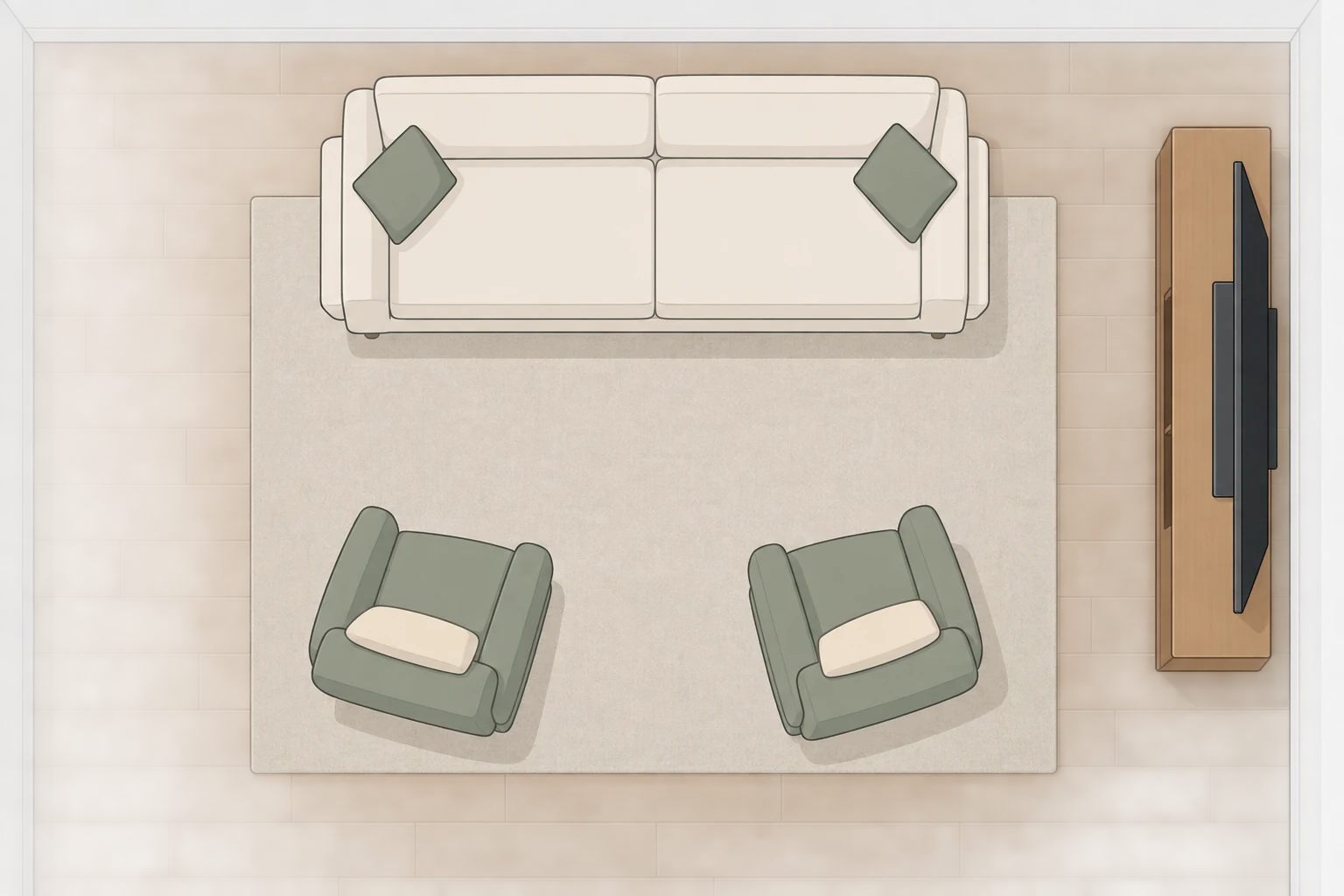
Before trying a placement, identify the entry, exit and usual circulation route. The Guild advises planning how people enter, leave and move around a room. Its preference for sofa occupants to see the main entrance can inform a choice when possible, but it is not a reason to sacrifice an operable door, a usable path, or the household’s required TV view. Keep any cords off walking surfaces as well; Guy’s and St Thomas’ advises against electric cables trailing over floors and recommends removing clutter. This trial offers no reason to change the TV’s cables.
Now test the rental’s two chair positions. No clearance number is assumed: the residents must check the furniture with people actually seated in it.
Placement A: the bottom edge of the group. Move the existing armchair from beside the sofa to the bottom edge of the central seating area, facing the sofa across the coffee table. On a simple plan, this looks promising: a chair occupant and a sofa occupant could face one another. But the chair, and the legs of someone sitting in it, intrude on the entry door’s swing and the normal through-route along the bottom. That is a failed placement, even if the room looks balanced while empty. Restore the chair before trying another position; do not ask people to step around an occupied seat or partly open door to preserve the sketch.
Placement B: the upper-left edge. Move that same chair to the upper-left edge of the seating group and angle it toward the sofa. Leave the coffee table within the central group rather than pushing it into the bottom path. In this stipulated room, the chair’s new position lets its occupant face a sofa occupant and use the window-side reading position. It also preserves access to the window controls and existing reading light. The bottom through-route and full door swing remain clear.
B is a candidate conversation-and-reading chair, not an additional TV seat. Both regular viewers stay on the sofa for their existing comfortable view. That distinction makes the trial fair: the household is not claiming to have preserved a viewing position it never tested from the angled chair. Nor has it changed the fixed TV or introduced a cord.
If your own room is narrower, do the occupied check rather than copying B’s apparent position. A chair may fit at an edge while empty yet block a person who rises from the sofa, reaches a control, or walks past seated legs. If no location for the existing chair passes those checks, keep the usable seating. You can consider a visual-only change if the switched-off screen bothers you, or accept an intentionally TV-centered arrangement. Neither outcome requires buying another chair or inventing a second seating zone that the room cannot hold.
Give Attention Another Direction While Keeping the Screen Available
A second focal point need not be a new object. An existing window, picture or fireplace may already offer somewhere else to look or an activity to arrange a seat around. Architectural Digest gives an example of a fireplace that already serves as a focal point in a room with a TV. That is an example to recognize if a fireplace exists, not a recommendation to add one or mount a TV above it.
In the rental, the window-side position and the person on the sofa provide the armchair occupant with reasons to sit at an angle. The chair can support reading by day or a face-to-face exchange before the evening show; the sofa remains directed at the TV for two-person viewing. The useful change is not that the screen has vanished. It is that the only movable seat no longer has just one assigned direction.
An existing picture can play a similar visual role if people already enjoy looking toward it. But distinguish a choice about where to sit or look from a claim about what people will do once seated. A window view cannot make occupants converse; an angled chair simply gives them a position from which they can see each other. Test the use rather than relying on the name “second focal point.”
For an existing L-shaped sofa with a backrest along both sides, IKEA describes a different two-direction arrangement: one backed seated direction can face a TV, while the other can face existing art or a window. IKEA contrasts that with an L whose end is a chaise longue. A chaise-only end does not provide the same backed, upright second seating direction; IKEA instead discusses orienting that chaise for reclining toward the TV. This is an alternative for the right sofa, not a description of the hypothetical rental’s straight sofa.
Check the actual sofa before adopting the idea. Its fixed return may be on the wrong side for the proposed views; do not assume its handedness can be reversed or its parts detached. Sit on each backed section, check the view available from it, then walk the surrounding routes with seats occupied. If the alternate direction makes regular TV watching uncomfortable or puts a sofa section in the way of movement, retain the useful orientation and try another reversible option. The value of two directions depends on this furniture and this room, not on the letter L alone.
If the Seats Work, Change Only How the Switched-off TV Looks
Sometimes nobody needs a different seat. Conversation, reading and walking routes already work, but the switched-off TV feels too prominent to the residents. In that case, changing the furniture solves the wrong problem. First decide whether its visibility is actually unwelcome during the hours the room is used without it.
Architectural Digest distinguishes frequent viewers, who may give the TV an open, prominent position, from occasional viewers, who may prefer to hide it. It also frames display versus concealment as a choice guided by the room’s function. Thus an openly visible screen can be a sensible outcome for people who watch frequently; concealment is an option, not an anti-TV rule.
There are proportionate visual choices. Architectural Digest suggests placing art around an existing TV. If securely installed art is already there, residents can first judge it from their usual seats without adding or moving anything. Another designer proposal in Architectural Digest is a deeper wall tone to reduce contrast with a screen. Paint, however, requires permission where applicable and a trial of the color in the actual room before anyone can decide whether they like the result. Neither proposal is necessary when the current view suits the household.
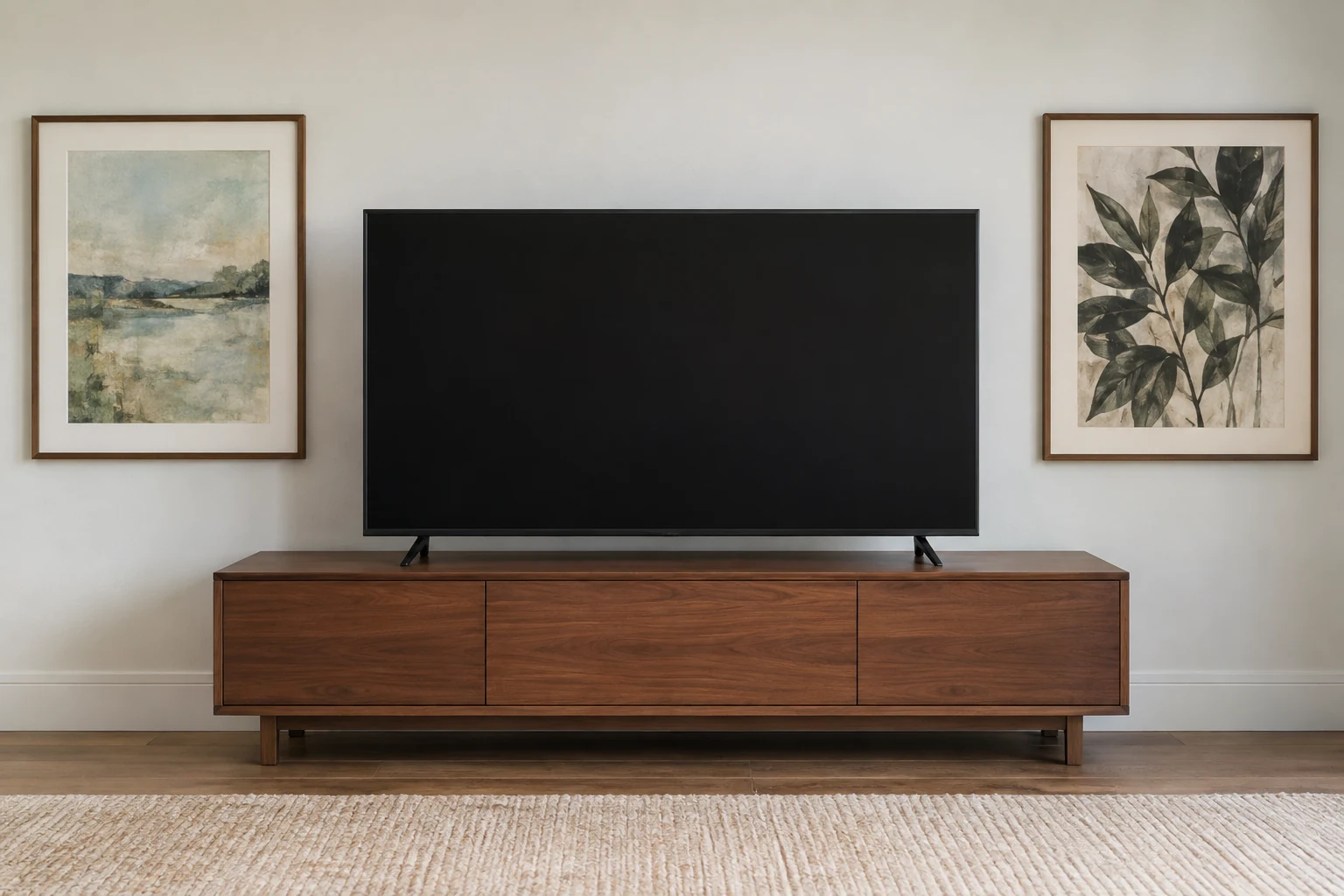
For an occasional viewer who already has a suitable TV cabinet and whose manufacturer permits that use, a limited trial is to close it while the TV is off. Reopen it and operate the TV exactly as its installation instructions require; do not operate it enclosed unless that use is approved. If the cabinet’s suitability is unknown, skip this option. Architectural Digest presents cabinet concealment for a TV not in use, but that design idea is not an instruction to improvise a cover or enclosure. The main rental has no cabinet option. There is no need to drape fabric over a TV, build a housing, relocate it, or alter its mounting to run this visual test.
Here is a separate hypothetical visual-only outcome. A household watches frequently. Its seating already supports conversation, and its routes are clear, but residents notice the fixed, visible TV when it is off. They have an existing picture beside the screen on an approved secure hook. They compare ordinary off-screen sitting with the picture in its established position—without remounting or relocating it—then try reading and conversation from their normal seats and evening TV viewing from those seats.
In this stipulated example, they decide the picture is a sufficient alternative point of attention as things stand. Reading, conversation and viewing remain workable, so they keep both the visible TV and the existing art. They buy nothing, paint nothing and conceal nothing. That is their preference after trying the room, not evidence that artwork objectively reduces visual dominance for every viewer.
Use the Room, Then Keep or Undo the Change
A floor plan can identify candidates, but it cannot decide whether an occupied room works. Use a practical before-and-after activity check. This is an author-designed household trial, not a scientific measure: compare the old and candidate arrangements against the uses residents named, without treating a pleasing shape as proof of success.
For the main rental, put people in the sofa and armchair rather than assessing empty furniture. Have them stand up and walk to the entry and window. Open the door through its normal swing, use the bottom through-route, operate the window controls, and use the existing installed reading light. Check whether occupied legs, the coffee table or other clutter obstruct movement, and confirm that no cords have entered walking paths. Guy’s and St Thomas’ specifically advises keeping trailing electric cables off floors and removing clutter; a furniture trial should not compromise those basics.
Then test each intended activity separately. From the sofa and angled armchair, can the residents see one another comfortably enough for the conversation they want? Can the reader use the chair, window-side light and installed reading light without losing access to the controls? Finally, with both regular viewers in their usual sofa places, does their evening TV view still work? Ask whether the new arrangement is preferable for these activities, not merely whether everyone can tolerate it once.
The filled verdict for the stipulated rental is clear. This is a mixed-use room, so giving its movable chair a non-TV direction serves a stated purpose while retaining the sofa’s two-person viewing role. Bottom-edge placement A failed because the chair and occupied legs obstructed the doorway and through-route; the residents restored it. Upper-left placement B passes the specified occupied entry, window, light, conversation, reading and sofa-viewing checks. The TV remains visible, and its installation is unchanged. Both residents prefer B for their stated uses, so they keep it—and agree to revisit the position if the people using the room or their activities change.
Your room may produce another verdict. If any occupied check fails, restore or reposition existing furniture rather than forcing a U-shaped group or moving the TV. A narrow room may be best left with its usable seating; a household may prefer a visible screen with no change at all; a dedicated media room may be working exactly as intended. These trials establish only whether a layout suits the people and uses tested. They cannot guarantee interaction or comfort for unknown users, much less health, wealth or happiness—outcomes the Feng Shui Society itself says it cannot guarantee.