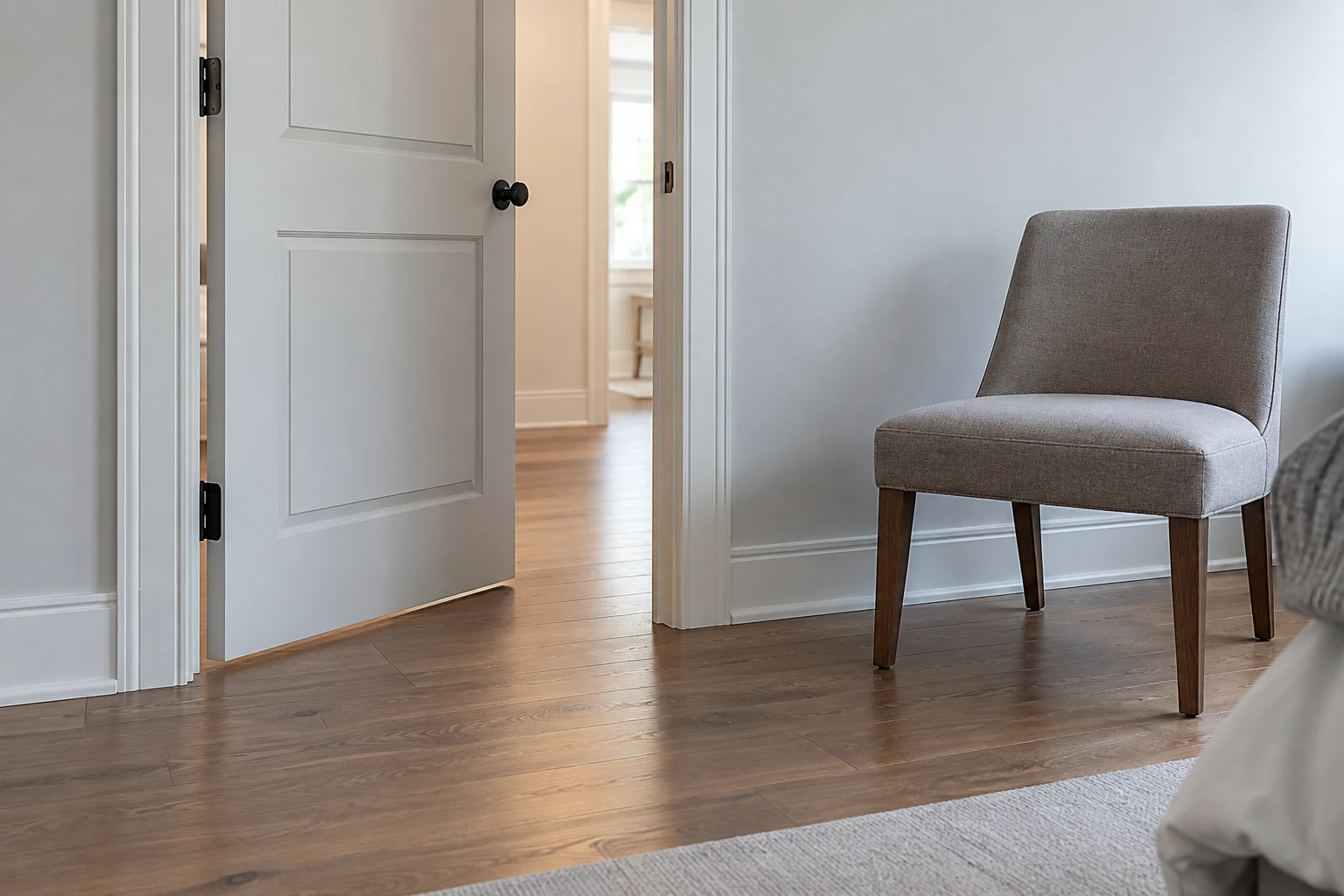
To check furniture door swing clearance, start with the door you have—not a generic opening angle. Measure where its leaf and handle travel, mark the proposed furniture position, then operate the door carefully through its full intended movement. Check the route from both sides before committing to the move. A plan can reveal an obvious collision, but it cannot show every problem: a handle may meet a tall cabinet, a drawer may enter the sweep, or a rug may catch the door. If the furniture prevents normal operation or passage, change the layout rather than the door hardware.
Measure the Door and the Proposed Layout
First, stand on each side of the doorway and identify which edge carries the hinges and which way the door swings. With the area clear, gently open the door to the full position it is intended to reach in its existing installation. Record where it stops. Do not force it farther or substitute an assumed 90- or 180-degree opening. You are checking whether the proposed layout preserves the door’s actual intended operation, including the movement needed to reach that position.
Measure the door leaf from the hinge side to its outer edge. Note where the handle sits on the leaf and measure how far its most projecting part extends from the door face. Record which side of the door that projection faces as the door swings toward the proposed furniture. A leaf and its handle do not occupy the same space, so a measurement of the leaf alone may miss a collision.
Look down as well as across. Note the threshold, any rug edge, and anything else at floor level that the moving leaf might catch. If a rug is part of the proposed arrangement, include its intended position in the check. Record the doorway and nearby wall positions so you can place the door accurately on a sketch. IKEA’s measuring guidance specifically calls for distances between corners and doorways and for noting which way doors and windows swing.
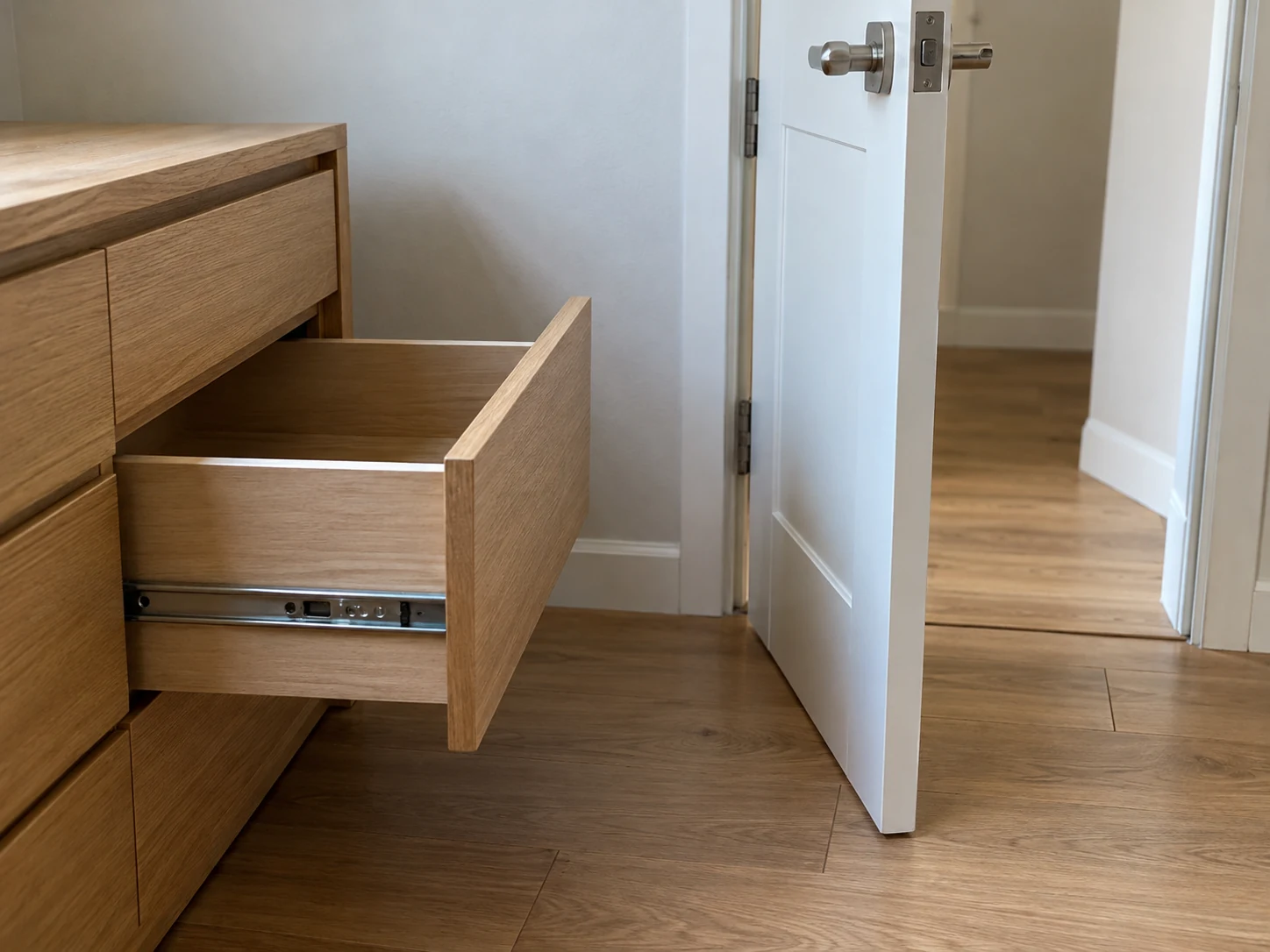
Next, measure the proposed furniture rather than estimating it from a product picture. Record its floor footprint, height, and intended distance from the doorway or nearby corner. Include any part that changes position during ordinary use: for a cabinet, that may mean the depth of an open drawer or the space occupied by an open cabinet door. Note handles or projecting trim on the furniture too. A low piece and a tall piece with the same footprint may present different obstacles to the door handle.
Before treating the furniture as the cause of any problem, establish a baseline. Does the door already move smoothly to its intended full position with the area clear? If it sticks, scrapes, or appears damaged before the rearrangement, record that separately. Moving furniture might remove a collision, but it will not repair a faulty door. If you rent, that may mean contacting your landlord; otherwise, a qualified repair professional may be the appropriate next step.
| What to check | Record for your room |
|---|---|
| Hinge side and swing direction | Mark the hinge side and the direction the door swings |
| Doorway relative to nearby corners | Record the distances from nearby corners to the doorway |
| Door leaf and intended open position | Record the hinge-to-outer-edge measurement and mark the position the door is intended to reach |
| Handle | Record its position and how far it projects from the door face |
| Proposed furniture | Record its footprint, height and position relative to the doorway |
| Furniture parts that move | Record how far drawers or other parts extend during ordinary use |
| Floor-level obstacles | Note any threshold or rug the moving door might catch |
Test the Whole Sweep, Not Just the Open Position
Make a simple plan-view sketch using the measurements you recorded. Draw the doorway, nearby walls, and proposed furniture to the same scale—for example, choose one consistent amount of paper space for each centimetre of room space. Mark the hinge position and the path of the door’s outer edge from closed through its intended full-open position. Place the furniture footprint on that same plan. If the furniture crosses the leaf’s path on paper, revise its position before trying the move.
Use that drawing as a screen, not as a verdict. The arc shows where the leaf travels on the floor plan, but it does not by itself show the height of a cabinet, the projection of a handle, or a drawer pulled out during use. Nor does a drawing of a door at 90 degrees prove that 90 degrees is its intended stopping point—or that a person can comfortably enter and leave when it is there.
Check the likely points of contact in the room, with the furniture in its proposed position or a reversible trial position. Start with the door closed, then move it slowly through partly open positions to its intended full-open position. Watch both faces and the outer edge of the leaf. Compare their path with the furniture at the heights where the two could meet. At handle height, check the handle separately; at floor level, watch for a threshold or rug catching the moving leaf. Do not push through resistance to see whether it will fit.
Consider an illustrative measurement, not a universal clearance rule. Suppose the face of an open door leaf has 3 cm of space beside a cabinet. At the point where the handle passes that cabinet, the handle projects 5 cm from the door face toward it, at a height where it can strike the cabinet. The handle lacks 2 cm of clearance there: 3 cm of space minus 5 cm of projection equals −2 cm. The leaf may look clear while the handle collides. If the handle does not enter that particular gap, however, adding its projection to that gap would describe the wrong interference. Measure the parts that actually approach one another, at the position where they do so. None of these example figures is a legal minimum.
Now test the furniture in its normal use states. Pull out a drawer, open a cabinet door, or position another moving part as it would be during everyday use, and carefully repeat the door check. A layout that works only while every drawer stays shut may still cause a routine collision. If an open drawer temporarily occupies the sweep, decide whether the door and furniture can be used together without contact or whether the placement needs to change.
Finally, have a household member carefully operate the door while you observe from a safe position, then switch sides. Approach the doorway from both sides with the door partly open and fully open. Can someone use the handle and pass through without squeezing around the proposed furniture or moving it first? Can the door complete its movement without brushing a person who is trying to pass? This in-person check covers the route as well as the door’s motion. It is why a clear-looking arc, especially one drawn only to 90 degrees, cannot settle the question on its own.
Revise the Layout and Verify the Route
If the test finds interference, change the furniture placement first. Shift or rotate the piece so its body and projecting parts sit outside the measured sweep. Then repeat the door and passage tests: a small move may clear the leaf while leaving the handle, an open drawer, or the route in conflict. If no position for that piece preserves both full door operation and usable access, choose a shallower, shorter, or smaller piece, or put it elsewhere.
Try the revised position reversibly before the final move. You can mark the proposed furniture footprint on the floor with a removable method suitable for that surface, or temporarily place the piece where you intend it to go. Keep the test careful: open the door slowly, stop at contact, and do not force it. Repeat the check with the rug in place and with handles, drawers, and other moving parts in their ordinary positions. Walk the route from both sides rather than judging it only from where the furniture stands.
Door movement and exit usability are related but distinct tests. The U.S. Fire Administration advises that doors and windows should not be blocked in a home fire escape plan. A cabinet position that allows the door to move somewhat but obstructs an exit is not an acceptable compromise. Do not remove a closer, wedge a fire door, or alter hinges to accommodate an oversized piece. If the door still cannot operate as intended after the furniture is moved clear—or if it is sticking or damaged—seek repair through your landlord or a qualified professional as appropriate, instead of disguising the problem with the layout.
Keep the arrangement only if the door reaches its existing intended full-open position, the leaf and handle avoid contact throughout the sweep, and people can use the route from both sides. If any of those tests fails, revise the furniture choice or position and test again.
Continue reading
More room decisions to consider