Use planting for privacy by interrupting the view that matters, rather than surrounding the whole garden with the tallest greenery you can buy. Find where you want to sit or stand, identify where the unwanted view comes from, and place foliage where those two points meet. Then choose plants that can hold that position in your climate and within the space you can maintain.
For Roomwise Feng Shui, the useful design question is how to combine a sheltered place with an open, understandable approach. A planting screen can give a seat a sense of enclosure while leaving the route to the house visible. It does not need to turn a small garden into a sealed green box.
Define the View You Want to Interrupt
Begin at the place you actually use: a patio chair, kitchen window, outdoor dining table or garden path. Look towards the source of exposure. Is it a neighboring ground-floor window, an upstairs window, a public path or a gap beside the gate?
Record the problem from your usual position. A photograph taken while standing in the middle of the lawn may tell you very little about the view from a low chair. Repeat the check seated and standing. If privacy matters in winter, include what happens when deciduous foliage has fallen.
Write a short brief, such as: “Screen seated diners from the adjacent ground-floor window, keep morning light and leave the gate approach open.” That is more useful than “make the garden private,” because it gives you a way to judge whether a screen is doing its job.
Distinguish seeing from hearing. A leafy barrier that reduces the view of a neighbor does not establish confidential conversation space. This guide concerns visual privacy; do not choose a thin planting strip on the assumption that it will soundproof a patio.
Use the Sightline to Find the Screen’s Position
Ask another household member to hold a temporary marker or piece of fabric at a possible screen position within your property. Sit in the intended seat and adjust the marker until it interrupts the unwanted view. Check how much width is needed as you shift to the next chair. The test should include the whole area you want to use, not just a single carefully chosen viewpoint.
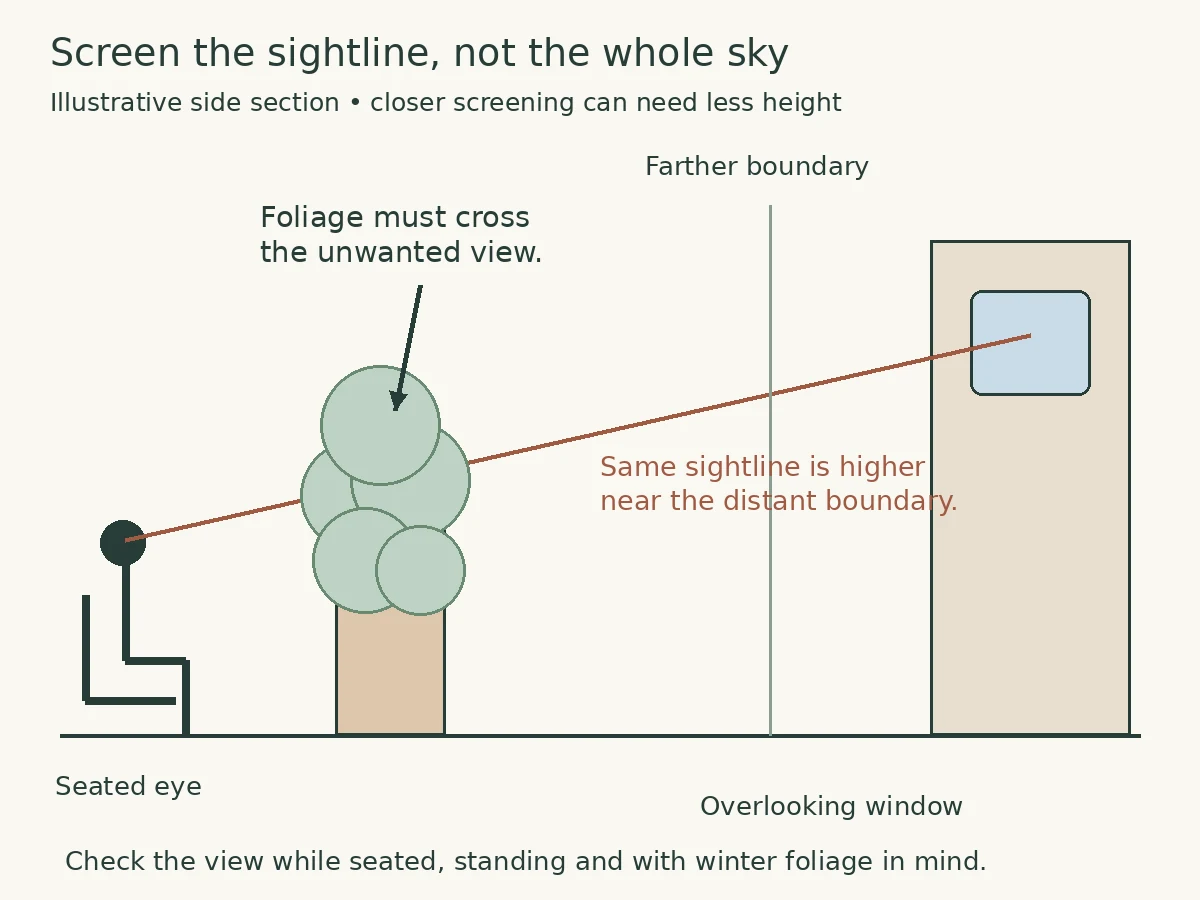
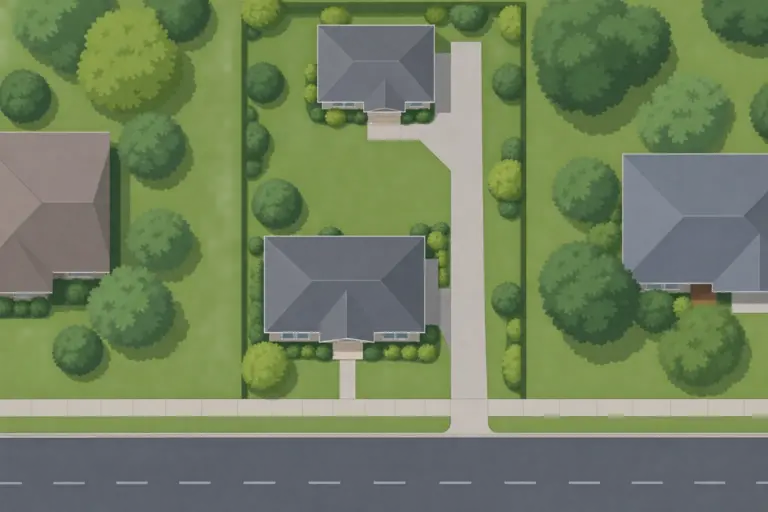
The side-section illustration shows a view between a seated person and an overlooking window. Along that rising line, the necessary screening height changes with position. A screen closer to the seating can intercept the view lower down than the same screen at a distant boundary. That is a geometric relationship, not a reason to crowd foliage against your face.
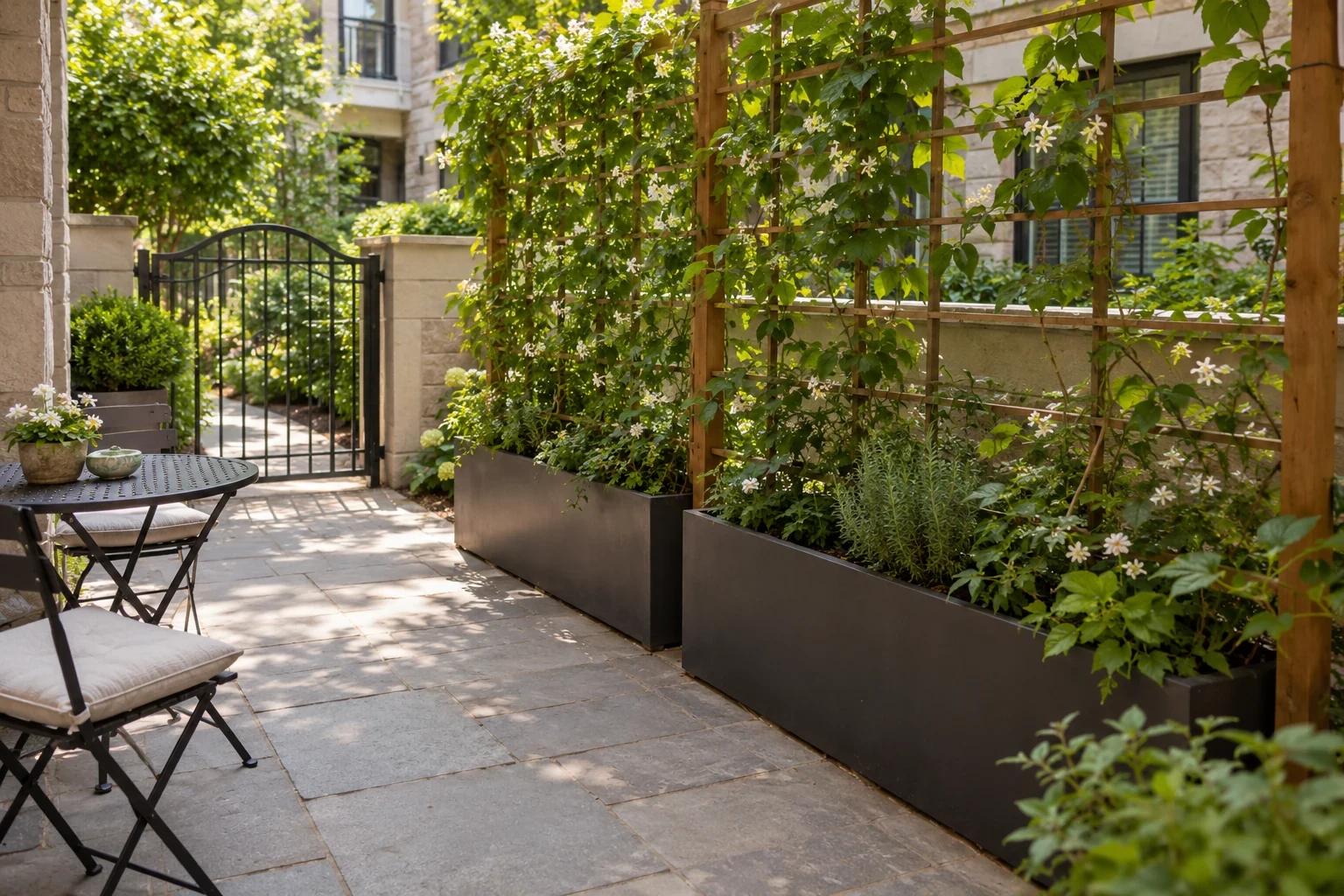
For example, a short planted trellis beside a dining area might block a neighboring window without requiring a very tall hedge along the whole boundary. Move the proposed position outwards if it would leave too little room around the table. Test the view again; the tradeoff may call for a different screen height or a smaller screened area.
An upstairs view may need overhead or raised foliage rather than a taller ground-level shrub beside the fence. Look along the actual line before deciding. A tree with a high canopy may interrupt an elevated view while leaving a ground-floor view open beneath it. The solution changes with the height you need to screen.
Balance Shelter with an Open Approach
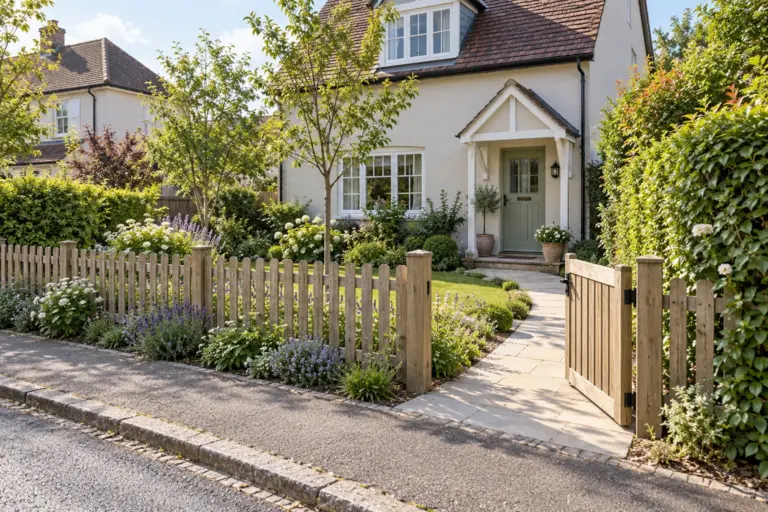
The Institute of Feng Shui describes trees and bushes behind a house as a symbolic supporting enclosure, using the traditional Tortoise image, and associates the front with openness. That is one practitioner account of landscape form. It is not evidence that a particular hedge will produce luck or protect a household from harm.
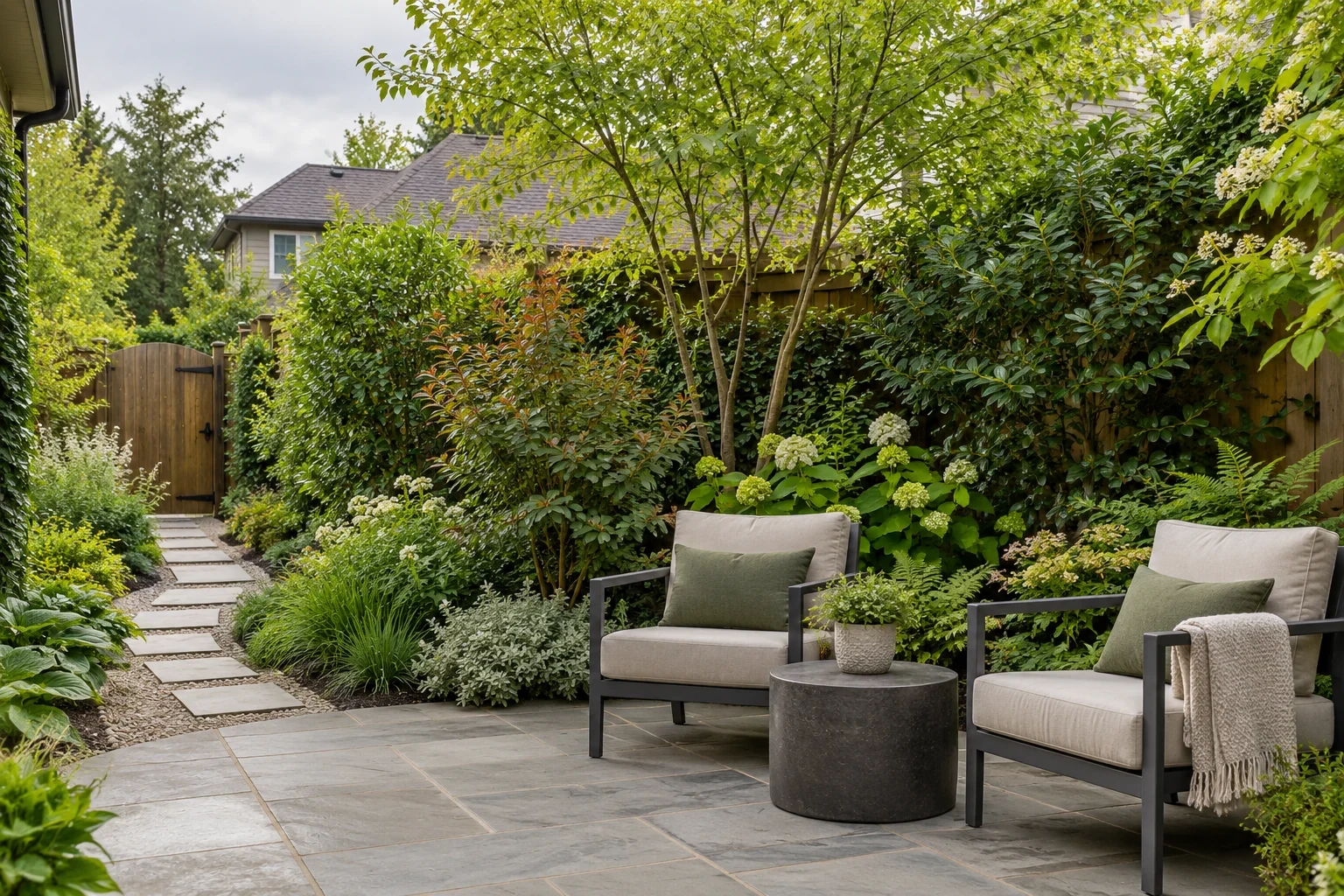
For a small seating area, you can borrow the design question without claiming the whole property has been assessed: where would a modest planted backdrop feel comfortable, and where should the view remain open? The main scene uses planting behind and beside the chairs while keeping a route visible along the other side.
Do not automatically wrap every side in dense foliage. Walk towards the seat from the house. If you cannot see where to enter, or have to push past branches, widen the opening or reduce the planted footprint. A legible route can coexist with a sheltered seat.
Likewise, do not force a winding path into a narrow strip merely because a feng shui illustration shows curves. The useful arrangement is one you can walk and maintain. Choose the amount of enclosure you enjoy, while keeping access, light and plant health in the decision.
Match the Planting Form to the Privacy Task
Several forms can work, but they solve different problems. Choose the form before choosing a favorite species.
| Planting form | Most useful when | Main tradeoff to check |
|---|---|---|
| Clipped hedge | You need a continuous screen at a fairly consistent height | Mature width and access for repeated trimming |
| Layered shrubs | You have depth for a varied planted backdrop | The bed can consume more usable ground than a single row |
| Climbers on trellis | A narrow strip needs screening at a defined location | The support and lower foliage must remain effective |
| Container planting | A small patio needs a targeted, changeable arrangement | Watering, root space and stability need ongoing attention |
| Raised canopy or trained trees | The unwanted view is higher up | The space below the canopy may remain exposed |
For a hedge, mark its intended mature edges on the ground. Walk past those edges, not just the line of small nursery pots. For a layered bed, place taller forms behind shorter ones in the view you are screening and check gaps between their eventual canopies.
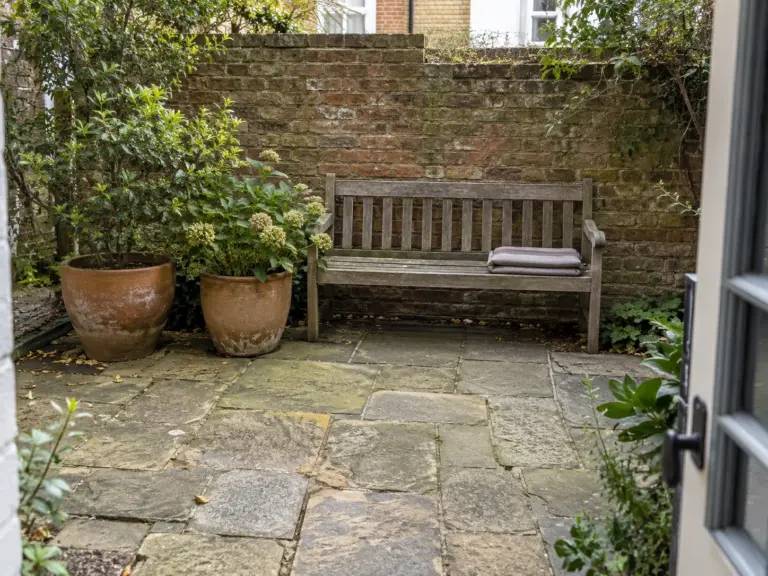
For a trellis, decide where the supporting structure belongs and how it will be installed before choosing a climber. The courtyard scene shows a targeted screen near seating while the gate route remains open. It illustrates placement, rather than identifying a particular plant or proving year-round coverage.
Climbers can leave gaps where you need privacy most. RHS notes that some concentrate growth higher up and require thoughtful pruning to screen below. Inspect the plant's expected habit rather than assuming any vigorous vine will cover every part of a panel.
Choose Plants for the Site and the Season
Record sun exposure, shade, wind, available soil depth, drainage and the space for roots and canopy. Check the site's winter conditions as well as its summer appearance. The RHS advises considering ultimate height, soil conditions, nearby structures and the ability to maintain fast-growing screens. Its examples are drawn from UK gardening; use locally appropriate information when choosing plants elsewhere.
Turn that information into a nursery brief. For example: “I need foliage at seated eye level, year-round cover, a plant that tolerates this afternoon shade, and a mature spread that fits inside this marked bed.” Ask for the exact species and cultivar, expected mature size, local suitability and the pruning needed to maintain the intended form.
If you need winter privacy, evaluate evergreen options or a structure that supplies some screening while seasonal plants fill in. If the area is only used in summer, seasonal foliage may be enough. A deciduous tree is not a failed screen when its winter openness was part of the plan; it is a poor choice when the brief required winter cover.
There is no universal best privacy plant. A species recommended for one region may not suit your weather or local ecological conditions. Check local invasiveness guidance and any toxicity concerns relevant to the people or animals using the space before choosing it. For boundaries and tall screens, check applicable local requirements and property restrictions rather than treating a general gardening article as permission to plant.
Keep thorns, abrasive leaves and maintenance access in the placement decision. A plant may be suitable in a deep boundary bed but uncomfortable beside a narrow path. Give it a location where its mature form can remain useful without constant corrective cutting.
Plan for Growing Time, Spacing and Maintenance
Choose spacing from the actual plant's expected spread and the intended hedge or screen management. There is no single interval that suits all plants. A clipped hedge and a loose mixed border use space differently; ask how the proposed spacing will work at establishment and at maturity.
Do not crowd young plants simply to make the first season look finished. Mark the eventual outline and decide whether you can live with the gaps while the planting establishes. If privacy is needed immediately, use a suitable temporary screen in the necessary position while the plants develop, instead of selecting an oversized tree solely for instant height.
Plan how you will reach both faces of a hedge, train a climber and carry out watering. Keep the mature planting within a footprint you can maintain without routinely entering a neighbor's property. Think about access to nearby drains and structures as well as the visible canopy.
For containers, assess the whole arrangement: pot, growing medium, plant and support. A tall screen in a small pot is not automatically stable or sustainable. In an exposed or elevated location, check the structure's load and wind requirements through an appropriate source before adding large planters or attaching screens. A courtyard example cannot determine what a balcony can support.
Provide a watering plan, including absences in hot weather. RHS specifically warns about potted bamboo drying out and about spreading shoots from some bamboo types in the ground. Do not assume “bamboo” describes one predictable screening plant.
Check the Result from the Places You Use
After setting out the proposed positions, repeat the original view test from every seat. Check the route to the gate, the light at the house and the maintenance space. Move one element at a time so you can see which change helps.
Revisit the screen after pruning and when seasonal foliage changes. If a gap opens at eye level, identify whether it comes from the plant's habit, a training decision or an unsuitable position before buying more plants. You may need a lower layer or a better-placed trellis rather than greater overall height.
A successful living screen does a specific job within a garden that still works. It gives the chosen spot enough visual shelter, leaves an understandable way in and out, and can be cared for at its mature size. That balance is a more useful starting point for natural privacy than pursuing maximum enclosure everywhere.