The most useful feng shui rules for a bunk-bed room are conditional: give each occupant a settled sleeping place, preserve an understandable approach and avoid adding clutter or hanging remedies around the beds. First, however, confirm that the bunk itself and its users meet the relevant safety conditions. Symbolic preferences cannot make an unsuitable upper bunk appropriate.
Bunks solve a real space problem, but they also create two different sleeping positions within one structure. Assess the top and bottom separately. A room that looks generous from the doorway may still have a crowded ladder landing or a lower occupant who feels enclosed.
Begin with the Bed, Mattress and Upper-bunk User
Health Canada's guidance says children under six should not use the upper bunk at any time. It also advises one person on the top bunk, using the ladder and following the manufacturer's instructions. Being old enough is only one consideration; the actual user must also be able to use the equipment appropriately.
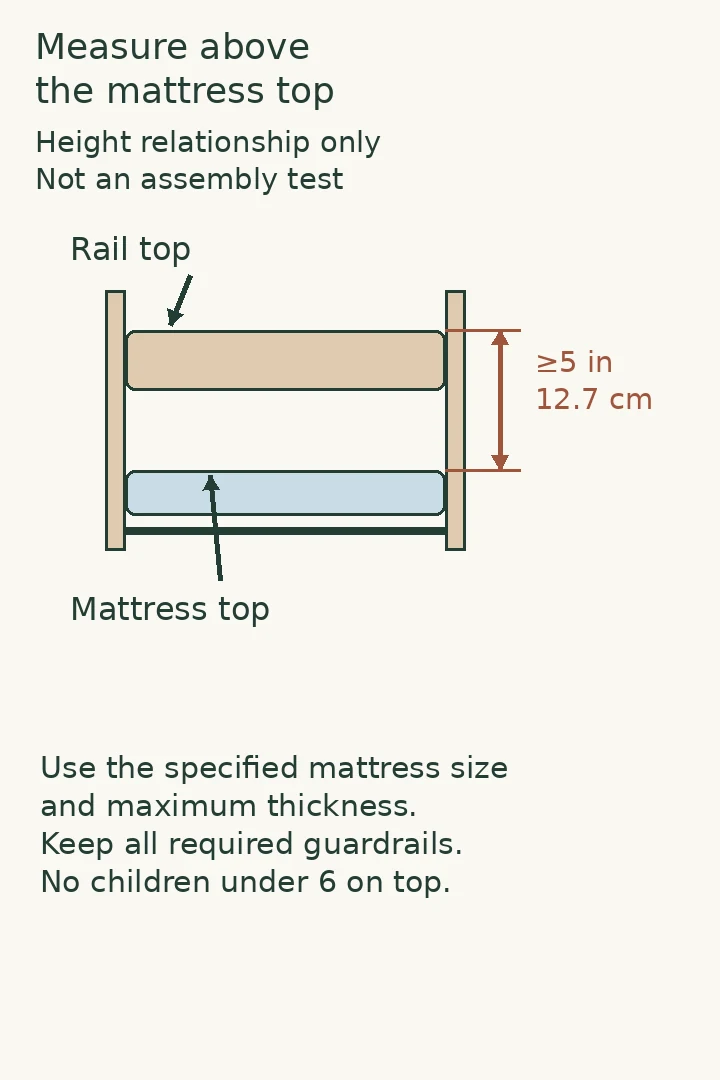
Check the model, assembly instructions, condition and any applicable recalls. For a second-hand bed, obtain the original instructions and appropriate manufacturer parts rather than improvising missing components. A sturdy appearance does not establish that the complete bed is correctly assembled.
Use the specified mattress size and thickness. Health Canada advises that upper guardrails stand at least 12.7 cm, or 5 inches, above the mattress top. A thick replacement mattress or added topper can reduce the protection even though the wooden structure has not changed.
For a household size check, identify the mattress specification on the bed’s label before replacing bedding. Measure from the actual mattress top to the guardrail’s upper edge, rather than from the support below. If the mattress size, maximum thickness or condition of a required rail cannot be verified, keep the upper bunk out of use until the manufacturer or another appropriate source resolves it.
The detail illustration shows where that measurement begins and ends. It is not a test procedure for certifying a bed. Keep the actual product's mattress maximum and other requirements, and follow applicable local standards where they are more specific.
Keep Guardrails and the Ladder Intact
Do not remove a wall-side rail because the bed is against a wall, or detach the ladder to make the room look calmer. Health Canada advises guardrails around the top bunk and a securely attached ladder. The space between a bed and wall is not a substitute safety feature.
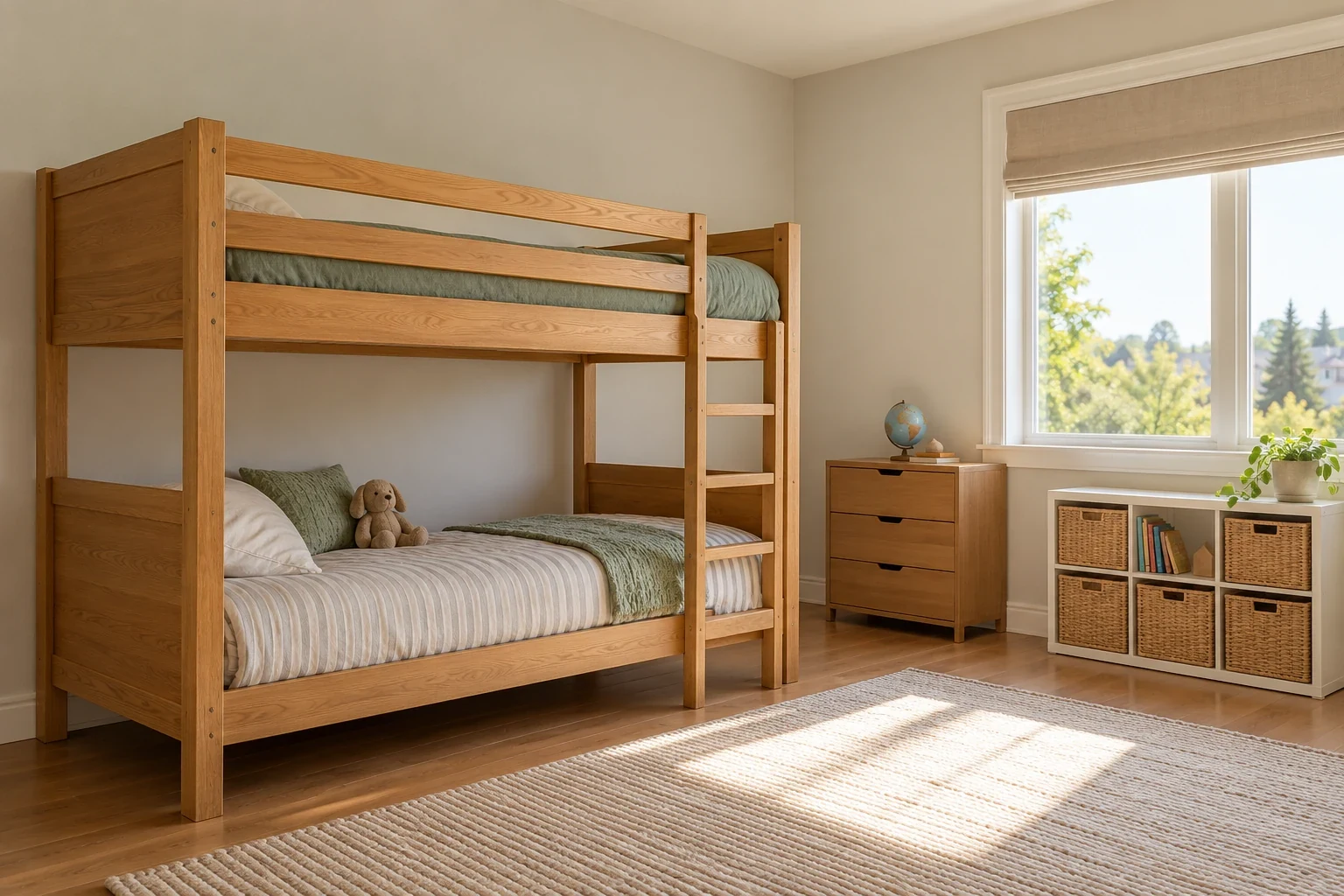
Check that the ladder can be approached without moving another child's belongings. Keep its landing clear when the room is in ordinary use, including when drawers are open or a desk chair is pulled out. Give the occupants a predictable place to put things other than the steps.
Avoid tying anything to the bed. Cords, scarves, ropes and similar hanging objects can create a strangulation hazard. That includes decorative additions made for a feng shui purpose. A crystal on a cord, canopy or string of lights is not an appropriate cure to attach casually to a bunk.
Use lighting that lets the intended user identify the ladder and route, with its installation and cords appropriate to the room. Do not rely on a hanging light draped across the frame to make a themed sleeping space.
Locate the Whole Bunk Within the Room
Map the bed, ladder, windows, doors, fans, lights, storage and walking route. Follow the product's placement and clearance instructions. Health Canada advises keeping bunks away from ceiling fans, windows, cords and other furniture.
Look at what each occupant can reach or climb towards. Nearby furniture can change how the top bunk is approached, and a window that seems separate from the mattress may still be reachable. Do not treat the room plan as two-dimensional floor packing alone.
In the main scene, the ladder has a clear approach and the bed is separate from the window area. Use those relationships as prompts for your own survey, not as measured clearance evidence for a particular product.
If the room cannot accommodate the bunk safely, consider a different sleeping arrangement. Moving a wardrobe or choosing suitable separate beds may be more useful than trying to correct an unworkable position with decoration.
Apply Door Awareness as a Preference, Not a Demand
Anjie Cho's adult-bed guidance describes seeing the entrance without lying directly in its line, with support behind the head. That principle can prompt you to notice how an occupant experiences the room, but it is not a reason to alter guardrails or choose an unsafe bunk position.
Sit or lie in each permitted sleeping position when it is appropriate and safe to do so, following the bed's intended use. Notice the view, light and feeling of enclosure. The upper and lower occupants may have different preferences even though the bed occupies one wall.
If the lower berth feels visually crowded, first remove unnecessary objects around its approach and surrounding walls. Do not take structural parts away to open the view. If the upper berth feels too close to the ceiling or other obstructions, compare actual model requirements and a different arrangement rather than installing a mirror overhead.
A door-view ideal is a way to compare feasible options. It should not become an instruction to rotate a heavy bunk diagonally into a route or shift it closer to a window.
Separate Symbolic Overhead Pressure from Physical Safety
Some people find the upper platform above the lower berth oppressive; others enjoy the enclosed sleeping place. Treat that response as something to discuss with the occupant, not proof that the bunk is causing illness, academic difficulty or family conflict.
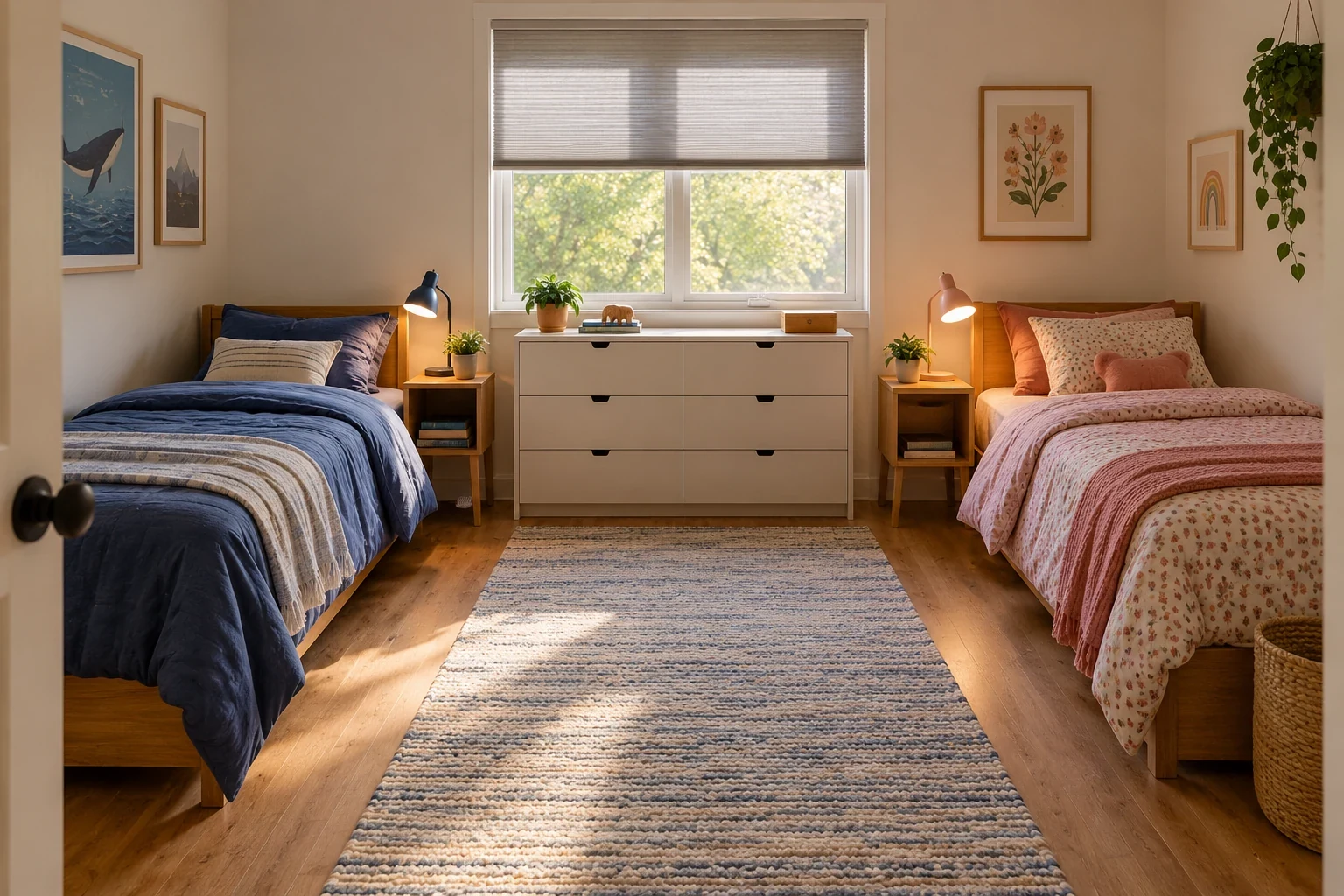
Similarly, a generous-looking ceiling gap in a picture does not establish suitable clearance. Use the manufacturer's requirements, the actual user's movements and appropriate local guidance. Do not invent a universal feng shui headroom measurement.
If a person remains uncomfortable despite a safe and less crowded arrangement, consider whether a different bed would serve them better. The separate-bed scene shows an alternative that gives both occupants independent approaches. It is not a requirement that all shared rooms abandon bunks.
Some bunks are designed to separate and some are not. Check the actual instructions before treating conversion into two singles as an option. Do not make a homemade structural change to satisfy a symbolic preference.
Give Both Occupants Personal Territory
A bunk can save floor area without making every remaining surface communal. Give each person a definite place for the belongings they use at bedtime and for personal display away from the bed's safety areas. Decide what can be borrowed and what requires asking.
Keep storage separate from the ladder and sleeping surfaces. Avoid placing heavy toys or other loose objects on the upper bunk. A nearby appropriate shelf or drawer may serve a bedtime book better than a makeshift hanging pocket tied to the rail.
Discuss lighting and routines. One occupant may want to read while the other is ready to stop, or need to get up at a different time. Use appropriate independent controls and an agreed routine rather than assuming the shared structure means identical needs.
If space allows only one desk or another shared function, provide a way to store each person's current work. A dispute about moving a sibling's project is a household-use problem, not evidence that one bunk has the wrong energy.
Review the Room as Children and Equipment Change
Recheck the arrangement when replacing a mattress, moving furniture or changing who uses the upper bunk. A room that worked for one set of users may need a different approach later. Inspect the bed's fasteners, ladder and other components as its instructions require.
Teach the intended use: climb by the ladder, keep within the rails and avoid play that the manufacturer does not permit. Health Canada's guidance also limits the space under an upper bunk to play only when it was designed for that use.
Finish by following the route from the doorway to each occupant's bed and belongings. Keep the arrangement that preserves safe equipment use, clear access and a place for both people. Feng shui preferences can help you reflect on support and enclosure, while the actual bed, its instructions and the users determine what is appropriate.