Bed size matters because it changes both the place where you sleep and the space left around it. A larger mattress may suit its users well while its frame blocks a wardrobe or squeezes one person against a wall. A smaller bed may improve circulation but leave too little sleeping room. The useful choice accommodates the people and the room together.
In feng shui, that relationship is often discussed through support, proportion and balanced access. It does not establish a universally lucky mattress size. Start with the actual frame dimensions, the people using it and their routes through the bedroom, then compare the feasible options.
Distinguish the Mattress from the Bed’s Footprint
Names such as double, queen and king vary between markets. Even within one market, a mattress label does not tell you the outside dimensions of an upholstered frame, projecting footboard or bedside platform. Obtain the dimensions of the specific bed you intend to use.
Measure the widest and longest fixed parts, including any headboard wings. Add the space needed to operate drawers or other moving storage. If you are keeping an existing frame, measure it rather than substituting a standard mattress measurement from a chart.
Also check how the bed will enter the room. A frame may be delivered in sections while a headboard or base has to pass through a stair turn. Confirm the packaging and assembly requirements with the supplier before treating a plan on paper as a purchase decision.
For an adjustable bed, the footprint also needs a movement check. A drawing of the mattress laid flat does not establish the clearance its mechanism, headboard or moving sections require. Follow the actual model's instructions rather than enlarging a conventional-bed sketch by a guessed amount.
Understand What the Feng Shui Preference Means
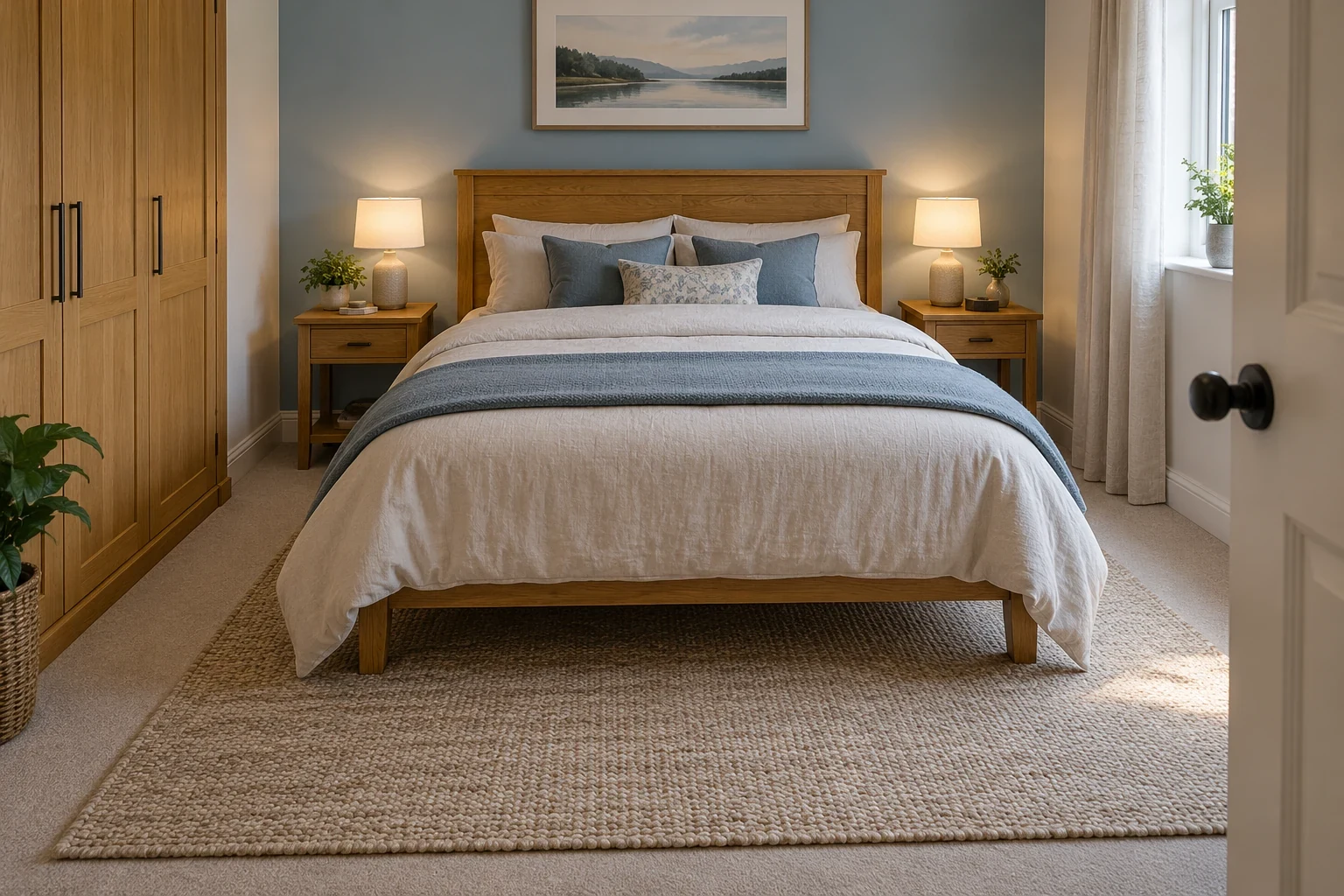
Anjie Cho describes the commanding bed position as having a wall behind the headboard and a view of the bedroom door without being directly in its line. A bed's size affects whether you can achieve that relationship while keeping access usable.
For a couple's room, Cho also favors balanced open space on both sides and a bedside surface for each person. That is her symbolic interpretation of accommodating both partners. It does not mean a cramped side causes an unequal relationship, or that identical tables are essential.
Try those preferences after locating windows, doors and fixed furniture. A very large bed might fit against the preferred wall but remove the only practical approach to one side. A slightly smaller frame may preserve both the door view and independent access. Alternatively, a different wall might accommodate the larger bed better.
For one adult, the relevant question is still whether the arrangement supports daily use. You do not need to buy a double bed solely to represent an imagined future relationship. Choose for the person using the room, while considering any known future needs you actually want to plan for.
Calculate What Remains, Then Test It Physically
Draw the room and mark its fixed obstructions. Put the proposed outer bed rectangle on that drawing. Work out the remaining space at each side and at the foot, then check where doors, furniture and actual movement reduce it further.
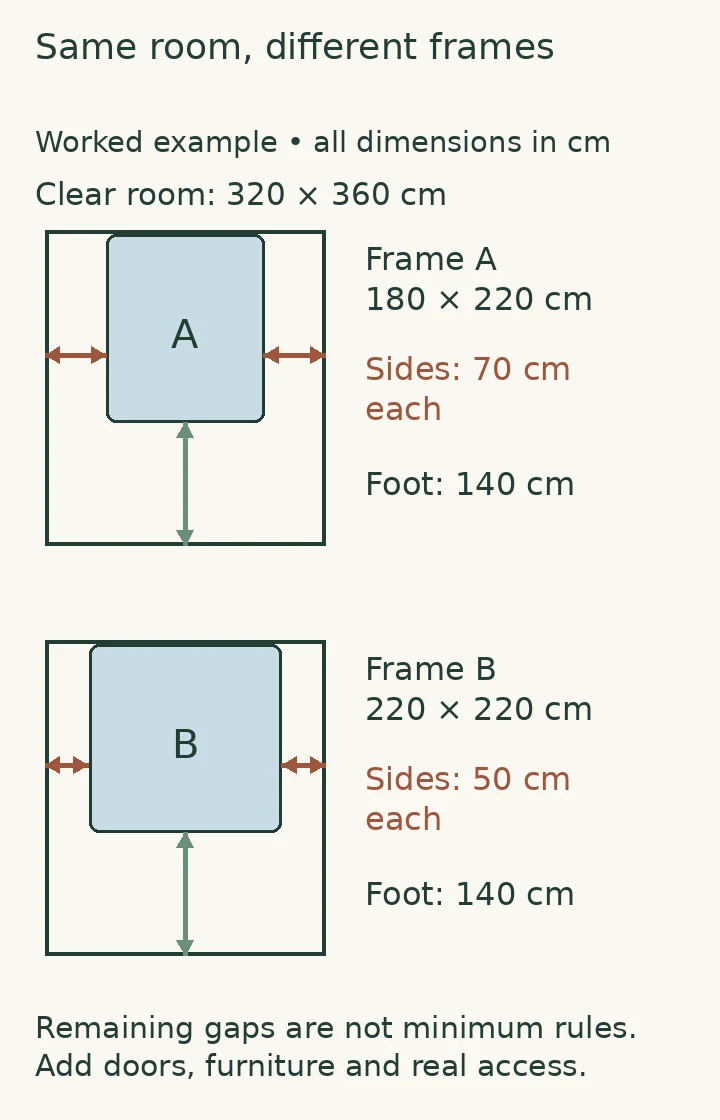
For example, imagine a clear rectangular area 320 cm wide and 360 cm deep. A frame 180 cm wide and 220 cm long, centered across that width, leaves 70 cm on each side and 140 cm beyond its foot. Those numbers are simply the remaining dimensions: (320 − 180) ÷ 2 and 360 − 220.
In the same area, a frame 220 cm wide and 220 cm long leaves 50 cm on each side, with the same 140 cm at the foot. The diagram compares those two footprints. These are invented frame dimensions for a layout exercise, not standard mattress sizes or minimum circulation requirements.
Now add a wardrobe door, bedside furniture and the bedroom door swing. The apparently generous foot area may contain the main route or a chest of drawers. If the room is irregular, calculate each real gap separately rather than dividing one leftover measurement equally.
Use removable floor markers to outline the frame where feasible, then walk around it. Open cupboards, carry a laundry basket and approach the bed from each side. The calculation tells you what remains on paper; the physical trial tells you whether that space works for your household.
Compare Sleeping Comfort and Access Fairly
Start with the sleeping requirements of the actual users. Consider their preferred space, height, movement, whether the bed is shared and any known access needs. Try candidate mattresses in a suitable setting if you are buying. A circulation improvement is not a success if the sleeping surface does not accommodate its users.
Then compare what each option removes from the room. Would a wider bed force one bedside table away, make dressing awkward or prevent a needed mobility aid from approaching? Would a longer bed affect the route to the bathroom? If a person needs assistance, test the approach with the relevant equipment and support rather than relying on an average clearance figure.
Do not solve an access need by making one person climb over another. For a shared bed, think about how both people get up at different times. Balanced function may require different bedside arrangements or a wider approach on one side. That can be a thoughtful response to real needs even when the drawing is not symmetrical.
Write down the tradeoff in ordinary language: “The larger surface suits us, but this frame blocks the wardrobe,” or “The smaller frame keeps both approaches usable.” That makes it easier to compare another frame or wall position without treating the issue as a mysterious energetic defect.
A King or Split Bed Is Not Automatically Bad Feng Shui
You may encounter claims that a king bed separates partners or that a split surface damages a relationship. Bed dimensions alone cannot establish that outcome. The relevant practical questions are whether both people are comfortable, how the bed is supported and whether its layout works.
A split arrangement can serve different preferences or independently adjustable sections. Check the mattress and base compatibility, how the two sides are intended to connect, and the bedding requirements with the manufacturer. Do not add an improvised board or tie the mechanisms together to make the bed symbolically “one.”
If the visual division bothers you, choose suitable coordinated bedding or a compatible common headboard where the system permits it. That is an aesthetic choice. It should not override the functions that made the arrangement useful.
Similarly, an unusually small room does not become better simply because it contains the largest bed possible. Proportion is a relationship between the bed, the people and the remaining use of the room, rather than a rule that one category of mattress is more auspicious than another.
Make a Small Bedroom Work Before Replacing the Mattress
Look first at frame bulk and secondary furniture. A projecting footboard or oversized bedside chest may use space without adding the function you need. A less bulky compatible frame, smaller bedside surface or relocated dresser may preserve the existing sleeping surface.
Test another supported headboard wall if the room offers one. Sit at the head of the proposed bed, check the door view, then repeat the access trial. Do not rotate the bed diagonally simply to imitate the phrase “diagonally opposite the door”; that can consume more floor area than it releases.
If one long side must sit against a wall, consider who will use it and how bedding will be changed. It may be workable for a single sleeper but unsuitable for the way two people need to get up. Name that limitation instead of declaring the room either perfect or hopeless.
Choose Using a Whole-room Rehearsal
Before buying, rehearse arrival, getting into bed, using both bedside surfaces, opening storage and leaving at night. Include the full frame outline and the furniture you will actually retain. If a choice works only after deleting a necessary wardrobe from the drawing, it is not yet a finished plan.
Keep the bed size that accommodates the sleepers while leaving the room usable. Support and balanced access can inform that judgment without becoming a prediction about love, health or luck. A well-chosen bed belongs to the room and its users; it does not win a competition to fill the most floor space.