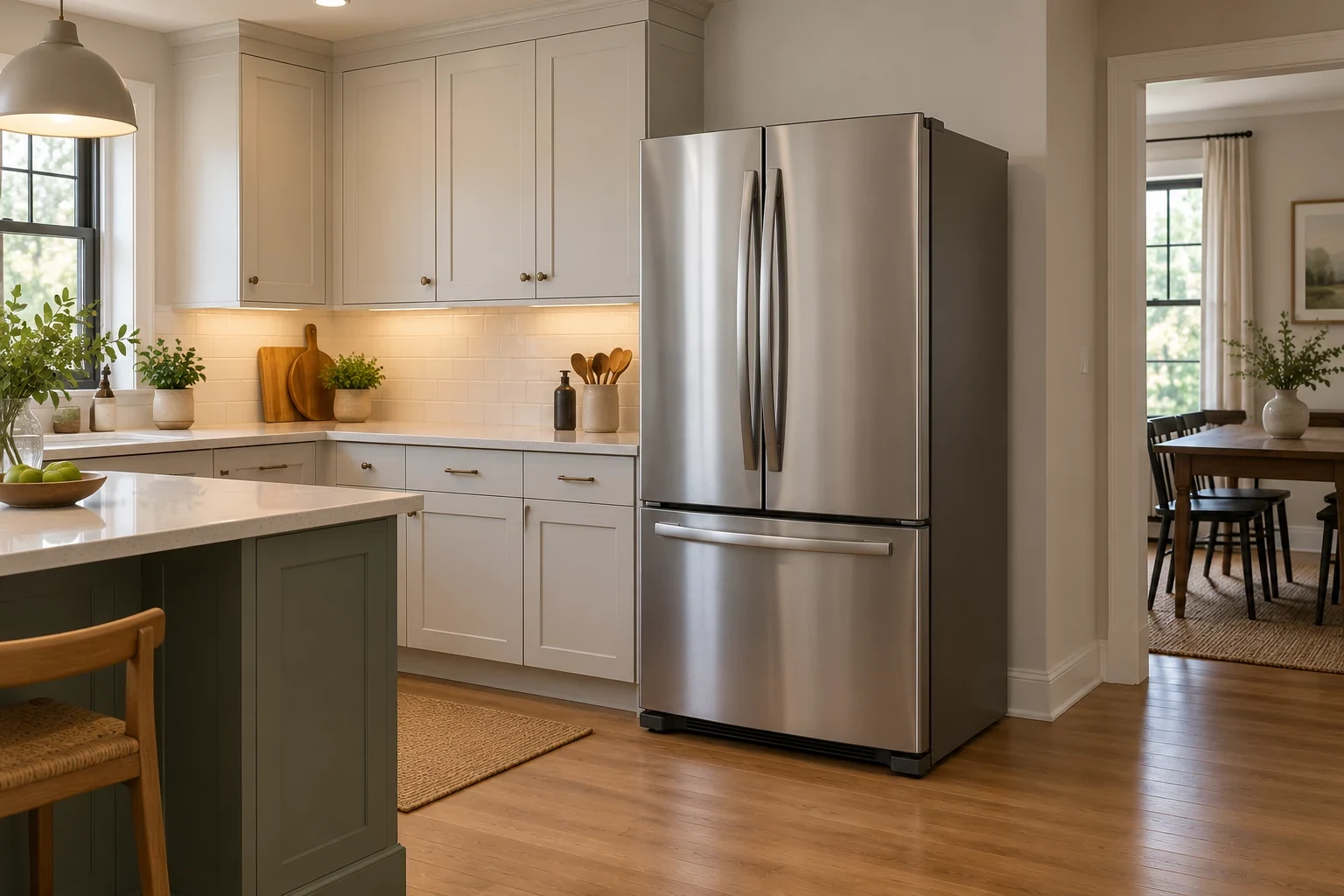
A refrigerator needs room for three different reasons: the air clearances its manufacturer specifies, the space needed to open its doors and drawers, and the kitchen route people use around it. Feng shui adds a symbolic reading of spaciousness and the appliance's relationship to other fixtures. These concerns can inform the same decision, but they are not interchangeable.
Start with the refrigerator you actually own. Note whether it is freestanding, counter-depth or an integrated model, where its visible vents are and what surrounds it. A gap that looks generous may still be in the wrong place for that model, while a close-fitting installation may be intentional for an appliance designed for it. Do not pull a connected appliance out simply to copy a generic feng shui diagram.
What “Breathing Room” Means in This Discussion
In ordinary room terms, breathing room means the refrigerator is accessible and its surroundings do not feel crammed. You can reach the handle, put groceries down nearby and move past without negotiating a tower of bags. That is a useful design aim even before considering symbolism.
Some feng shui teaching groups the refrigerator with Water while treating the stove as Fire. Geomancy.Net uses that classification in its kitchen guidance and discusses separation between opposing elements. This describes one traditional interpretive framework. It does not tell you the appliance's ventilation requirements or establish that an adjacent stove causes financial difficulty.
A refrigerator's appearance can also suggest how the kitchen is cared for. A clear usable approach may help the room feel ready for meals; an appliance buried under unrelated storage may look neglected. Those are observations and associations, not evidence that air gaps measure qi.
Separate the Three Spaces Before Moving Anything
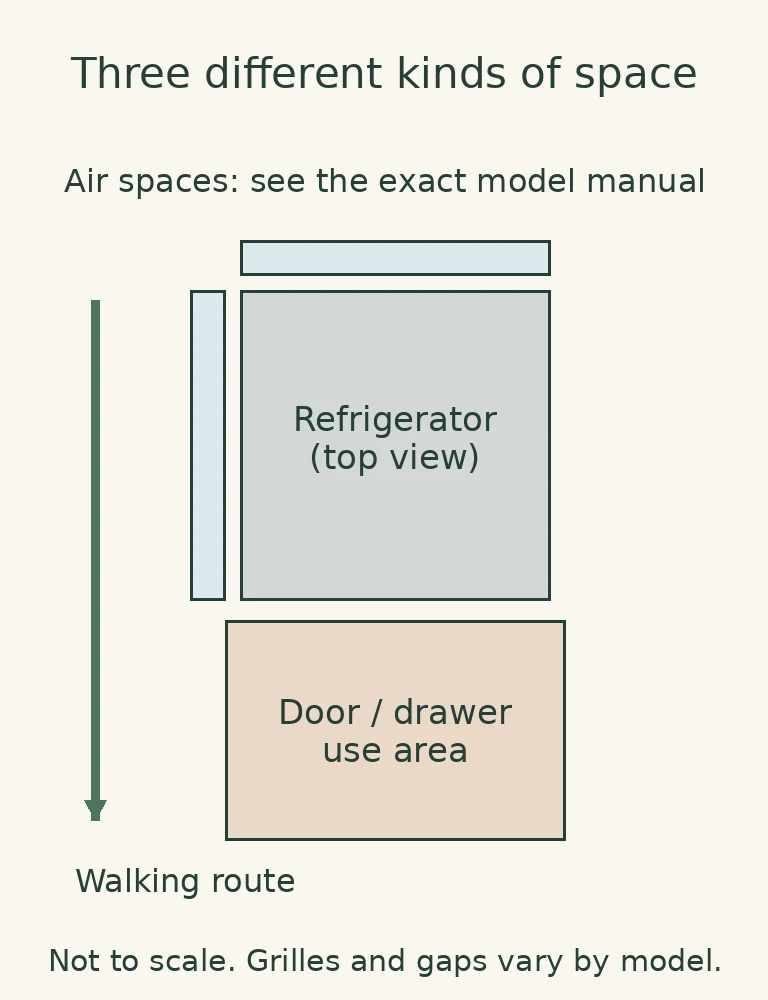
The technical gap, the door-opening area and the walking route may overlap on a drawing, but each answers a different question.
| Space | Question it answers | Where the requirement comes from |
|---|---|---|
| Ventilation clearance | Where must air move around or through this model? | The exact installation instructions |
| Door and drawer opening | Can this appliance open far enough to use and service its compartments? | Model geometry, hinge design and the instructions |
| Everyday working route | Can people stand, load groceries and pass through the kitchen? | The actual room and household use |
For example, adding a narrow rolling cart beside the refrigerator might leave a visible air gap yet prevent its door opening fully. Moving the cart fixes the operating problem without changing the appliance. Conversely, removing a decorative basket from the top may improve appearance while leaving an obstructed vent elsewhere unresolved.
Do not use a symbolic screen, plant or storage tower to “separate” appliances until you have checked all three spaces. A decorative improvement should not occupy the very clearance you are trying to preserve.
Find the Instructions for the Exact Model
Locate the model identifier using the owner's information or the manufacturer's guidance; it is often on a label accessible with the door open. Use the complete model number, not just the brand or the name of a refrigerator series. Find the matching installation instructions on the manufacturer's own support site.
Read the parts covering installation location, air clearances, ventilation openings and door operation. Check whether the diagram measures the cabinet case, the door, the hinge or another reference point. Those are not necessarily the same edge. If the refrigerator is built into cabinetry, identify any specified openings in the surrounding installation as well.
GE's general support guidance explicitly says installations vary and directs owners to the installation instructions for their specific model. Its general clearance examples are therefore not a universal set of dimensions to copy into every kitchen. The top-view diagram separates the appliance, model-dependent air spaces and the door/drawer use area; it gives no universal measurements.
If you cannot identify the appliance or find the right instructions, send the model label and a clear description of the installation to the manufacturer or responsible installer. In a rental, ask the owner or manager for the appliance information and any installation concern. You can still clear loose belongings from the approach while the technical question is resolved.
Inspect What You Can Reach Without Disturbing Connections
With the appliance in place, look for objects covering visible ventilation openings or crowding a space the manual says must stay clear. Notice anything stored above it or pushed into a gap beside it. Compare those locations with the actual instructions before deciding what to remove.
Do not remove fixed cabinetry, covers or grilles simply because they resemble an obstruction. Some are part of the intended appliance or installation. Cleaning or maintenance should follow the manufacturer's procedure, including any instruction about disconnecting power. A water line, power connection or floor that makes movement difficult is a reason to use appropriate service help rather than pulling harder.
Check the approach separately. Open the door normally and see whether a wall, handle, cabinet or cart limits it. Can the produce drawer slide out as intended? Can someone stand where groceries are being loaded while another person uses the necessary route? This practical test can reveal a problem that a closed-door photograph misses.
Give Surrounding Storage a Defined Boundary
Leave required openings and gaps available instead of treating them as convenient storage slots. A narrow space beside the refrigerator may be tempting for trays, bags or a folding step stool, but it is not usable storage if the installation needs it for something else.
Choose a different home for those items, where retrieval does not interfere with the appliance. Keep the top from becoming an undefined holding area; whether anything can be placed there depends on the model and the proposed item, not a universal rule that the top must always be empty.
Also consider the surface beside the refrigerator. A small usable landing place can make unloading groceries easier, where the kitchen allows it. It need not be a new piece of furniture. An existing counter cleared of non-kitchen belongings may do the job without narrowing the aisle.
When the Stove Is Close to the Refrigerator
Distinguish the symbolic Fire–Water concern from installation compatibility. Geomancy.Net's interpretation does not override appliance instructions. GE's general guidance, for example, says its stated air-clearance requirements can coexist with locations beside a range or wall oven. That is not a blanket approval for every appliance pair; the exact models and installation conditions still matter.
If the existing installation meets its requirements and you cannot move it, you can acknowledge the symbolic compromise without buying a cure. Keep the working surfaces useful and avoid inserting combustible decor, plants or a board into required gaps near cooking equipment.
For a planned renovation, tell the designer which traditional concern you want considered and ask for an arrangement that also satisfies the actual appliances. Review clearances, door swings and the occupied route together. A drawing that satisfies one concern by creating another is not ready.
Respond to a Concern with the Right Kind of Action
A refrigerator that seems unusually hot, performs poorly or makes a new troubling noise needs the manufacturer's troubleshooting or service route. Moving objects for feng shui is not a diagnosis. Describe what you observe, when it occurs and the model involved rather than assuming the cause is a blocked energy path.
For everyday crowding, begin with a reversible change outside the technical installation: relocate a trolley, give shopping bags a home or clear the landing surface. Then use the kitchen normally. If the door works better and people can pass, you have improved the room without claiming that a larger gap produces more luck.
Breathing room is most useful when you know which space you are protecting. Follow the model's requirements for air, allow its moving parts to work and make the surrounding kitchen usable. Let feng shui's symbolic language encourage attention to that arrangement rather than replace the instructions that make it function.