Apply feng shui to a dorm room by making its competing jobs easier to recognize: a place to sleep, a place to study, somewhere for belongings and a route everyone can use. Start with the fixed furniture, doorway, windows and roommate agreement. You can improve a small room without moving a bed into an impractical position or adding objects that the residence does not permit.
The most useful first change is often modest: turn a chair so the doorway is easier to notice, clear the route between the beds or give study materials a place to go when the day ends. Traditional ideas about support, awareness and quieter sleeping space become useful when they fit the room and the people sharing it.
Establish What Is Fixed, Movable and Shared
Sketch the room before shifting anything heavy. Mark the door swing, windows, closets, heaters or vents, beds and desks. Check which furniture may actually move and which arrangements the residence permits. Ask housing staff about an unfamiliar fixture rather than assuming it can be detached or altered.
Include the things you bring: luggage, a laundry hamper, a refrigerator if allowed, and the chair pulled out from the desk. A desk occupies more floor during use than when its chair is tucked away. The route must still work when someone is studying, opening a closet or entering with a bag.
Agree on shared floor and personal zones with your roommate. A change that improves your view of the entrance but pushes their chair into the only walking route is not a successful layout. Talk about daily habits as well as furniture: who studies late, who gets up early and where each person can put a coat or shoes.
Keep the exit and necessary access clear. Use the residence's rules for electrical items, wall attachments, lofting and decoration. Feng shui does not supply an exception to those conditions, and a rental-friendly product is not automatically approved for a particular dorm wall.
Give the Bed a Supportive Position Within the Constraints
Anjie Cho describes the bed's commanding position as a place from which you can see the doorway while lying down without being directly in line with it. In the same teaching she treats sleep as a quieter yin activity. These are feng shui preferences, not a forecast that a fixed dorm bed will harm its occupant.
If moving the bed is permitted, compare possible positions on the sketch. Check the head end against a suitable wall, the view toward the entrance and the routes beside and around the bed. Then include the roommate's bed and furniture rather than deciding in isolation.
If the bed cannot move, improve what is within reach. Clear loose objects from its approach, arrange a usable bedside surface if there is space and keep necessary belongings easy to reach. Do not squeeze in a second table simply to create symmetry. A light that works for you and a clear route may matter more in this room.
Avoid solving a sightline preference by hanging a heavy mirror or decorative object above a sleeping position. Adjusting a permitted furniture angle or the location of a small useful surface is a more manageable starting point. A room can remain workable when one traditional preference cannot be achieved.
Make the Desk a Place Where Study Begins
Sit in the actual chair and look up. Can you notice someone entering without twisting around every few minutes? Where a change is permitted, try a desk orientation or chair position that improves awareness while leaving the shared route available. Do not turn the desk solely for a view if its footprint blocks storage or forces cords across the floor.
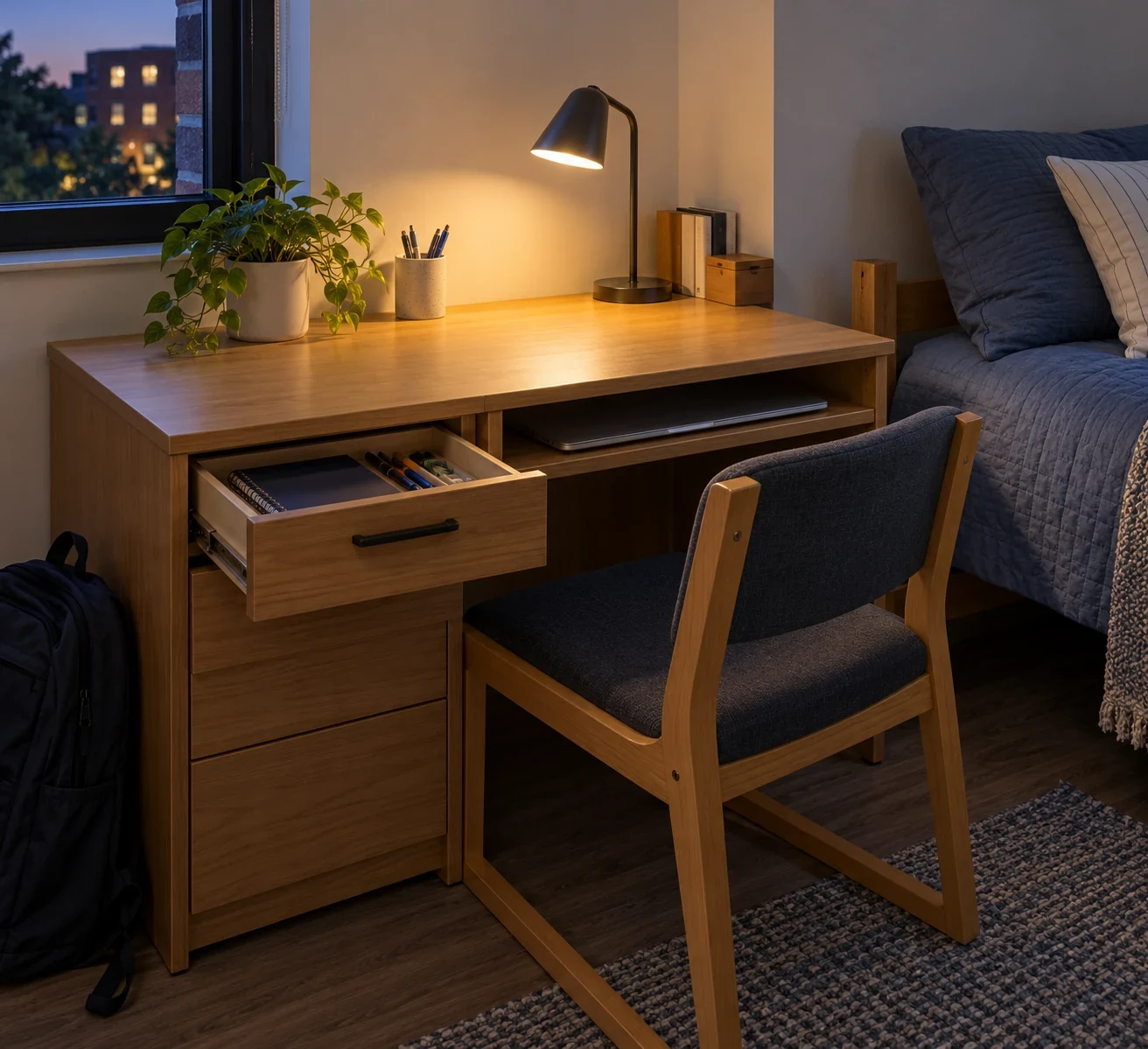
Keep the immediate working surface ready for the materials you use. Put everyday supplies within reach and keep occasional materials in a defined drawer or file. A permanently crowded desktop can make every study session begin with moving a pile elsewhere.
Use task lighting that suits the work and your roommate agreement. Notice reflections on a screen, shadows over a notebook and whether the lamp points into the other person's bed. A separate desk light can let you use the room differently at the same time, but it does not make every late-night activity considerate. Agree on quiet and lighting expectations explicitly.
If there is no desk-position choice, give the existing station a clear beginning and end. Open the materials you need at the start, then close the computer and put away loose work when you finish. Cho recommends similar transitions for a studio apartment where several activities share one room.
Protect the Route Between Personal Zones
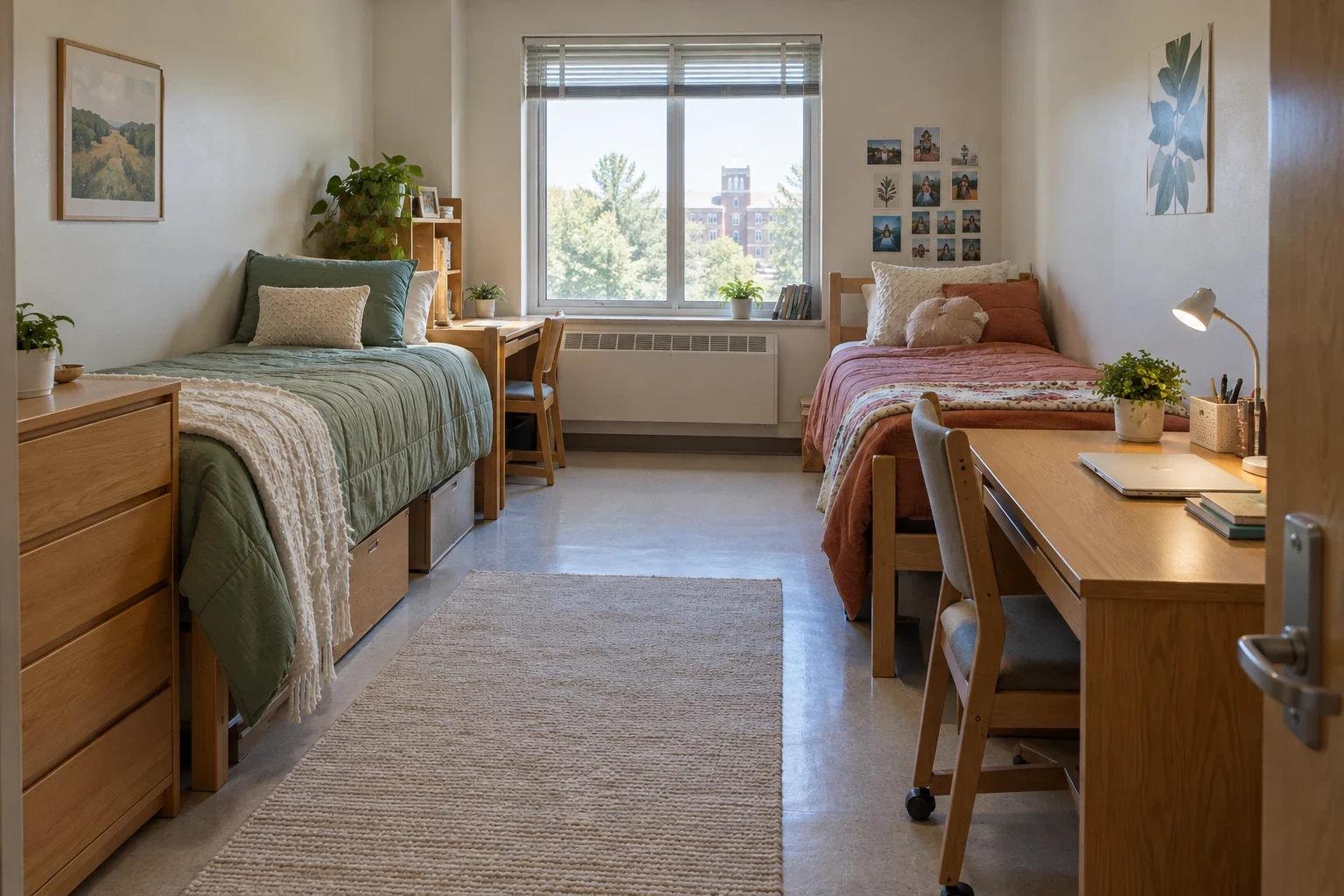
The plan shows two beds, two desks and a central shared route. It is a way to see the relationship, not a requirement for identical furniture positions. Your actual room may need the route along one side or around the foot of a bed.
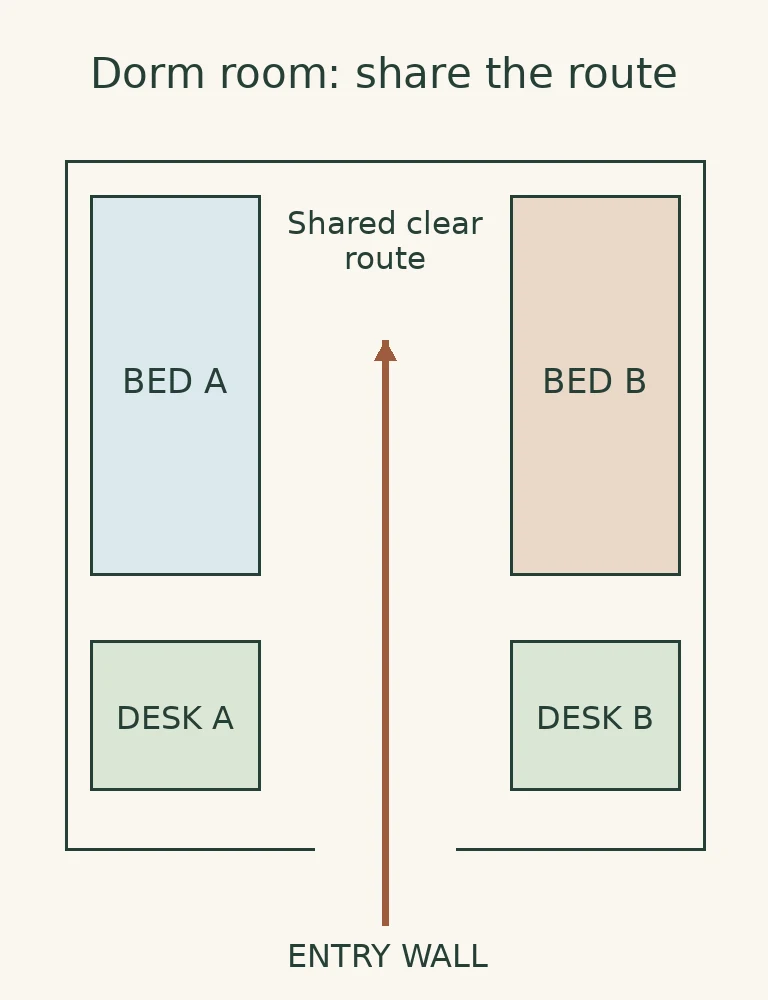
Walk it with both desk chairs occupied. Open the closet and room door through their normal ranges. Put the laundry hamper where you expect to use it. If the route disappears, identify which movable item is taking it rather than asking everyone to sidestep it indefinitely.
Keep shared circulation out of your long-term storage plan. Shoes, cartons and delivery parcels often accumulate near a dorm entrance because they have no agreed destination. A small permitted shoe space or an immediate unpacking habit may solve the issue more effectively than another decorative organizer in the doorway.
For example, two students might keep their desks near their own beds while agreeing that luggage belongs in designated storage after move-in. The shared route then stays available without either person having to make their whole side look like the other's.
Create a Quieter Sleeping Setting Without Dividing the Room Unsafely
A dorm may be one room, yet it can still have different modes. During the day, a clear desk, an open working surface and appropriate light signal activity. At bedtime, put loose study materials away and reduce the light you control in agreement with the other person.
Use bedding and a small selection of personal details to make the sleeping place recognizable. You do not need a particular “sleep color” or an exact matching set. Choose textiles that are useful, manageable to clean and welcome to their owner.
Do not improvise fabric canopies, hanging partitions or loft-bed modifications to manufacture a separate zone. Where privacy is needed, ask residence staff which options are allowed and check that the proposed arrangement preserves circulation, equipment access and the room's safety conditions. A personal routine can create a transition when a physical partition is not feasible.
Cho's small-space advice is useful precisely because it does not assume every activity can have its own room. Putting the laptop away at night can establish a practical boundary without pretending the desk no longer exists.
Store for Retrieval, Not Just Concealment
Give high-frequency items the easiest appropriate homes. A bag used every morning should not require moving the laundry hamper to reach it. Keep supplies for one activity together so unpacking and putting away do not spread into the shared area.
Under-bed space may be part of the residence's intended storage. If you use it, keep the items organized, reachable and compatible with the bed's instructions and any room equipment nearby. A traditional preference for openness does not require a student to pile those belongings into the walking route instead.
Check what storage looks like when it is in use. A box with a lid may fit under the bed but need much more space to open. If you must empty the shared floor each time you retrieve a notebook, use a different destination for that notebook.
For furniture requiring restraint or attachment, work through the approved residence arrangement. A low-looking shelf or a heavy load at its base does not by itself establish that a required anchor can be omitted. Do not substitute adhesive picture products for structural attachment.
Personalize Your Own Area and Negotiate Shared Changes
A postcard on a permitted display board, bedding you chose and a favorite small object on your desk can make the room feel more personal. Keep the object count proportional to the space available for daily tasks.
Ask before changing a shared surface, moving the other person's belongings or applying a feng shui map to their private area. Your roommate does not need to share the same beliefs for you to agree on a usable doorway, considerate lighting and storage that stays within its zone.
If you disagree about a position, describe the practical outcome you want: seeing arrivals while studying, getting to bed without moving a chair, or keeping a surface clear for food. Compare possible arrangements together. Framing the conversation as a problem to solve is more useful than declaring their side of the room energetically wrong.
Use a Short Reset and Review What Fails
Before bed or at another agreed moment, restore the shared route, return study materials and move laundry to its chosen place. Keep that reset small enough to repeat. It should not require rearranging the whole room.
After an ordinary week, notice where the plan breaks down. Perhaps a desk drawer cannot open with a chair in place, or a coat needs a permitted storage option closer to the entrance. Adjust that specific detail and try again.
A dorm room does not need to imitate a large permanent home. It needs to support the students living there, through both activity and rest. Feng shui can help you pay attention to those relationships while the room's constraints and shared agreements keep the result workable.