
A Murphy bed can fit a small home's feng shui when the room works as a sleeping place with the bed open and as a useful room with it closed. Judge both states, plus the movement between them. A beautiful daytime cabinet is not enough if opening the bed blocks the exit or requires a tiring rearrangement every night.
Start with the actual wall, floor, doorway and proposed bed model. Its installation and operating requirements are fixed conditions, while feng shui offers preferences about support, awareness and separating activity from rest. Choose a layout that satisfies the real bed first, then make its nightly setting feel settled and usable.
Treat the Open Bed as the Starting Point
A wall bed is often chosen for the floor space it returns during the day. Begin planning with the opposite state: the bed fully open, with the mattress and bedding it will actually use. Mark its full footprint from the manufacturer's dimensions and include the space needed to approach it.
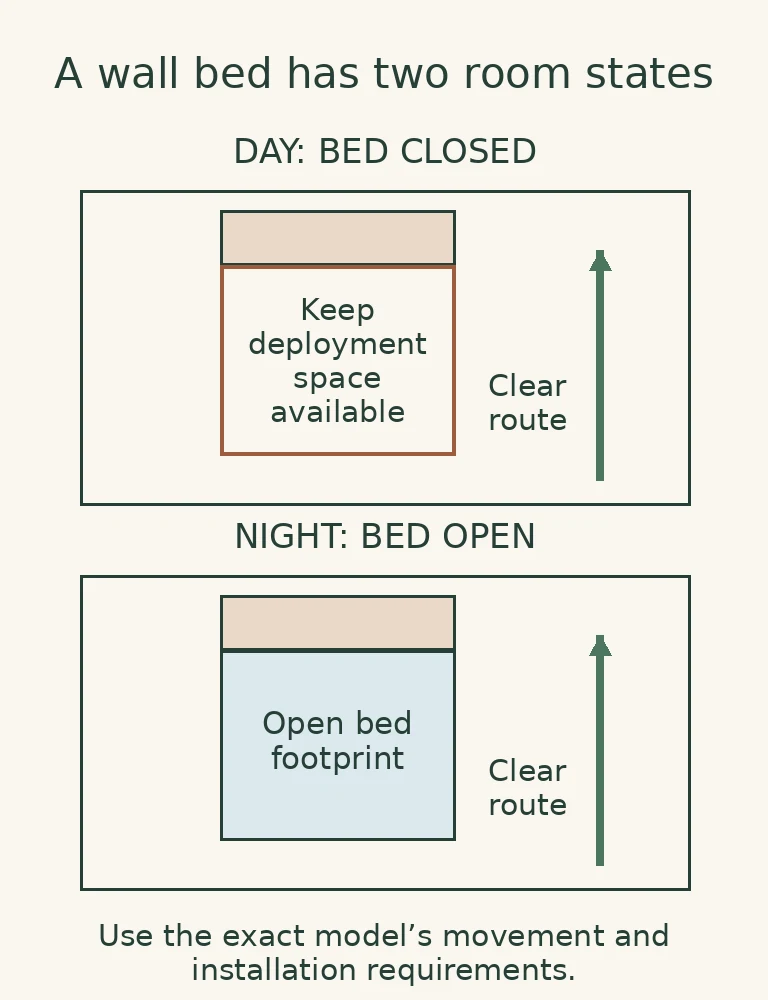
Check the door, closet, drawers and route to the bathroom or room exit. Imagine someone using the bed while the rest of the household follows its normal routine. A route that exists only when the bed is closed cannot be counted as a nighttime route.
Also mark the movement needed to open and close it, using the exact model's information. The operating envelope can differ from the final open footprint. Do not place a chair, rug edge, side table or lamp in that space simply because it does not touch the bed when the mechanism is at rest.
The two-state plan keeps that distinction visible: day use, night use and a clear route alongside both. It is a spatial comparison, not a template for installing a particular bed.
What Feng Shui Contributes
Anjie Cho's bed-position teaching favors seeing the doorway while resting without lying directly in its line. She also describes sleep as a quieter yin activity. Those principles can guide a wall-bed room without creating a claim that a folding mechanism has one universal effect on qi.
Look at the head end when the bed is open. Does the surrounding cabinet or wall give it a coherent position? Is the bedside arrangement usable, or does the bed seem temporarily dropped into an unrelated activity? These are design questions about how the sleeping setting is experienced.
A fold-down bed does not have to be disguised as though sleeping were unwelcome. If the room belongs mainly to a person who sleeps there, a recognizable nighttime arrangement can be valuable even when the bed folds away. Comfortable bedding, a usable light and a place for essentials can help establish that mode without additional symbolic objects.
Do not sacrifice a sound installation or necessary access to obtain an idealized view of the entrance. A wall that seems better on a feng shui sketch may not be suitable for that bed's attachment. Resolve the installation with the responsible professional before arranging the decorative details.
Installation Is a Condition, Not a Decorative Compromise
Health Canada warns that foldaway beds can cause serious injury if improperly installed, secured or maintained. Its guidance recommends following all manufacturer instructions, proper structural anchoring, regular inspection and appropriate professional help. A cabinet that appears heavy is not evidence that it can safely stand without the required attachment.
Before purchase or reuse, identify the exact model and obtain its complete assembly, installation and operating instructions. Check the manufacturer's notices and the relevant consumer-product recall service for that model. An attractive secondhand listing is not a substitute for the correct hardware and documentation.
Confirm the wall and floor conditions with an installer qualified for the product and the building. In a rental, secure the owner's permission for the required work before buying the bed. If you cannot obtain an approved installation, choose a different sleeping solution rather than substituting adhesive fittings or an improvised brace.
Use the mattress type, size and other specifications the bed requires. A general preference for a thicker mattress or heavier bedding cannot override a mechanism's instructions. Keep the information with the bed so future users know what belongs to it.
Plan the Daytime Room Without Making Bedtime Difficult
Decide what the recovered floor space will do. A quiet sitting area, room for a permitted desk arrangement or open floor for ordinary activities may be enough. You do not have to fill every square of newly available space with furniture.
For each movable item, identify where it goes when the bed opens. A light chair might have a genuine parking place against another wall. A large desk with cables and equipment may not. If the only destination is the exit route or another person's working area, the daytime plan needs a different choice.
Keep the transition realistic for the person performing it. Moving several heavy items twice a day can turn a space-saving purchase into an unwanted chore. If the household would usually leave the bed open, evaluate that arrangement honestly rather than paying for a daytime room that will rarely exist.
An integrated desk or sofa changes this question but does not remove it. Follow the specific product's instructions about what must be moved, removed or secured. Do not assume a shelf remains level or that objects may stay on it throughout operation just because another model works that way.
Give the Nighttime Room Its Own Essentials
Where will a glass, phone or book go without occupying the movement envelope? A built-in ledge may serve that purpose if the product allows it. A separate small table needs a place both during sleep and during operation. Test the actual reach from the mattress rather than arranging the surface only for its appearance from the doorway.
Consider lighting in both states. A bedside light should be reachable without requiring someone to walk across the room in darkness, while its cord and fitting must remain clear of the mechanism. Fixed electrical work or product-integrated lighting belongs to the relevant installation instructions and qualified help.
Give bedding a workable home if the product requires removal before closing. The storage should accommodate the actual pillows or cover without blocking another function. Otherwise the routine may end with bedding on a dining chair or desk, spreading the same problem elsewhere.
Keep the intended night setting simple enough to restore. A bedroom mode made from a clear bed, a light and an accessible bedside place can be more convincing than a cabinet surrounded by ornaments that must be moved each evening.
Create a Deliberate Change from Work to Rest
In her small-space guidance, Cho recommends rituals that mark the end of work when one room serves several purposes. The practical example is putting work equipment away rather than leaving work continually visible. That same idea can help a wall-bed room, without turning the opening mechanism into a ritual requirement.
For example, finish the day's desk use, put papers and equipment in their proper storage, clear the operating space and prepare the bed according to its instructions. Set the night light and place essentials where they belong. In the morning, reverse only the steps the product and the day's use require.
The meaningful part is that the room supports a change of activity. There is no need to open and close the bed a particular number of times for feng shui, or to close it every morning when leaving it open better suits the household.
Check the People Who Will Actually Use It
| Situation | What changes the decision |
|---|---|
| One adult uses it every night | Repeated operation, reachable lighting and manageable bedding storage matter every day. |
| Two people share it | Both need usable access and agreement about when the room changes modes. |
| It serves occasional guests | Instructions, lighting and an understandable route need to be available to an unfamiliar user. |
| Children live or visit | Keep them away during operation and follow the manufacturer's and safety authority's child-use guidance. |
| The person operating it has difficulty moving heavy objects | Obtain appropriate help or select a different arrangement; do not force the mechanism. |
Health Canada's guidance specifically cautions against forcing the bed open or closed and says to stop using it if problems are noticed. Do not interpret sticking, damage or a failed latch as a symbolic imbalance to decorate around. Use the manufacturer or suitable repair route.
Decide from a Normal Day and Night
Walk through a representative evening on the plan before committing: end work, retrieve bedding if necessary, open the bed, get into it and leave the room. Then run the morning transition. Record where an object has no destination or a necessary route disappears.
A Murphy bed can be a coherent part of a small home when those steps work. Its feng shui comes from the relationships you establish around sleeping and daily activity, while its safety and operation come from the actual product and installation. Keep both visible in the decision, and allow a conventional bed to remain an equally valid choice when changing modes would create more difficulty than useful space.