A fireplace brings both a fixed architectural focus and a strong association with the Fire element. In feng shui, you can consider how that focus supports gathering, visibility and the character of the room. In practical planning, its operating clearances, heat and maintenance requirements come first. A symbolic arrangement must work around those conditions.
You usually do not need to move an existing fireplace to begin. Look at the room from the entrance, identify how people sit and pass through it, and decide whether the hearth is serving a useful role or competing with several other focal points. Then make changes to the movable furniture and decoration.
Recognize the Different Meanings of Fire
Fire in five-element discussion is more than a literal flame. Anjie Cho associates it with red and fiery orange, describing the expressive character of those colors. A working hearth gives the room a direct, visible version of that quality, while color, light and imagery can suggest it symbolically.
That does not make the objects interchangeable in physical terms. A red cushion does not give off the heat of a fireplace. A photograph of flames does not need a chimney. Conversely, placing a blue ornament beside a working fire does not reduce its temperature or make nearby upholstery safe.
Consider what the room needs to feel like. A gathering room may welcome a lively focal point; a room used for quiet reading may benefit from fewer competing patterns and brighter accents. These are choices about atmosphere and use, not a measured formula for how much Fire a household can tolerate.
Establish What Kind of Fireplace You Have
Before arranging the room, identify the appliance or installation. A wood-burning fireplace, gas unit, electric heater and empty decorative opening do not have the same operating requirements. Check the relevant instructions and obtain appropriate professional advice if the installation's condition or permitted use is uncertain.
An unused hearth is not automatically ready to light. Likewise, an electric unit that produces heat needs its own clearances; the absence of wood or a chimney does not turn it into an ordinary display shelf. If an electric model allows a flame-effect-only setting, distinguish that setting from operation with heat and follow its instructions for both.
A permanently inactive decorative opening can become a visual feature, but do not assume that filling it with candles is a harmless substitute. That introduces actual flame and its own requirements. You can keep the opening simple without adding another source of fire.
Record the conditions that furniture must respect before deciding where a chair would look best. If you cannot identify those conditions, resolve that uncertainty before using the appliance or furnishing its immediate surroundings.
Reserve the Heat Zone Before the Seating Zone
The US Fire Administration advises keeping anything that can burn at least three feet from heat sources, including fireplaces. It also recommends professional annual care for heating equipment and chimneys. Treat that as general guidance alongside the installation's instructions and applicable requirements; greater specified distances still apply.
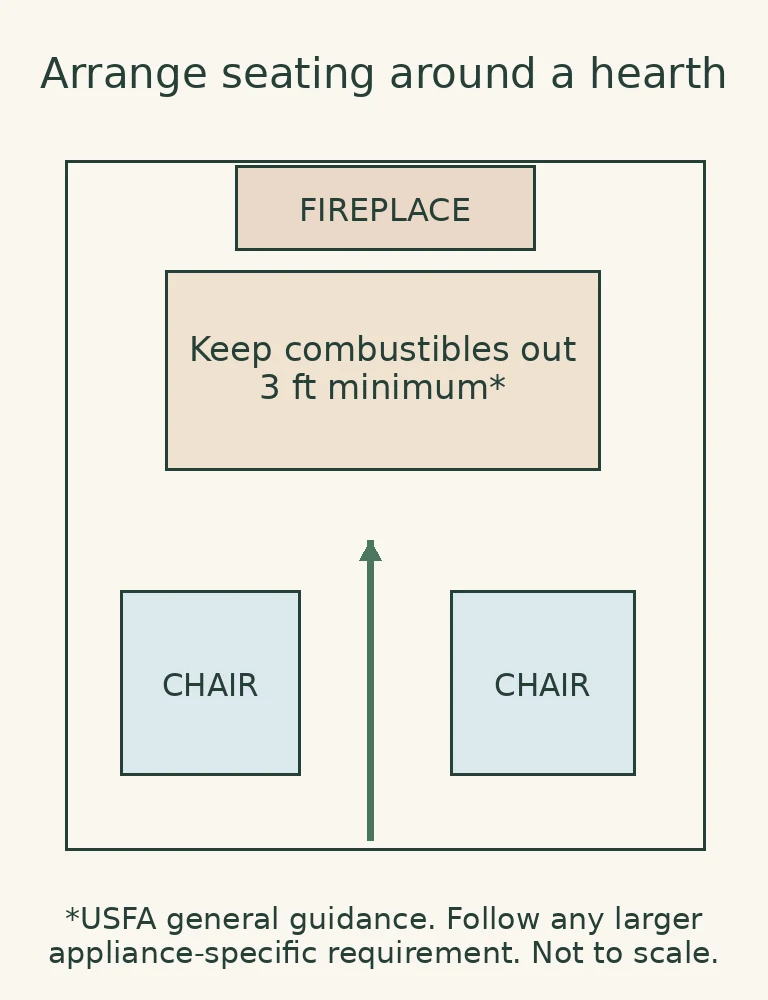
Curtains, baskets, books, rugs, cushions and seasonal decorations can all enter the space around a hearth even when the large furniture seems well positioned. Evaluate the arrangement as it is used: a chair pulled forward, a blanket draped over an arm, or a basket gradually pushed toward the opening.
The plan shows the fireplace, a reserved heat zone and seating beyond it, with a clear approach between the seats. It is a way to organize the decisions, not a dimensioned installation drawing. Check all relevant surfaces and projections in your own room rather than measuring from whichever point is most convenient.
Keep operating controls and required access available. Storage that has to be cleared every time you use the fire makes it easier for an ordinary busy evening to defeat the arrangement. Find another home for those objects instead.
Let the Hearth Organize Conversation Without Trapping It
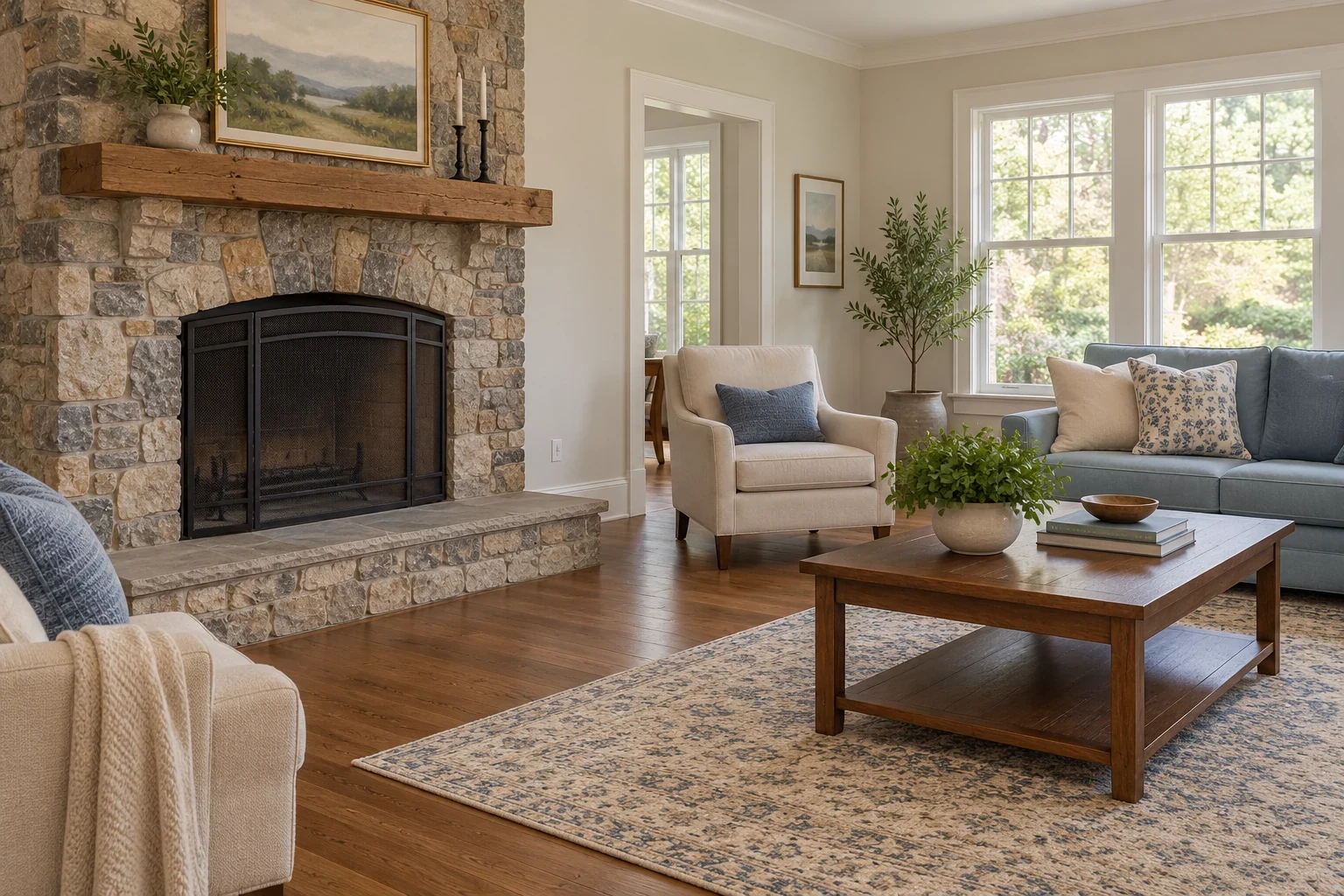
A fireplace often provides a natural direction for seating. Two chairs angled toward each other and the hearth can support conversation better than a row of seats facing only the flame. A sofa may face it if the actual room, heat conditions and circulation allow that position.
Check the entry from the seated person's viewpoint. A commonly used feng shui preference is to see the room's approach without feeling directly in its path. You can explore that preference by turning or shifting a chair, but it does not outrank the fireplace's requirements or a usable exit.
Walk through the room while someone is seated. Can another person pass without stepping between their knees and the hearth? Can they reach the next doorway without moving a chair? If every journey cuts through the conversation, reconsider which seats stay and which direction the group faces.
A smaller arrangement may work better than a complete matching suite. Choose places that people can actually use, rather than filling every side of a rug because a photograph suggests it.
Handle a Corner or Central Fireplace as a Layout Condition
A corner fireplace does not require every furnishing to turn diagonally. Start with the main routes and the room's usable walls. You might angle one chair toward the hearth while keeping the sofa aligned with the room, provided both positions remain appropriate for the appliance.
A fireplace between two areas can create a shared visual center. It can also become an obstacle if each side claims the same surrounding floor for seating. Map both sides together, including doors and normal journeys, before treating either side as an independent room.
If the fireplace sits near the room's entrance, preserve an obvious approach and pass-through route. Avoid placing a decorative screen or tall plant where it conceals the route or compromises the installation. A feature can feel acknowledged through the way the room is arranged without being surrounded by accessories.
For a very small room, the workable result may be one comfortable seat with a view of the hearth and other seating oriented elsewhere. Feng shui does not require symmetry that removes the floor needed to live there.
Understand Direction Claims Before Changing Anything Structural
You may encounter advice associating a southern sector with Fire, or warnings about fire in other compass sectors. For example, the World of Feng Shui Eight Aspirations discussion connects its South-sector decorative advice with Fire energy. That belongs to a particular compass-based explanation.
It is not the same operation as placing an entry-aligned bagua over a room. The far side of a drawing is not necessarily geographic south, and changing the scale from the whole home to one room changes what the drawing represents. Identify the method and scope before accepting a directional verdict.
A fireplace location alone is not enough information to justify costly construction or predict household problems. If you want a traditional assessment of a fixed installation, ask the practitioner to explain the method, the building information it requires and the realistic alternatives. Keep structural and appliance decisions with qualified professionals.
In the meantime, improve the actual room: circulation, seating, maintenance and the amount of visual emphasis are all meaningful decisions you can make without pretending to have completed a full building analysis.
Balance a Strong Focal Point Through the Surrounding Room
If the hearth already dominates, try removing some nearby competing emphasis. A quieter wall color, a simpler mantel arrangement or less busy textiles can let it remain distinctive without making the whole room feel intense.
Use material and color as design choices rather than as emergency cures. There is no need to install a fountain near the fire to “cancel” it. Water and electrical equipment bring their own placement, maintenance and spill considerations, and an object chosen only to counter a feared symbol may not support the room at all.
Also assess a television competing for the same wall. Do not assume the mantel is a suitable mounting location: heat exposure, the equipment's requirements, installation and the actual viewing position all need checking. An alternative wall may allow more comfortable use of both features. If the room cannot support both as equal centers, decide which activity matters most there.
For a fireplace in a bedroom, give the room's resting function particular attention. A calmer decorative treatment and an uncluttered sleeping arrangement may be useful, but they do not settle whether or how a heating installation should operate. Resolve that separately through its instructions and the appropriate professional advice.
Use the Mantel with Restraint
Choose a small group of objects you enjoy seeing from the room's normal seats. Leave enough visual breathing space for the architecture to register. There is no required object count, and a completely clear mantel is a reasonable choice.
Check whether each object's material and position are suitable around the installation. Do not make a row of books, hanging fabric or trailing foliage part of the composition simply because it appears in a styled interior. Placement above the opening does not remove the need to check heat and clearance requirements.
Finally, review the room with the fireplace in use and out of use, within its permitted operation. Does the seating still function when the fire is off? Does the hearth remain free of temporary storage? A successful arrangement supports ordinary life throughout the year. Its feng shui value lies in a coherent relationship between the fixed feature, the people and the room, rather than a promise attached to a compass label.