
An adjustable bed can fit into a feng shui-informed bedroom when its support, movement and everyday use are planned together. Keep the useful aims of a settled headboard position, awareness of the entrance and comfortable access, while allowing the equipment to function as designed. The fact that a mattress moves does not automatically make the room unsuitable.
Start with the exact bed and its users. A conventional bed plan shows one footprint; an adjustable base also needs a check through its permitted positions. Choose the room arrangement around that reality rather than trying to disguise the mechanism or make it behave like a fixed frame.
Separate Placement Preferences from Equipment Requirements
Feng shui practitioner Anjie Cho describes a bed position with a supported headboard and a view of the room's entrance, outside the direct line of the doorway. Those relationships concern the room around the bed; they do not require the sleeping surface to remain flat at all times.
Apply the idea by checking the view from the positions you actually use, including sitting up. Notice what lies behind the head and whether the entrance remains easy to identify. Do not assume that a raised mattress has lost its symbolic support simply because its angle has changed.
The base's instructions govern compatibility, installation, movement and operation. For example, the EASE manual warns about entrapment in moving parts and tells users to keep children and pets clear before repositioning the base. That is a specific equipment hazard, not a metaphor about disturbed energy.
If a traditional decorating suggestion conflicts with those instructions or a user's actual needs, adapt the decorating. Do not add a rigid panel, skirt, cord or object that enters a moving area to make the bed appear more conventional.
Survey the Whole Room with the Bed Flat
Mark the door swing, windows, wardrobe doors, outlets and bedside furniture. Measure the outer bed assembly rather than just the mattress. Include headboard wings, a surrounding frame and anything that projects into the route.
Check how each user gets into and out of bed. A bedside surface may fit neatly when the bed is unoccupied but obstruct a needed approach. If a person uses assistance or equipment, include that in the layout test. The relevant clearance is the one their situation and the actual equipment require, not a generic figure from a bedroom illustration.
Find a stable place for the remote and other necessary controls. Reach it from the normal resting position without leaning over the mechanism. Keep a light usable at the bedside as well. A room that looks symmetrical but leaves one person unable to reach their controls has missed its practical purpose.
If the preferred headboard wall makes those actions difficult, compare another wall before abandoning the bed. Preserve useful access and a stable installation rather than forcing a particular diagonal relationship to the door.
Check the Movement Envelope Before Enclosing Anything
The side-view illustration distinguishes the flat surface from the raised profile and the surrounding area that must remain clear. It is a way to understand movement, not a clearance drawing for your model. Consult the instructions for the specific base, mattress, frame and headboard combination.
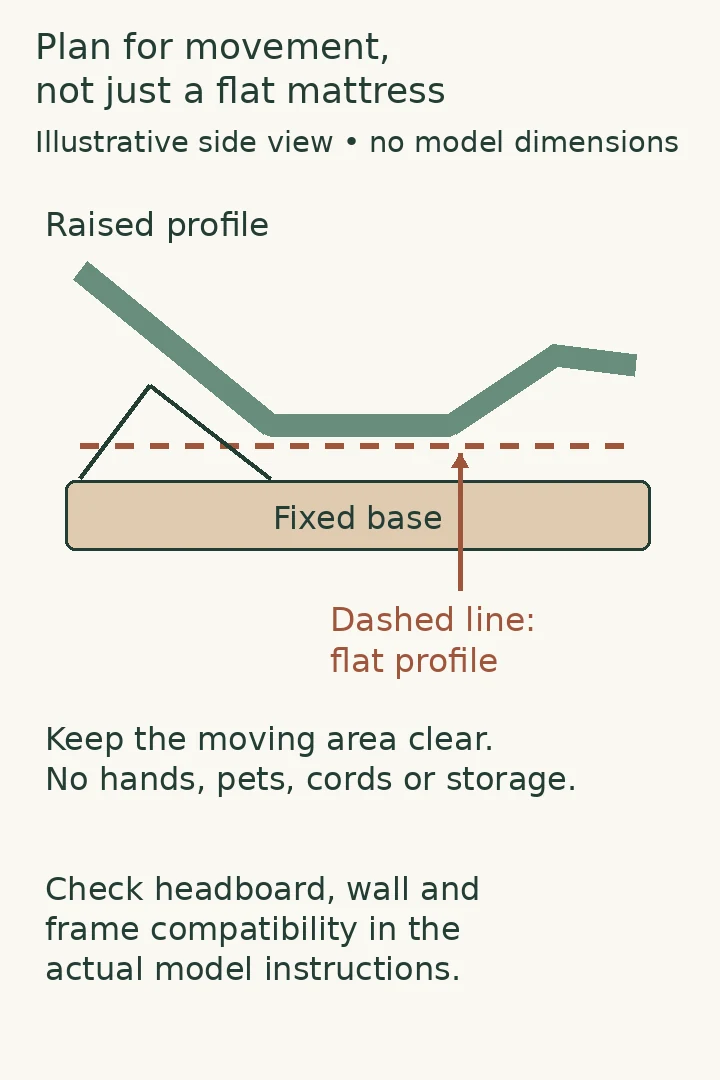
Before a movement check, clear the area and follow the manufacturer's operating procedure. Keep people, pets and loose objects away from moving parts. Do not use a hand or another object as a clearance gauge while the bed is moving.
Observe whether the chosen bedside furniture, headboard and nearby wall arrangement remain compatible through the positions the bed is designed to use. Keep loose bedding and stored objects out of the mechanism. If something catches or operation looks abnormal, stop and obtain the appropriate service or installation advice instead of compensating with a makeshift spacer.
Do not assume that a feature described as wall-hugging or wall-saving removes every clearance requirement. Its actual behavior and installation instructions matter. Likewise, a surrounding decorative frame must be approved for the system rather than merely wide enough to contain the mattress when flat.
Provide Support Without Improvising Attachments
A solid-looking headboard can give the room a settled visual focus. It may be attached to the bed through compatible hardware or installed separately where that arrangement is appropriate. Confirm the permitted method with the supplier or manufacturer before drilling, fastening or purchasing brackets.
Check the relationship from the user's position. An oversized headboard may crowd a window or light switch even if it looks balanced from the doorway. A smaller suitable headboard or a clear wall behind the bed may serve the room better than adding more material around the moving base.
Do not wedge a loose board behind the mattress or tie parts together as a symbolic cure. Avoid heavy shelves or storage directly above the head area. Keep the visual support simple enough that it does not introduce another installation problem.
If you prefer less visible equipment, consider the surrounding colors, a compatible frame and neatly placed controls. Concealment should not cover ventilation openings, obstruct servicing or make it difficult to notice damaged components. A usable room can acknowledge that it contains equipment.
Treat a Split Base as a Functional Choice
A split arrangement can let two people use different positions. It does not establish that their relationship is divided. Check how the actual system is intended to connect or synchronize, and follow its instructions rather than assuming every pair of bases behaves the same way.
Cho's couple-room guidance favors accommodation on both sides of the bed. You can apply that through accessible approaches, appropriate bedside surfaces and controls for each user. The furniture need not be identical if different functions are needed.
Discuss practical preferences together: where remotes rest, whether one person's reading light disturbs the other and which position each uses for getting up. Solve those specific conflicts without blaming the seam between two mattresses.
Only use mattresses, connectors and bedding compatible with the system. An improvised bridge, board or fastening can interfere with independent motion. If appearance matters, ask about suitable coordinated bedding or an approved common headboard instead of changing the mechanism.
Keep Power, Controls and Maintenance Accessible
Route the power connection as the model requires, keeping it away from pinch points, heated surfaces and walking routes. The EASE safety instructions also warn against blocked air openings. Other models may have different electrical and maintenance requirements, so do not copy one base's setup indiscriminately.
Keep the remote away from children and use any child-lock feature according to the actual manual. Learn the model's procedure for a power failure or a stuck position before you need it. Do not treat a smart plug or a room automation as an appropriate substitute for the manufacturer's controls without confirmation.
When cleaning or servicing, follow the shutdown and disconnection instructions. Avoid reaching beneath a powered moving base to retrieve something. A clear under-bed area can make that easier, but it is not a reason to perform maintenance the manufacturer reserves for qualified personnel.
Finish with an Everyday-use Rehearsal
Once the installation is confirmed, rehearse the normal routine: enter the room, reach the light and remote, use the bed as instructed, return to a suitable position and leave through the intended route. Include both users and any necessary assistance.
Keep the arrangement that allows those actions while giving the bed a calm, supported place in the room. Feng shui can inform the visual and spatial relationships without making a moving bed a problem to cure. Comfort, access and correct equipment use remain the conditions that let the room work.