To use a feng shui compass, first decide which side of the home you intend to measure. Stand facing outward from that side, take a degree reading, repeat it from other suitable positions, and record both the degree and its directional sector. Choosing the facing side matters as much as operating the compass: repeated readings can reveal a disturbed needle, but they cannot decide which facade a particular feng shui method considers the front.
Choose the Measurement Purpose and Compass
A degree bearing is useful when you are working with a named Compass-school method that calls for the building’s facing orientation. It is an input to later work under that method, not a feng shui layout rule on its own. If you have not decided which method you mean to use, settle that question before treating a bearing as the basis for a chart. Feng Shui Natural School describes taking an orientation reading before drawing up a geomantic chart.
Not every school starts with a cardinal bearing. Mindful Design School says that in BTB feng shui, the bagua is aligned with the formal front door and cardinal directions are not relevant to that alignment. That is a different task from the outward-facing measurement in this guide; it is not a reason to assume the formal door is the facing side for every Compass-school application.
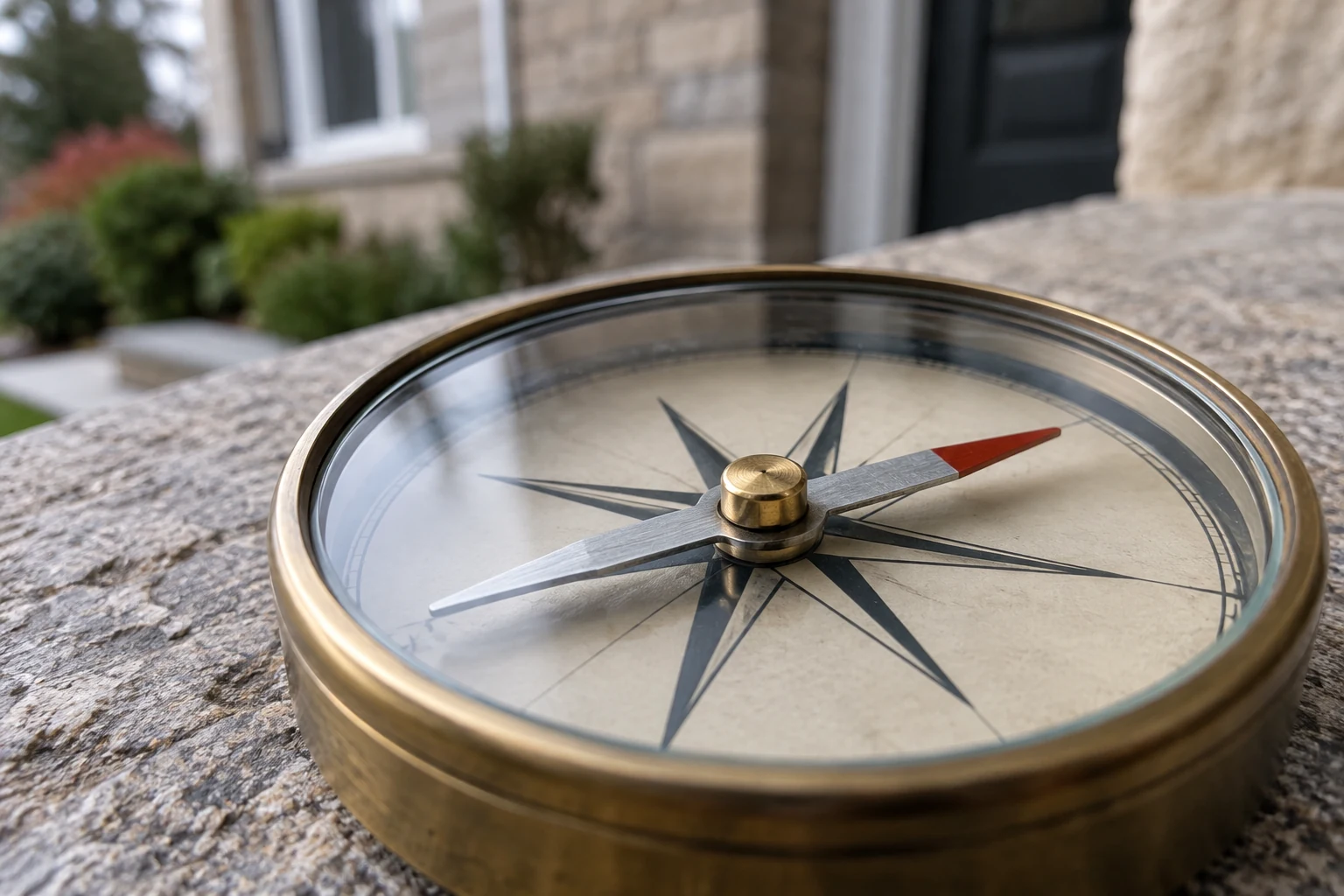
For the beginner procedure here, a degree-marked magnetic needle compass with an outer direction arrow and a movable degree ring is enough. Learn its three distinct references before taking it outside:
- The north-marked end of the needle responds to magnetic north.
- The outer direction arrow points along the outward direction you want to measure.
- The inner north arrow on the rotating ring is aligned with the needle’s north-marked end so that you can read a degree at the outer arrow.
The needle does not point along the facade’s outward direction unless that direction happens to be north. Nor is the inner arrow itself the bearing to write down. Feng Shui Natural School demonstrates a common needle compass with a manually rotated 360-degree ring for this kind of reading.
A Luo Pan is a traditional feng shui compass used to measure orientation. Feng Shui Natural School describes models with a magnetic needle and rotating information plate; the information rings differ, including between San Yuan and San He models. You may be able to obtain a basic orientation with one, but do not assume that a ring-reading procedure described for an unidentified model applies to yours. Use the markings and instructions for the instrument in your hand. You do not need to buy a professional Luo Pan, install an app, or calculate a chart to complete the bearing task described here.
Select the Outward-facing Side
Before reading degrees, name the facade whose outward direction you are measuring. Under Feng Shui Natural School’s approach, the facing is the brighter, more open and active side; the sitting is the side opposite it. The school notes that openness and obstructions matter to this judgment. In its city-flat example, the main living-room windows, a balcony overlooking a busy street, or the side with the best views may be the facing even when the front door points another way.
Look at the actual home rather than starting from the door label. Which side has the principal living-room openings? Is there a balcony, an open view, or an active setting outside? A door onto an interior corridor and a window wall overlooking a street present different plausible references. These observations help you state why you chose a side under the intended approach; a compass cannot supply that architectural judgment.
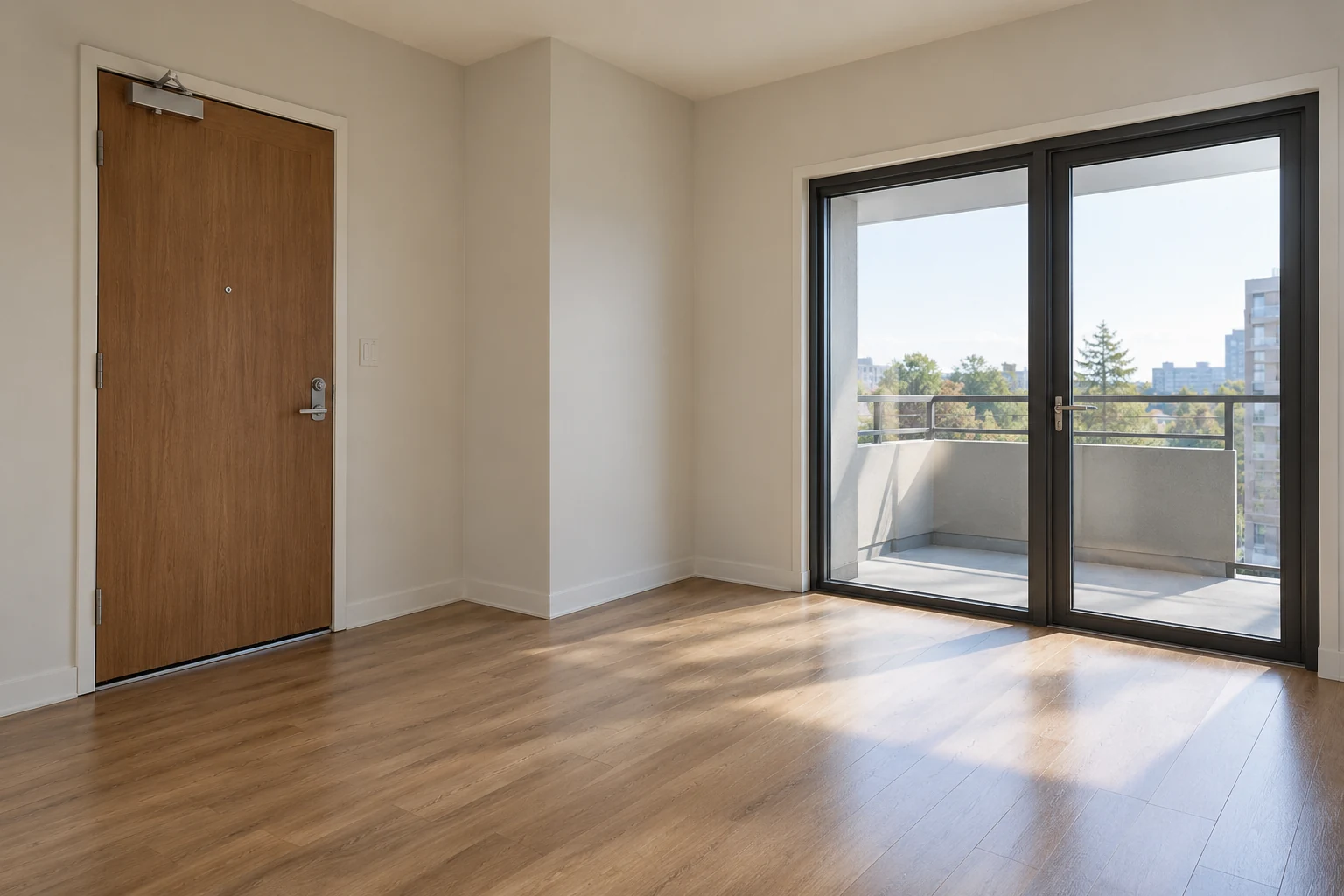
Give the side a name specific enough to find it again, such as “principal living-room window facade” rather than “front.” Write the name before the number. The measurement will be the direction outward from that facade, not a direction toward the building. Its sitting side is the opposite side, which can be noted after the facing reading is established. Keeping those entries separate prevents a half-turn error: if you measure outward from the facing and then record only its opposite, you have written down the sitting bearing in place of the facing bearing.
Here is the explicitly hypothetical flat used throughout this guide. Its principal living-room windows form the side judged to be the south-facing candidate under the chosen facing approach. There are accessible, lawful exterior reference positions A, B and C along that same side. “South-facing” is the working description to be tested by the compass; it is not a claim that the window wall must be the facing for every flat. The positions let us compare readings of one named facade, rather than accidentally combining measurements from different walls.
What if the door facade and window facade both remain plausible under the method you intend to use? Record each as a separate candidate, with the observations supporting it and, if useful, its own outward readings. Do not quietly select whichever direction gives a preferred result. Measuring each candidate repeatedly can establish whether its needle readings are dependable; it cannot establish which candidate the school would designate as the definitive chart facing. Leave that choice open and ask a practitioner of the intended method before fixing a chart facing. This is method or facade uncertainty, not magnetic uncertainty, and another pass with the same compass will not resolve it.
Take Repeat Readings Along That Facade
Prepare to record the named facade, reference position, outward direction and observed degree for each reading. Several exterior references along the same facade are more useful than one apparently precise number taken beside metal. There is no universal distance between positions or numerical agreement tolerance supplied by this procedure: compare what you observe, note possible disturbances and leave disagreement visible. Feng Shui Natural School advises taking several reference readings outside because metal and structural elements can disturb a compass, particularly indoors.
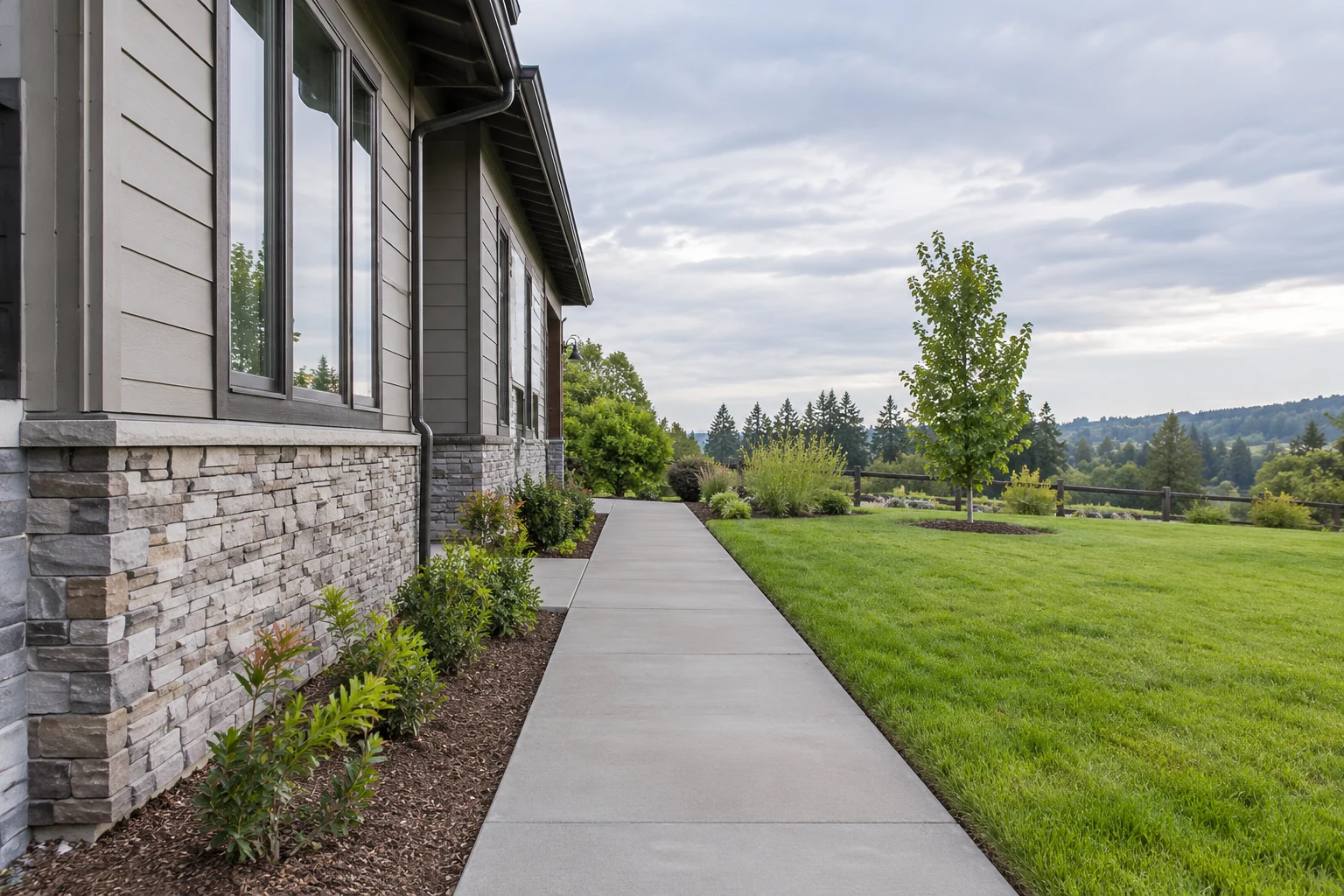
Use the following sequence for the demonstrated rotating-ring needle compass:
- Take a lawful, accessible exterior position along the named facade. Stand with your back parallel to that facade and face outward, as in Feng Shui Natural School’s facade example. Keep measuring the outward direction of the same side when you move to another position. Do not lean over a rail or enter an inaccessible area merely to get closer to the wall.
- Identify the needle’s north end on your particular tool. Check its instructions or markings rather than relying on color. The compass demonstrated by Feng Shui Natural School uses a red north end, but the school notes that some Chinese compasses use white for north and red for south. A color assumption would reverse the reference on those instruments.
- Aim and settle the instrument. Hold it steady, meeting any leveling requirements specified for that tool, without resting it on the ground. Point the outer direction arrow outward, along the direction the facade faces, and keep it aimed there. Allow the magnetic needle to move freely and settle; a sticking or unsettled needle is not a sound basis for a degree reading. The school emphasizes a freely floating needle and warns that buried elements can disturb a compass placed on the ground.
- Align the ring, not the direction of measurement. While keeping the compass body and its outer arrow pointed outward, rotate only the inner-arrow/degree ring until its north arrow matches the needle’s north-marked end. Then read the degree indicated at the outer direction arrow and write it down. In Feng Shui Natural School’s example, the ring is turned to align its inner arrow with magnetic north; the degree is read where the outer arrow points. Do not substitute the needle’s position or the ring’s north arrow for that outward bearing.
- Repeat from other suitable positions along the same facade. Record each position and degree before deciding which observations agree. Move away from sizeable metal you are carrying and from nearby cars, lampposts, rails or other likely interference. Prefer exterior references where you can measure safely and lawfully. Indoor readings can look exact while being disturbed by nearby metal, beams, pipes or wiring; the point of multiple exterior references is to test that apparent precision.
At each position, re-establish the outward aim before aligning the ring and reading again. If you turn the whole compass to chase the needle during ring alignment, you have changed the direction you are measuring. Conversely, if the needle will not float freely even while the compass is held steadily in the manner required by its instructions, do not force a number into the record as a reliable result.
A differently marked Luo Pan calls for its own identified reading procedure. The transferable task is to obtain and check the outward degree for the named facade; the exact ring or thread to use is not universal across Luo Pan models. If you cannot establish which markings supply that basic degree, use an understood degree-marked needle compass for this beginner task or seek help with the particular instrument rather than guessing.
Keep the Degree and Identify Its Sector
Record the degree first, then add a directional description. Feng Shui Natural School divides the circle into eight sectors of 45 degrees each. Its intervals are:
| Direction | Degree interval |
|---|---|
| North (N) | 337.5° through 0° to 22.5° |
| Northeast (NE) | 22.5°–67.5° |
| East (E) | 67.5°–112.5° |
| Southeast (SE) | 112.5°–157.5° |
| South (S) | 157.5°–202.5° |
| Southwest (SW) | 202.5°–247.5° |
| West (W) | 247.5°–292.5° |
| Northwest (NW) | 292.5°–337.5° |
North crosses the 360°/0° join because 0° and 360° indicate the same direction; its sector extends to either side of that point. Keep this in mind when comparing repeated readings. Hypothetical observations of 359°, 0° and 1° sit close together around North. Their ordinary linear mean, (359 + 0 + 1) / 3 = 120°, would instead indicate Southeast and badly describe that cluster. You do not need an averaging formula to see that these observations are near 0°/North; preserve the individual degrees rather than replacing them with that misleading mean. The sector intervals and North’s wraparound follow Feng Shui Natural School’s eight-direction scale.
For the flat in this guide, an outward reading of 180° lies in the South sector. Write “facing: 180° South,” not merely “South.” The opposite side is a half-turn, or 180° around the circle, so this example’s sitting is 0° North. That opposite is a separate entry; it does not change what was measured at the living-room window facade. Feng Shui Natural School likewise gives a consistency example of a 90° East-facing facade opposite a sitting side around 270° West. Such a comparison is useful only where that other side can be checked safely and accessibly.
You may encounter a finer label on a Luo Pan. Feng Shui Natural School divides its 24 mountains scale into 15-degree sectors, rather than the eight scale’s 45-degree sectors. On that scale, it calls a 180° facing S2, or Wu, within 172.5°–187.5°; on the eight-direction scale, the same degree is simply South. That label adds granularity to the example, not an interpretation of a ring or a completed chart. Retaining “180°” makes it clear what was observed regardless of which named method uses the record later.
A sector edge needs a qualified record. An exact 22.5° sits at the stated North/Northeast boundary, and repeats of 22° and 23° straddle it. These intervals alone do not give a justified endpoint tie-breaker or make those repeated readings one confidently settled sector. Write the observed degrees and “sector unresolved at boundary,” rather than assigning both sectors or silently choosing one. That is a different issue from the clear 359°/0°/1° North cluster: the latter crosses the numbering join but stays close to the center of North’s stated interval.
Resolve Suspect Readings and Finish the Field Record
Return to the hypothetical living-window facade. At exterior position A, close to metal, the first outward reading is 210°. At safer positions B and C along the same facade, repeated observations are 179°, 180° and 181°. After moving away from the metal, another reading at A is 180°. The original 210° remains in the notes, marked “suspected interference”; it is not silently deleted.
The closely agreeing readings away from the suspected disturbance, including the repeat at A, support 180° as an illustrative central recorded bearing and South as its eight-direction sector. That choice is a judgment about this invented set of observations, not a prescribed arithmetic average, a universal tolerance, or an actual measurement of a flat. In a real record, keep enough position and condition notes to show why you preferred one set of readings over another.
A completed record for this example could read:
> Method and reference: Outward facing of the principal living-room window facade, selected as the facing candidate under the stated bright/open/active-side approach. Exterior positions A, B and C are lawful, accessible references along that facade.
> Readings: A: 210° initially, close to metal—suspected interference. B and C: repeated outward readings of 179°, 180° and 181°. A: 180° on repeat after moving away from metal.
> Recorded orientation: Facing 180° South; opposite sitting 0° North. The original 210° is retained with its condition note.
> Remaining uncertainty in this hypothetical example: None about the chosen facade or recorded orientation. This is ready only as an orientation input for later work under a named method, not as a chart.
Your own record may end less neatly. If a reading changes near a likely disturbance, reposition away from it and repeat along the same facade before selecting a bearing. If clean exterior readings still disagree, the needle sticks, or safe exterior positions are unavailable, mark the orientation provisional and seek suitable instrument or method help; do not manufacture agreement. If the facade choice remains disputed, retain separate candidate records and seek a facing judgment under the intended method. If readings cluster across a sector boundary, keep the degrees but defer a definitive sector-dependent chart decision.
A compass provides a measured orientation, not a geomantic chart or a prediction. Feng Shui Natural School treats the reading as an input to subsequent chart work; the Feng Shui Society cautions that feng shui cannot guarantee wealth, health or happiness.