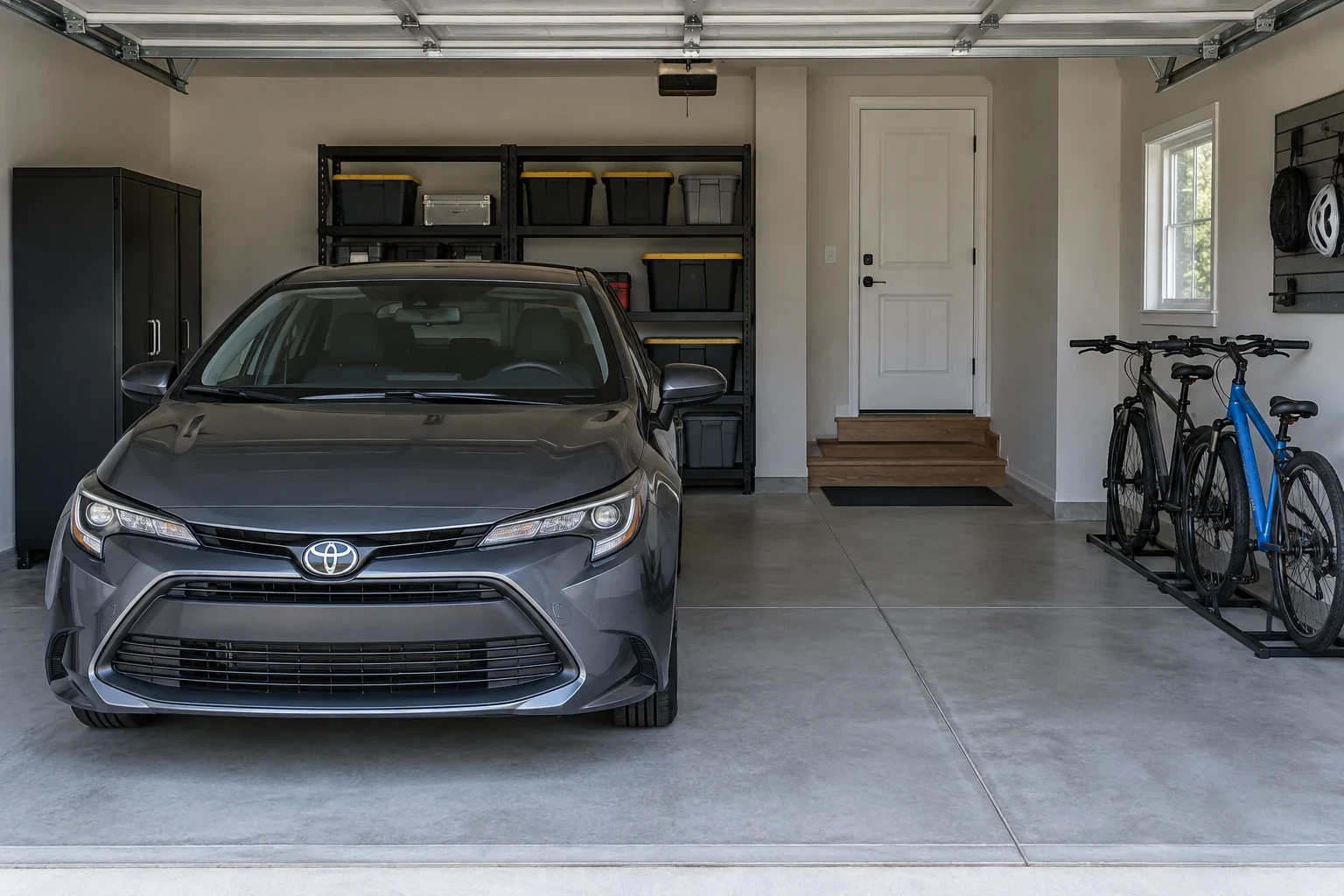
Apply feng shui to a garage by making its actual jobs work together: parking, storing equipment, supporting practical projects and, for many households, providing an everyday entrance. Start with the vehicle, doors, fixed equipment and pedestrian route. Then remove the things that obstruct those uses or remain as unresolved projects.
A garage does not have to look like a living room to feel cared for. Useful storage, visible destinations and a clear way into the house can give it a coherent role. Feng shui's attention to movement and the meaning of belongings can guide that work, while ventilation, chemicals, machinery and installation requirements remain practical conditions that decoration cannot replace.
Decide Which Jobs the Garage Will Keep
List what happens there during an ordinary week. Include entering with groceries, opening the car doors, taking out bins, retrieving a bicycle and accessing any fixed appliance. Add workshop or hobby use only if it is genuinely part of the plan.
Separate those uses from ambitions that have never become workable. A broken exercise machine, half-finished cabinet and cartons saved for a possible move may each represent an intention, but together they can displace the functions the garage actually serves.
Choose the priorities with the household. If parking is a priority, it needs a real vehicle footprint and space to operate, not whatever remains after storage. If the garage is intentionally used for another permitted purpose, plan that purpose directly rather than keeping an imaginary parking space everyone knows is unavailable.
This is a capacity decision, not a moral judgment about owning tools or stored belongings. A functioning garage may contain many things; the question is whether their presence supports or blocks its agreed uses.
Read Clutter as an Unfinished Relationship with the Space
Anjie Cho distinguishes feng shui from simply removing possessions. Her discussion of clutter considers obstruction and the burden of things that remain as reminders of unfinished tasks. That is a useful framework for a garage full of items that have nowhere else to go.
Ask what each object represents in practical terms. A working bicycle ready to use is different from a bicycle that needs a repair nobody has agreed to arrange. A labeled collection of seasonal equipment is different from sealed cartons whose contents no one remembers.
You do not need to call the second group bad energy to make a decision about it. Identify an owner, a next action and a destination. If a project is worth completing, give it the appropriate space and an actual plan. Otherwise, choose a responsible route out of the household.
Mark the Operating Space Before Arranging Storage
Draw the garage from above and mark the vehicle, pedestrian door, main door, fixed appliances and existing storage. Include the space needed to open vehicle doors, load belongings and walk to the house. Check the actual vehicle and users rather than copying another garage's dimensions.
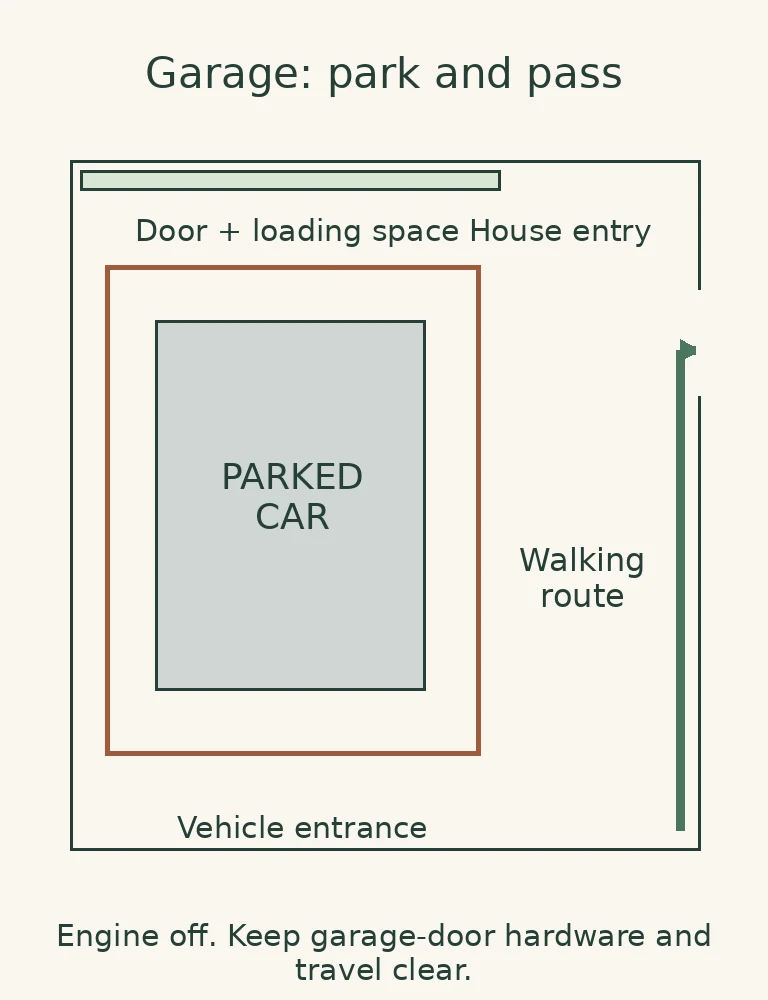
Mark the main garage door's moving parts and travel as constraints. Keep storage and proposed fittings clear of that operation, following the door system's instructions. A high shelf or suspended object can matter even if it never touches the floor. Problems with the door or its mechanism belong to an appropriate service professional, not a decorative adjustment.
The plan separates the parked car, its use area and a pedestrian route to the house entry. Your route may be on another side, but it must work with the vehicle in its normal parked position. Test it with a typical bag and the household member who needs the most usable space.
Also keep access to controls, meters, service panels and appliances available according to their requirements. Do not establish a storage zone by assuming an apparently empty technical space is unused.
Keep Vehicle and Combustion Safety Distinct from Qi
Do not run a car or truck in a garage attached to the home, even with the main door open. The CDC explicitly warns against this because of carbon monoxide. A cleared aisle, an open window or a feng shui object does not change that instruction.
Do not treat a garage as a place for indoor use of fuel-powered equipment because it has a large door. Follow the equipment's own restrictions and appropriate safety guidance. If you plan a change of use, address the building, ventilation and permission questions through the responsible channels before furnishing it as occupied living space.
The practical distinction matters to feng shui planning too. A room that looks comfortable is not necessarily suitable for the activity pictured in it. Keep the garage's actual conditions visible instead of assuming a rug, bright paint or a sofa transforms its use.
Sort in Sections That You Can Finish
Choose one manageable storage section while preserving the necessary route. Avoid emptying the entire garage into a driveway or shared area unless you can safely complete the process and have permission to use that space.
Identify items that remain for a defined function, items that belong elsewhere, repair projects with an owner and things leaving through donation, recycling or appropriate disposal. Keep unknown or potentially hazardous products separate from ordinary household donations until you identify the correct handling route.
Open and label ordinary storage cartons where appropriate. A label should tell the actual user what is inside and make returning things easy. “Winter sports” is more useful than “Miscellaneous,” but a label cannot make an overfilled shelf workable.
For a repair item, write the next action and who will arrange it. A scheduled repair occupies a different status from a permanent pile marked “fix someday.” If the household no longer wants the item, let the destination reflect that decision.
Store Around Use and Retrieval
Put frequently used items where their users can reach them without moving the car, another heavy object or several unrelated boxes. Store a bicycle in an appropriate rack or position that allows retrieval without narrowing the house-entry route. Keep its actual size and handlebar projection on the plan.
Group tools and supplies by task, with small parts together. Respect shelf capacities and the installation requirements of storage units. Keep heavier items at manageable low positions rather than relying on high overhead stacking simply because the floor is full.
Seasonal belongings can occupy less convenient appropriate storage if their retrieval remains planned and manageable. Record where they are. When a season changes, check what actually came out and what was never used before automatically returning every carton.
Containers are useful when they protect and identify contents, but buying a matching wall of bins before sorting can hide the same unresolved collection. Choose the items and storage conditions first, then the containers that genuinely fit them.
Give Household Chemicals Their Own Handling Decision
Paints, oils, cleaners, pesticides and batteries may need handling that differs from ordinary rubbish or donation goods. EPA's household hazardous waste guidance says to follow product labels, retain original containers and labels, avoid mixing products and check local management options.
Do not combine leftovers into one container to save space or pour them away during a fast declutter. For corroded, leaking or unidentified containers, ask the relevant local hazardous-materials authority for instructions rather than opening or transferring them experimentally.
Contact the local environmental, health or solid-waste service about the exact items you have, collection arrangements and any packaging requirements. A collection date or appointment is a real destination; an indefinite box beside the pedestrian door is not. Keep products awaiting collection according to their storage instructions and away from access by children or pets.
Make the Everyday Entrance Usable
If you usually enter the home through the garage, trace that arrival with the things you carry. Where do bags pause while you open the door? Where do shoes, keys and coats go next? Give those items appropriate destinations instead of allowing a new pile to form beside the car.
Use enough suitable light to recognize the route and operate the door. Address a failed fitting, damaged threshold or obstructed handle through the appropriate repair route. A welcome sign or decorative color cannot replace a functioning entrance.
You can still acknowledge the formal front entrance separately. There is no need to declare that frequent garage use automatically relocates the entire home's feng shui map. If a practitioner is analyzing the dwelling, show the garage and both entrances and ask how their method treats that space.
A Compact Shared-garage Example
Imagine one car, two bicycles, a tool collection and seasonal cartons. The first plan reserves the car's operating area and a route to the house. The bicycle position is chosen next because the bikes leave several times a week. Tools occupy suitable storage outside those areas; seasonal cartons use an appropriate less frequent-access position.
Now add an unwanted chair waiting for donation. If its only temporary position blocks a bicycle or the pedestrian route, the handoff needs arranging before the chair enters the garage. The route is not spare capacity simply because no one happens to be walking through it at that moment.
This example uses priority and frequency rather than an object count. Another household might choose a different combination, provided its agreed uses remain possible.
Maintain the Arrangement at the Points Where Things Arrive
Check the house-entry route, the car-use area and the incoming-project spot regularly. When a new item appears, assign its use and destination before it becomes background storage. Put an outgoing item on a real handoff schedule.
After a few normal weeks, notice which locations are inconvenient and change them. A garage with workable parking, accessible equipment and a clear arrival route is a meaningful improvement. Feng shui can help you see its role in the household without requiring it to imitate another room or promising that a cleared shelf changes your fortune.