Set up a home gym corner by reserving space for the activity as it happens, giving equipment an easy return destination and keeping household routes outside the movement area. Then consider the view, light and transition back to ordinary room use. A corner that looks energetic but is inconvenient to start or difficult to clear is unlikely to serve its purpose well.
Start with the room's fixed features: doors, windows, storage, furniture and the places other people pass. Choose the exercise equipment and activities you actually intend to use, rather than filling the space with a general idea of a gym. Feng shui can help you think about awareness and the relationship between activity and rest without turning a modern fitness corner into an ancient prescription.
Begin with a Realistic Activity and a Real Room
Decide what the corner must support. A mat for floor-based activity, a stationary machine and a collection of free weights make very different demands. List what you own or genuinely plan to use, who uses it and whether the area remains set up between sessions.
Walk the room at the time you expect to exercise. A sunny morning corner may become the household's busiest route in the evening. A place beside a desk may work while the desk is unused but become awkward when another person needs to work there.
Choose a modest initial setup that fits those conditions. A mat and a defined low storage area can be a complete corner if that is what you use. There is no feng shui requirement to add a treadmill, a mirror or a particular number of pieces.
If nothing fits without obstructing the room, change the proposed activity or location. Do not count on everyone else temporarily avoiding a necessary route every time you exercise.
Use Feng Shui as a Contemporary Interpretation
In her answer about home gyms, Anjie Cho explicitly says she has not received specific feng shui teachings about exercise equipment. She then offers ways of interpreting it, including the commanding position and the intention behind using the equipment. That distinction prevents modern advice from becoming a claim that every machine has a traditionally prescribed compass direction.
For a corner, the useful questions are whether you can notice arrivals, whether the area supports activity without taking over the entire room and whether the setup reflects your real intention. These questions do not establish a health outcome or guarantee that a particular orientation will make you exercise.
Cho also cautions against assuming gym equipment must occupy the center simply because it relates to health. A usable location at the edge of a shared room can be a more sensible choice than placing a machine in a central circulation area.
Draw the Movement Envelope, Not Just the Mat
Mark the footprint of the mat or proposed equipment on a plan. Then add the space needed during use: reaching sideways, stepping into position, approaching controls or getting on and off. Use the exact equipment instructions for required operating clearances; the dimensions of its frame are not the whole requirement.
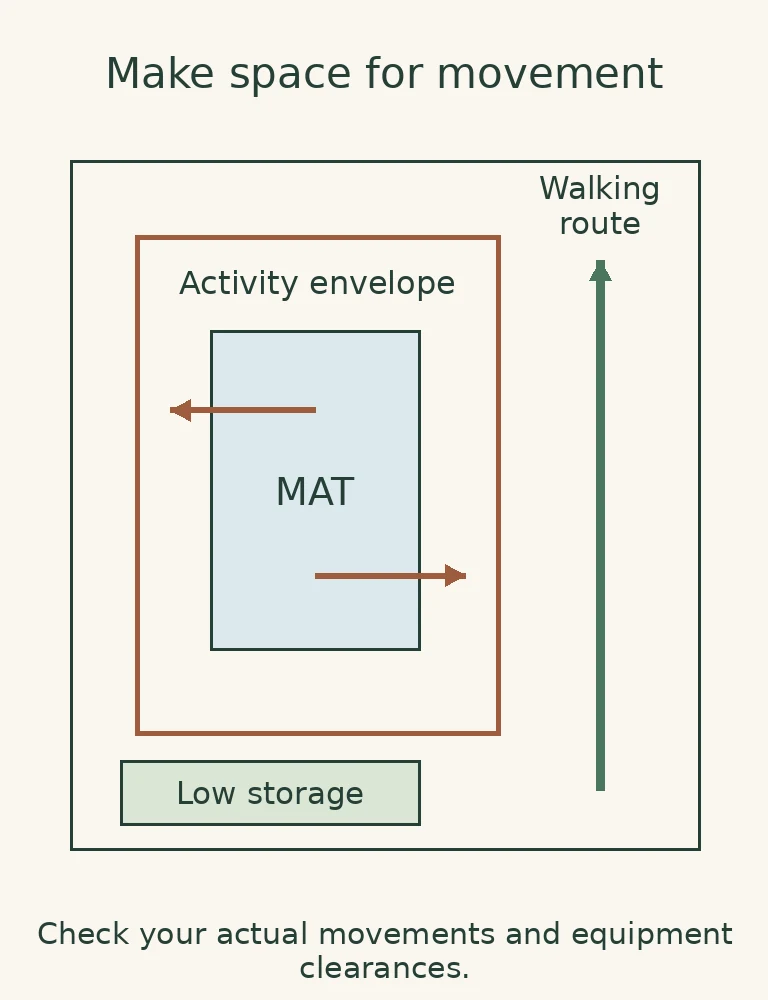
For a mat-based corner, gently check the intended movement area without weights or resistance. Notice nearby furniture, low shelves and the places a hand or foot might extend beyond the mat. This is a layout check, not an exercise assessment or proof that a floor is suitable for heavy equipment.
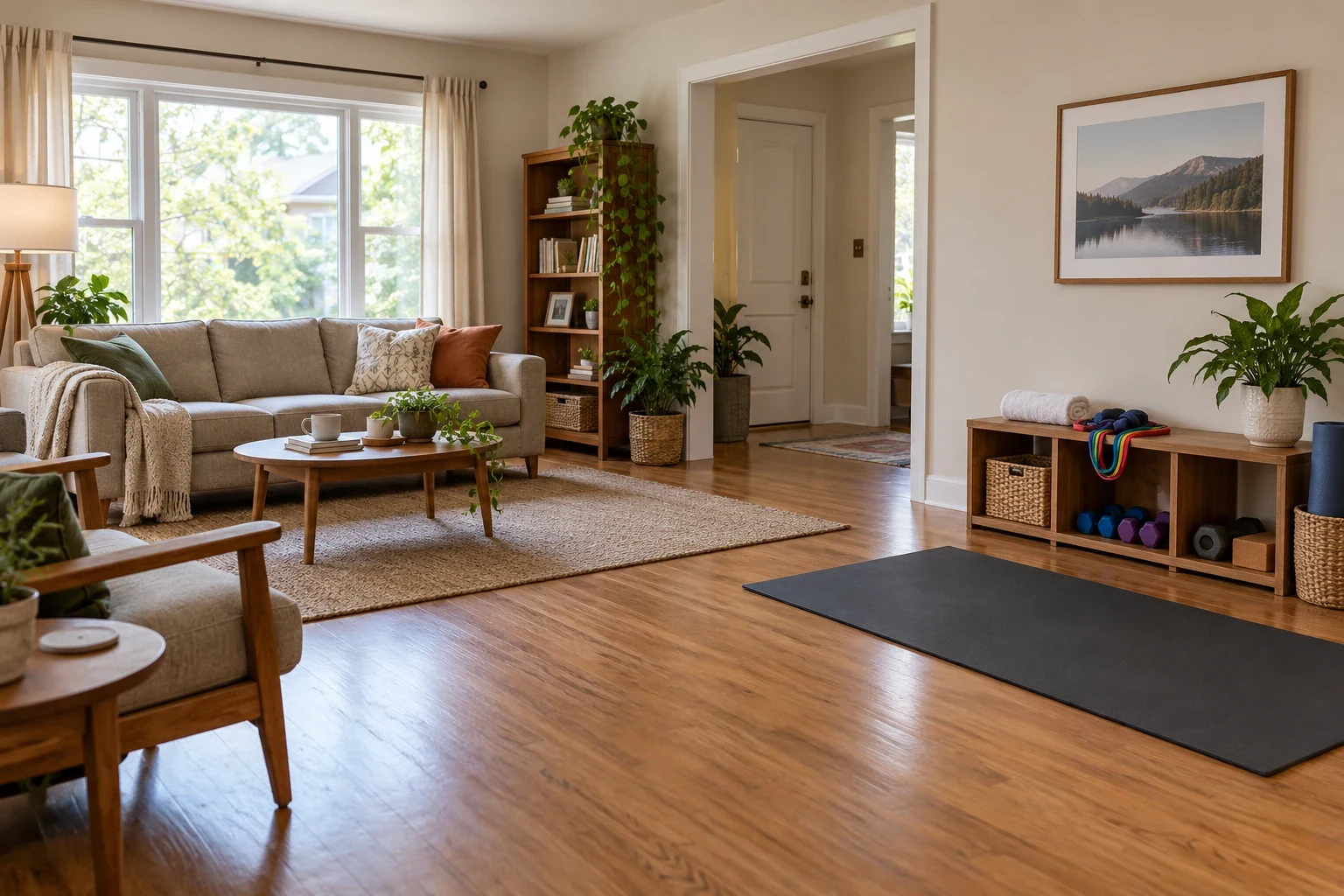
The plan separates a mat, its larger activity envelope, low storage and a walking route. Keep the route outside that envelope. If someone must pass through the place where you move, a different arrangement or time may be needed.
Include vertical space where relevant. A low beam, hanging light or shelf can matter even when the floor appears clear. Avoid planning only from a floor photograph that hides what is above the activity.
Choose a View Without Compromising Operation
Stand or sit where the equipment user will actually be. Can they see someone entering, or at least notice the approach comfortably? Cho applies the commanding-position idea to a treadmill by suggesting a view toward the doorway without standing directly in its line.
Treat that as a preference within the equipment's safe installation. Do not rotate a machine into a blocked exit, reduce its required rear clearance or cross a cord over the route to achieve a doorway view. If the room cannot provide both, the technical and circulation requirements take priority.
For a simple mat corner, changing the mat's orientation may be enough. Compare the view toward the room with the view toward a window or wall. Choose the position that feels comfortable and leaves the surrounding movement space available.
A mirror is optional. It can serve a particular activity, but a large unsupported leaning mirror is not a substitute for planning the view. Any mirror needs appropriate installation, placement and permission. Leave it out if it complicates the corner without serving the activity you chose.
Make Storage Part of the Starting Routine
Store small equipment where its actual user can retrieve and return it. Keep related pieces together so a session does not begin by searching several rooms. A low stable compartment may suit small hand weights, while a suitable separate container can keep bands and accessories from spreading across the floor.
Consider who else can reach the equipment. In a home with children, use storage and access controls appropriate to the equipment and its instructions. Do not leave a machine available for unsupervised play or assume that moving a weight to a shelf makes it secure.
Keep heavy items low and within the storage unit's stated capacity. A piece of furniture's attractive appearance does not establish that it can carry gym equipment. For a large or heavy setup, confirm the floor and building conditions with the appropriate responsible person before installation; a floor mat does not settle structural suitability.
Choose the storage after identifying what must fit. Buying a large rack for a small corner can consume the very movement area the equipment needs. Existing appropriate storage may be sufficient.
Help the Room Change from Activity to Rest
A living room or bedroom may need to support a more active period and a quieter one. Cho's small-space guidance recommends an end-of-use ritual when several activities share a room, such as closing and putting away work equipment. An exercise corner can use the same practical idea.
Return accessories to their homes, follow equipment care and shutdown instructions, and leave the floor ready for the room's next use. If a mat is stored, give it a proper place rather than leaning it where it falls into the route. Let any cleaning or drying required by its care instructions happen before storage.
Keep the visual boundary simple. A suitable mat can mark the activity while in use; a clear storage place can mark its end. A new screen or tall cabinet is not necessary just to make the corner feel separate, particularly if that object would narrow the room or require attachment you cannot provide.
Agree on Sound, Light and Shared Timing
Discuss the room's other uses with the household. Agree on when the corner is available, which route stays open and what happens when someone needs quiet. A symbolic preference for an active area does not override another person's need to work or rest.
Notice the sound of the actual activity and equipment in your building. Floor coverings may affect the experience, but do not assume a mat guarantees silence or makes every activity suitable for an upstairs room. Follow applicable building arrangements and choose a setup compatible with the space.
Use enough appropriate light to see the area and controls without glare. Check a screen from the actual exercise position if you use one. Do not arrange the corner solely for the appearance of a photograph while its user looks directly into a bright window.
A Workable Small-room Example
Imagine a living room with a sofa along one wall, a window at the end and a route from the entrance to the kitchen on the right. A mat can occupy part of the left-hand open floor while the right-hand route stays available. Small accessories return to an appropriate low compartment near the mat.
During exercise, a chair that normally occupies part of the activity envelope has a defined temporary position elsewhere. Afterward, accessories are returned and the chair goes back. If the chair has nowhere to go except the main route, the plan fails that test and needs a smaller setup or a different location.
Now compare a stationary machine proposed for the same corner. Its required clearances, access, power arrangement and movement may exceed the available area. The fact that the mat worked there does not establish that the machine will. Evaluate it as a new layout, using its own instructions.
Review the Corner After Ordinary Use
After several normal sessions, notice what creates friction. Does equipment repeatedly land on the sofa? Does someone interrupt because the walking route is inside the activity area? Does the setup take so long that you avoid starting?
Change the specific relationship that fails. Keep the corner that is easy to begin, comfortable to use and straightforward to restore. Feng shui can provide a language for intention and awareness; the successful arrangement is the one that supports your chosen activity while still allowing the rest of the home to function.