Apply feng shui to a laundry room by making the space easy to enter, work in and leave ready for its next use. Begin with the machines, water connections, ventilation and doors that are already there. Then arrange sorting, washing, drying and folding so that one stage does not obstruct another.
You do not need to move plumbing or add a water feature. A laundry room has a practical job, and its most useful changes are often a better basket position, accessible storage or a clear folding surface. Traditional symbolism can inform the room's character after those requirements work.
Start with the Fixed Equipment, Not the Color Scheme
Sketch the machines, sink if present, doors, windows, outlets and any floor drain. Mark the locations you need to reach for controls, filters, shutoffs and servicing. Keep appliance instructions with the sketch so you can check actual installation requirements rather than guessing from a finished-room photograph.
Open the washer and dryer doors fully. Pull out any hamper and stand where you normally load the machine. Try carrying a basket through the doorway. These movements reveal space that an empty-floor measurement misses.
If a proposed cupboard, counter or decorative panel interferes with those actions, change the furniture plan. The right clearance depends on the actual appliance and installation. Do not copy the gaps in an illustration or move equipment simply to put it in an allegedly favorable compass sector.
The U.S. Fire Administration advises plugging major appliances directly into a wall outlet and avoiding extension cords. If a rearrangement would depend on extending a washer or dryer cable across the room, stop that layout experiment and obtain an appropriate installation solution. Decor should adapt to the equipment's requirements.
Understand What the Feng Shui Interpretation Adds
Wu Xing, often translated as the five elements, describes relationships between water, wood, fire, earth and metal in a traditional symbolic framework. The Institute of Feng Shui presents these as interacting qualities rather than simply five materials to collect. That distinction is useful in a room already containing water, metal equipment and heat.
You can use the framework to consider the room's overall impression. For example, you might choose a quiet earthy wall color to soften a room dominated by glossy white machines, or add a small green detail to an otherwise hard-edged storage area. Those are design choices informed by symbolism. They do not change drainage, correct a leak or guarantee a financial outcome.
There is no need to install all five representations, paint a warning-red wall, or add a plant where it will struggle. Start with the surfaces and objects that already serve the room. A durable finish you can clean and a cupboard you can open are more useful than a prescribed object that gets in the way.
Keep the distinction clear when discussing “flow.” You can assess a walking route by carrying laundry through it and assess a blocked handoff by noticing where a pile accumulates. Those observations do not measure qi. They give you concrete reasons for choosing one arrangement over another.
Give Each Stage of Laundry a Dependable Place
Follow one ordinary load from arrival to return. Where does used clothing wait? Where do you sort it? Where does wet laundry go if it is not machine-dried? Where can clean items be folded without first moving cleaning supplies?
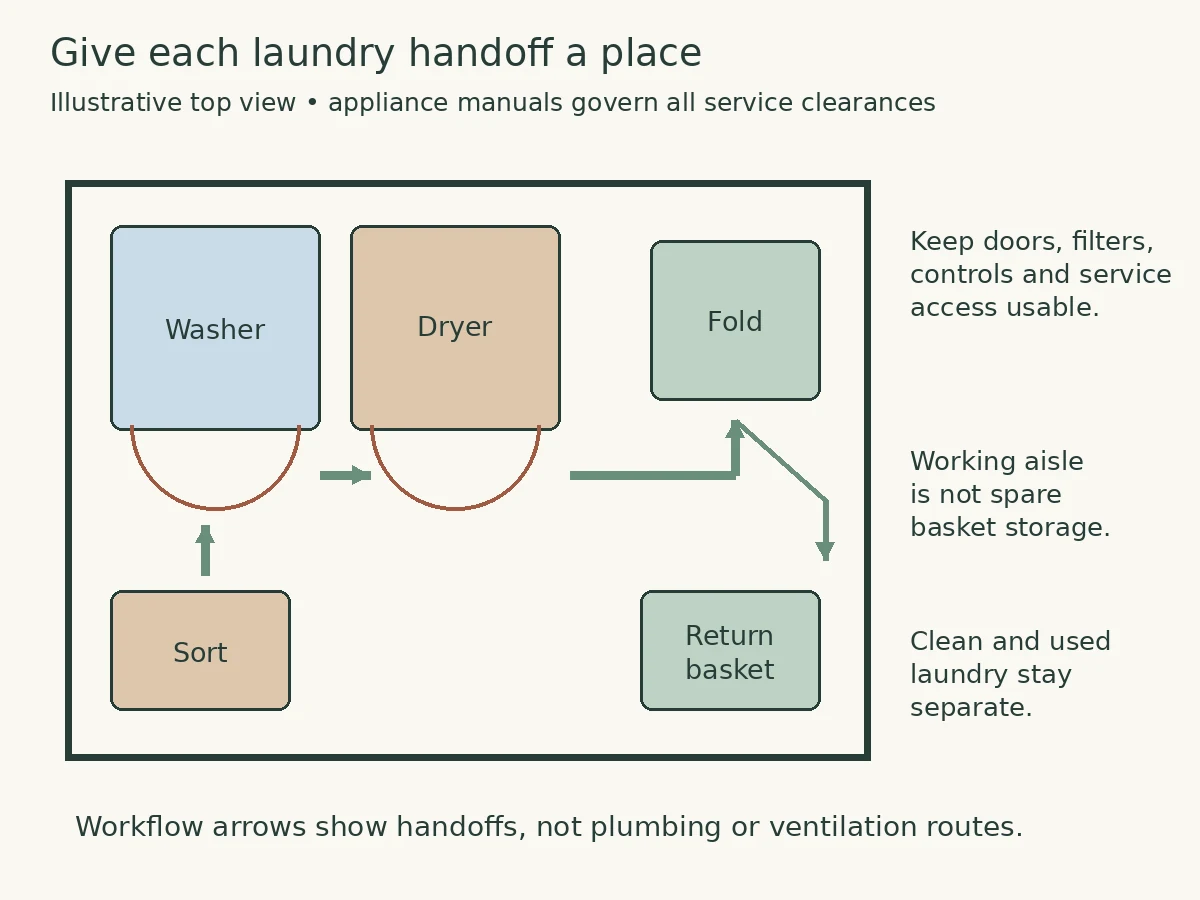
In the diagram, sorting sits near the approach to the washer, with a separate folding surface and return basket. The arrows show handoffs, not pipes or ventilation. The room need not reproduce that plan: it needs an equally clear answer to each handoff.
For example, if the washer is beside the entrance and the only folding counter is across the room, keep the middle as working space. Park waiting baskets under a suitable counter or in a designated position outside the machine-door area. A basket that must be lifted away every time you load the washer is a sign that its parking place needs changing.
Separate clean and used laundry visibly. Different baskets or different locations can do this without an elaborate label system. Give the clean basket a destination beyond the laundry room so it does not become a permanent second wardrobe.
If there is no room for a dedicated folding counter, choose a reliable alternative and include the trip in the routine. A fold-down surface may help when its installation and load capacity suit the job. Test it deployed, with the doorway and appliance doors in use. More worktop is not an improvement if it eliminates the space needed to stand.
Keep Ventilation and Maintenance Out of the Styling Zone
For a vented dryer, Fairfax County Fire and Rescue advises keeping the exhaust unrestricted, cleaning the lint filter before or after each load, and arranging vent cleaning at least annually or sooner when drying takes longer. It also advises following the manufacturer's instructions and turning the dryer off when leaving home or going to bed.
Make those tasks easy to perform. Leave access to the filter and avoid using the space behind or around the appliance as miscellaneous storage. A cabinet door or woven panel should not conceal a blocked vent or prevent the machine from being serviced.
Ventless dryers have different maintenance and installation requirements. Use the specific manual for filters, condensate handling and room conditions rather than applying a vented-dryer arrangement to every model. The feng shui choices in this article concern the surrounding room; they do not redesign the appliance system.
If you notice leaking connections, persistent dampness, unusual machine movement or a change in operation, investigate the actual cause before adding decor. A tray of stones or a symbolic “cure” cannot perform that repair. Keep the relevant shutoff and inspection points accessible so the problem can be dealt with.
Use Storage and Light to Make the Room Legible
Put routine supplies where the person doing laundry can identify and retrieve them without moving unrelated objects. Keep products in their original labeled containers and follow their storage instructions. If children can enter the room, use an appropriate secured storage arrangement rather than an open decorative tray.
Avoid filling every reachable shelf with spare towels. Reserve a place for supplies currently in use, and give occasional equipment a separate home. Keep the folding surface available for fabric rather than making it the only storage for bottles, tools and lost items.
Test lighting at the machine controls, sorting area and folding surface. If you cannot see a care label comfortably, improve that task's light before buying accent lighting. Put fixtures and cables where they do not interfere with wet handling, appliance doors or the route through the room.
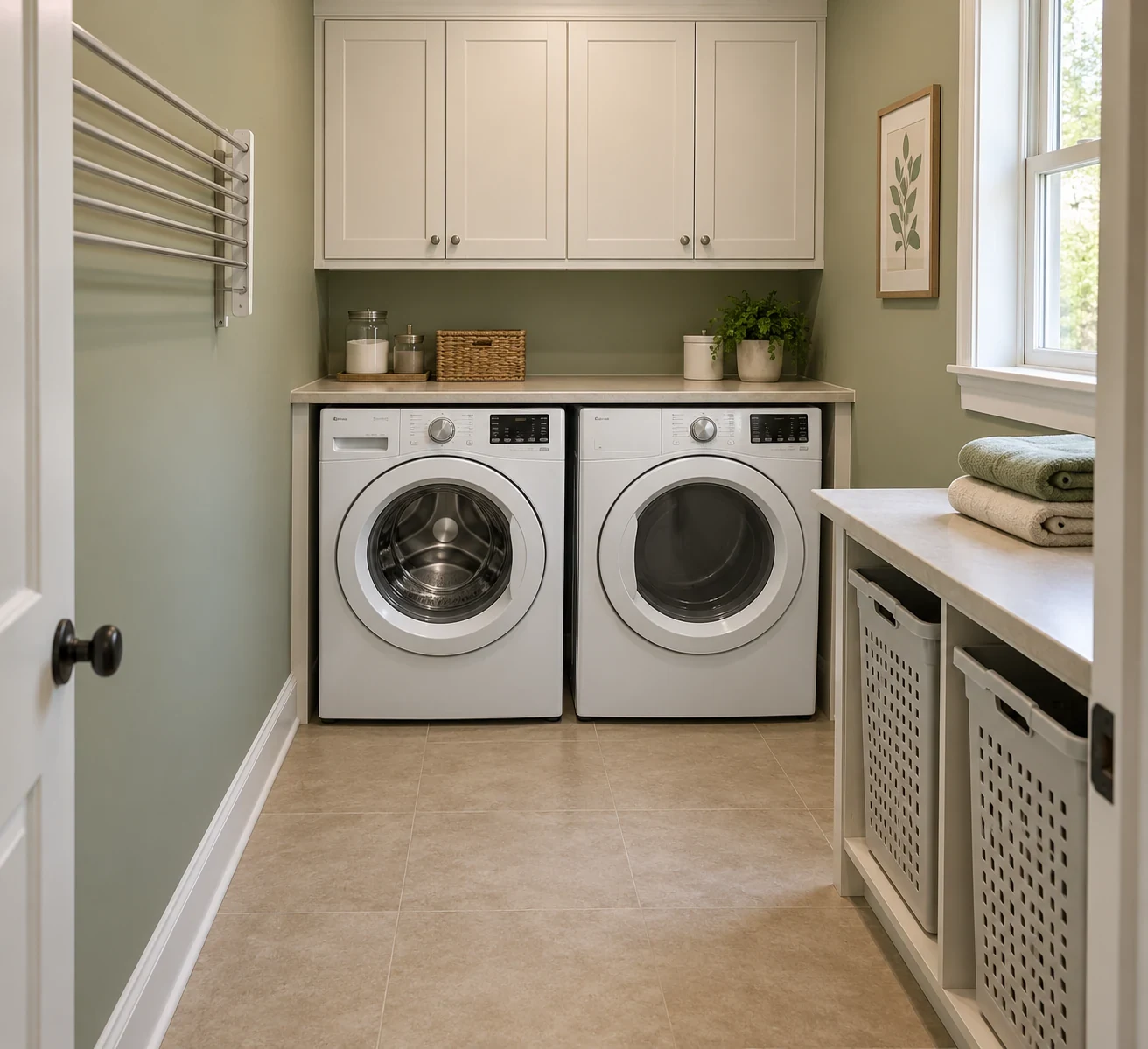
Choose one modest decorative feature only after the work areas function. In the main scene, a restrained wall color and small framed print add character while the machines and aisle remain usable. Before fitting a counter, check ventilation and installation clearances against the requirements of your real equipment.
Adapt a Laundry Closet Without Enclosing Its Problems
A closet can work with fewer permanent work areas. Open its doors fully during your layout test and include the depth of any door-mounted organizers. Check whether the machine doors, controls and required ventilation remain usable.
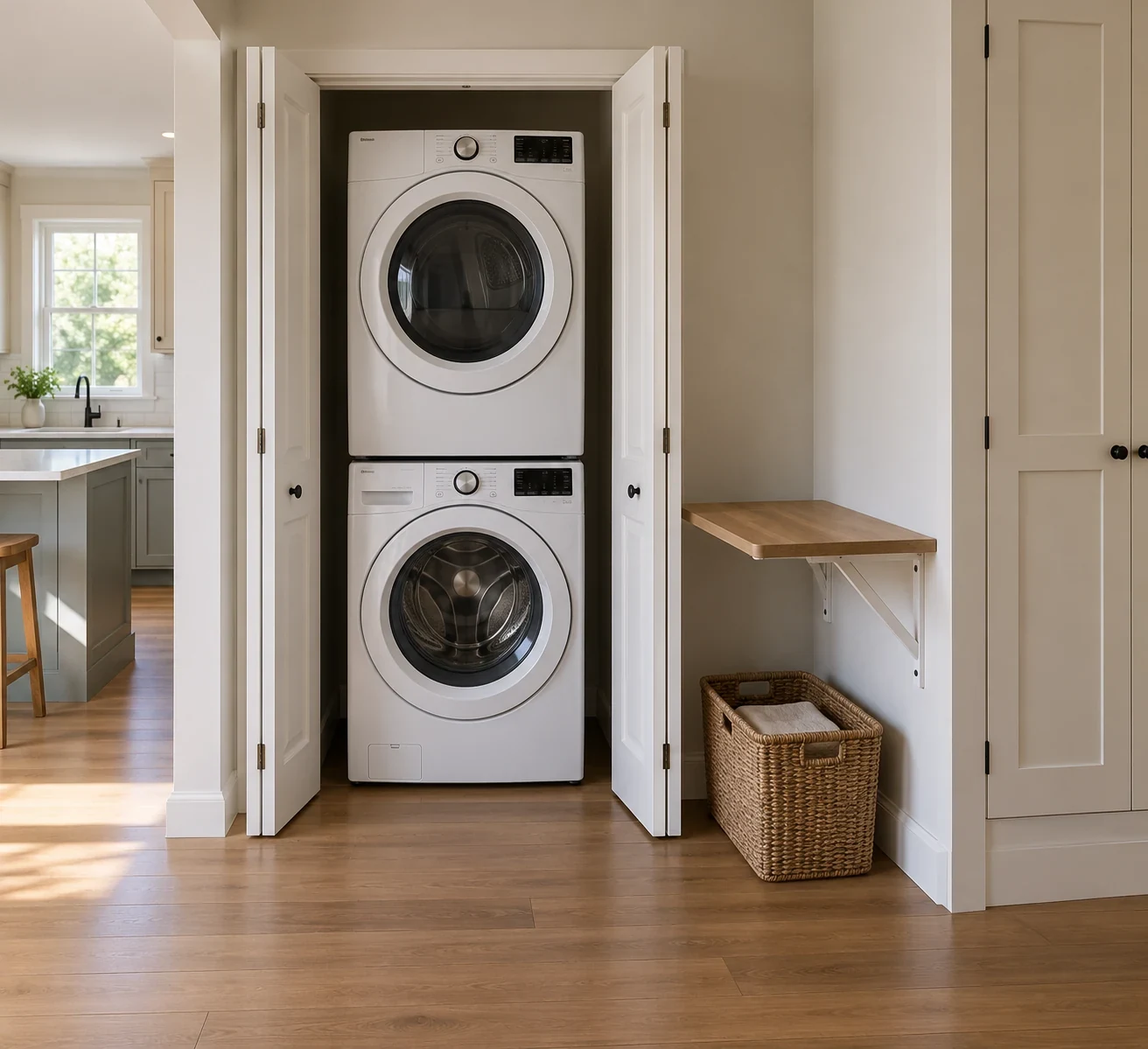
The closet scene pairs stacked appliances with a separate folding surface nearby. It demonstrates how a task can sit beside the closet rather than being crammed above or between the machines. Confirm that a stacked arrangement is approved for the actual models and installed with the required system; a room illustration is not a stacking instruction.
Closing the closet can provide a visual boundary when the work is finished, provided the installation permits it and the appliance instructions are followed. Do not add a curtain or sealed enclosure to hide equipment without checking what the installation needs.
Test One Complete Load Before Adding Anything Else
Use the proposed arrangement for a full cycle, including putting the clean items away. Note each point where a basket blocks a door, wet items have no destination or supplies must be shifted to create working space.
Repair one recurring interruption, then repeat the test. Move the waiting basket if the approach is blocked; reduce countertop storage if folding has nowhere to happen. A room that supports the whole cycle can feel more settled without a larger footprint. Feng shui symbolism can help you choose its visual character, while the working layout keeps everyday laundry moving.