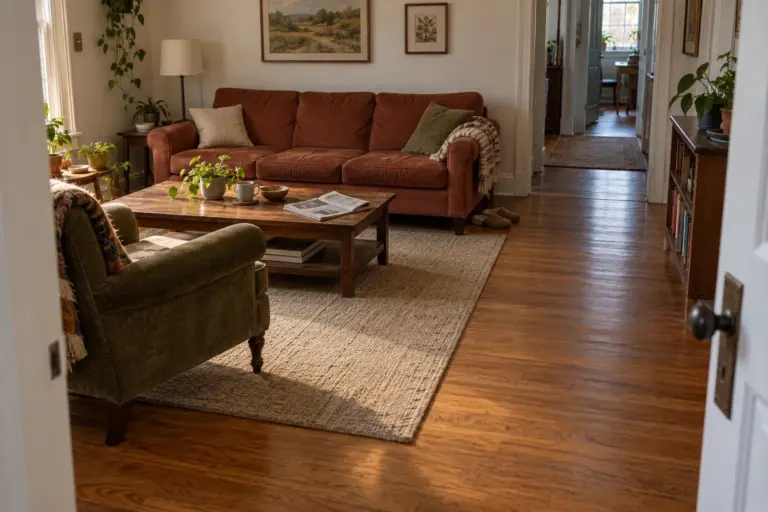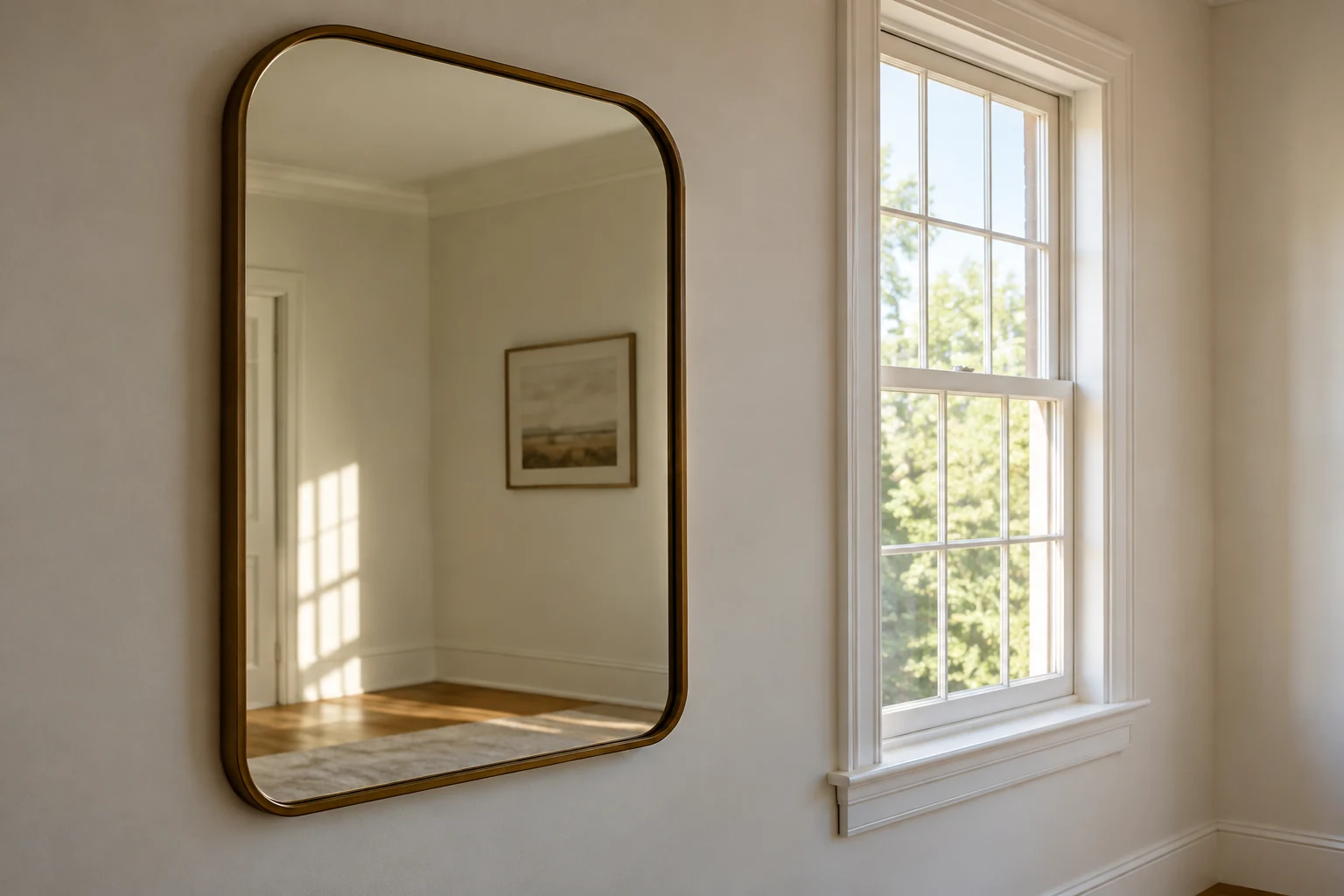
Choose a mirror position by checking what it shows from the seats and standing spots people actually use—not just from the spot where you plan to hang it. Test feasible locations when the window is bright, then keep one only if the reflection is comfortable, the mirror remains useful, and it can be mounted securely. There is no wall or compass direction that guarantees a window-free reflection: the result depends on the window, the mirror’s orientation, and where you stand or sit.
Map the Window and the Views That Matter
Start with a quick sketch or written description of the room. Mark the window, the walls where a mirror might fit, doors, furniture, and fixed fixtures. Include the routes people take through the room and the space needed to open doors and windows. A candidate wall may look promising until you account for a door swing, a chair that moves back, or the path between two parts of the room.
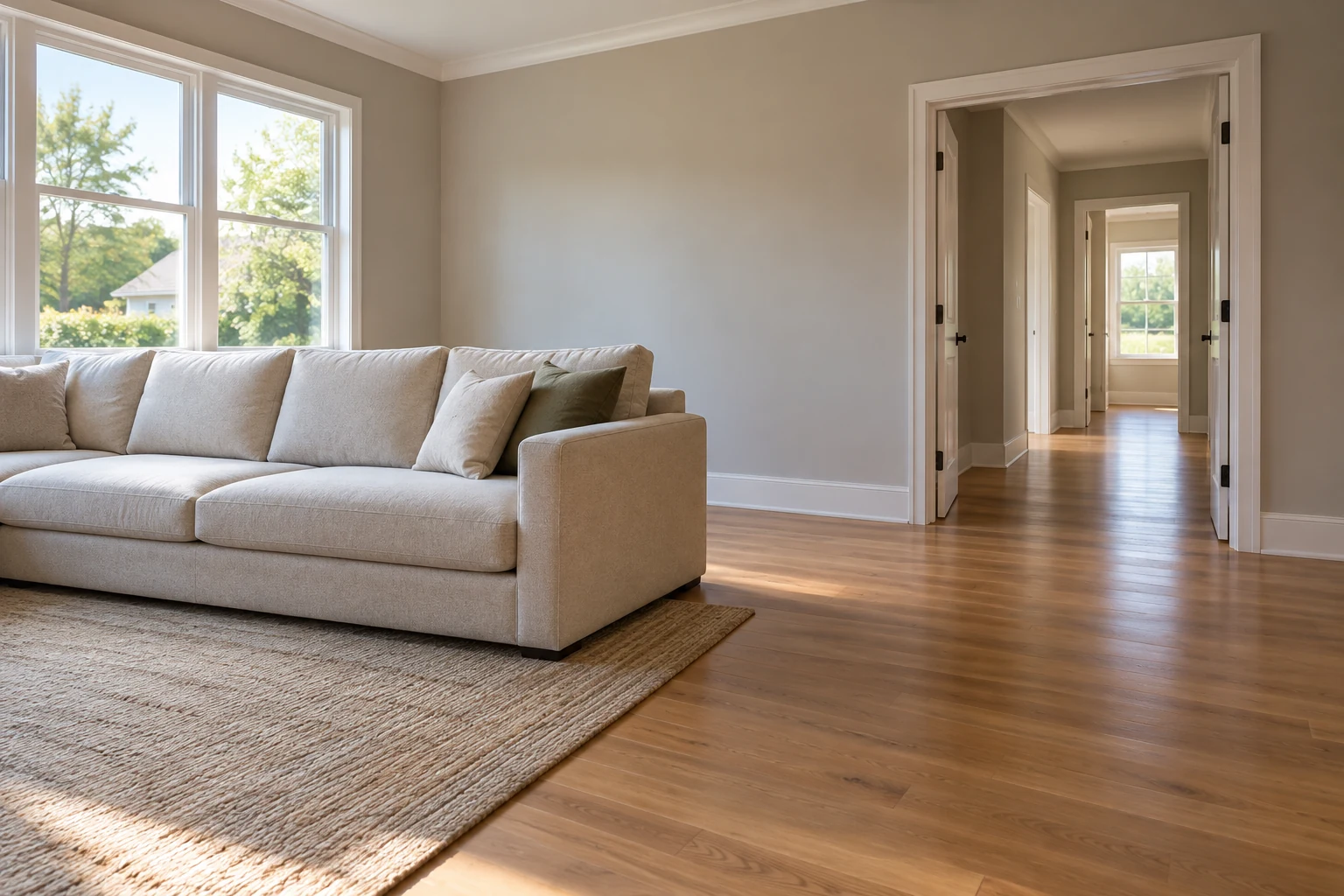
Next, mark where eyes will actually be. Include a sofa seat, dining chair, desk chair, or other place where someone spends time facing the proposed mirror. Add standing spots, such as the place where someone would use the mirror before leaving or the position from which it is seen on entering. If people of different heights use the room, their usual views may differ. You do not need precise measurements yet; a mark for each seat and standing position is enough to guide the trial.
Note which window seems responsible and when it is bright during normal room use. A morning check may not represent an afternoon seating position. You are looking for the times that make the reflection objectionable, not trying to predict every lighting condition from a floor plan.
Before moving anything, identify the problem you want placement to solve:
- A reflected window: From a usual viewpoint, you can see the bright window inside the mirror’s surface. This is what the position test can address.
- Direct window light: The light reaches your eyes without appearing in the mirror. Relocating the mirror will not block that direct view or light.
- A brighter-looking room: The mirror may make part of the room look lighter without showing an uncomfortable window image from the places you use. Decide whether that appearance is actually a problem before ruling out the location.
Finally, state what the mirror needs to do. If it is meant for a standing viewer, mark the standing position and the part of the person that must be visible. If it is primarily decorative, consider the seats from which it will be seen most often. A spot that hides the window by putting the mirror too high, too low, or out of reach has not met the whole brief. These room notes give you a short list of locations worth testing rather than an abstract “best wall.”
Test Candidate Positions from Your Actual Eye Level
A mirror’s reflection changes with the viewing position. OpenStax explains that a smooth mirror reflects light at specific angles: the angle of reflection equals the angle of incidence. Both angles are measured from a line perpendicular to the mirror’s surface at the point where light strikes it. In practical terms, whether a bright window appears in your view depends on where the window is, how the mirror faces, and where your eyes are. That principle explains why you must test the room; it does not identify a universally safe wall.
Use a small mirror you can hold securely to trial a candidate location. Hold it at roughly the height and orientation you intend for the installed mirror, or ask someone to hold it while you check the marked viewpoints. If the proposed mirror is much larger, remember that a small trial shows only part of the area the finished mirror could reflect. Check across the area the larger mirror would occupy rather than assuming one small clear patch settles the question. Do not lean, tilt, or prop an unsecured heavy mirror for a temporary test.
At the first candidate position, look from each marked seat at normal sitting eye level. Then check the standing positions at normal standing eye level. Record whether the bright window appears in the mirror from each place and whether the proposed height would let the mirror perform its intended job. If a window appears only at the edge, note that rather than recording an unqualified “no”; the finished mirror’s size and exact placement may matter. The test is an application of the reflection principle to your room, not a result established by OpenStax for your layout.
For example, a mirror position might show a useful reflection from the doorway while showing the bright window to someone seated on the sofa. Testing only while standing near the proposed mounting point would miss the sofa view. Neither viewpoint is automatically the “right” one: decide which views people encounter often and which ones need to be comfortable.
Now compare feasible alternatives, changing one feature at a time where possible:
- Try a modest sideways shift along the same wall, leaving room for the mirror and nearby furniture. Check every marked viewpoint again; shifting sideways changes the geometry but does not guarantee that the window disappears.
- Try a different workable height. Keep the mirror’s purpose in mind, particularly if someone needs to see themselves while standing. Retest seated and standing views rather than judging the height from directly in front of it.
- Try an adjacent wall if one offers enough space and would not obstruct an opening or route. Repeat the same view checks so the comparison is fair.
Record the position, viewpoint, and light conditions for each trial. A simple yes-or-no note about the visible window and the mirror’s usefulness helps prevent a promising view from the doorway from outweighing a poor view at the desk. A room rendering may help you compare layouts if it represents the relevant eye position and lighting, but it is not proof of what the finished mirror will show. Confirm promising options in the real room.
| Candidate position | Viewpoint and light conditions | Bright window visible in mirror? | Mirror still useful? |
|---|---|---|---|
| Record the first feasible position | Record the seat or standing spot and time checked | Record yes or no | Record yes or no |
| Record an adjusted position or height | Record the seat or standing spot and time checked | Record yes or no | Record yes or no |
| Record an adjacent wall, if feasible | Record the seat or standing spot and time checked | Record yes or no | Record yes or no |
Choose a Workable Spot and Mount It Securely
Before committing to a location, repeat the view check at the bright times you identified. Look again from the seats and standing positions that matter most. If another occupant regularly uses a different seat or has a different eye level, have them check their usual view too. A position passes when the unwanted window image is absent from those important sightlines and the mirror still serves its purpose. It need not produce an identical view from every point in the room.
Pay particular attention if the mirror is near a computer workstation. OSHA’s workstation guidance recommends arranging workstations and lighting to avoid reflected glare on the display screen or surrounding surfaces. Apply that guidance by checking the normal desk position, including whether the proposed mirror affects the screen or nearby surfaces. It is lighting guidance, not a way to diagnose eye symptoms or a promise of a measured health benefit.
Then check the full proposed mirror and frame against the room’s everyday use. Can doors and windows still open as needed? Can people use the furniture and pass through their normal routes without the mirror getting in the way? A trial reflection is only one part of the decision; a location that works optically but interferes with the room is not a workable choice.
Once you have selected a location, follow the actual mirror’s and wall’s documented mounting requirements, including the specified hardware and support. Get suitable help if the size, weight, wall, or installation calls for it. The small-mirror trial does not establish that a heavy mirror can be supported at the chosen spot, and temporary supports are no substitute for a proper installation.
If no location is both usable and free of the unwanted reflection, consider suitable window shading and run the view test again under the conditions in which you would use it. Shading may change the result, but it is not a guarantee at every time of day. You can also decide to omit the mirror rather than force it into an unsafe or impractical position.
Keep the location only when the real seated and standing views, the room’s daily function, and secure mounting all work together.
Continue reading
More room decisions to consider