Set up a nursery around safe sleep, straightforward care and a clear route for the adult carrying the baby. Then use gentle feng shui ideas to consider the room's support, visual activity and sense of welcome. A calm color scheme is optional; a suitable sleep surface and an arrangement that keeps hazards out of reach are fundamental.
Also distinguish the nursery from the baby's initial sleeping location. A room can be prepared for changing, feeding and storage while the baby sleeps in a separate suitable sleep space in the adult's bedroom. You do not need to move an infant into a separate nursery to complete a feng shui arrangement.
Begin with the Safe-sleep Plan
CDC guidance supports placing babies on their backs for every sleep, on a firm, flat surface in a safety-approved crib or another appropriate infant sleep space, with a fitted sheet. Keep soft bedding, pillows, bumper pads and soft toys out. CDC also recommends room-sharing, ideally until the baby is at least six months old.
Plan the actual sleep space with those conditions in mind. Do not add a cushion, nest, incline or decorative blanket to make it look more comfortable. Do not use an adult adjustable bed, an armchair or a sofa as the infant's sleeping arrangement.
The main nursery scene keeps the crib bare. Its warmth comes from the room around it, rather than objects inside or suspended over the sleep space. That is the relationship to preserve when choosing your own furnishings.
If your baby has specific medical or care requirements, confirm them with the appropriate clinician and the equipment instructions. Feng shui preferences should not be used to change prescribed care or a safe-sleep recommendation.
Survey Openings, Cords and the Care Route
Draw the door's opening arc, windows, outlets, heating and fixed storage. Mark the route an adult will use while carrying the baby and the locations where drawers or cupboard doors open into it. Check the room in its working state, not only when all the furniture is closed.
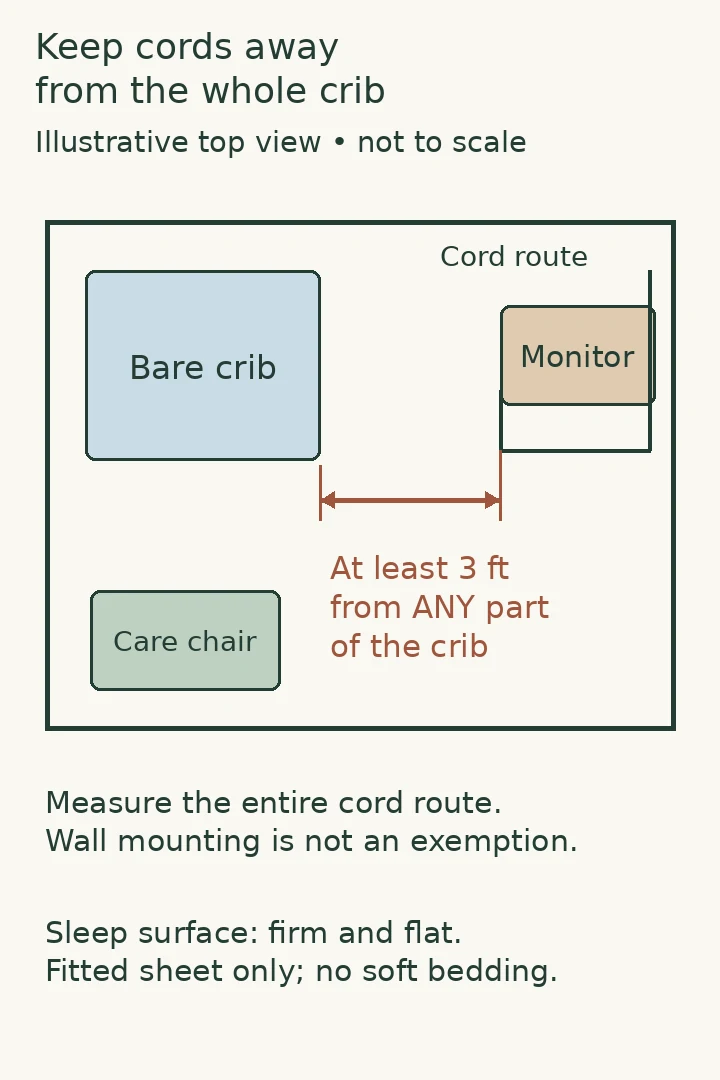
Identify every cord, including those on window coverings, lamps, monitors and chargers. A cord that appears neatly tucked away may still be reachable as a child grows. Keep the crib away from those hazards, and choose appropriate cordless window coverings rather than relying on a loose cord being out of sight.
CPSC advises keeping monitor cords at least three feet from any part of the crib or other safe sleep environment and never putting the monitor inside or on the crib's edge. A wall mounting does not remove the need to keep its cord out of reach.
The plan illustrates that separation, with a bare crib and the monitor position outside the marked zone. Measure from the nearest part of the actual crib, including where the cord runs, rather than from the mattress center. Recheck the arrangement as furniture and the child's reach change.
Choose a Supported Crib Position Without Importing Adult-bed Cures
A solid wall can give the crib area a quiet visual background while leaving a practical approach for care. Avoid using the wall above it for a heavy shelf, dangling ornament or an improvised canopy. The baby does not need a display above the mattress to make the area feel finished.
Anjie Cho's adult-bedroom guidance describes a supported headboard and a view of the entrance outside its direct line. That is an optional placement preference for considering the adult's experience of a room. It does not establish a safe position for an infant, change the need for a flat surface or justify a hanging crystal between the crib and the door.
Compare only crib positions that satisfy safe use and the equipment instructions. Then consider which leaves the adult a clear route and makes the room easier to supervise. Do not rotate the crib into a doorway path to achieve a particular diagonal view.
Keep the distinction visible in your decisions: crib safety first, usable care access next, optional symbolic interpretation afterwards. You can create a thoughtful nursery without trying to apply every rule written for an adult bed to a baby's sleep space.
Arrange Feeding and Changing as Separate Tasks
Try the feeding chair with the person who will use it. Check the arm support, how they sit down and stand up, and whether a necessary item can be reached without leaning over the crib. Put a stable side surface where it serves that adult without crowding the route.
Keep the chair's purpose clear. It is a care seat, not a substitute infant sleep space. Follow safe-sleep guidance when returning the baby to their own surface rather than treating a sleepy adult's comfortable chair as the final destination.
At the changing area, lay out the routine before filling every drawer. Put the supplies needed during a change within the caregiver's reach, following the furniture and care-product instructions. Keep unrelated decorative objects off the working area. A setup that requires crossing the room mid-task needs reconsideration.
Use the appropriate furniture restraints and installation instructions, and keep medicines, cleaning products and other unsuitable items secured separately. Do not assume that a low dresser is automatically safe or that a basket makes its contents inaccessible. The room's storage needs will evolve well beyond the newborn stage.
Make Nighttime Care Easy to Understand
Enter the room at night with the lighting you intend to use. Check whether the adult can see the route, identify supplies and use the sleep space appropriately. A dark, atmospheric photograph does not establish whether those tasks are manageable.
Choose light that can be operated from useful positions. Place lamps and their cords outside the baby's reach and outside walking or moving-furniture routes. Do not drape a fabric over a light to soften it; use suitable lighting equipment and its controls.
Avoid filling the floor with small baskets, loose cushions or a rug that interrupts the approach. Keep frequently used items in predictable locations so another caregiver can also find them. If more than one person shares care, agree on where supplies are returned rather than organizing entirely around one person's memory.
Test any monitor according to its instructions from the actual permitted position. A clear camera image should not be achieved by bringing the monitor or cord closer than the safety arrangement allows. Keep equipment accessible for its normal checks without placing it on the crib.
Use Color and Display Around the Baby, Not Inside the Crib
Start with the existing room and what its users enjoy. Soft colors, natural-looking materials or a small amount of personal art can make the room welcoming. They are choices about appearance, not requirements for a baby's temperament or development.
Put meaningful items where adults can enjoy them without introducing reach, fall or cord hazards. A family photograph on a separate wall can be more appropriate than a heavy framed picture over the crib. Keep display manageable so it does not occupy every supply surface.
Do not add a plant simply because a feng shui list names one. Consider the room's light and whether the plant, pot and contents can be kept safely out of reach. A simple room without plants is preferable to creating an avoidable care or placement problem.
Skip scented cleansing, candles and elaborate symbolic cures as nursery necessities. The room does not need those additions to meet its purpose. The most useful sense of order comes from clear care locations and predictable access.
Adapt the Same Priorities to Room-sharing
For an initial adult-bedroom arrangement, locate the baby's separate suitable sleep space where it can be used according to its instructions while preserving adult access. Keep adult pillows, bedding and cords away from it. An adjoining bedside position is not permission to let an adult duvet spill into the infant's area.

The room-sharing scene shows a distinct bare infant sleep space and an adult bed, rather than a nest on the adult mattress. Check your actual equipment's instructions, especially if a product is designed to attach to a bed; products and configurations are not interchangeable.
Move adult furniture or optional electronics if they occupy the needed safe space. You may have less symmetry around the adult bed for a period. That is a practical adjustment to the household's present needs, not a feng shui defect that requires moving the baby away.
The nursery can still hold clothing, changing supplies and a care chair during this stage. Let the rooms' functions evolve with the baby's needs and current safe-sleep advice rather than setting an inflexible decorating deadline.
Rehearse the Room Before Calling It Ready
Walk the route with your hands occupied by a suitable practice load, open the needed storage and try the light controls. Check for furniture collisions, reachable cords and objects that have migrated into the crib. Repeat the check with another caregiver.
Resolve the specific problem you find: move a lamp, relocate supplies or remove an unnecessary furnishing. A nursery is ready when its safe sleep arrangement remains intact and ordinary care can happen without obstacles. Gentle feng shui ideas can help you reflect on the surroundings, while the baby and caregivers' real needs determine the final layout.