A teen bedroom works best when it offers three different kinds of room: somewhere to rest, somewhere to concentrate, and somewhere that feels personally owned. Those needs can fit within one small space. Start by protecting the route through the room, then place the bed and study surface, and finally decide how each area becomes private or visually quiet when needed.
The teenager should help make those decisions. A beautifully arranged room still fails if the desk cannot hold an open workbook, the bed is visible from every passing visitor, or someone else decides what may be displayed. Feng shui can offer a language for placement and boundaries; the room also needs agreements that furniture cannot supply.
Begin with a Room Survey and a Privacy Conversation
Draw the room as it is, including the door's opening arc, windows, wardrobe doors, outlets and fixed heating. Measure the bed, desk and storage you intend to keep. Include the desk chair when it is pulled out, not just when everything is neatly pushed in. Mark the route from the entrance to the bed, wardrobe and window.
Then ask the teenager to describe three ordinary moments: changing clothes, working on a difficult assignment, and spending time alone or with a friend. What gets in the way? An exposed bed, a sibling crossing the work area and nowhere to put a half-finished project are different problems. They need different boundaries.
Agree on what privacy means in this household. For example, knocking and waiting for an answer may matter more than moving a cupboard. Set a place for belongings that other people should ask before borrowing. Discuss when a door may be closed and how someone can ask for uninterrupted study time. Treat these as household agreements, rather than claims that a particular arrangement automatically improves family relationships.
Keep the teenager's interests on the plan. A music corner, collection or drawing surface belongs in the brief if it is part of how the room is used. The aim is to make space for real life, not turn a bedroom into an adult's model study.
Give the Bed a Settled Position Without Sacrificing Access
Feng shui practitioner Anjie Cho describes the commanding position for a bed as a location where the occupant can see the door without lying directly in its line, with a wall behind the headboard. Use that as a traditional placement preference to consider, rather than a prediction about sleep or academic performance.
To try it, sit against the pillows and look towards the entrance. Can you see someone arriving? Is the headboard supported by a wall? Would moving the bed slightly put it outside the direct doorway view? Check those questions against the route you drew before committing to a move.
In a small room, a single bed with one long side against a wall may release the only workable study area. That is a reasonable compromise. Make sure the teenager can get in, change the bedding and use nearby storage. Do not rotate the bed into the middle of the floor merely to achieve a diagonal relationship with the entrance.
If the bed cannot move, improve the immediate surroundings. Remove the pile that has become a bedside obstacle, give a book and glasses a stable place, and keep school materials in their own container. A mirror is sometimes suggested by practitioners to recover a view of the entrance, but it is optional. If reflections feel distracting or expose the bed to the hallway, leave it out.
Build a Study Position Around the Actual Work
Test the desk with the equipment the teenager uses. Open a textbook beside a notebook, set out the laptop if needed, and check where elbows and a task light can go. A shallow decorative console that holds only a closed laptop is not a useful substitute for that test.
Cho applies door visibility to desks too, and recommends visual boundaries when a workspace shares another room. For this bedroom, treat those ideas as prompts for a usable study position: a view into the room if feasible, plus a clear way to stop looking at schoolwork when study finishes.
Try the desk in two positions before buying anything. An inward-facing desk can offer a view of the entrance but consume floor area behind the chair. A desk against a wall can preserve circulation but leave the door behind the user. Choose the position that allows real work and a clear route; acknowledge the tradeoff instead of calling the less traditional arrangement wrong.
Check window light while seated. If the screen is hard to read, change its angle or adjust a shade, then check again at the time homework usually happens. Add a task light where it illuminates the page without becoming an obstacle. Route its cable along furniture or the wall, away from the chair's movement.
Keep current supplies within reach and less-used supplies elsewhere. A small tray for today's work, a place for reference books and a hook for headphones can be enough. The desk does not need to store every school object to count as a study zone.
Separate Activities with the Lightest Boundary That Works
Before adding a divider, choose what it must hide. To reduce the view of worksheets from bed, a closed drawer or upright folder may solve the problem. To screen changing from an open door, the boundary needs to interrupt a particular sightline. To stop a sibling talking during homework, a visual screen alone is unlikely to satisfy the agreement.
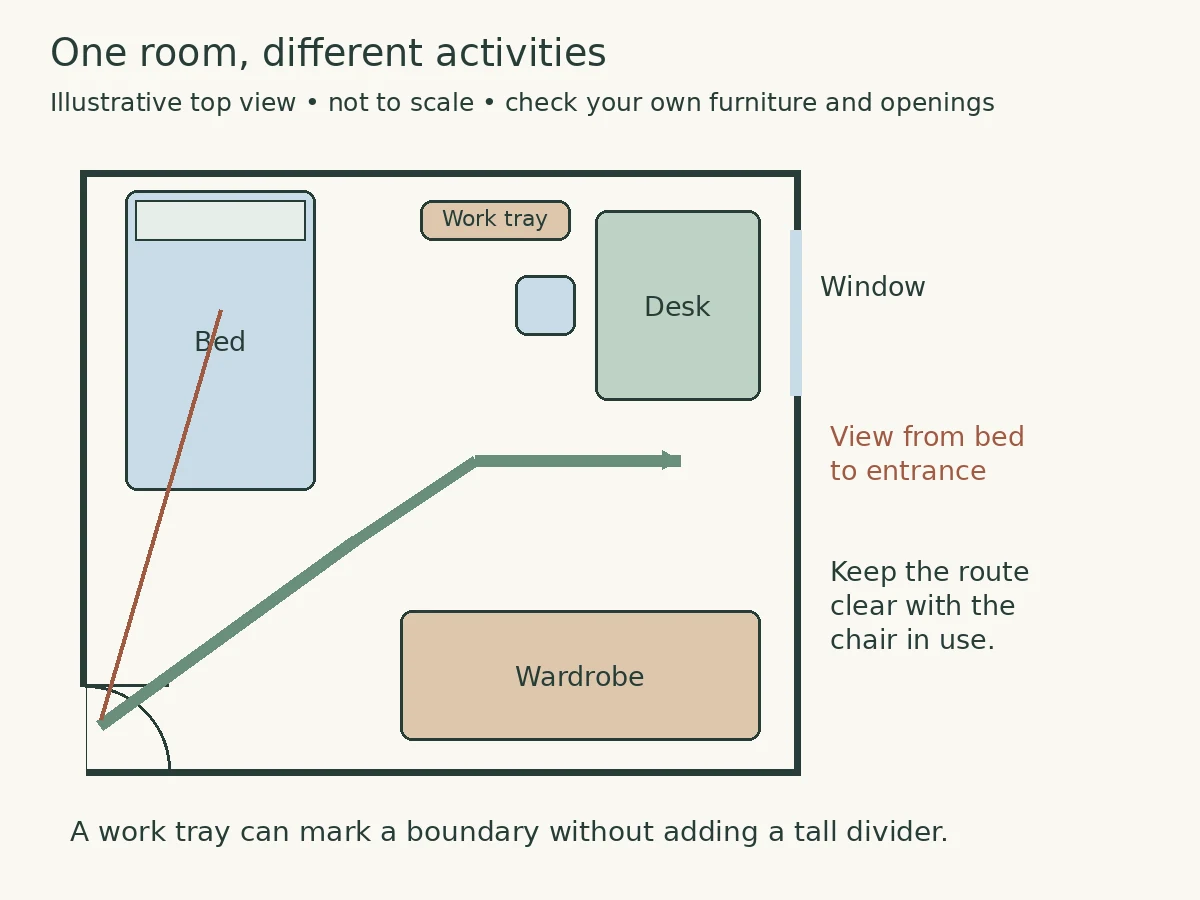
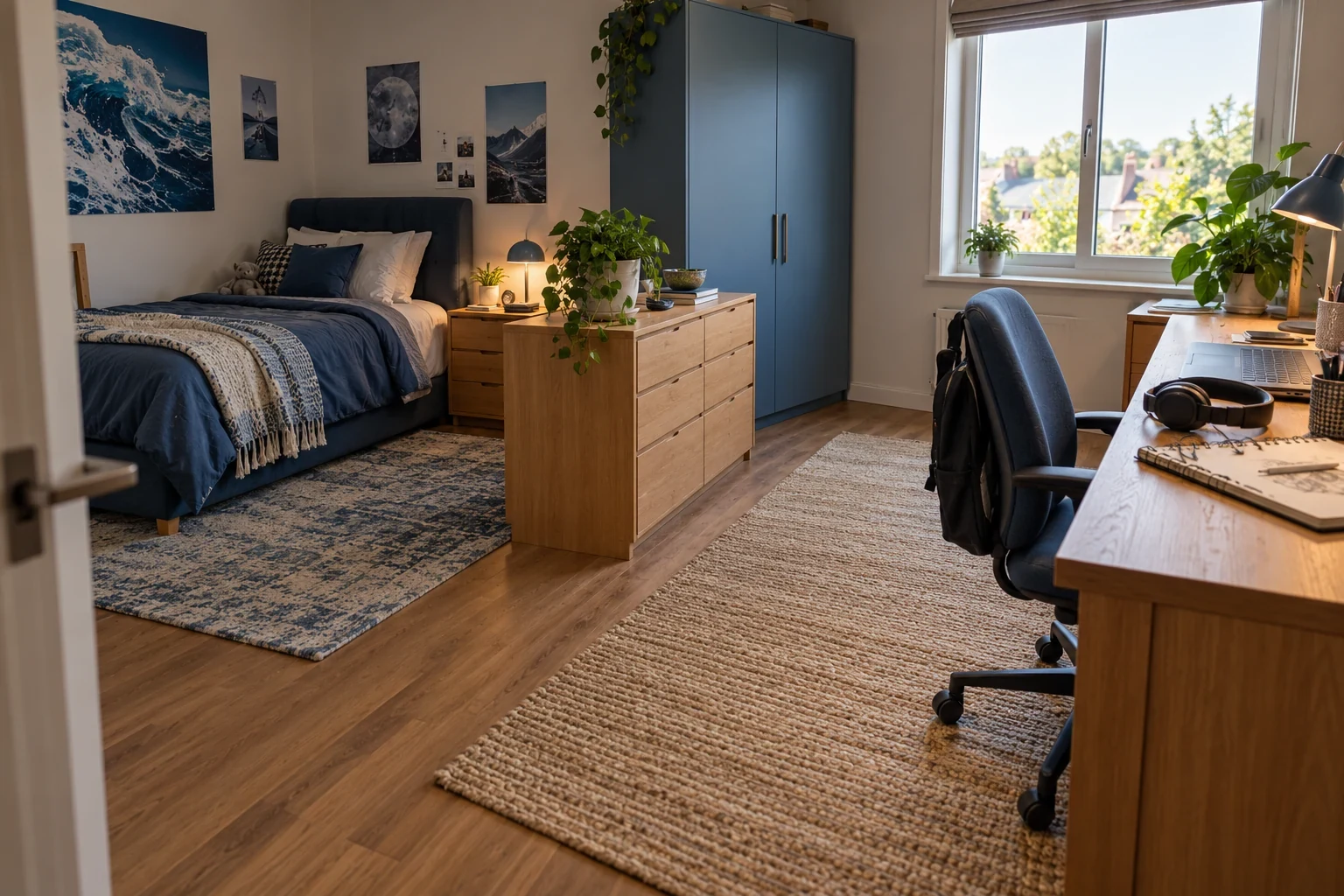
For example, in a rectangular room with the door near one corner, put the bed along the opposite side and the desk nearer the window. A low closed cabinet beside the desk can mark where study materials belong while leaving the center open. This is a layout example, not a scale plan: check the chair, cabinet doors and walking route against your own measurements.
Stand in the doorway, then sit at the desk and on the bed. A boundary that works from only one viewpoint may not give the privacy you expected. If you add a curtain, position its track and stored fabric outside the route and clear of lights and heating. It should be easy to open fully rather than become a permanent dark enclosure.
Avoid using a tall, unsecured bookcase as a quick room divider. CPSC recommends anchoring bookcases and dressers securely to a wall. A freestanding divider needs to be designed and installed for that use; an attractive furniture photograph is not an installation plan.
Make Personal Space Visible, Including in a Shared Bedroom
Give the teenager an area they can arrange without asking permission for every change: a pinboard, a shelf of chosen objects, the wall beside the desk or a small hobby surface. Set practical limits together, such as keeping a light switch clear. There is no need to replace a favorite poster because its color does not match a suggested feng shui palette.
Group display by where it is enjoyed. Put project references near the work surface and the objects they like seeing on waking near the bed, where placement is secure. If a collection spreads across the whole desk, try rotating part of it into display storage. Keep the decision about what stays with the owner rather than treating personal possessions as clutter by default.
For siblings sharing a bedroom, identify individual territory and shared territory on the drawing. Each person needs a dependable place for work supplies and personal belongings. Equal ownership need not mean identical furniture: one may draw at a wide desk while the other needs more book storage.
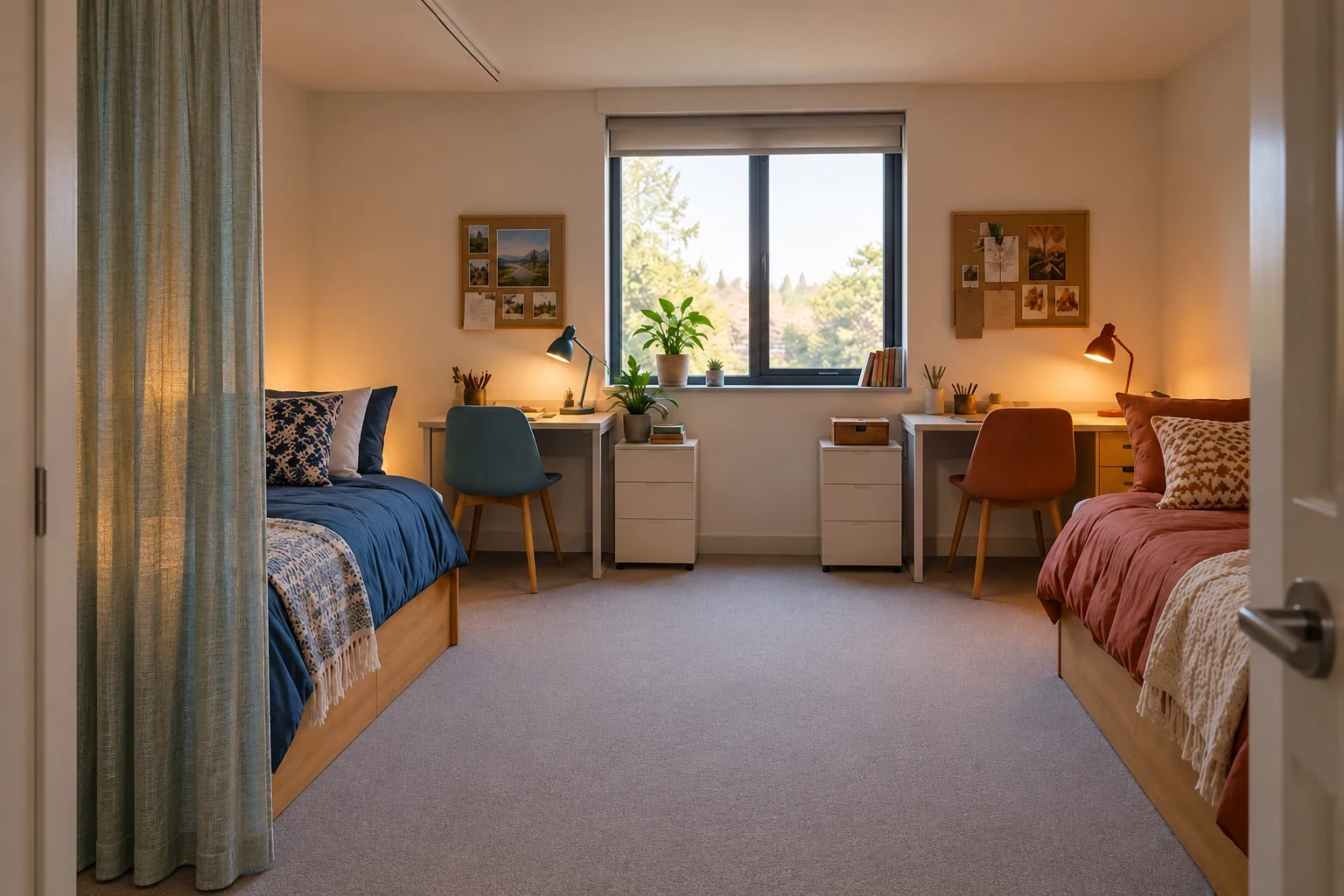
The shared-room scene shows a central route between two bed areas, with separate work surfaces and a partial curtain beside one bed. The curtain provides a visual boundary; it does not make the room soundproof. Agree on quiet periods, lights and borrowing separately. If only one desk fits, give it a schedule and provide separate trays so clearing one person's work does not mean dismantling it.
Use a Short Evening Reset and a One-week Trial
An evening reset should help the room change use, not demand that every project disappear. Close school folders, park the laptop, put loose supplies in the agreed tray and leave tomorrow's first task easy to retrieve. An ongoing model or artwork can stay on a designated surface if that surface is not needed for sleeping or circulation.
Try the arrangement for a week before adding furniture. Ask specific questions: Is changing private enough? Can someone carry laundry through without touching the desk chair? Is there a comfortable place to put a phone according to the household's rules? Does homework spill onto the bed because the desk is too small, or because its storage is inconvenient?
Change the cause you find. Move supplies closer if retrieval is the problem; adjust the boundary if the doorway view is the problem. If a new divider creates a daily squeeze, remove it and try a smaller intervention. The useful result is a bedroom the teenager can operate: work has a place, personal belongings have an owner, and rest does not require clearing a desk-sized pile from the bed.