If you usually enter through a garage or side door, feng shui does not give you a reliable forecast of what will happen to your money, relationships or opportunities. Some practitioners interpret a neglected front entrance as a less active mouth of qi and suggest giving it attention or using it occasionally. That is a traditional interpretation and practice, rather than proof that your household is being deprived of something invisible.
The useful starting point is the entrance itself. Is your front door simply used less often, or has it become difficult to find, open or walk through? A clean, functioning door that guests can use is a different situation from one hidden behind furniture. You can care for the formal entrance while continuing to use the route that works for everyday life.
Why the Front Door Receives Special Attention
Anjie Cho describes the front door as the mouth of qi: the place where energy enters the home in her feng shui teaching. Her practical suggestions include a visible entrance, an unobstructed approach, working hardware and occasional use. The symbolism links the threshold with receiving something new.
Within that view, an entrance that is never noticed can represent withdrawal or stagnation. The word “represent” matters. It describes how a practitioner reads the space; it does not establish that a closed door causes a stalled career. A front door is normally closed for much of the day, and occasional opening is not a measurable supply of luck.
You can choose to make arrival more intentional without turning the idea into a compulsory ritual. For example, stepping out through the front entrance to collect the mail might help you notice that the mat has curled or the porch light has failed. Those are observable discoveries. A change in finances after opening the door would not, by itself, establish a cause.
Does the Garage Door Become the Front Door?
Keep three things distinct: the large garage opening, the pedestrian door from the garage into the house, and the formal entrance visitors use. Calling all of them “the front door” can hide different questions about the home.
In an answer to a reader who mostly entered through the garage, practitioner Uncle Dixer said he would look at the main door first and the garage door second, distinguishing the occupants' habitual route from the route visitors commonly use. This is one named practitioner's approach, not a reason to ignore the everyday entrance.
If you already follow a particular feng shui method, keep that method consistent when deciding which entrance anchors its analysis. Do not change a whole home's directional or bagua interpretation simply because your daily route changed. For a consultation, show the practitioner both routes on the same plan and ask which door they are using, for what purpose, and why. A useful answer should describe the assumptions rather than assert that your garage has secretly replaced the front door.
For an apartment, include the building entrance and your unit door in that conversation. They are separate thresholds. You may have control over one and little control over the other; responsibility for a shared lobby does not become a personal decorating assignment.
Read Both Arrival Routes on a Simple Plan
Illustrative plan: the front-door route and the route from the garage both reach the shared rooms. The arrows trace people walking; they are not a diagram of measured energy.
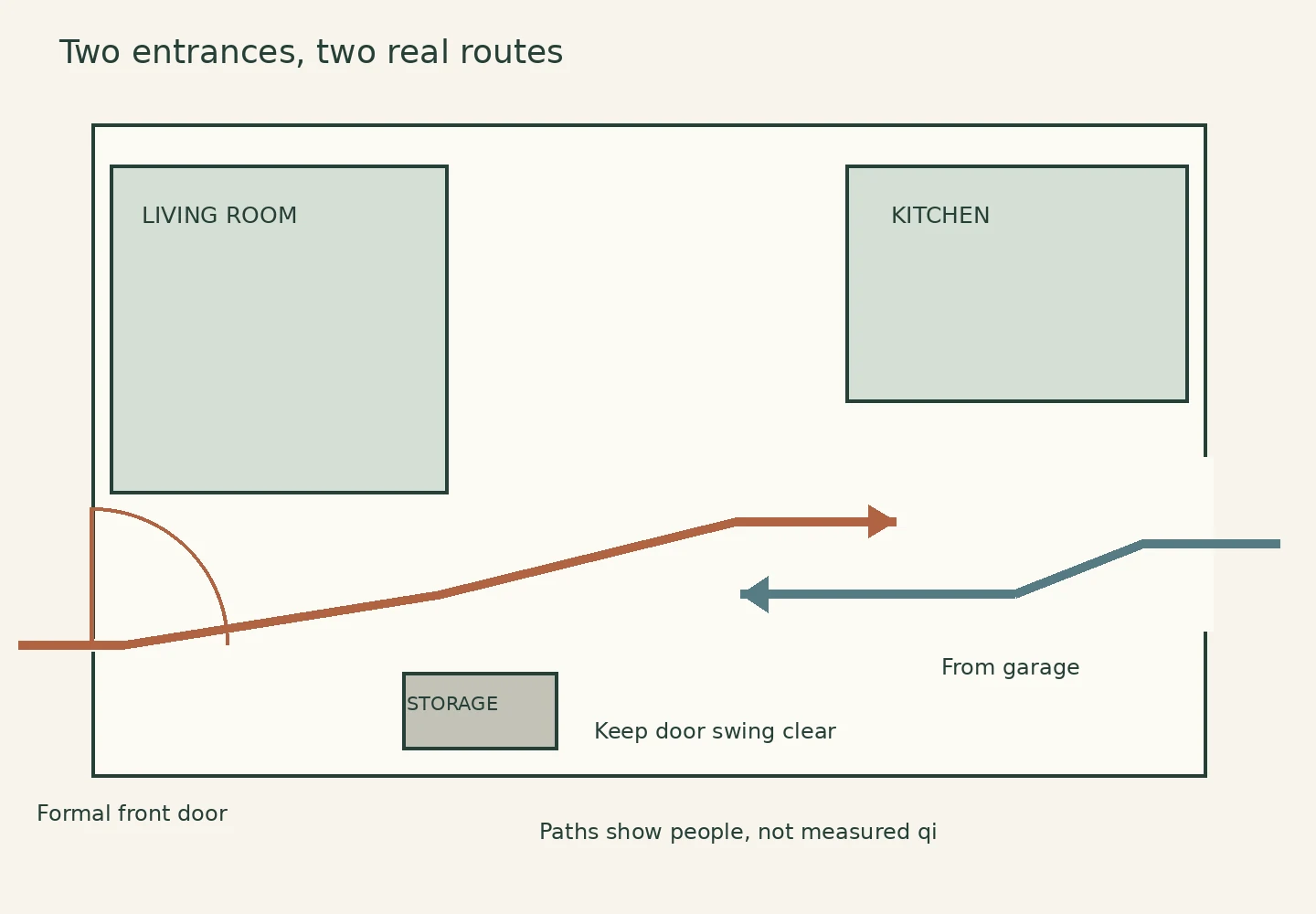
Draw the outside edge of your home and mark the formal door and the door you normally use. Trace your trip with groceries or a work bag. Then trace a visitor's arrival. Where do shoes, parcels and coats land? Which doors must remain free to swing? You do not need a compass or an elaborate floor plan to make these observations.
If a narrow hallway serves both routes, keep storage out of their meeting point. A console that looks attractive from the front entrance may still block someone carrying a bag from the garage. If storage cannot move, reduce what projects from it or relocate the drop zone to a place where you can stop without blocking others.
The everyday entrance deserves the same ordinary care as the front door. Make it easy to enter, put things down and continue into the home. Improving only the rarely used formal threshold while leaving the daily route congested misses much of your actual experience of arriving.
Give a Rarely Used Door a Practical Check
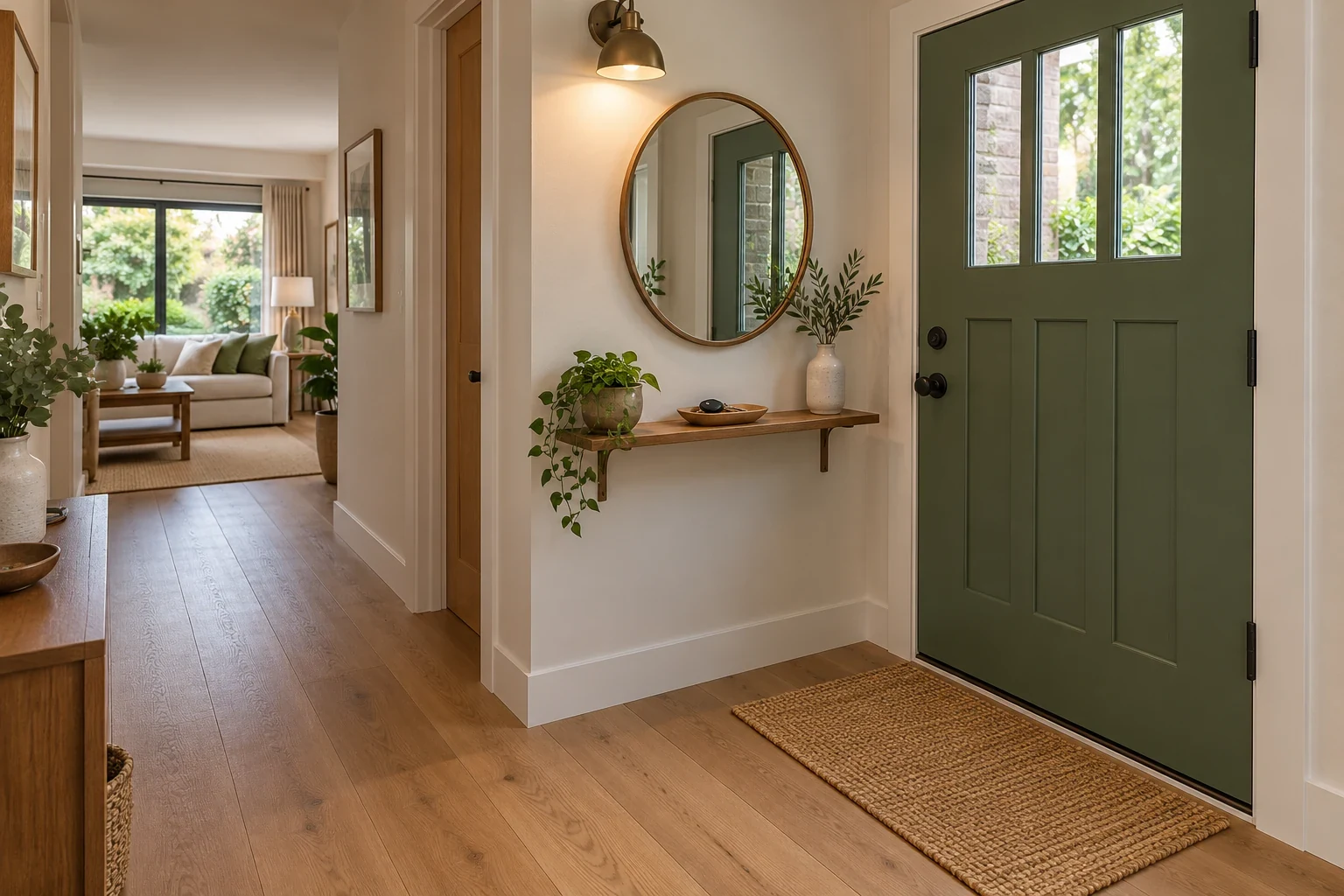
Start outside, from the point where a first-time visitor would approach. Can they recognize the entrance and house number? Are branches, stored items or bins obscuring the route? Work within the property boundaries and permissions you actually have. Cho's suggestions about visibility and clear access can be applied without changing the color or rebuilding the porch.
Inside, remove loose objects from the door's moving area and open it through its normal range. Notice anything catching, scraping or preventing it from closing properly. Put furniture outside that area. An entrance that functions properly is a better result than a beautiful arrangement that you must dismantle whenever someone visits.
Look at the floor after opening the door. A mat should sit flat and allow the door to move. Give shoes a definite place away from the landing area. Test a narrow shelf with a real bag in your hand: if you have to turn sideways to pass it, a smaller drop zone elsewhere may be the better choice.
Finally, check what happens when you close and secure the door again. Address a sticking lock or damaged fitting through the appropriate repair route. Ritual opening is not a substitute for a door that can be used and secured reliably.
Use It Occasionally If That Serves Your Household
If the approach is accessible and you enjoy the practice, connect front-door use to something you already do: a short walk, greeting a visitor or collecting a delivery. Choose an action that makes sense rather than counting openings to earn a promised result.
Cho's article includes a specific repeated-opening practice. You may encounter that instruction elsewhere, but it belongs to the practice being taught; it is not a universally necessary daily quota. A manageable habit can be meaningful without being treated as a test you fail when you are busy or away.
For example, a household using the garage for groceries might continue doing so, while using the front entrance for walks when convenient. If nothing needs attention and the front door already works well, there may be no further project to undertake.
When the Front Entrance Is Not the Workable Route
Steps, mobility needs, weather exposure, a shared corridor or household security can make another entrance the sensible choice. Do not force a difficult route to satisfy symbolism. Keep the front door maintained within your responsibilities and make the accessible daily arrival welcoming.
In a rental, cleaning and relocating your own loose belongings may be within reach, while new hardware, exterior lights or paint may require the owner's agreement. For shared buildings, keep personal decor inside your own permitted space. Adding plants or a cabinet to a common landing can create a problem for neighbors even if you intend it as an improvement.
If the door is unusable because of a physical defect, record what is wrong and arrange the relevant repair. Do not label it an energy problem and leave the defect unresolved. The action depends on the cause, not how often you would prefer to use the entrance.
What to Notice Afterward
After a few ordinary arrivals and a visitor's use of the door, ask what changed. Is the entrance easier to find? Can the door open without moving a shoe rack? Is there a comfortable place for a bag? Does your everyday route feel less congested?
Those observations let you judge whether the effort helped. In feng shui terms, you may also find value in attending to a threshold you had overlooked. You can hold that meaning without assuming that rare front-door use has harmed your life, or that opening it must deliver a particular future.